If you source industrial products — lighting fixtures, aluminum profiles, electrical components — from China, you will eventually face the same question: which platform deserves your time? Alibaba is the obvious first stop for most buyers. But experienced procurement managers know that choosing the right platform for the right product category can mean the difference between finding a certified factory and spending three weeks filtering through trading companies. This review breaks down all three major B2B platforms across the dimensions that matter most for industrial and commercial sourcing.
Key Takeaways
- Alibaba offers the largest supplier volume (200,000+ in electronics alone) and the most flexible MOQs — best for market research, small trial orders, and private-label sourcing.
- Made-in-China.com excels in industrial machinery, raw materials, and component sourcing; government-adjacent credibility makes it a strong secondary verification tool.
- Global Sources provides the most rigorous supplier screening and is the preferred platform for electronics and tech hardware buyers who prioritize verified factories over price competition.
- For LED lighting procurement specifically, all three platforms have coverage — but each serves a different stage of the sourcing workflow.
Platform Profiles: What Each One Actually Is
Alibaba.com — Scale and Accessibility
Founded in 1999, Alibaba.com is the world’s largest B2B marketplace, connecting buyers with suppliers across virtually every product category. Its electronics category alone lists over 200,000 suppliers, and the platform hosts 40+ million registered buyers globally. For procurement professionals new to China sourcing, Alibaba offers the most comprehensive starting point: extensive product photos, buyer reviews, price benchmarks, and competitive quoting tools.
The platform’s Trust & Assurance framework includes Gold Supplier status, Verified Supplier badges (requiring paid membership and third-party audit), and Trade Assurance — a financial protection mechanism that covers buyers in dispute scenarios. The depth of verification varies significantly, however. Gold Supplier status is purchasable; Verified Supplier status involves an on-site audit but is not universally applied. Buyers should treat these badges as helpful signals, not guarantees of manufacturing capability.
For LED lighting sourcing specifically, Alibaba has strong coverage across tri-proof fixtures, industrial high-bays, and commercial downlights. China accounts for over 70% of global LED production, and the majority of that export volume flows through Alibaba-listed suppliers concentrated in Guangdong’s Shenzhen-Foshan corridor, where manufacturers specialize in IEC/EN 60598-compliant fixtures for EU and North American markets.
Made-in-China.com — Industrial Depth
Established in 1996 and operated by Focus Technology, Made-in-China.com (MIC) has approximately 400,000 registered suppliers and a particular strength in industrial components, machinery, raw materials, and construction materials. Unlike Alibaba’s consumer-friendly interface, MIC is structured for specification-driven industrial buyers: engineers sourcing PCB assemblies, procurement managers ordering aluminum extrusions, or facility managers looking for industrial lighting fixtures with documented IK10 ratings.
MIC’s “Assessed Supplier” program involves document verification and some on-site checks, cross-referenced with China’s State Administration for Market Regulation (SAMR) database. For orders exceeding $5,000, the platform verifies suppliers using third-party inspection companies. MIC Payment Protection offers mechanics similar to Trade Assurance, though with less transaction volume behind it.
The platform’s government-adjacent positioning — as a public company with domestic regulatory connections — gives it particular credibility within China’s manufacturing sector. Prices on MIC typically run slightly lower than equivalent Alibaba listings, making it a useful price-check instrument even if it is not your primary sourcing channel. According to sourcing professionals at China-Electronics.com’s 2026 platform analysis, MIC has “particularly deep coverage” in the LED lighting category, especially for industrial components and PCB assemblies.
Global Sources — Verified Quality Focus
Global Sources is the oldest of the three platforms with roots in print-era trade media, and it has built its reputation on a fundamentally different proposition: fewer suppliers, more rigorously screened. The platform maintains approximately 1.5 million registered buyers — far smaller than Alibaba’s 40+ million — but the factories listed, particularly in electronics and tech hardware, tend to be more established operations with documented export track records.
Global Sources conducts more aggressive on-site verification before listings go live. According to DocShipper’s import platform analysis, Global Sources verifies suppliers through physical audits more systematically than Alibaba, with suppliers on Global Sources reporting 31% fewer quality issues on average compared to Alibaba-sourced equivalents, though at 12–18% higher unit prices. The platform’s Hong Kong trade shows remain a key venue for face-to-face supplier qualification in electronics and tech.
For industrial LED lighting buyers — particularly those sourcing fixtures for EU or Australian compliance requirements — Global Sources provides direct access to factories that understand ENEC, TUV, and SAA certification workflows. Response times on Global Sources average 15–20% faster than Alibaba suppliers, per a 2025 buyer report cited by StormDigitals’ platform comparison.
Head-to-Head Comparison: The Factors That Matter
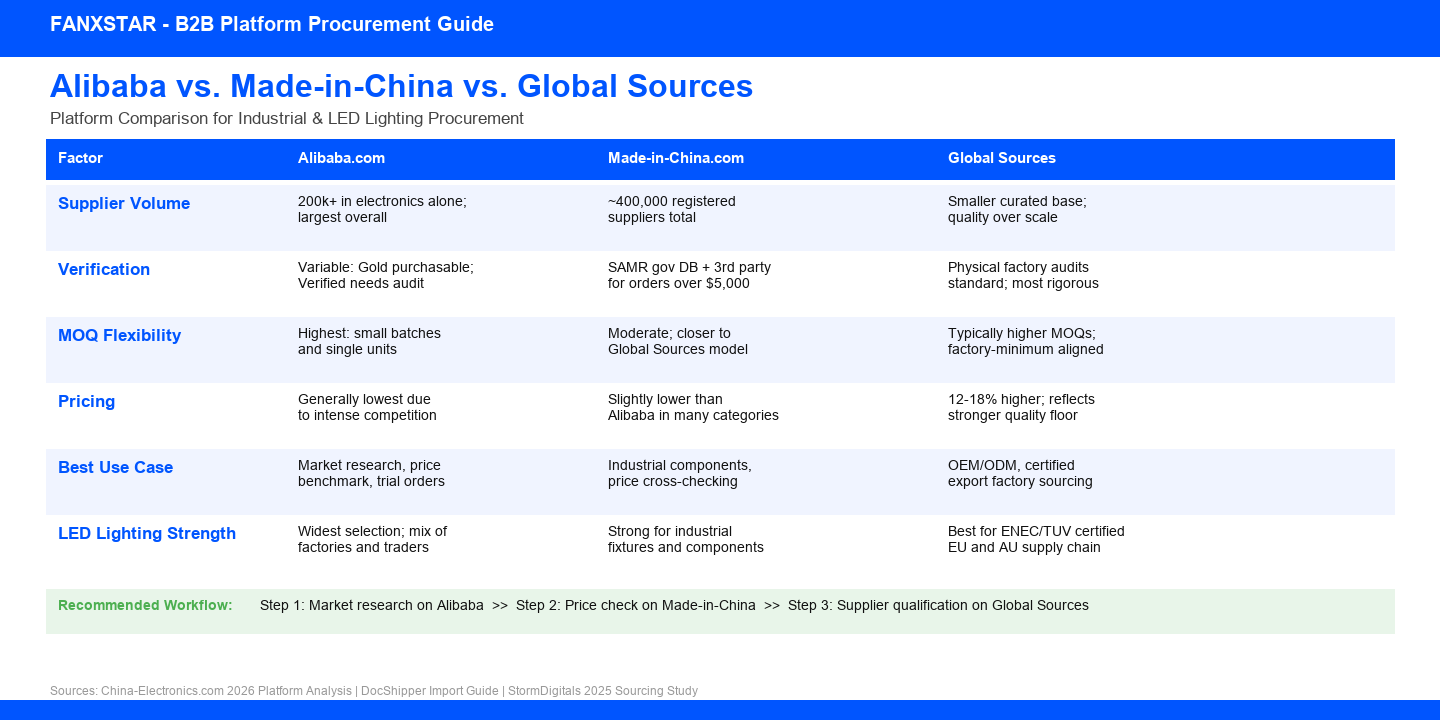
LED Lighting Sourcing: Which Platform Performs Best?
Why Platform Choice Matters for Lighting Procurement
LED lighting sits at the intersection of high technical specification requirements and intense price competition — exactly the conditions where platform selection has outsized impact. A procurement manager sourcing weatherproof tri-proof fixtures for a European warehouse project needs suppliers with documented IP65 ratings, CE/ENEC certification, and the engineering capability to provide LM-79 photometric reports. That is a fundamentally different requirement from someone sourcing 500 units of decorative pendants for a retail store.
China accounts for approximately 78% of worldwide LED manufacturing capacity, per sourcing industry benchmarks, with Guangdong’s Shenzhen-Foshan corridor producing over 65% of China’s LED exports to EU and North American markets. All three platforms have meaningful coverage of this manufacturing base — but they access different tiers of it.
Platform-Specific Strengths for LED Sourcing
For exploratory sourcing — understanding what fixtures are available at what price points, what certifications are standard, and which factories have international export experience — Alibaba is the most efficient starting point. Its search depth and buyer review system make market intelligence gathering faster than any other channel.
Made-in-China.com offers particular strength in the industrial LED segment: high-bay fixtures, weatherproof battens, explosion-proof luminaires, and specialized grow light systems. Its industrial-buyer orientation means supplier profiles often include more technical detail than equivalent Alibaba listings. Cross-referencing MIC prices against Alibaba quotes is a standard practice among experienced procurement managers for good reason.
Global Sources is the preferred channel when certification compliance is non-negotiable. Factories listed on Global Sources in the lighting category have typically invested in the export infrastructure — third-party lab testing, CE/TUV documentation, organized sample programs — that supports systematic supplier qualification. For OEM/ODM projects where you need a factory capable of IK10-rated housing development or LiFePO4 battery integration for emergency lighting, the Global Sources supplier base provides a more reliable starting point than the broader Alibaba pool.
Manufacturers like Fanxstar Technology operate across multiple B2B channels precisely because sophisticated B2B buyers use different platforms at different stages of the procurement cycle. Understanding which platform to use — and when — is itself a procurement competency.
The Recommended Three-Platform Workflow
Stage 1 — Market Intelligence (Alibaba)
Begin every new category on Alibaba. Use it to benchmark pricing, understand typical MOQs, identify which certifications are standard in your target market, and gather initial supplier candidates. Do not place production orders based on Alibaba research alone — use it as your market map.
Stage 2 — Price Verification (Made-in-China.com)
Cross-check your Alibaba price benchmarks on Made-in-China. If MIC prices run 10–15% lower for equivalent specifications, you may be looking at intermediary markup in your Alibaba quotes. MIC’s industrial focus also surfaces factory-direct suppliers who may not invest in Alibaba’s paid visibility programs.
Stage 3 — Qualified Supplier Selection (Global Sources)
For final supplier qualification — particularly for regulated products, safety-critical applications, or high-volume OEM programs — move your shortlist to Global Sources. The verification depth reduces due diligence costs and provides a higher-confidence starting point for factory audits.
This three-stage approach is standard practice among experienced importers sourcing industrial lighting, electronics, and manufactured components from China. Using any single platform exclusively leaves value — or risk — on the table.
Supplier Verification: What Each Platform Actually Checks
Alibaba’s Verification Tiers
Alibaba operates a tiered verification system. Basic Gold Supplier status requires a paid annual membership (approximately $10,000 USD/year for premium tiers) and confirms business registration, but does not include a factory audit. Verified Supplier status requires a third-party on-site audit covering manufacturing capability, quality management systems, and export compliance — but this upgrade is optional and not universally adopted. According to DocShipper’s analysis of platform verification, cross-checking suppliers on both Alibaba and Global Sources increases authenticity verification by a statistically meaningful margin over using either platform alone.
Made-in-China’s SAMR Integration
MIC’s Assessed Supplier program cross-references the China Credit Information System (gsxt.gov.cn), which is the government’s primary business registry. This government database integration is one of MIC’s genuine differentiators — it provides a layer of legal entity verification that Alibaba’s self-reported profiles do not systematically replicate. For industrial buyers where counterparty legitimacy matters as much as product quality, this is a meaningful advantage.
Global Sources’ Physical Audit Model
Global Sources caps exhibitor numbers and conducts on-site verification before listings go live — a model that creates a higher quality floor but a smaller supplier base. The platform’s Hong Kong trade shows add a face-to-face dimension to supplier qualification that is particularly valuable for complex OEM programs where technical specification alignment cannot be fully confirmed through digital channels alone. If you are sourcing certified industrial lighting for critical infrastructure — healthcare facilities, food processing plants, hazardous locations — the Global Sources verification model provides a higher-confidence starting point.
For procurement teams evaluating industrial weatherproof lighting solutions for demanding environments, understanding which platform your target factory type is most likely to appear on can reduce qualified supplier identification time significantly.
Common Questions
Is Alibaba safer than Made-in-China for international buyers?
Alibaba’s Trade Assurance program provides stronger buyer protection for payment disputes than MIC’s equivalent, primarily because of its larger transaction volume and more developed dispute resolution infrastructure. For financial transaction security on initial orders, Alibaba is the safer choice. For supplier identity verification, MIC’s SAMR integration provides a government-backed check that Alibaba does not systematically replicate.
Can I use Global Sources as my only sourcing platform?
You can, but you will miss the price benchmarking utility of Alibaba and the industrial depth of Made-in-China. Global Sources performs best as a supplier qualification and OEM partnership platform, not as a market research tool. Experienced sourcing teams use all three at different stages.
Which platform is best for sourcing LED lighting with EU certifications?
All three platforms have CE-certified LED lighting suppliers. For industrial applications requiring ENEC, TUV, or LM-79 documentation, Global Sources’ stricter supplier screening means a higher proportion of listed factories will have the compliance infrastructure in place. Alibaba’s Verified Supplier tier also surfaces compliance-capable factories, but requires more individual supplier vetting to identify them. Direct manufacturer websites remain an important complement — Alibaba and Global Sources listings often represent a curated subset of a factory’s actual capability. To explore certified emergency lighting solutions from specialized manufacturers, direct manufacturer engagement typically yields faster specification alignment than platform-mediated initial contact.
Do these platforms support OEM/ODM projects?
Yes — all three explicitly support OEM/ODM manufacturer discovery. Alibaba and MIC both have OEM-filtered search options. Global Sources’ factory-direct model means OEM capability is typically more consistently present across its supplier base. For complex customization projects — custom housing geometry, specialized spectrum, or multi-certification products — direct engagement with a manufacturer’s customization team (rather than their platform profile) is the appropriate next step after initial platform-based discovery. Explore Fanxstar’s OEM/ODM customization capabilities as a reference for what a full-service industrial lighting manufacturer’s custom program looks like.
Are prices on Made-in-China.com actually lower than Alibaba?
In many industrial categories, yes. MIC’s lighter advertising spend and industrial buyer orientation means prices often run slightly lower than comparable Alibaba listings. The difference is most pronounced in categories where Alibaba has significant trading company representation alongside factory-direct suppliers. In LED lighting specifically, MIC often provides direct factory access for industrial fixture categories (high-bays, weatherproof battens, explosion-proof) where Alibaba’s search results are more heavily populated by intermediaries.
Next step for lighting procurement teams: Once you have identified qualified factories through platform research, direct manufacturer engagement is typically more efficient than continued platform-mediated communication for technical specification alignment. Contact Fanxstar’s team for project-specific pricing and specification support — the team provides direct technical consultation without platform intermediary delays.