The question comes up in almost every conversation with B2B buyers who are exploring China-origin LED lighting sourcing for the first time: should I use a buying agent, or go direct? The honest answer is that it depends — on your order volume, your technical specification complexity, your in-house sourcing capability, and critically, on what “saving money” actually means when you account for the full cost of a sourcing decision, not just the line item on the purchase order.
This article provides a framework for making this decision correctly, based on the specific context of industrial and commercial LED lighting procurement — weatherproof fixtures, emergency lighting, OEM/ODM products — rather than generic import advice. The math looks different when the product involves IP rating certification, ENEC compliance, and LiFePO4 battery management systems than when it involves commodity items without technical depth.
Key Takeaways
- Buying agents add genuine value in early-stage sourcing (market navigation, factory vetting, logistics coordination) but extract margin on every subsequent transaction — often 5–15% — that accumulates into substantial cost over a sustained procurement relationship.
- Direct sourcing from export-first manufacturers with established EU/AU after-sales infrastructure removes the primary risks that make buyers rely on agents in the first place: language barriers, post-shipment communication failures, and warranty inaccessibility.
- The break-even point where direct sourcing becomes more economical than using a buying agent is typically around the third or fourth repeat order for the same product — after which the agent’s margin represents pure overhead with diminishing discovery value.
What a Buying Agent Actually Does — and What They Charge
By Julie Zhu, LED Lighting Specialist at Fanxstar Technology · 2026
A buying agent (also called a sourcing agent or purchasing agent) is an intermediary who represents the buyer in China to identify factories, negotiate prices, manage quality control inspections, coordinate logistics, and handle communication. Their services typically cover factory sourcing and verification, sample coordination, pre-shipment inspection, export documentation management, and ongoing supplier relationship management on the buyer’s behalf.
The fee structure varies. Most agents charge a commission of 5–15% on the FOB value of orders placed through them. Some charge flat fees for initial factory identification and then a lower ongoing commission. A smaller number charge purely time-based fees for specific services (factory audits, QC inspections) without commission on the purchase price. Understanding which model your agent uses is essential — a 10% commission on €500,000 of annual lighting procurement is €50,000 per year in agent fees, regardless of whether the agent provided €50,000 worth of value in year two.
The Case for Using a Buying Agent
When You’re Starting From Zero
For a buyer with no existing China factory relationships, no Mandarin language capability, no experience with Chinese export documentation requirements, and limited knowledge of how to evaluate a factory’s quality management system, a buying agent provides genuine value. The agent’s market knowledge — which factories in Guangdong manufacture which categories, which certifications are authentic versus forged, which logistics routes and forwarders are reliable for specific destination markets — is real and takes years to develop independently.
The cost of a bad first factory choice, including a container of out-of-spec or uncertified product, customs rejection, or compliance failure, can easily exceed the total fee you would have paid a competent buying agent for 12 months of transactions. For buyers entering China-origin sourcing for the first time with meaningful order values, the agent’s fee is genuine insurance against the worst outcomes.
For Highly Diversified Product Portfolios
If your sourcing covers multiple product categories across multiple factories — LED lighting, electrical accessories, control gear, mechanical installation hardware — a buying agent with broad category coverage provides coordination value that would require a full-time China-based employee to replicate independently. The agent manages factory relationships, monitors production schedules, and consolidates logistics across multiple suppliers, reducing the buyer’s operational overhead for China sourcing management.
The Real Costs of Buying Agent Dependency
The Ongoing Commission Erosion
The agent’s value is highest in the discovery and vetting phase. Once you have identified a reliable factory that consistently delivers compliant product, the agent’s ongoing 8–12% commission buys you coordination services that decrease in value as the supply relationship matures. In year one, the agent’s factory knowledge and QC management might justify their full commission. In year three, you are paying 8–12% of purchase value for email forwarding and logistics coordination that an experienced internal procurement manager could handle directly.
The math compounds quickly. On €200,000 of annual LED lighting procurement with an 8% agent commission, you are paying €16,000 per year for ongoing agent services in a mature supply relationship. Over five years, that is €80,000 — sufficient to fund a dedicated sourcing manager or, more relevantly to the lighting category, to fund a full factory audit programme and quality management system for direct supplier relationships.
The Specification Translation Risk
For technically complex products — LED fixtures with specific IP ratings, certification requirements, custom CCT specifications, or emergency battery configurations — an agent who is not a domain expert creates a specification translation risk. The agent receives your technical requirements and communicates them to the factory in their own interpretation. If the agent does not fully understand the difference between IP65 and IP66 for pressure-washing environments, or between ENEC certification and self-declared CE marking, or between LiFePO4 and NiMH battery chemistry for cold chain applications, the specification that reaches the factory is not the specification you intended.
This risk is not hypothetical. In the industrial LED category, specification mistranslation is one of the most common causes of first-container failures — products that visually match the sample but fail to meet the certification or performance requirements that were the entire commercial reason for the specification. Working directly with an export-focused manufacturer whose engineering team speaks technical English and understands your market’s compliance requirements removes this layer of interpretation risk entirely.
The Case for Direct Sourcing
From Export-First Manufacturers
The traditional objection to direct sourcing from Chinese manufacturers — language barriers, timezone communication difficulty, unreliable post-shipment support, and inaccessible warranty service — is a legitimate concern when applied to domestic-market manufacturers who do not prioritize international B2B service. It is not a legitimate concern when applied to export-first manufacturers whose entire business model is built around international buyers.
Export-first LED manufacturers like Fanxstar maintain English-language engineering teams, European offices for after-sales service (Spain and Netherlands), and operational processes calibrated to the documentation requirements of EU, UK, and Australian import compliance. The risks that make buyers rely on agents — unclear certification documentation, difficult post-shipment communication, warranty claim inaccessibility — do not characterize this type of manufacturer. Buyers who conflate “China manufacturer” with “domestic China factory” make sourcing decisions based on a risk profile that does not apply to the supplier they are actually dealing with.
Cost Comparison: Agent vs. Direct
The following model assumes a buyer sourcing LED tri-proof fixtures for EU industrial applications, with annual procurement of €150,000 FOB value:
| Cost Element | Via Buying Agent (8% fee) | Direct (Export-First Manufacturer) |
|---|---|---|
| Product FOB value | €150,000 | €150,000 |
| Agent commission (8%) | €12,000 | €0 |
| Additional QC inspection (3rd party) | €1,200 (often agent-sourced) | €1,200 (buyer can appoint independently) |
| Internal sourcing coordination (est.) | €2,000 (reduced — agent handles) | €3,500 (buyer manages directly) |
| Total cost (Year 1) | €165,200 | €154,700 |
| 5-Year Total Cost | €826,000 | €773,500 |
| 5-Year Savings (Direct) | €52,500 | |
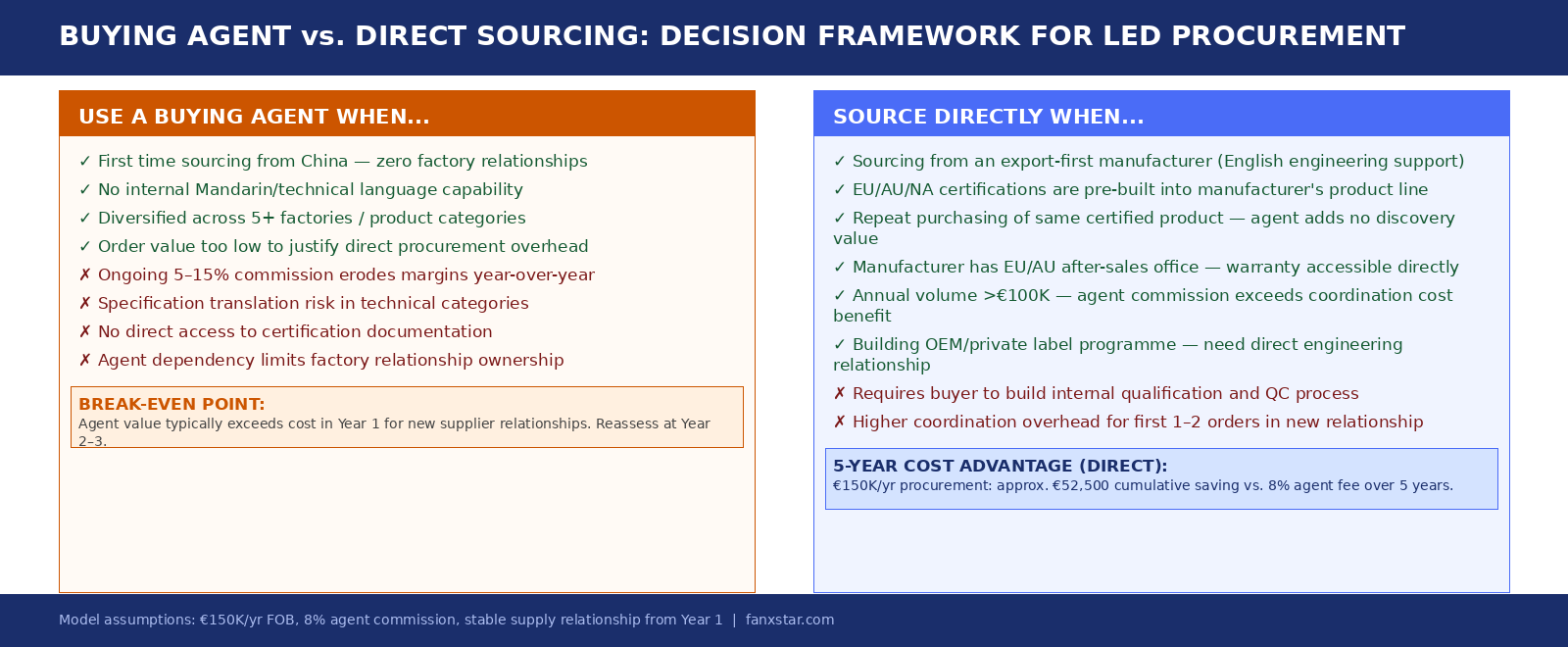
How to Transition from Agent to Direct Sourcing
Step 1: Identify Which Product Categories Have Stable Factory Relationships
Not all categories transition simultaneously. Start with the categories where you have the most repeat purchasing, the most stable specification, and the highest confidence in the factory’s quality system. Industrial LED tri-proof fixtures, if you have a certified factory relationship producing consistent results, are a strong candidate for direct management — the technical specification is well-defined, the factory knows your quality requirements, and the ongoing agent value has diminished to logistics coordination.
Step 2: Evaluate Whether Your Existing Factory Is Export-First
Before committing to direct sourcing, assess honestly whether the factory you are currently buying from through your agent is equipped to manage a direct international B2B relationship. Key indicators: do they have English-speaking engineers who can respond to technical queries independently? Do they have European or local-market after-sales contacts? Do they hold and can they independently provide complete certification documentation? If yes, the transition to direct is low-risk. If the factory is primarily domestically oriented and your agent has been the translation layer, a factory change to an export-first manufacturer may be appropriate alongside the transition.
Fanxstar’s OEM/ODM programme and weatherproof LED range are specifically designed to serve direct international B2B buyers — with English-language engineering support, European after-sales offices, and certification documentation that buyers can access and present to their own customers or compliance authorities independently. Learn more about Fanxstar’s export credentials and manufacturing capabilities, or contact the team for a direct consultation on transitioning your LED sourcing programme.
Step 3: Build Your Direct Qualification Process
Replace agent-managed quality control with a direct qualification process: request LM-80 test data for the LED package, driver specification sheets from the named driver manufacturer, and certification documents with verifiable certificate numbers. Commission an independent pre-shipment inspection (SGS, Bureau Veritas, Intertek, or similar) for first orders and periodically thereafter. Document your own specification requirements formally — a written specification that includes IP rating, operating temperature range, certification requirements, and warranty terms removes ambiguity that agents previously managed through informal negotiation. For guidance on what certification documentation should look like, contact Fanxstar’s engineering team — we regularly assist buyers building their own direct sourcing qualification frameworks.
Frequently Asked Questions
Is a buying agent legally liable if they source non-compliant products?
Generally, no — not unless your contract explicitly assigns liability for certification compliance to the agent. Most buying agent agreements classify the agent as a service provider facilitating transactions, not as the responsible party for the products themselves. Under EU product liability and market surveillance regulations (including the General Product Safety Regulation, GPSR, effective from December 2024), the legal responsible party for a non-compliant product placed on the EU market is typically the importer — meaning the buyer, not the agent who sourced it. This makes it essential for buyers to independently verify certification compliance rather than relying on an agent’s assurances.
How do I verify a Chinese LED factory’s certifications without visiting in person?
Request the specific certificate number for each claimed certification and verify it directly on the issuing body’s public database: ENEC at enec.com, UL at database.ul.com, ETL through Intertek’s database, CB certificates through iecee.org/certification, SAA/RCM through the Australian Product Safety database. A legitimate certificate has a verifiable number — a factory that cannot provide verifiable certificate numbers for the certifications they claim is not a factory whose compliance claims should be trusted. Complementarily, commission an independent third-party factory audit (SGS, Bureau Veritas, or similar) for significant first-time relationships.
What is the typical payment term difference between agent-mediated and direct sourcing?
Payment terms in direct factory relationships are directly negotiable and typically improve with relationship depth and order volume. Common structures: 30% deposit with order confirmation, 70% against copy of bill of lading (T/T); or Letter of Credit (L/C) for larger orders where the buyer requires documentary assurance. Agent-mediated sourcing often involves the agent holding the full payment risk position — which can simplify the buyer’s process but adds the agent’s financing cost into their margin. Direct factory relationships with established export manufacturers frequently offer more flexible payment terms over time, which can have meaningful cash flow implications at significant annual procurement volumes.
When should I keep using a buying agent even for repeat purchases?
There are legitimate ongoing reasons to maintain a buying agent relationship: if your procurement spans more than 4–5 different factories across multiple product categories, the coordination overhead of direct management may exceed the agent fee; if you lack internal procurement bandwidth and your China sourcing volume does not justify a dedicated hire; or if you are operating in a market segment where personal factory relationships and Mandarin-language negotiation access genuinely drives better factory economics than the agent’s commission cost. The key test is whether the agent is still creating value commensurate with their fee in each year of the relationship — not just in year one when their market knowledge was most scarce.