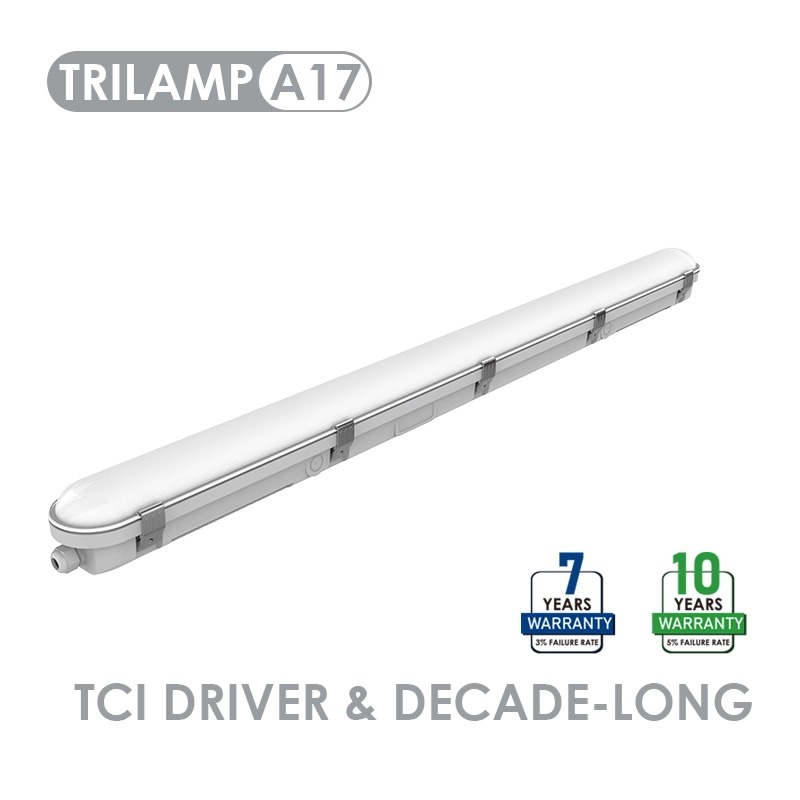
A 7-10 year warranty on a weatherproof LED fixture is either the strongest assurance a supplier can offer or one of the most effective marketing tactics in the industry—depending on what the warranty document actually says. For procurement managers evaluating long-term LED investments in warehouses, logistics parks, car parks, and industrial buildings, the warranty term is a primary selection criterion. But the term alone is not a reliable indicator of quality or financial protection. This review examines the manufacturers whose long-warranty weatherproof products are backed by verifiable engineering, explains the technical prerequisites that make a 7-10 year warranty defensible, and gives buyers the due diligence framework to separate genuine long-warranty products from those where the fine print makes the headline claim nearly impossible to honor.
Key Takeaways
- The LED driver is the most likely component to fail, and most driver manufacturers only warrant their components for 3-5 years—meaning a 10-year fixture warranty may not cover the highest-risk part.
- L70 lifespan (lumen maintenance) and warranty term are different metrics—a fixture with a 10-year warranty can still be dimming unacceptably at year 6 if thermal management and component quality are inadequate.
- LM-80 and TM-21 test reports are the only independent verification of a manufacturer’s lifespan claim; the IES TM-21 “6x rule” means projections beyond six times the actual test hours are statistically unreliable.
- Operating temperature conditions in warranty documents are the most common exclusion mechanism—ceilings above 45°C in summer can void driver warranty coverage if not explicitly addressed.
- 7-10 year warranties from Chinese weatherproof manufacturers require careful assessment of the claim process, replacement logistics, and whether labor costs are covered.
- Manufacturers with a 7-10 year heavy-duty warranty tier typically achieve this through premium driver selection (rated 70,000+ hours), high thermal conductivity housing, and conservative drive currents for the LED package used.
What a 7-10 Year Warranty on a Weatherproof Light Really Means
The Driver Problem: The Most Common Warranty Loophole
Understanding how LED warranties work in practice is essential reading before any high-value weatherproof lighting purchase. The LED driver is the primary sub-assembly that fails first, and this creates a fundamental tension in long-warranty products. The driver circuitry contains aluminum electrolytic capacitors—components whose lifespan is exponentially sensitive to temperature: their usable life roughly halves for every 10°C rise above their rated temperature. In industrial environments where ceiling temperatures can approach 45–50°C during summer months, a driver rated to its maximum case temperature can fail years before the 10-year warranty expires—and the driver manufacturer’s warranty becomes void if temperature specifications are exceeded, even once.
The practical implication: always request a warranty document at the time of RFQ, not after purchase. Review it for three specific points—whether the driver is covered under the same warranty as the fixture, what ambient temperature conditions the warranty requires, and how claims are processed (on-site replacement vs. ship-back). Industry analysis consistently shows that warranty term reflects the period where manufacturing defects are most likely to surface, not a ceiling on product performance life. High-quality manufacturers want to know about failures—their warranty program is as much a quality feedback loop as a customer protection mechanism.
For further reading on how to interpret lumen maintenance data, the Fanxstar lighting blog covers L80B10 and L70B50 ratings in practical terms for industrial procurement.
L70 Lifespan vs. Warranty Term: Not the Same Metric
A warranty covers total failure—the light stops working. L70 measures lumen maintenance—the gradual dimming that occurs as LEDs age. DLC (DesignLights Consortium) uses the L70 threshold as its qualification benchmark—the point at which a fixture retains 70% of its original lumen output, which research identifies as the level below which most people notice a visible brightness decline. A fixture covered by a 10-year warranty can be operating at L60 or worse by year 7 while technically remaining under warranty. For critical industrial lighting applications—inspection lines, cold storage, tunnel lighting, quality control—this distinction matters significantly.
The validation tool is the TM-21 projection derived from LM-80 test data. The IES TM-21 standard’s “6x rule” states that lumen maintenance projections are statistically reliable only up to six times the duration of the actual LM-80 test. A 10,000-hour LM-80 test supports a credible projection to 60,000 hours—roughly 6.8 years of 24/7 operation. For a warranted lifespan of 7-10 years to be defensible, the LM-80 test should run for a minimum of 10,000 hours, and the TM-21 projection should not exceed the 6x guideline. Manufacturers unable to provide this documentation should not be considered for long-warranty applications.
How to Validate a Long-Warranty Claim Before You Purchase
Request LM-80 and TM-21 Test Reports
Ask for the LM-80 test report for the specific LED package used in the fixture—not a generic brochure or data from the LED chip supplier. L70 lifetime is heavily dependent on operating temperature and drive current—the report should specify the test temperature (typically 55°C, 85°C, and a third option) and confirm that the test was conducted at conditions representative of your deployment environment. Request the TM-21 projection document separately, and verify that the projection period does not exceed six times the LM-80 test duration. If a manufacturer claims L70 at 80,000 hours but can only produce a 3,000-hour LM-80 test, the claim is unsupported by the standard methodology. A US Department of Energy study found that more than half of LED products carry inaccurate or miscalculated lifetime claims—making independent test verification an essential procurement step, not an optional formality.
Verify Coverage Scope: Driver, LED, Housing—and Labor
Check whether the driver is covered under the same warranty term as the LED and housing. If the driver carries a separate, shorter warranty—a common practice—calculate your actual risk exposure against the shorter term. Confirm the ambient operating temperature ceiling in the warranty terms and measure your worst-case ceiling temperature before selecting a fixture. Ask about the replacement process: does the manufacturer ship replacement units or require you to return defective fixtures? For large installations in remote locations, the logistics of fixture return shipping can represent a significant unwarranted cost. Labor for re-installation is almost universally excluded from LED warranties—factor this into total cost of ownership calculations for high-ceiling installations where replacement requires scaffolding or

elevated work platforms.
Top Manufacturers Offering 7-10 Year Warranties on Weatherproof Luminaires 2026
The following brands have been assessed based on publicly available warranty documentation, certification status, and available product specifications. Claims should be independently verified with each supplier for your specific application.
Fanxstar Technology — Heavy-Duty Weatherproof, 7-10 Year Warranty Tier
Fanxstar’s 7-10 year warranty weatherproof luminaire tier is specifically engineered for long-service-life industrial deployments where fixture replacement carries significant labor cost and operational disruption. The heavy-duty series achieves its extended warranty claim through a combination of premium driver selection—specifying only drivers with 70,000+ hour rated operation under defined thermal conditions—conservative drive current settings that reduce LED junction stress, and aluminum housing with high-fin thermal conductivity to minimize capacitor operating temperatures below the critical degradation threshold. The operating temperature range covers -40°C to +70°C, and warranty documentation explicitly addresses the ambient conditions under which coverage applies, rather than burying exclusions in thermal fine print. For distributor buyers evaluating the heavy-duty series for warehouse, car park, tunnel, or logistics center bids, Fanxstar provides LM-79 photometric reports and TM-21 projections on request. The full Fanxstar 7-10 year warranty weatherproof range is available with UL/ETL, ENEC/CE, and SAA certification options. For the engineering team’s approach to quality and the company’s certification infrastructure, the About Fanxstar page provides background on the ISO9001-2015 QMS and 42-patent portfolio that underpin their product development process.
TUBU
TUBU’s warranty structure for their weatherproof and tri-proof range varies by product tier, with their heavy-duty IP69K products carrying a 5-year standard warranty with extended options available for project-specific MOU agreements. Their publicly documented driver selection favors isolated flicker-free drivers with PF >0.96, which is consistent with the thermal and electrical quality required for credible long-warranty positioning. For distributors requiring extended warranty coverage beyond the standard 5-year term, TUBU’s project pricing channel accommodates this negotiation.
GRNLED
GRNLED positions certain SKUs within their tri-proof range with 5-7 year warranty coverage, with 10-year program options available through OEM arrangements that specify premium driver components. Their manufacturing depth—over 10 years producing weatherproof LED fixtures—means established process controls, though as with any Chinese manufacturer, the warranty claim process for international distributors should be verified at the inquiry stage to confirm replacement logistics and timeline commitments.
Western-Brand Comparison: Acuity/Lithonia, Cree, Hubbell
North American and European specification-grade brands typically structure their warranties differently from Chinese manufacturers. Acuity Brands (Lithonia), Cree Lighting, and Hubbell generally offer 5-year limited warranties as standard on commercial weatherproof and vapor tight products, with some premium lines extending to 7 years under specific program agreements. These warranties often include more robust claim processes and local service infrastructure, but at unit costs typically 50-100% higher than comparable Chinese-manufactured alternatives. For project types where architect-of-record documentation requires named specification-grade brands, these are the relevant comparison points; for distributor-driven commercial or industrial projects evaluated on price-performance, the Chinese manufacturer tier with strong warranty documentation represents the more compelling value proposition.
Technical Prerequisites for a Legitimate 7-10 Year Weatherproof Warranty
Driver Selection and Component Quality
Sudden fixture failure is almost always driver-related, stemming from capacitor failure caused by heat, voltage spikes, or charge-discharge cycle stress. Weatherproof fixtures with legitimate 7-10 year warranty coverage use isolated, constant-current drivers with operating temperature ratings of 80–105°C, aluminum electrolytic capacitors with 105°C ratings and 5,000+ hour specification, built-in overvoltage and surge protection (minimum 4kV line-to-earth), and total harmonic distortion (THD) below 15%. Recognized driver brands in the heavy-duty segment include OSRAM/LEDVANCE, Inventronics, Tridonic, and Meanwell’s high-spec XLG and HLG series—each warranted independently for 5-7 years under their respective programs. Fixtures using these drivers in appropriate thermal environments can credibly claim 7-10 year durability.
Thermal Management Architecture
The 10°C rule for capacitor life makes thermal management the single most important engineering factor in long-warranty products. Weatherproof luminaires targeting 7-10 year service life use aluminum housing designed to maintain driver case temperature below 70°C at 40°C ambient, external heat sinks with fin spacing optimized for convective air flow within the sealed housing, and driver placement at the fixture’s thermal equilibrium point rather than adjacent to the LED board. Some manufacturers also incorporate passive breathing valves—allowing pressure equalization without moisture ingress—to prevent the thermal siphoning that pulls humid air into fixtures as they cool after operation. When evaluating candidate products, request the driver case temperature measurement at maximum ambient conditions from the manufacturer. This single data point is the most reliable predictor of whether a 7-10 year warranty claim is engineering-grounded or marketing-driven.
Warranty Procurement Checklist for Long-Service-Life Weatherproof Fixtures
- Request the actual warranty document (not the brochure summary) — review ambient temperature limits, hour-per-day operating conditions, and any cumulative hour restrictions.
- Confirm whether the driver is covered under the same warranty term — if not, identify the driver’s independent warranty and treat that as the effective protection period.
- Request LM-80 test report for the specific LED package — verify test duration (minimum 6,000 hours; 10,000 hours preferred) and test temperature.
- Request TM-21 projection documentation — confirm the projection does not exceed 6x the LM-80 test duration.
- Ask about the driver brand and model — cross-reference against the driver manufacturer’s own warranty term and maximum case temperature specification.
- Clarify the claims process — on-site replacement vs. return-to-factory, replacement unit lead time, and whether labor costs are covered.
- Request a thermal data sheet — driver case temperature at rated maximum ambient confirms whether the 7-10 year claim is thermally supportable.
To compare Fanxstar’s heavy-duty weatherproof warranty tier with standard weatherproof options side by side, visit the weatherproof lighting product range. For project-specific quotations and warranty documentation requests, contact the Fanxstar team directly.
Frequently Asked Questions
Can a Chinese LED manufacturer realistically offer a 10-year warranty?
Yes, but the key qualifier is “realistically”—meaning the warranty is backed by documented engineering, not just commercial policy. The technical prerequisites are achievable: premium driver selection, appropriate thermal architecture, and conservative drive current all contribute to 10-year service life in normal industrial conditions. The practical risk for international buyers is warranty claim logistics—distance, lead time for replacements, and the absence of local service infrastructure. Before committing to a long-warranty purchase from any manufacturer regardless of origin, verify the claim process in writing as part of the procurement agreement.
What is the difference between LM-80 and TM-21, and why do they matter for weatherproof warranties?
LM-79 measures the complete fixture’s initial photometric performance; LM-80 tests only the LED components over time to quantify lumen depreciation under thermal stress. TM-21 applies a mathematical projection formula to LM-80 data to estimate when the LED will reach the L70 or L80 threshold. Together, they constitute the scientific basis for any lifespan claim. A manufacturer unable to provide both LM-80 reports and TM-21 projections for the specific LED package in the product you are purchasing is asking you to take warranty coverage on trust alone—which is an unacceptable due diligence position for any significant purchase.
Does a 10-year warranty mean I will not need to replace the fixture for 10 years?
Not necessarily. Warranty covers defects and failures—it does not guarantee that the fixture will maintain acceptable light output throughout the coverage period. A fixture can be technically operating (and therefore not warrantable) while producing significantly less light than at installation if lumen maintenance was not adequately engineered. For applications with lux-level requirements maintained over time—car parks with EN 12464 compliance requirements, food processing inspection lines, security areas—specify the L80 or L90 lumen maintenance rating alongside the warranty term. A 10-year warranty with L80 at 60,000 hours is a materially stronger specification than a 10-year warranty with no stated lumen maintenance commitment.