When a facility manager or lighting specifier selects a weatherproof luminaire for a coastal warehouse, a chemical processing plant, or an outdoor logistics yard, the housing material determines how long that fixture functions before intervention is required. Polycarbonate tri-proof lights dominate the budget end of the market, but aluminum weatherproof luminaires occupy a distinct performance tier—one defined by passive thermal management, structural rigidity, and a corrosion resistance profile that depends critically on alloy selection and surface treatment. This guide evaluates the leading aluminum weatherproof luminaire brands in 2026, the technical factors that separate exceptional from adequate, and the procurement criteria that let buyers make a defensible sourcing decision.
Key Takeaways
- Aluminum’s natural oxide layer (Al₂O₃) provides inherent corrosion resistance, but the alloy grade and surface treatment applied determine longevity in salt spray, chemical fume, and high-humidity environments.
- Die-cast aluminum suits compact, complex geometries with strong structural integration; extruded aluminum offers superior thermal conductivity, lower tooling cost, and greater robustness at elevated operating temperatures.
- A360 alloy with powder coat finish outperforms A380 in coastal and industrial corrosive environments due to higher magnesium content.
- Thermal management is a differentiated advantage: quality aluminum weatherproof fixtures achieve 200+ W/m·K thermal conductivity, extending LED junction life significantly versus polycarbonate housings.
- IP65 to IP66 is the practical range for aluminum weatherproof luminaires; IP69K variants with stainless steel end caps are available from specialist manufacturers for washdown environments.
- OEM and private-label aluminum weatherproof programs offer distributors higher margin and differentiation compared to commodity polycarbonate alternatives.
Why Aluminum Outperforms Polycarbonate in Long-Term Industrial Weatherproof Lighting
Thermal Management: Aluminum’s Passive Cooling Advantage
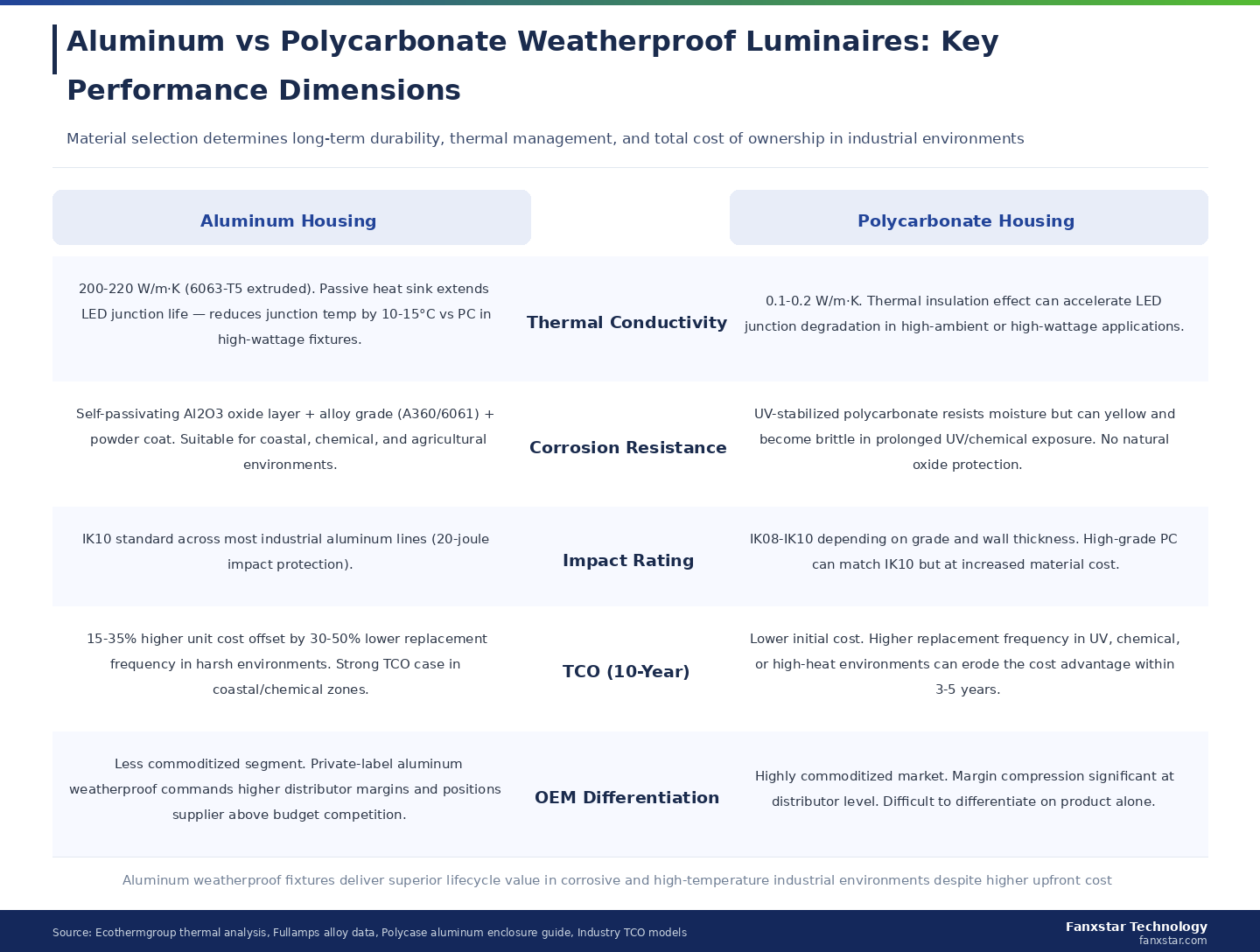
Heat is the primary driver of LED degradation. Elevated junction temperature reduces lumen output over time and accelerates the failure of phosphor and driver components. Aluminum’s thermal conductivity—typically 200–220 W/m·K for 6063-T5 extruded alloy, according to thermal engineering analysis—provides a passive heat sink that polycarbonate cannot replicate. In industrial environments where ambient temperatures are elevated and fixtures operate continuously, this thermal advantage directly translates into longer L70 service life and fewer unscheduled replacements. Industry data from high-bay LED manufacturers indicates that well-optimized aluminum fins can reduce LED junction temperature by 10–15°C versus comparable polycarbonate housings at similar power ratings, a difference that compounds significantly across a 50,000-hour lifespan. For a facility running 24/7, this is measured in years of additional reliable service.
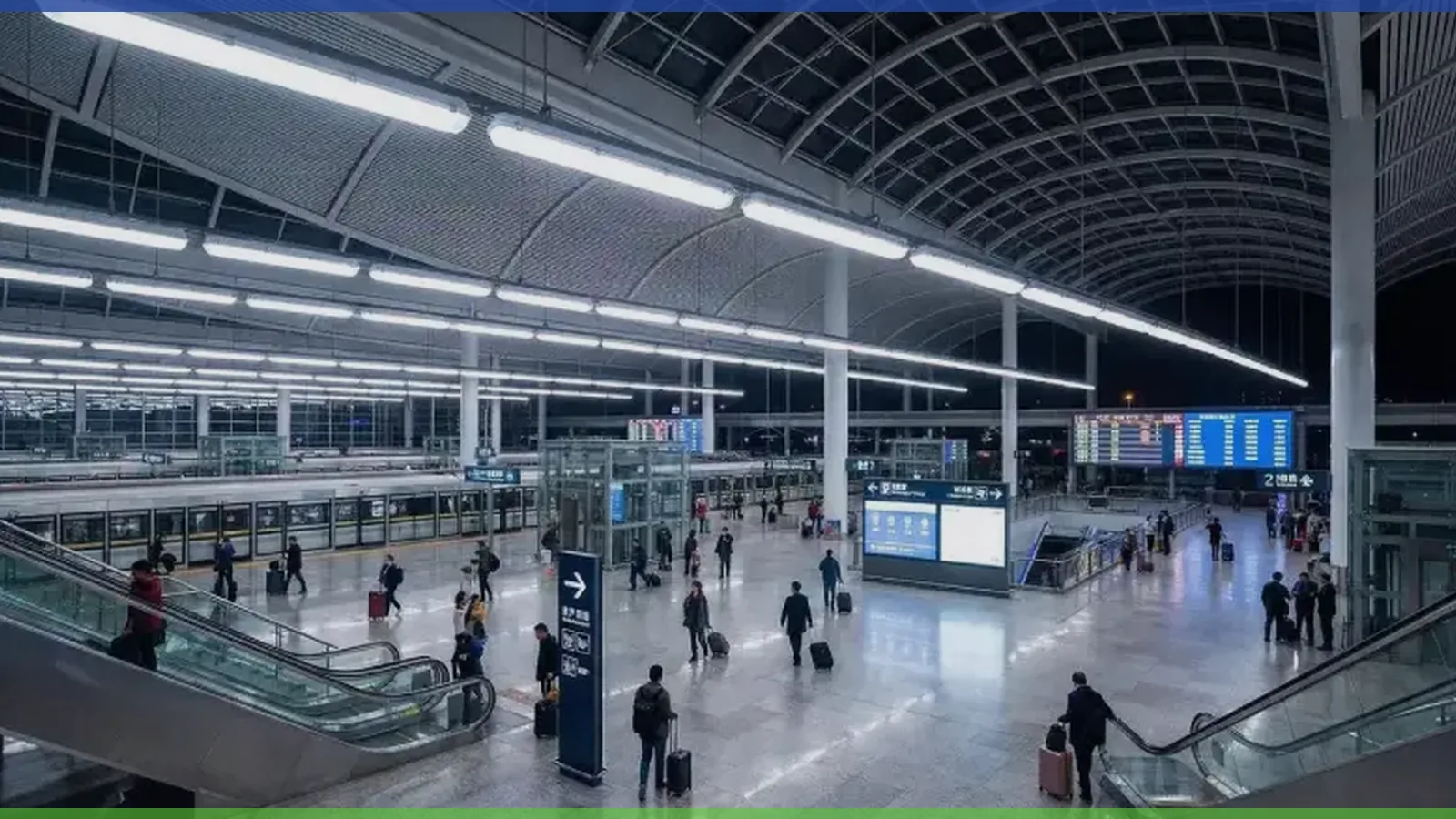
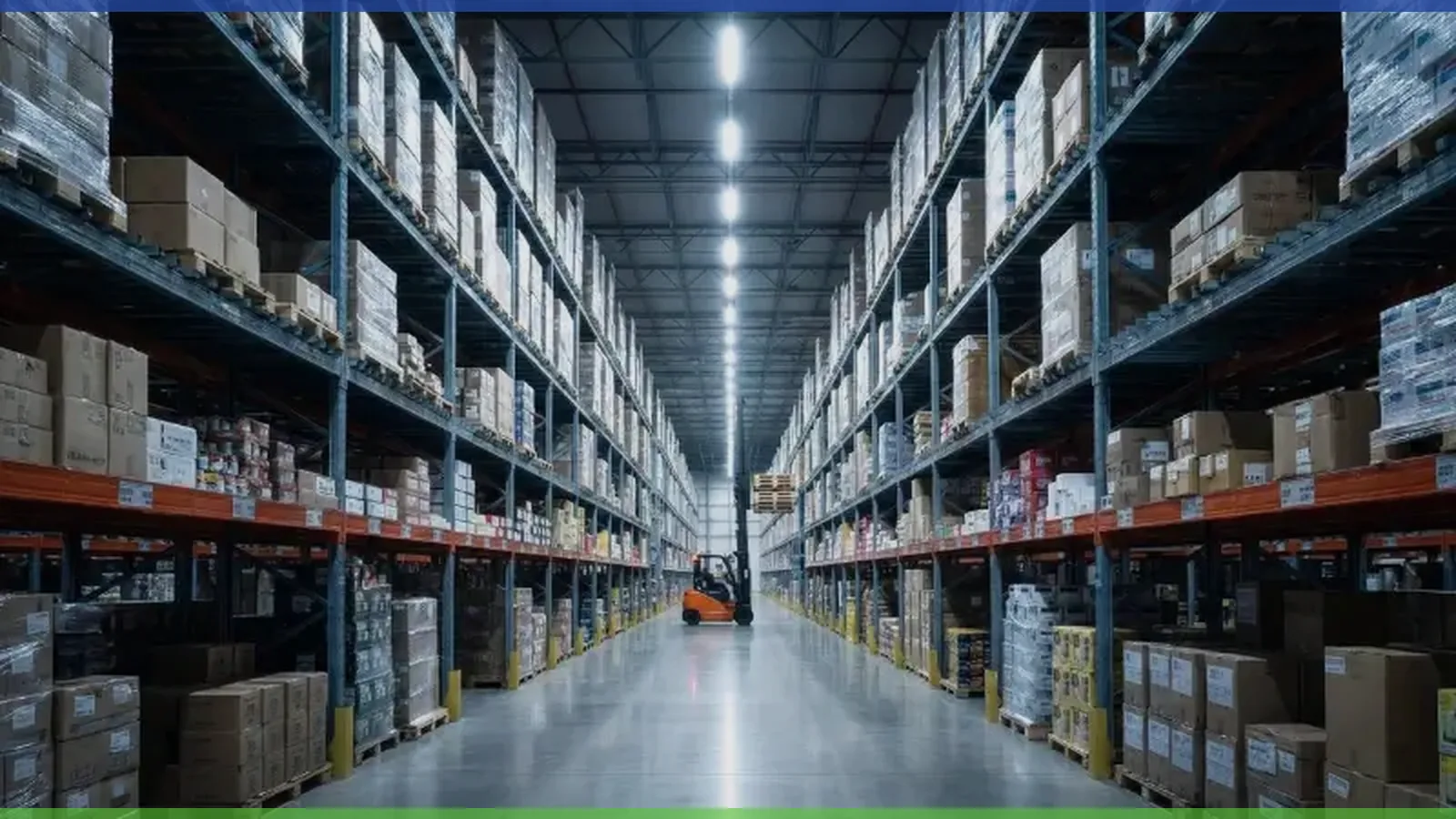
Explore lighting performance requirements across a range of industrial environments on the Fanxstar Applications page, where aluminum weatherproof fixtures are specified for warehouses, food processing plants, and logistics centers.
Corrosion Resistance: Alloy Choice and Surface Treatment Define the Outcome
Aluminum resists corrosion through self-passivation: exposure to air causes aluminum to instantly form a stable aluminum oxide (Al₂O₃) layer that chemically blocks further oxidation. This inherent property makes even untreated aluminum superior to untreated steel in most outdoor and industrial environments. However, in coastal environments with salt-laden air, in chemical processing facilities with corrosive fumes, or in food plants using acid or alkaline sanitizers, the base alloy and the applied surface treatment become critical selection variables. For outdoor LED luminaires, the A360 aluminum alloy’s higher magnesium content provides measurably superior corrosion resistance versus the more common A380 alloy, particularly when paired with a robust powder coat finish in environments with persistent moisture or chemical exposure. In less aggressive environments, standard ADC12 die-cast or 6063 extruded alloy with anodized or powder-coated finish delivers adequate protection at lower unit cost.
Die-Cast vs. Extruded Aluminum: Which Construction Method Suits Your Application?
Die-Cast Aluminum Luminaires
Die casting injects molten aluminum into a three-dimensional steel mold under high pressure, allowing manufacturers to produce complex integrated shapes—including internal cooling channels, mounting brackets, and optical housings—as a single component. Die-cast aluminum’s high precision and corrosion resistance make it particularly effective for outdoor fixtures where complex geometry, aesthetic quality, and integrated mounting solutions are priorities. The trade-off is higher tooling cost, making die casting most economical for established, high-volume product lines. Surface finish from die casting is typically smooth, which is advantageous for hygienic environments and for powder coat adhesion. Wall thickness is thinner than extrusion equivalents, reducing fixture weight.
Extruded Aluminum Luminaires
Extrusion forces heated aluminum billets through a precision die to create long, uniform cross-sectional profiles. This process is dominant for linear weatherproof luminaires—tri-proof battens, vapor tight fixtures, and linear high bays—where the consistent cross-section matches the fixture’s linear geometry. Extruded enclosures offer greater robustness for high-temperature environments and lower per-unit cost at scale. Extrusion tooling is also significantly less expensive than die casting molds, making it the preferred process for OEM buyers developing custom fixture programs at lower initial investment. The 6063-T5 alloy commonly used in extrusion provides a strong balance of thermal conductivity, structural strength, and anodizing
suitability.
Top Aluminum Weatherproof Luminaire Brands 2026
The following assessment covers manufacturers with verified aluminum weatherproof product lines available for distributor or OEM sourcing. All certification information reflects publicly available documentation and should be confirmed directly with each supplier for specific projects.
Fanxstar Technology — Aluminum Tri-proof and Weatherproof Specialist
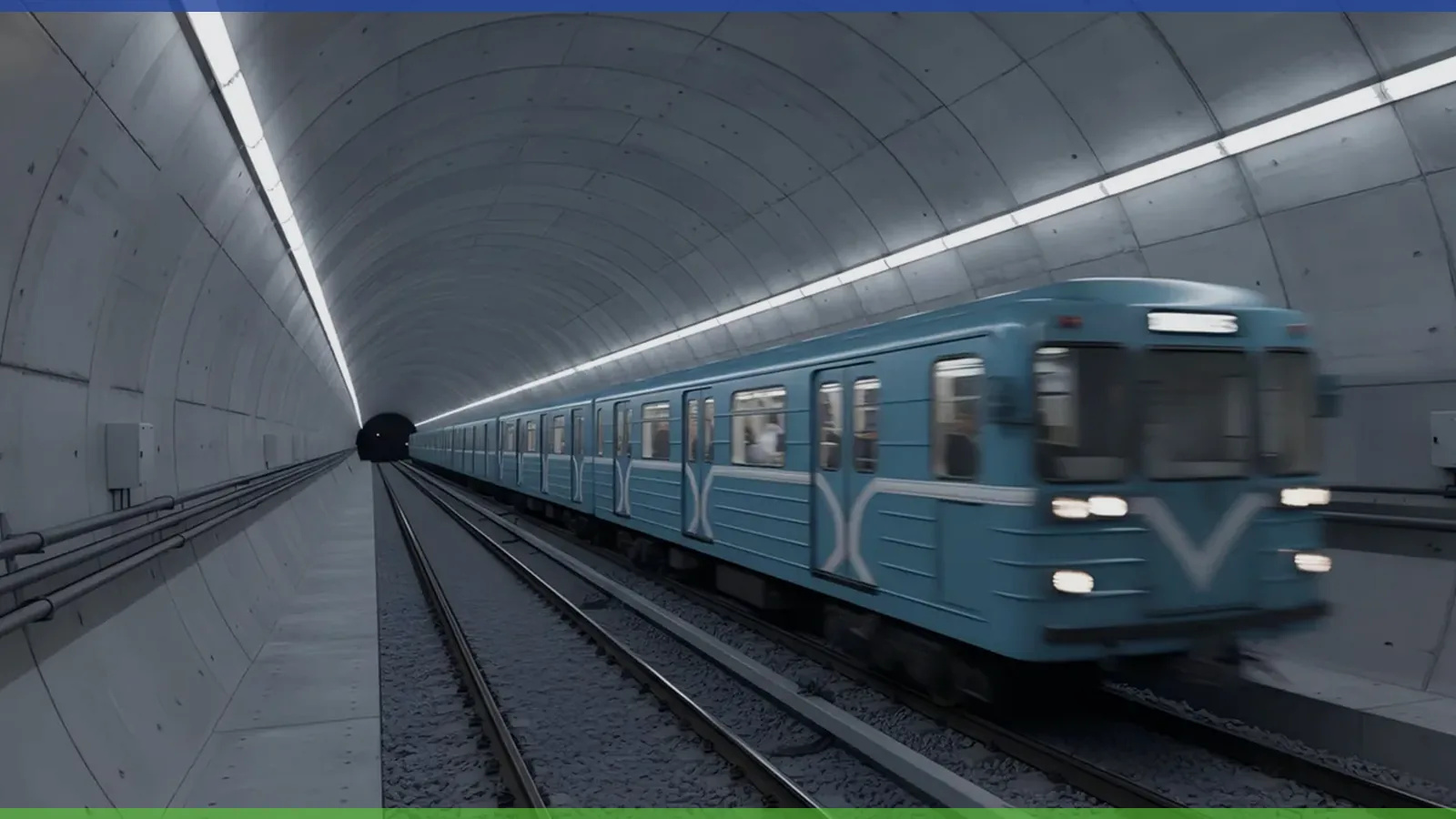
Fanxstar’s aluminum weatherproof luminaire line spans IP65 and IP66 configurations in both die-cast and extruded alloy formats, covering 2ft to 8ft lengths across a 20W–120W wattage range. The aluminum series is engineered for corrosive or demanding environments where polycarbonate tri-proof fixtures are insufficient—including coastal warehouses, chemical plants, tunnels, and agricultural facilities. Key specifications include IK10 impact protection, operating temperature from -40°C to +70°C, and a 7-10 year warranty tier for heavy-duty configurations. Philips Lumileds and Bridgelux chip options provide specifiers with traceable LM-79 photometric data. Certifications span UL/ETL, ENEC/CE/ErP, TUV/CB, SAA, and ISO9001-2015, enabling direct export to North America, Europe, and Australia without third-party recertification. The OEM/ODM customization program accommodates private-label branding, custom wattage configurations, CCT selection, and packaging—making aluminum weatherproof fixtures one of Fanxstar’s highest-differentiation OEM offerings. Review the full Fanxstar aluminum weatherproof range for current specifications and available certifications.
Fanxstar’s 42-patent portfolio and 15+ years of average team experience in industrial LED export underpin their engineering depth in this segment—further detail is available on the About Fanxstar page.
TUBU
TUBU positions its aluminum weatherproof line alongside its stronger IP69K round-tube product, with a range of extruded and die-cast housing options for general industrial applications. Their European export focus means ENEC and CE/ErP certification is standard on most aluminum variants, and they have established distribution in several EU markets. Typical efficiency ratings land in the 130–160 lm/W range across standard configurations.
OLAMLED
OLAMLED’s aluminum weatherproof series covers IP65/IP66 batten and tri-proof formats with a strong showing in the European round-up and comparison buyer guides for corrosion-resistant LED fixtures. Their K series has been noted for consistent quality across high-volume orders, and they offer multi-CCT and multi-wattage selectable variants as standard rather than as OEM-only options.
GRNLED
GRNLED’s ten-plus years of manufacturing in the tri-proof space include a well-developed aluminum weatherproof segment with 50+ SKUs covering standard 4ft and 5ft batten formats through to wider aluminum flood-style configurations. Their geographic reach spans European, Australian, and Middle Eastern distributor networks with corresponding certification coverage.
International and European-Spec Brands
For specifiers requiring Western-brand project documentation or where bid specifications explicitly name recognized brands, the indirect competitive landscape includes Thorlux Lighting (UK-based, known for heavy industrial specifications), Philips/Signify’s industrial range (higher price point, full IoT integration), and GE Current (North American infrastructure focus). These brands typically command a 40–80% price premium over equivalent Chinese-manufactured aluminum weatherproof luminaires while offering comparable photometric performance—a premium that is justified by existing contractor relationships, project documentation requirements, or service infrastructure in certain bid environments.
Surface Treatment Standards: Anodizing vs. Powder Coating
The choice between anodizing and powder coating significantly affects long-term corrosion performance in aluminum weatherproof luminaires. Anodizing—an electrochemical process that thickens the natural aluminum oxide layer—is an integral part of the base metal, making it impossible to chip or peel. The result is a hard, uniform surface with excellent UV resistance and moderate corrosion protection. However, anodizing does not provide the same level of protection as a high-quality powder coat in environments with chemical fumes, salt spray, or aggressive cleaning agents. Powder coating applies a polymer film that physically seals the aluminum surface from environmental attack. For industrial and coastal weatherproof applications, a polyester powder coat with AAMA 2604 performance rating provides reliable protection over typical 10-year fixture lifespans. Some manufacturers apply a chromate conversion coating before powder coat—adding a secondary corrosion barrier at the metal surface. Both die-cast and extruded aluminum enclosures can be finished with these treatments, making surface treatment a specification variable to confirm at the RFQ stage rather than assuming from fixture category alone.
IP Rating Landscape for Aluminum Weatherproof Fixtures
Most aluminum weatherproof luminaires on the B2B market carry IP65 or IP66 ratings. IP65 protects against low-pressure water jets from any direction—adequate for outdoor installations, car parks, warehouses, and most industrial interiors where direct hosing is not a routine sanitation method. IP66 upgrades protection to powerful water jets, appropriate for more aggressive rinse-down environments. Some manufacturers—including Fanxstar—offer aluminum variant fixtures with IP69K rating via stainless steel end cap integration for full washdown-compatible aluminum luminaires. Aluminum’s mechanical properties allow thinner wall sections than polycarbonate to achieve equivalent or superior structural integrity at IP66+, enabling lighter fixture weights despite the material density difference.
For a full glossary of IP ratings and weatherproof lighting terminology, visit Fanxstar’s lighting glossary.
Procurement Decision Matrix: Aluminum vs. Polycarbonate Weatherproof
| Criterion | Aluminum Weatherproof | Polycarbonate Weatherproof |
|---|---|---|
| Thermal performance | Superior (passive heat sink) | Adequate for standard wattages |
| Corrosion resistance | High (alloy + surface treatment) | Moderate (UV may degrade over time) |
| Impact resistance (IK) | IK10 standard in most lines | IK08–IK10 depending on grade |
| Unit cost | 15–35% premium over PC | Lower upfront cost |
| Long-term TCO | Favorable in harsh environments | Higher replacement frequency in corrosive zones |
| OEM differentiation | High — less commoditized | Lower — highly competitive market |
| Best applications | Coastal, chemical, tunnel, agriculture | General warehouse, car park, retail |
To discuss aluminum weatherproof luminaire specifications for your project or OEM program, reach the Fanxstar technical team for a customized product proposal.
Frequently Asked Questions
Is aluminum or polycarbonate better for weatherproof lights in coastal environments?
Aluminum is the preferred choice for coastal environments. Salt-laden marine air accelerates UV degradation of polycarbonate housings over time and promotes galvanic corrosion at unsealed metal fastener points. Aluminum fixtures with A360 alloy housings and AAMA 2604-rated powder coat finishes withstand years of salt air exposure without structural compromise. For corrosion-critical coastal installations, verify the alloy grade and coating specification rather than relying on IP rating alone—IP65 can be achieved with either material, but long-term durability differs substantially.
Do aluminum weatherproof lights cost more than polycarbonate versions?
Yes, typically 15–35% more per unit at the ex-works level from equivalent Chinese manufacturers. However, the total cost of ownership calculation over a 7-10 year installation often favors aluminum in harsh environments due to longer service life, lower replacement frequency, and reduced labor costs for fixture swaps. In benign indoor warehouse environments, the polycarbonate cost advantage is more durable because the environmental stress that shortens PC fixture life is absent.
What alloy should I specify for aluminum weatherproof luminaires?
For general industrial and outdoor applications, 6063-T5 extruded aluminum or ADC12 die-cast alloy with a polyester powder coat finish provides adequate performance. For coastal, chemical, or high-humidity environments, request A360 die-cast alloy or 6061-T6 extruded alloy with a chromate conversion pre-treatment plus powder coat. In highly corrosive environments—offshore, chemical plant, salt processing—consider specifying additional marine-grade anodizing or protective coating options and request a technical data sheet confirming alloy composition.
Can aluminum weatherproof fixtures achieve IP69K rating?
Yes, though the standard approach is to use stainless steel end caps and high-grade silicone gaskets in combination with an aluminum body, rather than relying on aluminum end caps alone. The conduit entry point requires special attention for IP69K compliance regardless of housing material. Several manufacturers, including Fanxstar, offer IP69K-capable aluminum weatherproof configurations as OEM products—these are not typically standard catalog items and require specification at the inquiry stage.