Mushroom cultivation houses present one of the most demanding environments for LED lighting outside of chemical processing facilities. The combination of continuous near-saturation humidity (80–95% RH), frequent high-pressure steam sterilisation cycles, organic acids and decomposition byproducts from substrate, and ammonia accumulation from biological processes creates an environment that destroys standard commercial LED fixtures within months. Yet the lighting specification for a mushroom grow room is also biologically precise: the right wavelengths at the right intensity — particularly blue light in the 450–495 nm range — are the primary cue that triggers pinning and fruiting in most commercially grown species.
This guide is written for procurement managers, agricultural facility developers, and lighting distributors specifying LED systems for commercial mushroom operations: oyster, shiitake, lion’s mane, button, and specialty species. We cover the environmental chemistry that destroys inadequate fixtures, the biological light requirements that must be met for optimal yield, and the specification criteria that distinguish purpose-built mushroom house LEDs from general agricultural or industrial alternatives.
Key Takeaways
- Blue wavelengths (450–495 nm) are the primary photosensory signal for pinning initiation in most commercially cultivated mushroom species — fixtures must maintain spectral stability over their full operational lifespan, not just at installation.
- Optimal fruiting lux levels are 500–1000 lux at substrate surface; too low and pinning fails, too high and substrate dries and caps deform — precision dimming is required for zoned grow rooms.
- The mushroom growing environment generates ammonia (NH3), organic acids, and undergoes steam sterilisation at temperatures up to 95°C — requiring IP68 or IP69K rated fixtures with PMMA housing and non-silicone gaskets.
- Standard polycarbonate and silicone-sealed LED fixtures typically fail within 6–18 months in high-density mushroom houses; the true cost comparison must be based on total cost of ownership across 5–7 years, not initial fixture price.
- Finless housing design matters as much as IP rating: fins and ridges trap spores, substrate particles, and moisture, creating contamination vectors and accelerating corrosion of exposed surfaces.
The Mushroom House Environment: Why Standard LEDs Fail
Humidity, Steam, and Chemical Exposure
Commercial mushroom production takes place under environmental conditions that are deliberately hostile to most electrical equipment. During fruiting, grow rooms maintain relative humidity between 80–95% to prevent substrate desiccation and promote mushroom development. The high humidity alone exceeds the design parameters of standard IP65 fixtures designed for “occasional splash” protection. But humidity is only the first challenge.
Between production cycles, mushroom houses undergo sterilisation: high-pressure steam cleaning at temperatures up to 95°C, followed in some operations by disinfectant misting or formalin fumigation. These sterilisation cycles subject lighting fixtures to rapid thermal cycling, hot water at pressure, chemical cleaning agents, and corrosive vapours. Standard silicone gaskets — used in most IP65 and IP66 rated LEDs — allow ammonia vapour to permeate the gasket material over time at elevated temperatures. Once ammonia enters the fixture housing as ammonium hydroxide, it corrodes copper circuit traces on LED boards, attacks solder joints, and degrades the phosphor coating on LED chips.
Substrate decomposition also releases organic acids. The acidic, ammonia-rich internal atmosphere of a high-intensity mushroom house is fundamentally different from a food processing facility or a poultry barn in terms of the combined chemical challenge it presents to LED driver components, gasket materials, and housing surfaces. Fixtures with finned aluminium heatsinks collect spores and organic debris in their fins, creating contamination vectors and accelerating surface corrosion.
The Spectral Stability Problem
A less visible but commercially significant failure mode in standard LED fixtures in mushroom environments is spectral drift. The blue LED phosphors that generate the critical 450–495 nm wavelengths are sensitive to thermal stress and chemical contamination. Research on commercial mushroom lighting notes that generic LED fixtures can lose up to 30% of their blue light output within six months under mushroom house operating conditions — not because the fixture has failed electrically, but because the phosphor conversion efficiency has degraded. Since blue light at 450–495 nm is the primary photoreceptive signal for pinning in oyster mushrooms, shiitake, lion’s mane, and most other commercial species, this silent spectral degradation directly reduces yield consistency and quality without triggering any visible fixture failure.
Purpose-built mushroom house LEDs use phosphor formulations and thermal management strategies that maintain stable spectral output across their 50,000-hour operational life. The procurement implication is significant: fixtures should be evaluated on published lumen maintenance and spectral stability data, not just initial lux output and price.
Mushroom Lighting Biology: What the Fungi Actually Need
The Two-Phase Light Requirement
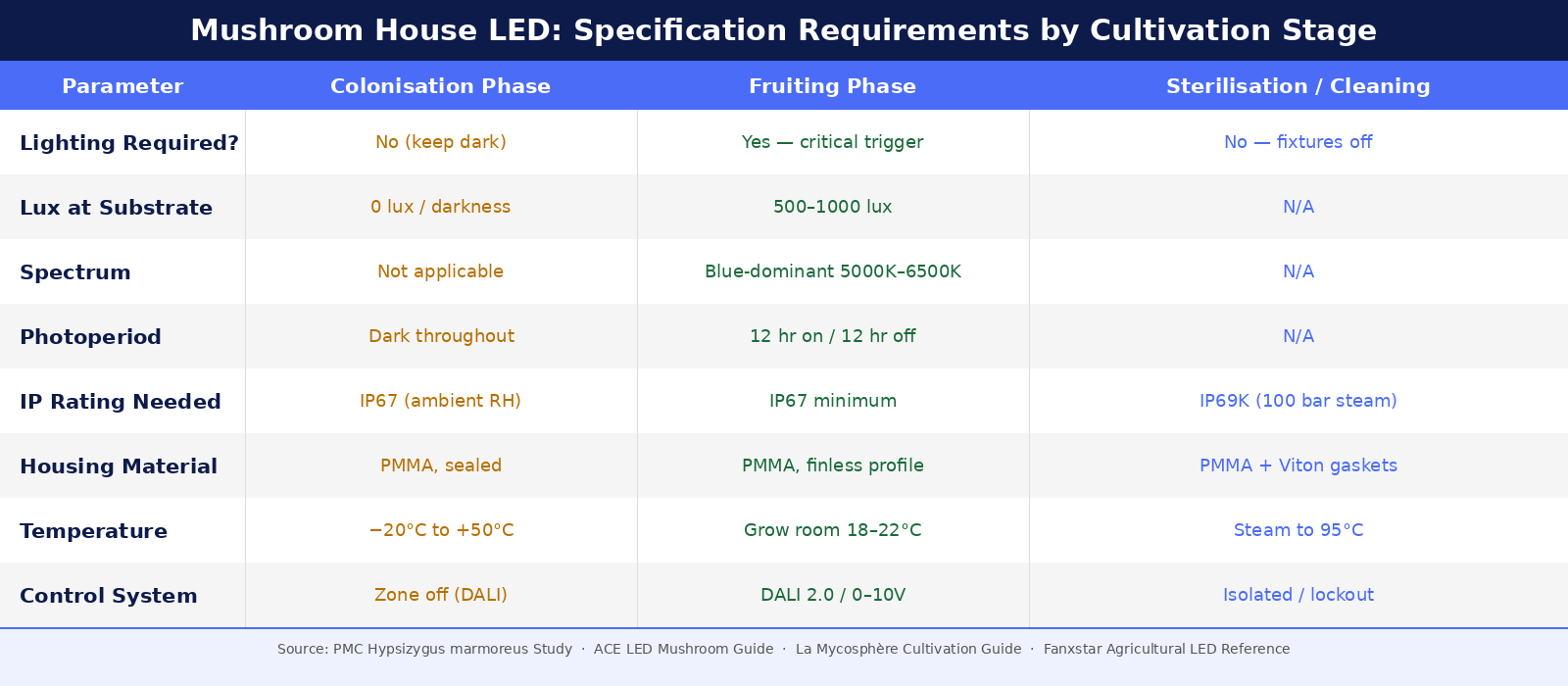
Mushroom cultivation has two fundamentally different phases with different environmental requirements. During colonisation — when mycelium spreads through the substrate — light is not only unnecessary but can be counterproductive. Mycelium colonises efficiently in darkness, and excessive light exposure can trigger premature pinning before the substrate is fully colonised, reducing overall yield. Fixtures in multi-room grows should be independently controlled per zone so that colonisation rooms remain dark while adjacent fruiting rooms are lit.
Once the substrate is fully colonised and environmental conditions shift to fruiting mode (lowered CO₂, increased fresh air exchange, temperature drop), light becomes the primary biological trigger for fruiting body initiation. The light acts as a signal — not as an energy source, since mushrooms are heterotrophic organisms that derive energy from substrate decomposition, not photosynthesis. This signal tells the mycelium that the substrate has “reached the surface” and that environmental conditions are appropriate for producing reproductive fruiting bodies.
Spectrum, Intensity, and Photoperiod by Species
Blue light wavelengths between 450–495 nm are the dominant photosensory signal for most cultivated species, with responses mediated by photolyase and cryptochrome-type photoreceptors in fungal tissue. Research published in PMC on Hypsizygus marmoreus (beech mushroom) confirmed that blue LED treatment produced the highest commercial yields and ergosterol content compared to red LED and fluorescent controls. Oyster mushrooms (Pleurotus spp.) show particularly strong responses to blue-dominant spectrum, with better cap development, more uniform pinning, and higher antioxidant content under blue LED lighting relative to other spectral treatments.
The recommended light intensity range for commercial mushroom fruiting rooms is 500–1000 lux at substrate surface. Below 300 lux, pinning becomes inconsistent and mushroom morphology suffers — stems elongate and caps remain underdeveloped, a phototropic response to perceived inadequate light. Above 1000–1500 lux, there is no meaningful additional benefit to yield, and excess light energy can dry the substrate surface if not offset by humidity management. Photoperiod for most species follows a 12 hours on / 12 hours off cycle, mimicking natural day-night alternation. Some oyster mushroom varieties benefit from extended 14-hour cycles; Enoki mushrooms (Flammulina velutipes) are the notable exception, cultivated in darkness to produce their characteristic long, thin stems.
| Species | Spectrum Preference | Fruiting Lux (at substrate) | Photoperiod |
|---|---|---|---|
| Oyster (Pleurotus spp.) | Blue-dominant (5000K–6500K) | 500–1000 lux | 12 hr on / 12 hr off |
| Shiitake (Lentinula edodes) | Blue/white (5000K–6500K) | 100–500 lux (moderate) | 12 hr on / 12 hr off |
| Lion’s Mane (Hericium erinaceus) | Blue/white consistent spectrum | 100–500 lux (gentle) | 12 hr on / 12 hr off |
| Button (Agaricus bisporus) | Very low or dark | < 150 lux (or dark) | Dark preferred; indirect only |
| Enoki (Flammulina velutipes) | Dark cultivation | Near-zero (intentional) | Dark throughout fruiting |
| Beech / Hypsizygus marmoreus | Blue-dominant | Below 150 lux (controlled) | 12 hr on / 12 hr off |
Fixture Specification for Commercial Mushroom Houses
IP Rating Hierarchy and What It Means in Practice
The IP (Ingress Protection) rating system provides a standardised shorthand for evaluating a fixture’s resistance to liquid and particle ingress. For mushroom house applications, the specific ratings and their practical significance are as follows. IP65 provides protection against water jets directed from any angle — adequate for light splash and humidity in less intensive operations, but insufficient for high-pressure washdown or direct steam exposure. IP66 provides protection against powerful water jets, which covers most standard washdown protocols. IP67 provides protection against temporary water immersion up to 1 metre depth, important for fixtures that may be submerged during floor flooding. IP68 provides protection against continuous water immersion at greater depths. IP69K is the highest standard, tested against high-pressure water jets at 100 bar (1450 psi) and 80°C — relevant for operations that use steam cleaning equipment on fixtures directly.
For commercial mushroom houses, IP67 is the practical minimum. IP68 or IP69K should be specified for facilities with aggressive steam sterilisation protocols, high-pressure washing of the entire room envelope including fixtures, or operations in tropical climates where ambient humidity may remain at 95%+ for extended periods. The rating alone is insufficient — the gasket material and housing composition determine whether the rated protection remains intact over years of chemical exposure.
Housing Materials and Gasket Chemistry
PMMA (acrylic) housing material is the preferred choice for mushroom house LED fixtures. Unlike polycarbonate, which is susceptible to ammonia-induced stress cracking and can cloud under prolonged UV and chemical exposure, PMMA is chemically inert to NH3 and maintains light transmission above 90% throughout its service life. In mushroom house environments, PMMA also resists the organic acids produced during substrate decomposition, which polycarbonate cannot reliably withstand at elevated temperatures.
Gasket specification is equally critical. Standard silicone gaskets allow ammonia vapour permeation over time at elevated temperatures — a failure mode that is invisible until corrosion has already damaged the PCB and driver components inside. Viton (fluoroelastomer) and EPDM (Ethylene Propylene Diene Monomer) gaskets provide superior chemical resistance and maintain their sealing properties through repeated thermal cycling. Any fixture specification for a mushroom house should explicitly require the gasket compound to be stated in supplier documentation.
Thermal Management and Finless Design
Conventional industrial LED fixtures use finned aluminium heatsinks to dissipate heat away from LED components. In a mushroom house, fins collect spores, substrate dust, moisture, and organic debris — creating persistent contamination vectors and accelerating corrosive attack on the aluminium surface. Purpose-built mushroom house LEDs use smooth, finless housing profiles that allow condensation and debris to drain or wipe away cleanly, eliminating both the contamination risk and the surface degradation mechanism.
Thermal management in finless designs relies on the thermal conductivity of the housing material itself and the LED board’s thermal interface to the housing, rather than convective fin area. This design constraint means that the LED power density and driver electronics must be carefully engineered for passive thermal stability — another reason why low-cost general commercial LEDs are not appropriate substitutes, regardless of their stated IP rating.
Control Systems and Dimming Requirements
Commercial mushroom operations with multiple rooms in different stages of the production cycle require independent lighting control per zone. Colonisation rooms must remain dark; fruiting rooms must be lit to the appropriate species-specific lux level on the correct photoperiod schedule. Automation via 0–10V or DALI 2.0 dimming, connected to a central grow room controller, is the professional standard for medium-to-large commercial operations. This integration allows the lighting programme to be coordinated with humidity, fresh air exchange (FAE) cycles, and CO₂ management — all of which interact with light as coordinated fruiting triggers.
For multi-shelf vertical growing systems, where fixture-to-substrate distance varies by shelf level, dimmable fixtures allow light intensity to be calibrated per shelf to achieve uniform 500–1000 lux at substrate surface regardless of mounting height. This is practically impossible to achieve with fixed-output fixtures and is a strong argument for specifying dimming capability in all commercial installations.
Procurement Specification: What to Demand from Suppliers
Core Specification Checklist
| Parameter | Minimum Specification | Recommended |
|---|---|---|
| IP Rating | IP67 | IP68 / IP69K for steam sterilisation |
| Impact resistance | IK08 | IK10 for rack-dense environments |
| Housing material | PMMA (acrylic) | PMMA + finless profile |
| Gasket compound | Viton or EPDM (stated) | Viton for highest chemical resistance |
| Operating temperature | -20°C to +50°C | Steam survival to 95°C stated |
| Spectrum (fruiting) | 5000K–6500K blue-dominant | Stable 450–495 nm over full lifetime |
| Lux output (fruiting) | 500–1000 lux at substrate | Dimmable to ≤150 lux for colonisation zones |
| Dimming | 0–10V | DALI 2.0 for multi-room control |
| Lumen maintenance | L80 at 50,000 hours | L90 with spectral stability data |
| Certifications | CE, RoHS | CE + ETL/UL (US) or SAA (AU) |
OEM Solutions for Commercial-Scale Mushroom Operations
Large-scale commercial mushroom producers — particularly those running block or bag systems on multi-tier racking across multiple rooms — often have dimensional and operational requirements that standard off-the-shelf fixtures cannot meet. Room heights, rack configurations, and zone lighting separation requirements may call for custom lengths, integrated daisy-chain wiring, or specific wattage-per-metre densities that differ from catalogue products. In these situations, working with a manufacturer capable of OEM customisation of the weatherproof housing, PCB, and driver electronics provides the only practical path to a compliant and optimised specification.
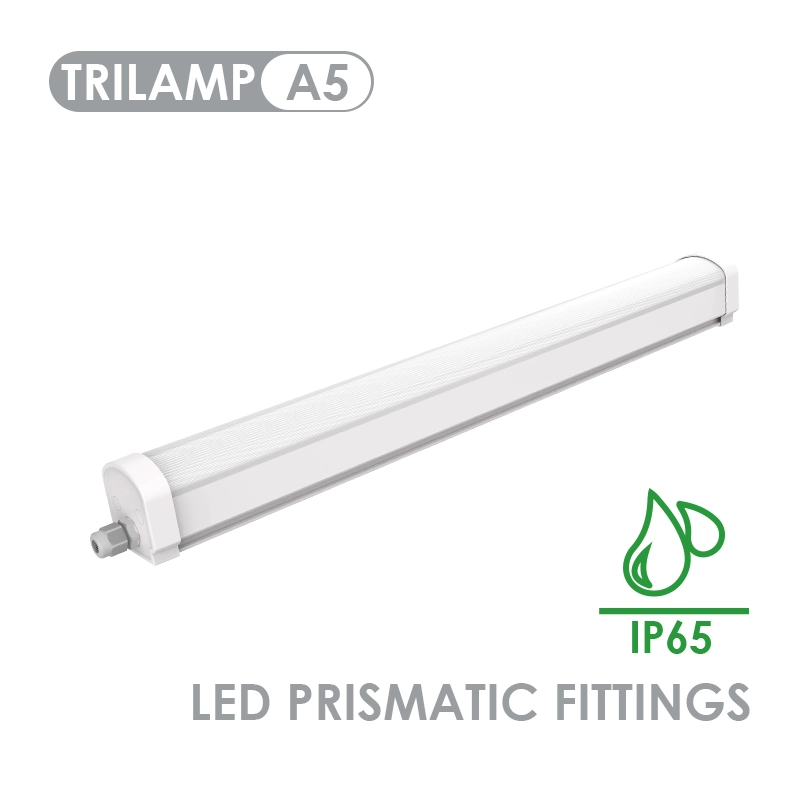
Fanxstar’s OEM and ODM manufacturing capability supports custom linear LED development for harsh agricultural environments, including PMMA housing profiles, blue-dominant spectrum configurations, and IP68/IP69K sealing to customer specifications. For mushroom operations requiring standard weatherproof linear fixtures as a cost-effective base platform, Fanxstar’s weatherproof LED range provides IP65/66 rated aluminum tri-proof and vapor tight fixtures that serve as the engineering starting point for further environmental hardening.
Frequently Asked Questions
Do mushrooms need special LED grow lights, or will any LED work?
For small hobby setups, a standard cool white LED (5000K–6500K) providing 500–1000 lux at substrate level will produce adequate results for most common species. For commercial operations, the distinction matters significantly: spectral stability over 50,000+ hours, IP68/IP69K protection, and PMMA housing are all practically necessary to maintain yield consistency and avoid costly fixture replacement cycles. General commercial LEDs that degrade their blue output within six months create invisible yield reduction that may only be diagnosed after multiple disappointing flushes.
What makes mushroom houses harder on lights than standard industrial environments?
The combination of near-saturation humidity (80–95% RH), steam sterilisation cycles at up to 95°C, ammonia from organic decomposition, organic acids from substrate, and spore accumulation creates a simultaneous multi-vector attack on LED fixtures that no single design feature can address alone. Each of these factors — thermal cycling, chemical exposure, biological contamination — independently destroys fixtures not designed to withstand it. Purpose-built mushroom house fixtures address all of them through the synergy of IP69K sealing, PMMA housing, Viton gaskets, finless profiles, and stable phosphor engineering.
How important is the 12-hour photoperiod for commercial yield?
The 12 hours on / 12 hours off photoperiod mimics natural day-night cycling and is well-established as the baseline for most commercially cultivated species. Deviating significantly — particularly toward continuous lighting — suppresses fruiting in most species by disrupting the biological signal function of light. The total cumulative light exposure across the fruiting period matters alongside the daily cycle; consistent, predictable photoperiod delivery via automated lighting controls is one of the factors that distinguishes high-yield commercial operations from less controlled environments.
Can I use the same LED fixture for both colonisation and fruiting rooms?
The same physical fixture model can be used across both room types if it is dimmable — in colonisation rooms, fixtures can simply be switched off or kept at minimal output. Independent zone control is essential. Where operations run multi-phase rooms adjacent to each other, light-tight separation between zones prevents contamination of colonisation-stage rooms with fruiting-triggering light levels. If budgets require specifying a single fixture SKU for the entire facility, a DALI-controlled dimmable fixture covers both requirements when combined with appropriate zone isolation.
Commercial mushroom house lighting demands more from LED fixtures than almost any other agricultural environment. The combination of biological precision — consistent blue spectrum at controlled lux levels — with extreme physical durability — IP69K, PMMA, Viton, finless — creates a procurement brief that eliminates most catalogue products from consideration. Fanxstar works with agricultural integrators and distributors to develop LED solutions engineered for these environments, from standard weatherproof platforms to fully customised OEM builds. Contact us to discuss your mushroom facility lighting requirements.