Museum curators and facilities managers face a lighting paradox: the same light that lets visitors appreciate a painting is also quietly destroying it. Ultraviolet radiation degrades pigments, yellows varnishes, weakens textiles, and bleaches photographs — and the damage is cumulative and irreversible. For decades, institutions managed this by adding expensive UV filters to halogen and fluorescent fixtures. Today, purpose-built UV-free LED linear lights eliminate that compromise — but only if you specify the right ones.
This guide is written for procurement managers, lighting designers, and electrical engineers who need to specify conservation-grade linear LED fixtures for museums, art galleries, archival spaces, and heritage institutions. We cover the technical criteria that separate museum-grade from standard commercial LEDs, the key specifications to demand from any supplier, and how DALI 2.0 dimming control integrates into a preservation-focused lighting strategy.
Key Takeaways
- UV-free LEDs eliminate the need for separate UV filter accessories — reducing cost, maintenance complexity, and the risk of filter degradation over time.
- Museum-grade linear LEDs require CRI ≥ 95 (ideally ≥ 98) and R9 ≥ 90 — standard commercial CRI 80 fixtures are not adequate for fine art environments.
- Lux level discipline matters as much as spectrum: sensitive materials (textiles, paper, photography) should not exceed 50 lux, while oil paintings may be lit at 150–200 lux.
- DALI 2.0 dimming with scene memory allows curators to dial exact lux levels per exhibit zone — without re-wiring or replacing fixtures between exhibitions.
- Buying OEM-customized linear LED systems gives distributors control over CCT, wattage, CRI, and housing dimensions — critical for specifying into heritage or architecturally sensitive environments.
Why UV Damage Is the Primary Lighting Risk in Museums
The Physics of Light-Induced Art Degradation
Light causes damage through two mechanisms: photochemical reactions (driven primarily by UV and blue light) and thermal stress (driven by infrared radiation). Ultraviolet radiation — wavelengths below 400 nm — carries high energy that breaks chemical bonds in organic materials. This is the mechanism behind fading pigments in oil paintings, brittling cellulose in paper, and discolouration in textiles. The rate of degradation depends on the intensity of the light, its spectral content, and cumulative exposure time.
Traditional light sources — tungsten halogen, fluorescent, and metal halide — all produce significant UV output. Fluorescent tubes, in particular, can emit UV wavelengths that rival certain daylight conditions. Museums historically responded with UV-filtering films, sleeves, or filter glass on fixtures. These add cost, require replacement as the filters yellow, and fail silently if not monitored.
Why LED Linear Fixtures Change the Conservation Calculus
Modern LED technology built on blue-pump phosphor conversion operates above 415 nm at the lower wavelength boundary — entirely above the UV range that causes photochemical degradation. This means a well-engineered LED linear fixture produces zero meaningful UV output as a fundamental property of its construction, not as an add-on feature. As the Conservation Institute of Canada’s technical guidance notes, LED lamps with blue or violet pumps above 415 nm allow institutions to remove UV filters entirely, eliminating the associated cost and maintenance burden.
That said, LEDs are not automatically safe. Some early and lower-quality LED products produced elevated blue light content, causing accelerated fading in certain light-sensitive pigments. The conservation community now distinguishes between generic LED linear lights — which may be appropriate for office corridors and warehouse aisles — and museum-grade LED linear lights engineered specifically for conservation environments. The difference comes down to measurable specification criteria.
The Core Technical Specifications for Museum-Grade LED Linear Lights
CRI, R9, and TM-30: The Color Rendering Stack
Color rendering is non-negotiable in museum environments. The Color Rendering Index (CRI) measures how accurately a light source reproduces color relative to a reference light source — scored on a scale of 0 to 100. For art galleries and museums, the accepted professional minimum is CRI ≥ 95. For the most demanding applications — fine art, textile collections, archaeological artifacts — CRI ≥ 98 is the appropriate target. Ledrise’s application guidelines specify CRI 98 or above for museum and gallery environments.
Within the broader CRI score, R9 is a specific sub-metric that measures how well a source renders saturated red. This has become an essential quality indicator for museum LEDs because many standard LED products with acceptable overall CRI scores still render reds poorly — distorting earth tones, human figures, and historical pigments. Conservation scientists recommend a minimum R9 of 50 for general museum use, with R9 ≥ 90 for critical fine art applications. Any museum-grade linear LED specification should explicitly require R9 as a stated value, not just the aggregate CRI.
The more advanced TM-30 measurement system adds two additional metrics: Rf (fidelity index) and Rg (gamut index). Rf measures accuracy similarly to CRI, while Rg measures whether a light source is oversaturating or undersaturating colors. A Rg value between 98 and 102 is ideal — it confirms that hues are being rendered truthfully without artificial enhancement. Procurement specifications for high-value museum installations should request full TM-30 data sheets alongside standard CRI figures.
Lux Levels and Conservation Exposure Limits
Even the most conservation-safe spectrum will cause damage if applied at excessive intensity over time. Established museum lighting standards set firm lux limits based on material sensitivity:
| Material Type | Recommended Lux Limit | Notes |
|---|---|---|
| Highly sensitive (watercolours, photographs, natural dyes, paper documents) | ≤ 50 lux | Strict annual exposure budgets often also applied |
| Moderately sensitive (oil paintings, tempera, undyed leather) | 150–200 lux | Most permanent gallery collections fall here |
| Less sensitive (metals, ceramics, stone, glass) | Up to 300 lux | General circulation zones and display cases |
| Circulation, lobby, café areas | 300 lux+ (Ra ≥ 80) | EN 12464-1 minimum for non-display zones |
The practical consequence for linear LED specification is that your fixtures must be precisely dimmable, not merely dimmable in a broad range. A linear LED that dims smoothly from 100% to as low as 10%–15% of output allows curators to hit a 50 lux target in sensitive galleries without compromising even illumination across the ceiling plane.
Color Temperature Selection for Art Environments
Color temperature determines the warmth or coolness of the illumination — and therefore the perceived atmosphere of the gallery space. The dominant professional recommendation for permanent fine art collections is 2700K–3000K (warm white). This color range minimises blue light content, creates a visually comfortable and immersive environment, and tends to render the warm tones of traditional oil paintings and historical artifacts sympathetically.
Contemporary art galleries and science museums increasingly specify 3500K–5000K for the cleaner, more analytical appearance of cooler white light. Research no longer strongly supports the older belief that warm light is always preferable at low lux levels — visitor preference is more flexible. However, the most important rule is consistency: mixing color temperatures within a single exhibition space creates visual dissonance that detracts from the visitor experience and makes artwork appear differently under different zones.
For maximum flexibility, specifying a tunable white (TW) LED linear fixture — typically 2700K to 5000K adjustable via DALI 2.0 DT8 control — allows curators to adapt color temperature to different exhibitions without changing fixtures. This is particularly valuable for mixed-use gallery spaces that alternate between historical and contemporary collections.
Infrared Radiation and Thermal Management
UV receives the most attention in conservation discussions, but infrared (IR) radiation causes thermal stress damage to delicate organic materials. Traditional halogen lamps directed significant IR directly at artwork surfaces — contributing to surface cracking in oil paints, embrittlement of varnishes, and distortion of three-dimensional objects. LED linear fixtures emit negligible IR in the light beam, with thermal energy managed at the driver and heatsink rather than radiated toward the lit surface. This is a structural advantage of LED technology over any alternative light source, and it has material implications for high-value or three-dimensional exhibits including sculpture, ceramics, and mixed-media works.
DALI 2.0 Dimming Control in Museum Lighting Design
Why DALI 2.0 Is the Professional Standard for Gallery Control
DALI (Digital Addressable Lighting Interface) is the professional standard for addressable lighting control in commercial and institutional environments, now governed by the IEC 62386 technical specification series. DALI 2.0 — the current certified generation managed by the Digital Illumination Interface Alliance (DiiA) — enables bidirectional digital communication between luminaires and control gear, supporting individual addressing of up to 64 devices, 16 programmable scene levels per zone, and real-time feedback from fixtures to the control system.
For museum applications, DALI 2.0 delivers three specific advantages over 0–10V or switched dimming alternatives. First, scene recall: curators can pre-program specific lux levels and color temperatures for each gallery zone and recall them instantly — useful when switching between exhibition setups. Second, occupancy and daylight integration: DALI-connected sensors can automatically reduce light output when galleries are unoccupied, reducing cumulative light exposure across the day. Third, fault reporting: DALI 2.0’s bidirectional protocol means the building management system can detect lamp failures and degradation without manual inspection — critical for large institutions managing hundreds of fixtures across multiple galleries.
The DT8 Device Type for Tunable White Applications
Within DALI 2.0, Device Type 8 (DT8) is the specific profile for tunable white and color-changing luminaires. A DALI 2.0 DT8-compatible LED linear fixture accepts commands for both brightness and color temperature, enabling the full adaptive capability described above. When specifying linear LEDs for flexible gallery spaces, confirm that the driver carries genuine DALI 2.0 DT8 certification — not simply “DALI-compatible,” which may mean only basic dimming support.
Specifying UV-Free LED Linear Lights: The Procurement Checklist
Non-Negotiable Specification Criteria
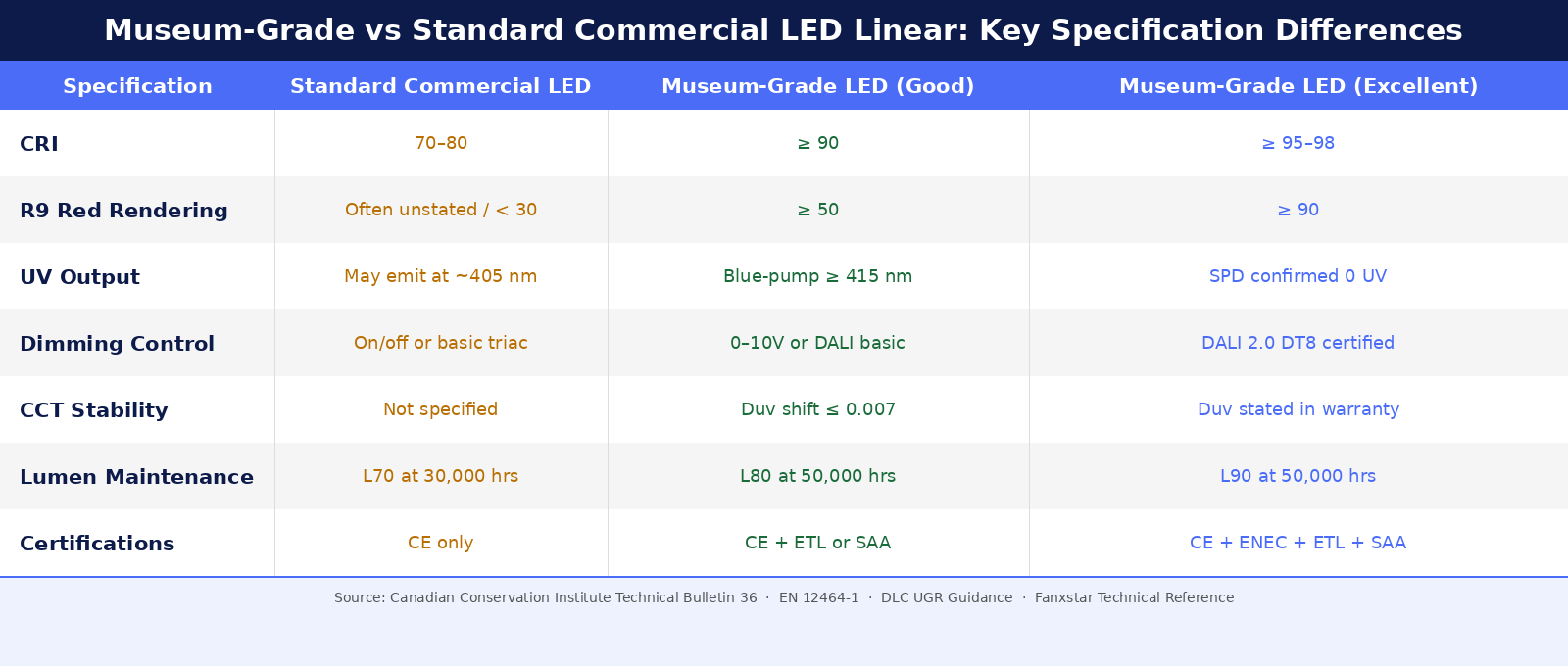
When developing a specification sheet for museum or gallery linear LED fixtures, the following criteria should be treated as non-negotiable minimums. Any supplier unable to provide documented confirmation against these criteria should be disqualified from consideration:
| Specification | Minimum (Good) | Recommended (Excellent) |
|---|---|---|
| CRI | ≥ 90 | ≥ 95–98 |
| R9 (red rendering) | ≥ 50 | ≥ 90 |
| TM-30 Rf / Rg | Rf ≥ 90 | Rf ≥ 95, Rg 98–102 |
| UV output | Blue-pump LED (≥ 415 nm) confirmed | SPD chart showing zero sub-400 nm output |
| Dimming control | 0–10V or DALI | DALI 2.0 DT6/DT8 certified |
| CCT stability over life | Duv shift ≤ 0.007 | Duv consistency stated in warranty documentation |
| Lumen maintenance | L80 at 50,000 hours | L90 at 50,000 hours (stated in warranty) |
| Certifications | CE (EU); ETL/UL (US); SAA (AU) | ENEC for EU institutional projects |
Demand IES LM-79 photometric reports from any supplier shortlisted for museum-grade installations. These reports provide independent, standardised measurement of a fixture’s lumen output, efficacy, and spectral power distribution — and are essential for verifying CRI and UV suppression claims that cannot be confirmed through product literature alone. Manufacturers with genuine engineering depth will always provide this documentation proactively.
OEM Customization for Heritage and Architecturally Sensitive Spaces
Standard off-the-shelf linear LED products are often inadequate for heritage museum environments where ceiling profiles, mounting depths, and dimensional constraints are determined by listed building requirements or period architectural features. In these situations, the ability to work directly with a manufacturer capable of custom housing profiles, specific CCT binning, and low-profile aluminum extrusions becomes the decisive procurement factor.
Purpose-built OEM linear LED systems allow procurement teams to specify exact length increments (0.6 m to 3.0 m+), housing finish (RAL-matched to heritage interiors), CCT (fixed or tunable), and wattage per metre — all in a single fixture family. This eliminates the compromise of forcing a standard product into an architectural context it was not designed for, and it reduces the number of SKUs required to cover an entire museum installation. For distributors supplying museum lighting projects at scale, Fanxstar’s LED customization and OEM services provide the engineering support — from Dialux simulation through prototype in 3–5 working days — required to specify confidently into these demanding environments.
Installation Geometry: Getting the Angle Right
The 30-Degree Rule and Veiling Reflections
Technical specification of the fixture is only half the work — correct installation geometry determines whether a museum-grade LED actually delivers the quality it was designed for. The widely adopted industry rule of thumb is to install artwork-directed fixtures at approximately 30 degrees from vertical. This angle minimises veiling reflections on varnished or glazed surfaces while providing effective grazing light that reveals surface texture, brushwork, and three-dimensional form. Placing a fixture at too steep an angle (closer to 45 degrees) increases glare and hotspots; too shallow an angle (closer to 60 degrees) flattens depth perception.
For linear LED fixtures running parallel to a wall or exhibit surface, even distribution across the artwork plane is more important than precise beam angle control. The advantage of a continuous linear source over discrete spotlights is the elimination of bright spots and dark transitions — a single linear run at appropriate height and offset produces a uniform wash that allows the artwork itself to carry visual weight without lighting distractions.
Layering: Artwork Lighting vs. Ambient Lighting
Professional museum lighting design rarely relies on a single circuit. The standard approach is to separate artwork accent lighting from ambient ambient circulation lighting and connect them to independent DALI zones. This separation allows artwork illumination to be reduced or extinguished when galleries are unoccupied — reducing cumulative light exposure to collections — while maintaining safe ambient levels for cleaning, maintenance, and after-hours operations. Linear LED systems with DALI 2.0 occupancy sensor integration can automate this layering, reducing unnecessary light exposure without requiring manual intervention from curatorial staff.
Frequently Asked Questions
Do all LED lights qualify as UV-free for museum use?
No — not all LEDs are UV-free to the conservation standard required for museum use. Modern blue-pump phosphor LED products operating above 415 nm produce negligible UV output and can be used without UV filters. However, some earlier LED products and certain violet-pump designs can emit wavelengths around 405 nm that pose measurable conservation risk. Buyers should require a Spectral Power Distribution (SPD) chart from any supplier confirming zero output below 400 nm, rather than accepting “UV-free” as an unverified marketing claim.
What is the difference between CRI 90 and CRI 98 in a real gallery context?
CRI 90 is adequate for general commercial and retail lighting where some color distortion is acceptable. In a museum context, CRI 90 can produce visible shifts in warm reds, earth tones, and subtle tonal gradations — precisely the ranges that matter most in fine art. CRI 98 fixtures reveal the full spectrum of pigment nuance that the artist intended, and are strongly preferred for permanent collections. The incremental cost of CRI 98 vs CRI 90 linear LEDs is modest compared to the irreplaceable value of what they illuminate.
Is DALI 2.0 dimming significantly better than standard 0–10V for museums?
For small, fixed installations, 0–10V dimming is functional but limited. DALI 2.0 provides capabilities that matter specifically in museums: individual fixture addressing (not just zone-level control), 16 storable scene configurations per zone, real-time fault detection across the entire circuit, and compatibility with building automation systems that log cumulative light exposure. For institutions managing conservation targets across hundreds of artifacts, this level of control is a genuine operational advantage.
Can linear LED fixtures be customized for historic gallery spaces?
Yes — and for heritage environments, custom OEM linear LEDs are often the only practical solution. Standard products may not fit the mounting profiles, ceiling depths, or dimensional constraints of listed or period buildings. OEM customization allows specifiers to define housing dimensions, CCT binning, wattage, and finish to match both the architectural context and the conservation brief. Manufacturers with genuine engineering capability — including aluminium extrusion tooling and in-house electronics integration — can deliver prototypes within days and certified mass production within weeks. For projects with complex environmental or dimensional requirements, consulting directly with a specialized manufacturer ensures specifications are achievable before commitments are made.
What lux level should I specify for a painting gallery?
For oil paintings and similar moderately sensitive works, 150–200 lux is the widely accepted professional range. For highly sensitive materials — watercolours, photographs, organic dyes, paper documents — the conservation limit is 50 lux, sometimes accompanied by annual exposure budgets to control cumulative dosage. The EN 12464-1 standard governs general museum lighting; exhibit lighting is discretionary under this standard, meaning the institution’s conservation brief should drive the specification rather than the minimum regulatory requirement.
Specifying UV-free LED linear lights for a museum or gallery is an exercise in matching precision engineering to conservation science. The fixtures must perform to a specification standard that standard commercial linear LEDs are not designed to meet. Fanxstar works directly with facilities managers, electrical contractors, and lighting distributors to engineer LED linear solutions with the CRI, spectral control, and DALI compatibility that conservation-grade applications require — backed by full certification support for CE, ENEC, ETL, and SAA markets. Tell us about your project for a free technical consultation.