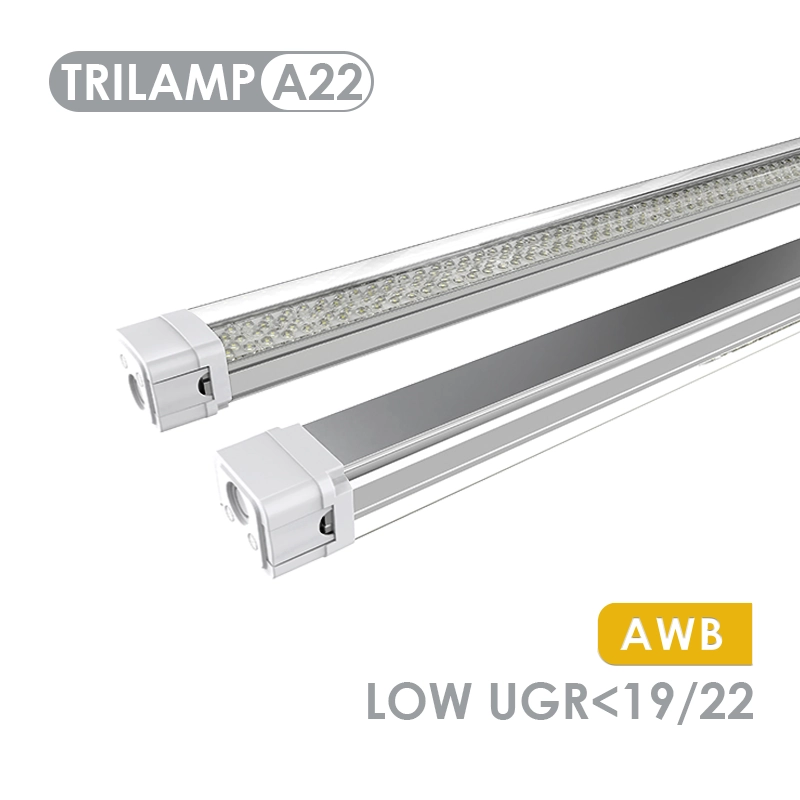
Prison lighting is governed by a set of constraints that no other commercial lighting application combines simultaneously: the fixtures must be physically indestructible enough to deny inmates access to internal components, deliver legally mandated illuminance levels for hygiene and reading, support 24-hour surveillance camera performance, integrate with emergency backup systems, and operate without maintenance access for multi-year periods. Standard commercial LED battens fail this specification comprehensively — their plastic diffusers crack under impact, their unsecured mounting screws can be removed with improvised tools, and their open-profile housings create concealment spaces and sharp edges that present safety risks.
This article explains how correctional facility managers, specifiers, and procurement teams should evaluate vandal-proof LED lighting: from the IEC 62262 IK impact rating scale to zone-specific illuminance and construction requirements, through the tamper-resistant hardware details that separate genuine security-grade fixtures from merely “robust” commercial products.
Key Takeaways
- IK10 (20 joules) is the correct minimum for cell blocks and high-security areas; IK08 (5 joules) is the minimum for corridors, common areas, and exterior zones with supervised access — per IEC 62262 / EN 62262.
- The American Correctional Association recommends a minimum of 20 footcandles (approximately 215 lux) in inmate living spaces; courts in the US have upheld this as the measurable minimum required to meet constitutional adequacy standards.
- Tamper-resistance goes beyond impact rating — genuine correctional-grade fixtures require sealed unibody housings, centre-pin TORX or spanner-head fasteners, concealed mounting hardware, and no accessible internal voids.
- CCTV performance drives CCT selection — 4000 K neutral white is the standard for most interior security zones; cool white 5000 K is preferred in exterior yards for maximum camera acuity and facial recognition performance.
- Emergency battery backup (LiFePO4-based) integrated at fixture level is increasingly required to maintain security visibility during power interruptions — separate from the building’s central emergency circuit.
Understanding the IK Rating Scale for Prison Applications
What IK Ratings Measure
The IK (impact protection) rating system is defined in IEC 62262 / EN 62262. It classifies an enclosure’s ability to withstand mechanical impact, expressed in joules of kinetic energy. Tests are conducted with standardized hammers — a pendulum hammer for IK01–IK06, a spring-loaded hammer for IK07–IK10 — applied five times at specified points on the enclosure. The test is pass/fail: the enclosure must maintain its structural integrity and retain its IP rating after impact.
| IK Rating | Impact Energy | Equivalent Impact | Correctional Application |
|---|---|---|---|
| IK08 | 5 joules | 1.7 kg dropped from 300 mm | Minimum for supervised corridors, administration areas, exterior with CCTV coverage |
| IK09 | 10 joules | 5 kg dropped from 200 mm | Common areas, dining halls, workshops — areas with regular staff presence |
| IK10 | 20 joules | 5 kg dropped from 400 mm | Cell blocks, solitary confinement, behavioural health units, shower/washroom areas, any unsupervised or high-risk zone |
An important limitation of the IK standard: the test applies five impacts at specified but manufacturer-selected points on the enclosure, and attachment hardware such as hinges and locking mechanisms is excluded from testing. This means two products can both carry an IK10 rating while differing significantly in practical tamper-resistance depending on where the manufacturer applied the test impacts. In correctional procurement, the IK rating is a necessary but not sufficient criterion — it must be accompanied by construction specification review.
IK Rating Is Not the Same as Tamper-Resistance
A fixture that survives a 20-joule pendulum strike on its lens face may still be compromised by an inmate who uses a sharpened food tray edge to work a standard Phillips-head screw out of its mounting flange. The defining characteristics of a genuinely tamper-resistant correctional fixture go significantly beyond the IK rating:
- Fastener type: Centre-pin TORX (TORX Plus), spanner-head, or pentalobe screws require tools not available in a cell environment. Standard Phillips or slotted screws are disqualifying in maximum-security applications.
- Unibody/welded housing: Die-cast or welded steel/aluminium housings with no removable sections eliminate the ability to pry open the fixture body.
- No exposed internal voids: Any accessible cavity can become a storage location for contraband. Sealed, flush-profile luminaires with no accessible gaps eliminate this risk.
- Flush or recessed lens: A lens protruding from the housing face provides a grip point and a lever for prying. Recessed or flush-mount lenses with no exposed bezel edge are the standard.
- Concealed or backset mounting: Mounting fasteners accessible from the face of the fixture are a security failure. Back-mounted or concealed mounting plates, installed before the fixture is locked into position, prevent direct access to mounting hardware.
- Ligature-resistant design: In behavioural health and mental health housing units, any protrusion, hook point, or gap from which a cord or fabric strip could be suspended is a self-harm risk. Ligature-resistant fixtures have smooth, rounded profiles with no attachment points.
Zone-by-Zone Specification: Illuminance, Construction, and Fixture Type

Cell Blocks and Inmate Housing Units
Cell block lighting carries the highest security and compliance burden simultaneously. The American Correctional Association (ACA) standards specify a minimum of 20 footcandles (approximately 215 lux) in inmate living areas for hygiene, reading, and sanitation purposes, a level that US courts have accepted as the measurable constitutional minimum for adequate lighting conditions. In practice, most well-designed cell block specifications target 30–50 footcandles (320–540 lux) to provide comfortable reading illuminance and to ensure camera performance in the corner of the cell.
The preferred fixture for cell block ceilings is a low-profile ceiling-mounted unit with an IK10-rated polycarbonate or tempered glass lens, die-cast aluminium housing, centre-pin tamper-resistant screws, and a sealed internal assembly. Many specifications also require a separate night-light circuit — typically 2–5 footcandles (21–54 lux) of maintained illuminance on a separate switch or dimming level for overnight staff observation rounds without fully illuminating the cell. A DALI-addressable driver allows this scene to be set and changed from the control room without physical access to the fixture.
Corridors and Secure Passages
Corridors in correctional facilities see constant foot traffic under staff observation but represent a zone where fixtures are regularly within reach. IES recommended practice suggests 10–20 footcandles (108–215 lux) for prison corridors. A surface-mount or semi-recessed batten-type fixture with IK09 or IK10 rating, IP54 or higher, and tamper-resistant mounting is the standard specification. Uniform distribution (U₀ ≥ 0.50) is critical: uneven corridor lighting creates contrast zones that interfere with CCTV coverage and staff sightlines. Wide-beam optics (120° symmetric) at a ceiling height of 2.7–3.5 m achieve acceptable uniformity in standard single-corridor geometry.
Common Areas and Dining Halls
Dining halls and common areas have higher ceiling heights (typically 4–6 m) and require more lumens. IES recommendations for prison dayrooms and dining areas are in the range of 30–50 footcandles (320–540 lux). The fixture type transitions from low-profile cell units to commercial-grade weatherproof battens or industrial linear high bays, but the security specification remains — IK08 minimum, IP65 for areas that receive wet cleaning, tamper-resistant fasteners throughout. In areas with ceiling heights above 4 m, ceiling-mounted fixtures may be sufficiently out of easy reach that the fixture construction specification can be moderated relative to cell block requirements, but this should be documented in the facility security classification assessment rather than assumed.
Shower and Wet Areas
Showers and washroom areas in correctional facilities present a combined requirement: IP65 or IP66 for water ingress protection, IK10 for impact resistance (these areas are often unsupervised and the privacy expectation creates a higher-risk environment for fixture attacks), sealed construction with no exposed fasteners, and materials resistant to the cleaning chemicals used in institutional hygiene protocols. A polycarbonate diffuser resists the bleach-based cleaners used in prison environments without yellowing; acrylic (PMMA) diffusers degrade visibly within 12–18 months under the same conditions.
Outdoor Yards and Perimeter
Outdoor exercise yards and perimeter fencing require a different product class: area floodlights, wall-pack floodlights, or high-mast luminaires with IP66 or IP67 ratings for weather protection, IK08 minimum (the fixtures are typically mounted at heights that limit direct inmate contact), and photocell-equipped drivers for dusk-to-dawn operation. CCT selection shifts to 5000 K for outdoor security zones — the cool white spectrum provides maximum scotopic (low-light) contrast for human observers on patrol and improves the signal-to-noise performance of CCTV cameras in low ambient light conditions. Perimeter lighting uniformity is critical: dark spots between fixtures are security vulnerabilities, and IES recommended uniformity ratios for perimeter security zones are U₀ ≥ 0.25 minimum (max/min ratio ≤ 10:1).
Sally Ports and Secure Entry Points
Sally ports — the interlocked entry/exit vestibules used to transfer detainees — are a high-security zone requiring both adequate illuminance for visual inspection (IES recommends a minimum of 20 footcandles / 215 lux in the sally port itself) and robust fixture construction. The combination of controlled access and the physical security role of the space makes tamper-resistant ceiling mounts with IK10 rating, IP54 protection, and a photometric design that eliminates shadows in the transition zone the standard specification.
CCTV Integration: Why Lighting Specification Directly Affects Camera Performance
Minimum Illuminance for Useful CCTV Footage
Modern HD IP cameras with Sony Starvis or similar back-illuminated sensors can capture usable footage at illuminance levels as low as 0.001 lux in full gain mode, but the resulting footage is noisy and unsuitable for facial identification. For evidence-quality facial recognition footage, most CCTV camera manufacturers’ specifications call for a minimum of 50–200 lux at the subject plane, with a uniformity ratio (max/min) ≤ 5:1 across the camera’s field of view. Dark spots within a camera’s coverage zone created by inadequate uniformity are operationally equivalent to blind spots.
The photometric design of a correctional lighting installation therefore needs to be evaluated not just for average lux on the floor plane, but for minimum lux at standing-person head height (approximately 1.5 m) and for uniformity across each CCTV coverage zone. Delivering this with tamper-resistant fixtures that cannot be repositioned after installation makes pre-installation photometric simulation with the IES files of the specified fixture an operational requirement, not an optional design tool.
Flicker-Free Operation for Camera Compatibility
Fluorescent fixtures — still present in many older correctional facilities — produce a 100 Hz or 120 Hz modulation at full brightness and much more complex modulation patterns when ballasts age. This interacts with digital camera frame rates to produce visible banding in recorded footage. LED fixtures with constant-current reduction (CCR) dimming at the driver level produce zero modulation. Specifying “flicker-free” is necessary but insufficient — demand a numerical PWM frequency above 25 kHz or verify CCR dimming mode in the driver specification, not a generic “flicker-free LED” claim.
Emergency Lighting Integration in Correctional Environments
Correctional facilities present a specific challenge for emergency lighting design: during a power outage or emergency lockdown, security operations cannot be suspended — staff need to maintain visibility for headcounts, perimeter control, and incident response. Standard EN 1838 emergency lighting requirements (1 lux on escape routes, 0.5 lux in open areas) are grossly inadequate for a functioning security operation. Most correctional facility specifications require maintained emergency illuminance of 10–20 footcandles (108–215 lux) in all occupied areas, which requires either a central battery/generator backup that maintains the normal lighting circuit, or fixture-level emergency battery modules capable of delivering at least 50% of normal lumen output for a minimum of 3 hours.
Lithium Iron Phosphate (LiFePO4) battery chemistry has become the preferred choice for fixture-level emergency backup in correctional applications. LiFePO4 cells have a fundamentally more stable electrochemical structure than lithium cobalt oxide chemistries, with significantly lower risk of thermal runaway — an important consideration in a confined secure environment. The battery management system (BMS) monitoring cell balance and state-of-charge should be specified alongside a self-test capability, allowing facility managers to verify emergency function without visiting each fixture individually.
Procurement and Specification Checklist
| Parameter | Cell Block / High Security | Corridors / Common Areas | Outdoor / Perimeter |
|---|---|---|---|
| IK Rating | IK10 | IK09–IK10 | IK08 minimum |
| IP Rating | IP54 dry / IP65 wet areas | IP54 | IP66 |
| Illuminance (maintained) | 30–50 fc (320–540 lx); night mode 2–5 fc | 10–20 fc (108–215 lx) | 2–5 fc perimeter; 5–20 fc activity zones |
| CCT | 3500–4000 K (cell welfare); 4000 K (general) | 4000 K | 5000 K |
| CRI | CRI ≥ 80 (camera + welfare) | CRI ≥ 80 | CRI ≥ 70 |
| Fastener type | Centre-pin TORX or spanner-head | Centre-pin TORX or Allen centre-pin | Standard anti-tamper hex or TORX |
| Housing material | Die-cast aluminium or welded steel, unibody | Die-cast aluminium, sealed | Die-cast aluminium, powder-coated |
| Lens material | Polycarbonate (PC) — shatter-resistant; or tempered glass | Polycarbonate | Polycarbonate or tempered glass |
| Emergency backup | LiFePO4 3h minimum, self-test, BMS | LiFePO4 3h or central circuit | Generator-backed or separate circuit |
| Dimming/control | DALI or 0–10V; centrally controlled | DALI or manual zone switching | Photocell + manual override |
| Certification | CE/ETL; IK10 test report from accredited lab | CE/ETL; IK test report | CE/ETL; IP66 ingress test certificate |
A Note on Ligature Risk in Behavioural Health and Mental Health Units
Correctional facilities housing inmates in mental health units or behavioural health programmes face an additional design requirement: ligature-resistant fixtures. In these environments, any surface feature that can anchor a cord, fabric strip, or other material presents a self-harm risk. Lighting specifiers working on these areas should request fixtures with the manufacturer’s written confirmation that the product has been evaluated for ligature risk, with no accessible gaps between the lens face and the ceiling surface, no protruding housing edges or exposed mounting flanges, and no angular housing features that could function as hook points. This is a distinct specification requirement from the IK and IP ratings and must be addressed separately in the procurement documents.
How to Evaluate a Supplier’s Correctional-Grade Claim
The correctional lighting market contains a significant number of products described as “prison-grade,” “vandal-resistant,” or “high-security” that do not meet the construction specifications described above. A systematic evaluation approach:
First, request the IK test certificate — not a specification sheet claim, but the actual test report from an accredited testing laboratory (TÜV, SGS, Intertek, Bureau Veritas, or equivalent) documenting the test date, fixture model, standard applied (EN 62262), and pass result. Confirm that the IP certificate is for the assembled luminaire, not just the driver or LED module.
Second, request a physical sample. Examine the fastener type directly — use a standard Phillips screwdriver and confirm it cannot engage with the screw head. Examine the housing for accessible internal voids, pry points along the lens/housing junction, and exposed mounting screws. If the sample passes this physical inspection, it is likely to survive correctional deployment. If a supplier declines to provide samples before order, treat this as a red flag for a correctional specification.
Third, verify the lumen maintenance specification with an LM-79 test report and LM-80/TM-21 lifetime projection. Correctional facilities operate lighting 24 hours per day, 365 days per year — approximately 8,760 hours annually, compared to 4,000–5,000 hours for a typical commercial application. At 24-hour operation, an L80B20 ≥ 50,000-hour specification means only 20% of fixtures will fall below 80% lumen output within 5.7 years. An L70B50 projection to 100,000 hours, which some manufacturers provide, offers a more meaningful long-term maintenance planning figure for a correctional environment.
Fanxstar’s weatherproof LED range includes IK10-rated, IP66-certified tri-proof and vapor-tight fixtures with polycarbonate diffusers and die-cast aluminium housings, available with emergency LiFePO4 backup and DALI 2.0 control integration. For correctional and institutional applications requiring custom housing profiles, anti-tamper fastener specifications, or ligature-resistant design variants, Fanxstar’s OEM/ODM engineering team can develop and certify application-specific solutions. Contact us with your facility specification for a technical consultation.
Frequently Asked Questions
What is the minimum IK rating required for prison cell lighting?
IK10 is the correct minimum specification for cell block lighting — corresponding to a 20-joule impact resistance per IEC 62262. Cell fixtures are subject to direct, sustained tampering attempts in unsupervised environments, making IK10 a practical minimum rather than a conservative choice. IK08 (5 joules) is adequate for supervised corridors and administration areas where the level of access and continuous observation limits tampering opportunity, but should never be applied to inmate cell or shower areas.
What is the legally required illuminance level in prison cells?
US courts have accepted the American Correctional Association’s standard of 20 footcandles (approximately 215 lux) as the measurable minimum for constitutionally adequate lighting in inmate living spaces — sufficient for hygiene, reading, and sanitation. Courts have found lighting inadequate when evidence showed it caused eyestrain, inhibited reading, or impaired the ability to maintain sanitation. There is currently no federally mandated maximum lighting level; the appropriate upper limit is determined by facility management based on security and operational requirements.
Is polycarbonate or tempered glass the better diffuser material for prison fixtures?
Polycarbonate (PC) is the preferred choice in most correctional applications. It is significantly more impact-resistant than glass (PC is approximately 250 times tougher than glass of the same thickness), does not shatter into sharp fragments that could be used as weapons, and is highly resistant to institutional cleaning chemicals including bleach and ammonia compounds. Tempered glass diffusers are specified in some maximum-security applications where the fixture must resist sustained grinding or cutting attacks rather than impact — in these cases, tempered glass’s hardness is an advantage, but the risk of fragmentation if the glass fails must be assessed against the facility’s security classification.
Do prison LED fixtures need to be flicker-free?
Yes, and for two distinct reasons. First, from a welfare perspective: inmates spend extended periods under artificial light, and flicker at frequencies below 200 Hz causes eye strain, headaches, and in susceptible individuals, can trigger photosensitive responses. Second, from a surveillance perspective: LED drivers that use pulse-width modulation (PWM) at frequencies below 25 kHz interact with digital camera frame rates to produce banding artifacts in recorded footage — directly compromising the evidentiary value of CCTV recordings. Specify drivers with PWM frequency above 25 kHz or constant-current reduction (CCR) dimming for all correctional applications.
How does DALI control improve security operations in a correctional facility?
DALI (Digital Addressable Lighting Interface) control allows correctional operations staff to set and trigger lighting scenes from a central control room without physical access to individual fixtures. Practical applications include: dimming cell block lighting to a 2–5 footcandle night mode during overnight hours (without eliminating the observation capability needed for welfare checks); triggering full emergency illumination across a wing during a disturbance; creating zone-specific lighting patterns for different daily operational phases (headcount, recreation, lockdown); and programming individual fixtures to a different output level when a cell is unoccupied. All of this is achievable on the existing DALI bus without facility staff entering the residential areas to manually adjust fixtures.
Correctional facility lighting demands a convergence of physical security, welfare compliance, surveillance performance, and operational flexibility that no standard commercial product can deliver. Fanxstar’s engineering team has direct experience developing IK10/IP66 LED solutions for institutional applications — including custom tamper-resistant hardware, emergency LiFePO4 backup, and DALI 2.0 integration. Tell us about your facility specification and we’ll provide a free technical consultation and product recommendation.