Corner-mounted LED profiles solve a problem that flat-surface mounting never can: getting consistent, glare-free light into recessed joints, enclosed cabinet interiors, and structural corners where there is simply no flat surface to work with. But when the space is tight — cabinet lips under 15 mm, machine enclosures with sub-20 mm clearances, or architectural coves with no room for thermal fins — the profile selection process becomes genuinely consequential. The wrong choice leads to overheating LEDs, failed diffusers, and expensive retrofits. This guide covers the engineering considerations that determine which corner profile works in constrained spaces, and where OEM customization becomes the better path for demanding applications.
Key Takeaways
- Mini V-profiles starting at 8×8 mm fit the most space-constrained installations, but thermal capacity drops significantly below 13×13 mm — match wattage to profile size.
- Corner installations restrict natural airflow by 15–20°C versus open-surface mounting, making 6063-T5 aluminum alloy — not plastic or recycled aluminum — a hard requirement for anything above 5 W/m strip loads.
- The 45-degree angle is the functional optimum for task lighting: it directs light onto the work surface while keeping the source out of the viewer’s sightline, eliminating the glare problem that flat-bottom profiles create on reflective surfaces.
- For OEM buyers sourcing private-label profiles, custom mold development enables precise internal dimensions and IP-rated sealing that standard off-the-shelf channels cannot deliver.
Why Corner Profiles Behave Differently in Tight Spaces
The Thermal Penalty of Corner Mounting
LED strip lighting generates approximately 3.4 BTUs per hour for every watt consumed — a manageable figure on an open wall surface with free-air convection. In a corner installation, that calculation changes. Two adjacent surfaces trap heat between them, and natural convection — the primary cooling mechanism for passive aluminum profiles — becomes partially blocked. Research on corner profile thermal behavior indicates that corner installations can raise ambient temperatures by 15–20°F compared to open surface mounting, and that restricted airflow in tight corners specifically reduces convective heat transfer below the figures used in standard thermal calculations.
The practical implication: a 6063-T5 aluminum profile with a thermal conductivity of approximately 201 W/(m·K) — over 1,000 times higher than plastic — is not a nice-to-have in tight spaces; it is the minimum specification. Engineering analysis of aluminum profile thermal performance shows that without adequate dissipation, LED PCB temperatures exceeding 80°C cause lumen depreciation, color shift, and lifespan reduction of up to 50%. In a tight corner where airflow is already compromised, that threshold is reached faster than specifiers often expect.
The wall thickness of the profile matters too. For strip loads above 15 W/m, profiles with less than 2 mm wall thickness lack the aluminum mass to manage thermal load effectively. Upgrading to a finned or deeper-channel profile may increase cost by 20–30%, but can extend LED lifespan by 30–40%, according to published aluminum profile lifecycle analysis — making it the economically rational choice for commercial and industrial installations with multi-year service expectations.
Diffuser Selection Changes in Tight Spaces
In an open installation, a clear diffuser is a legitimate choice for maximum lumen output. In a tight corner, where the viewing angle to the light source is often much closer and more direct, opal or frosted diffusers are almost always the correct specification. Optical guidance from LED strip installation specialists confirms that opal diffusers (65–75% light transmission) create smooth, hotspot-free illumination with excellent glare control. For tight spaces where the strip is close to eye level or frequently in the peripheral field of view, opal diffusers also prevent the “dotted” appearance that clear covers produce at short distances — a common complaint in under-cabinet and machine interior installations.
Profile Size Reference: What Fits Where
| Profile Size | Strip Width Compatibility | Max Recommended Strip Load | Typical Applications |
|---|---|---|---|
| 8×8 mm (mini V) | Up to 8 mm PCB | ≤5 W/m | Furniture accents, display case edges, trim details |
| 13×13 mm | Up to 10 mm PCB | ≤8 W/m | Kitchen under-cabinet, shelving, retail displays |
| 16×16 mm | Up to 12 mm PCB | ≤12 W/m | Workshop corners, cove lighting, corridor accents |
| 20×20 mm | Up to 16 mm PCB | ≤15 W/m | Industrial machine interiors, cold room corners |
| 30×30 mm | Up to 20 mm PCB (double row) | ≤20 W/m | High-output commercial applications, inspection lighting |
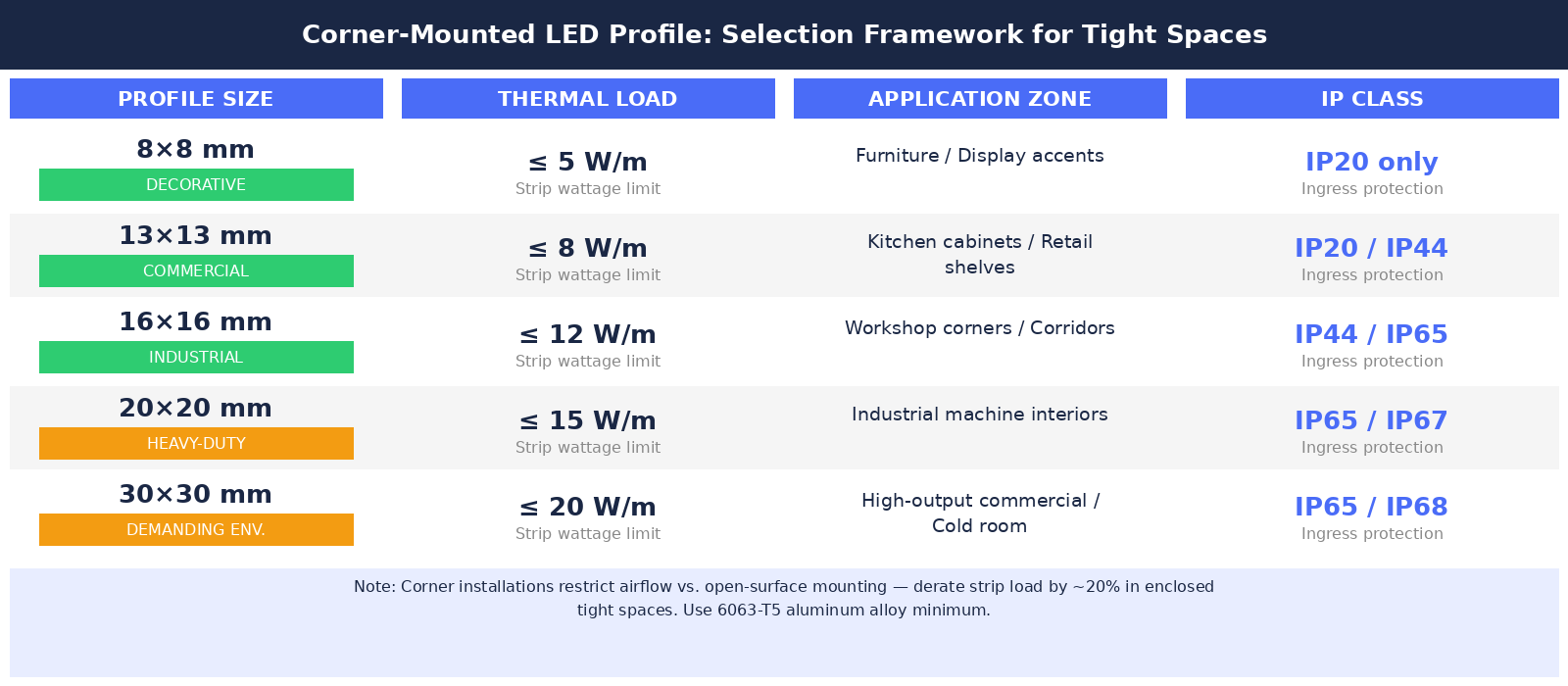 Corner LED profile selection framework: matching profile size, thermal load, and application environment
45-Degree vs. 90-Degree Corner Profiles: Which Angle for Which Application
The 45-Degree Standard and Why It Dominates Commercial Use
The 45-degree V-profile — where the LED strip sits at the interior apex and projects light outward at 45 degrees to both adjacent surfaces — has become the standard specification in commercial applications for several reasons. First, as lighting design specialists explain, placing the fixture at a 45-degree angle directs light onto the work surface while keeping the light source aimed away from the eyeline of seated occupants, preventing glare before it starts. Second, the 45-degree geometry means both legs of the profile contact the two adjacent surfaces, providing two-point thermal contact and better heat distribution than a single-surface profile — a meaningful advantage in tight corners where convection is limited.
For kitchen under-cabinet applications, the 45-degree profile at the front corner of the cabinet eliminates the reflective glare problem that flat-bottom profiles create on polished stone or quartz countertops. Lighting specifiers note that flat-bottom surface profiles carry real risk on reflective surfaces, turning the countertop into a mirror that reflects every individual LED diode. The 45-degree geometry avoids this entirely.
90-Degree Profiles: Where They Fit
The 90-degree square-diffuser profile projects light at a right angle and is better suited to applications where the corner is structural — staircase edges, architectural beam corners, outdoor fascia angles — rather than task-lighting scenarios. The square light diffuser emphasizes contours and hard lines, making it the right choice where the lighting is accenting geometry rather than illuminating a work surface. In tight spaces, however, the 90-degree profile is harder to specify because it requires precise surface contact on both legs; any gap between the profile and an uneven substrate creates thermal bridging issues.
IP Ratings and Tight Spaces: The Tradeoff to Understand
In standard LED strip profiling, there is a direct tradeoff between IP rating and thermal performance. Waterproofing coatings and silicone sleeves used to achieve higher IP ratings act as thermal insulators, trapping heat that would otherwise dissipate through the aluminum. Analysis of LED IP rating systems confirms that for clean indoor environments, an IP20 strip inside a well-spec’d aluminum profile outperforms a high-IP-rated enclosed strip for longevity — because the profile acts as the heat sink and environmental barrier simultaneously.
For tight spaces in industrial, food production, or cold storage environments where genuine washdown or condensation exposure is present, the calculus changes. In those cases, silicone-sealed IP65 or IP67 profiles are required — and the thermal penalty must be managed by derating the strip wattage. A strip running at 8 W/m inside an IP67 silicone sleeve in a 20×20 mm profile will run hotter than the same strip at 8 W/m inside a dry open-back profile. Specifiers sourcing for cold room corners, processing plant coves, or machine washing enclosures should budget for lower strip wattage and verify operating temperature specifications against the sealed ambient condition.
For a full view of IP rating options in weatherproof and industrial-grade LED fixtures designed for demanding environments, see Fanxstar’s weatherproof LED lighting range, which includes fixtures engineered for cold chain and harsh industrial applications.
OEM/ODM: When Standard Profiles Don’t Fit the Brief
The Custom Mold Case for Tight-Space Profiles
Standard catalog profiles — in 8×8, 13×13, 16×16, and 20×20 mm sizes — cover the majority of architectural and commercial applications. But distributors serving niche markets — food processing plant retrofits, marine interior lighting, custom machine builders — regularly encounter briefs where standard profiles don’t fit: non-standard corner angles (other than 45° or 90°), IP68 requirements for seawater exposure, dual-LED-row configurations in narrow-channel enclosures, or custom anodizing specs to match a specific industrial color standard.
Custom mold development for aluminum extrusion profiles is a well-established manufacturing process in China, with typical lead times of 3–5 working days for prototype delivery for straightforward profiles. The mold cost itself varies by design complexity — a simple V-profile variant costs significantly less to tool than a multi-chamber finned design with integrated IP sealing grooves. For distributors building private-label lighting product lines, custom profile development also creates a genuine differentiation that catalog-sourced profiles cannot — particularly when paired with proprietary strip and diffuser combinations.
Fanxstar’s OEM/ODM customization process covers exactly this type of work: profile ID design, aluminum extrusion mold development, diffuser engineering, and end-to-end certification support. For distributors or project developers who have encountered a tight-space brief that catalog profiles can’t satisfy, the Fanxstar customization page outlines the full development workflow and capabilities.
Profile Fitment Tolerance: A Detail That Matters at Scale
One engineering detail that becomes significant at OEM scale: the internal width of a corner profile should exceed the LED strip PCB width by 1–2 mm on each side. Installation guidance for corner profiles notes that manufacturing tolerances in both LED strips and aluminum channels can vary by ±0.5 mm, and that tight-fitting profiles create stress points during thermal cycling — the repeated expansion and contraction of the aluminum as it heats and cools. At the LED operating temperatures common in industrial installations, this thermal cycling is continuous and cumulative. Profiles specified with inadequate internal clearance will show strip adhesion failures and connector stress within the first year of operation.
For OEM buyers specifying profiles in volume, this tolerance verification belongs in the sampling and qualification process — not discovered after mass production.
Installation Considerations for Confined Spaces
Mounting Methods in Practice
Corner profiles in tight spaces are most commonly installed with one of three methods: 3M double-sided adhesive tape (fastest, suitable for smooth surfaces and loads under 5 W/m), stainless steel mounting clips screwed to the substrate (preferred for higher-wattage or long-run applications), and adhesive-backed channels that combine both approaches. In extremely confined spaces where a drill cannot reach, clip-on systems that snap the profile to pre-positioned mounting rails are the professional solution.
For long runs exceeding 2–3 meters in industrial settings, screw-and-clip mounting is the only specification that reliably maintains profile contact with the substrate across the full length. Adhesive-only installation on long runs in warm environments risks progressive peel-away as the adhesive softens under the combined effect of LED heat and ambient temperature — a failure mode that is invisible until the profile drops.
Diffuser Fit in Tight Assemblies
In tight-space installations, the diffuser cover removal and replacement during maintenance is often overlooked at the specification stage. Corner profiles with snap-fit diffusers that require perpendicular insertion cannot be maintained when the profile is installed in a narrow enclosure with less than 30 mm of clearance above. Slide-in diffusers that load from the end of the profile are the correct specification for any installation where access to the profile face is restricted — a point worth specifying explicitly when sourcing profiles for machine interiors or enclosed cabinet runs.
Frequently Asked Questions
What is the smallest corner-mounted LED profile that still provides adequate thermal management?
For LED strips up to 5 W/m, 8×8 mm mini V-profiles made from 6063-T5 aluminum provide sufficient thermal mass for sustained operation. Below this size, heat dissipation becomes inadequate for any continuous-duty application. For strips above 5 W/m, the minimum practical size is 13×13 mm — and any installation in a genuinely tight space (sub-20 mm clearance) should also include a wattage check against the profile’s rated thermal capacity, since corner mounting reduces effective cooling compared to open-surface deployment.
Can I use a standard IP20 LED strip in a corner profile for a food production environment?
Not if the environment involves washdown, steam, or condensation. In those conditions, the LED strip itself needs at minimum IP65 rating (silicone-coated), and the profile system should be specified as a sealed assembly. For food production corners specifically, the combination of an IP65 silicone-sleeved strip in a fully sealed profile with gasketed end caps is the minimum acceptable specification. Strip wattage should be derated to account for the thermal penalty of the silicone coating. Fanxstar’s weatherproof LED range and OEM customization service can address food production environment briefs that require both IP sealing and precise dimensional fit.
Why does a 45-degree corner profile reduce glare compared to a flat-bottom profile?
The 45-degree angle physically redirects the LED’s primary emission axis away from the typical viewer sightline. When a flat-bottom profile is installed on the underside of a cabinet, the light fires straight down — directly along the line of sight for anyone seated at a worksurface. The 45-degree profile, positioned in the front corner where cabinet meets backsplash, fires light downward and rearward at a diagonal, keeping the brightest part of the beam on the work surface while moving the source out of the direct sightline. On reflective countertops (polished stone, stainless steel), this eliminates the mirror-reflection effect that flat profiles consistently produce.
What should OEM buyers look for when qualifying a custom corner profile from a China manufacturer?
Four areas are critical: alloy specification (confirm 6063-T5 or equivalent, not recycled or unspecified alloy), wall thickness (minimum 1.5 mm for sub-15 W/m applications, 2 mm+ for higher loads), internal dimension tolerance (request ±0.3 mm or tighter), and diffuser retention mechanism (verify the clip force is adequate for the thermal cycling range of your application). For certified market entry — particularly EU or Australian certification schemes — confirm that the manufacturer’s engineering team can support the required documentation. Fanxstar’s OEM/ODM process includes certification support as part of the standard development workflow, which is relevant for distributors entering regulated markets.
Corner profile selection in tight spaces combines thermal engineering, optical specification, and installation practicality into a single decision. Getting it right at the specification stage — alloy grade, wall thickness, angle, diffuser type, and IP class — prevents the expensive retrofit cycles that result from under-specified profiles in demanding environments.
Fanxstar’s engineering team works directly with distributors and project developers to specify and custom-manufacture LED profiles for industrial, cold storage, and process environments — with full OEM/ODM capability and European after-sales support. Describe your application and get a free technical consultation.