Self-serve car wash bays look simple from a lighting standpoint — a rectangular enclosure, a few ceiling fixtures, done. In practice, they are one of the more technically demanding lighting environments in the commercial sector: continuous water spray, chemical detergent vapour, rapid thermal cycling from hot water to cold ambient air, and customers who make a direct judgment on whether your facility looks clean and worth using based on the quality of light inside the bay. Getting the IP rating right is the minimum requirement. Getting the total specification right — CCT, lux levels, fixture type, gasket chemistry, and mounting position — is what separates lighting that lasts five years from lighting that fails in the first winter. This guide covers the full specification decision, including when IP66 is sufficient and when operators need to step up to IP69K.
Key Takeaways
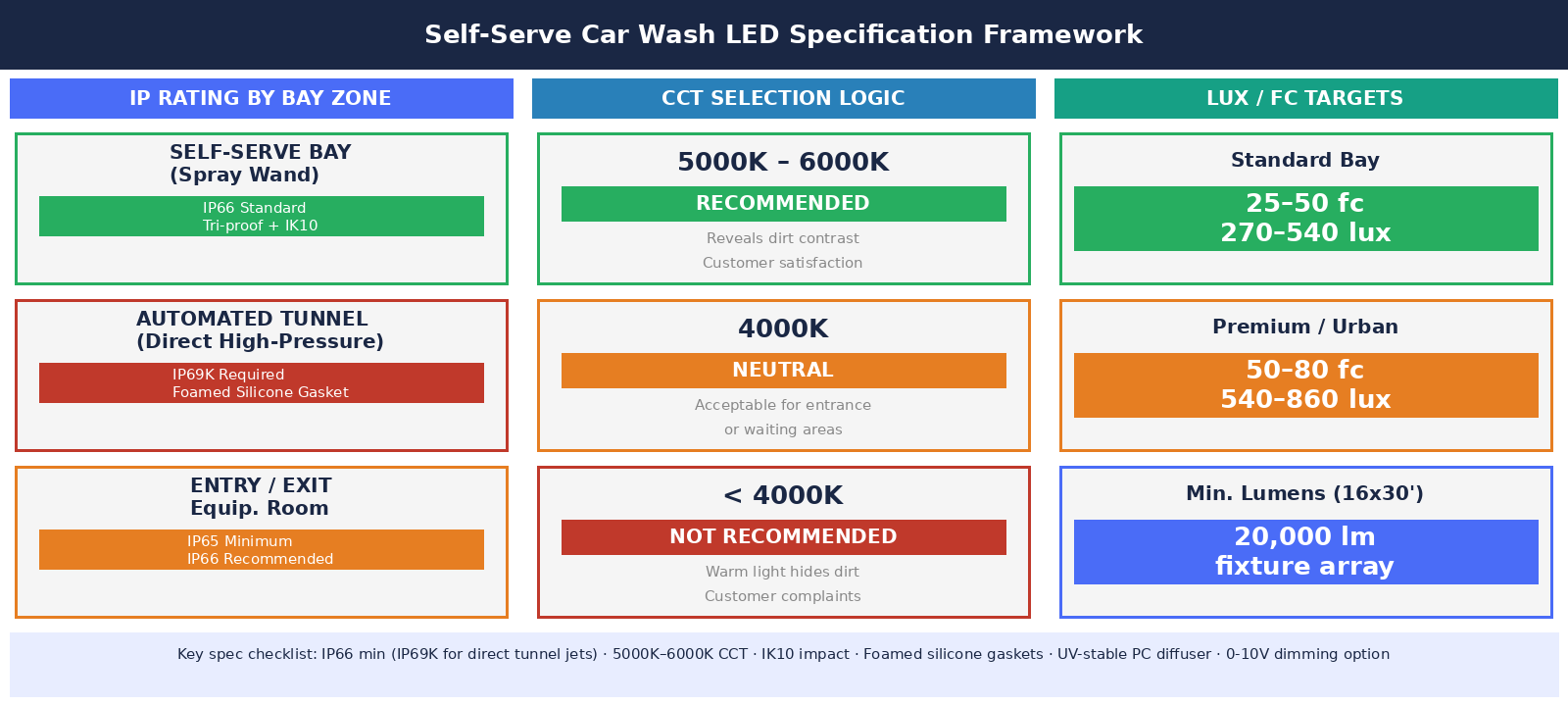
- IP66 is the correct baseline for self-serve bays; IP69K is required only in high-pressure automated tunnel zones — not standard self-serve environments.
- 25–50 foot-candles (270–540 lux) is the IES-aligned target for self-serve bay illumination; operators in high-competition areas or premium branding should target the upper end or above.
- 5000K–6000K CCT is the industry standard for car wash bays — not for aesthetics, but because warm-white light makes vehicles appear cleaner than they are, creating customer complaints at the exit.
- Tri-proof fixtures with IK10 impact ratings and foamed-in silicone gaskets — not basic O-ring sealed units — represent the durable long-term specification for this environment.
Why Self-Serve Bays Are Harder on Lighting Than They Look
The Three Failure Mechanisms in Car Wash Environments
Standard commercial fixtures fail in car wash bays for three distinct reasons that operate on different timescales. First, direct water ingress — the immediate failure mode that a proper IP rating prevents. An IP66-rated fixture is dust-tight and protected against powerful water jets from any direction, making it suitable for the water spray pattern of a self-serve wand. Fanxstar’s analysis of IP rating selection for car wash environments makes clear that IP66 provides sufficient defence for bays where water contact is splash or indirect spray — the typical condition in self-serve operations — while IP69K becomes essential only where high-pressure direct spray contacts the fixture, as in automated tunnel jets.
Second, chemical seal degradation — the medium-term failure that IP ratings do not measure. Car wash detergents contain surfactants that leach plasticizers out of standard rubber O-ring gaskets over months of exposure, causing the seals to shrink, crack, and ultimately fail. Technical documentation on car wash lighting durability identifies this as the primary reason that commercially-rated IP66 fixtures fail prematurely in wash environments — the IP test was passed with water, not with the alkaline detergent cocktail actually present in the bay. The solution is foamed-in-place silicone gaskets, which maintain elastic recovery through repeated chemical exposure, rather than moulded rubber O-rings.
Third, thermal shock — the long-term failure that affects drivers and PCBs regardless of IP rating. A self-serve bay goes through rapid temperature transitions: hot water wash, cold air flush, condensation cycles between operating hours and overnight. High-quality LED drivers rated for -30°C to +75°C ambient can manage this range; budget drivers rated for +5°C to +40°C cannot, and the driver is statistically the most frequent failure point in industrial LED fixtures. When specifying fixtures for car wash bays — particularly in Northern Europe, Canada, or other cold-climate markets — operating temperature range should appear explicitly in the spec checklist alongside IP rating.
Lux Levels and CCT: The Customer Experience Specification
Functional illumination in self-serve bays requires 25–50 foot-candles (approximately 270–540 lux) according to IES guidelines, with commercial car wash lighting specialists recommending the lower end for low-traffic rural locations and the upper end (or above) for high-competition urban or premium-brand facilities. For context, a standard 16′ × 30′ self-serve bay needs approximately 20,000 lumens minimum from the fixture array to hit the standard level, based on lumen planning data from the car wash industry.
Color temperature is arguably more commercially important than raw lux level in a self-serve context. The recommendation from operators with the most experience consistently lands at 5000K–6000K for bay fixtures. The reasoning is counterintuitive but well-documented: warm-white light (below 4000K) makes a wet vehicle appear cleaner than it is, because warm light reduces the contrast between clean and dirty surfaces. When a customer who washed their car under warm-white lighting drives it into daylight and notices dirt still present, they form a negative impression of your facility. Cool-white light at 5000K+ reveals what is actually there — the customer sees the vehicle getting clean in real time, which drives both satisfaction and repeat visits. Experienced car wash operators consistently specify 5000K to 6000K CCT as the effective standard for this reason.
IP66 vs. IP69K in Self-Serve Context: The Right Tool for the Zone
| Specification Factor | IP66 Fixture | IP69K Fixture |
|---|---|---|
| Water jet resistance | Powerful jets from any direction | High-pressure (1450 PSI), 80°C |
| Self-serve spray wand | ✅ Sufficient | ✅ Overkill (higher cost) |
| Automated tunnel jets | ⚠️ Risk of seal failure over time | ✅ Required specification |
| Typical gasket type | EPDM or silicone O-ring | Foamed-in-place silicone |
| IK rating (impact) | Often IK08 | IK10 standard |
| Relative cost | Standard commercial pricing | 20–40% premium |
| Recommended zone | Self-serve bays, equipment rooms, entry/exit | Automated tunnel direct-jet zones |
Tri-Proof vs. Vapor-Tight: Understanding the Distinction
What Makes a Tri-Proof Fixture Different
The terms “vapor tight” and “tri-proof” are used interchangeably in some markets but describe different performance tiers in the lighting industry. Vapor-tight fixtures are sealed to prevent moisture ingress, typically achieving IP65 ratings with standard polycarbonate lenses and silicone seals — suitable for general damp environments. Tri-proof fixtures go further: the “three proofs” are waterproofing, dustproofing, and impact resistance (IK08–IK10), typically combined with UV-resistant diffusers, anti-corrosion coatings, and reinforced gaskets. Detailed comparison analysis describes the distinction as the difference between an umbrella in a drizzle (vapor-tight) and a full rain suit ready for heavy spray and rough handling (tri-proof).
For self-serve car wash bays, the tri-proof specification is the better long-term choice even though the environment does not technically require IP69K. The upgrade from a basic vapor-tight to a tri-proof fixture with IK10, foamed silicone gaskets, and UV-stable diffuser costs perhaps 15–25% more at purchase. The return is a fixture that doesn’t require replacement when a customer’s pressure wand accidentally contacts it, doesn’t develop lens yellowing from UV exposure and chemical residue after year two, and doesn’t develop seal fatigue from repetitive chemical exposure. Facilities using vapor-tight construction have been shown to achieve significantly longer equipment life compared to standard waterproof models in high-moisture environments, based on car wash lighting lifecycle analysis.
Lens Material: Polycarbonate vs. PMMA
Diffuser lens material is a specification point that receives less attention than IP rating but has significant impact on long-term performance. Standard polycarbonate (PC) lenses are tough and impact-resistant but degrade under UV exposure and chemical surfactants — yellowing progressively over years of car wash service, which reduces lumen output and creates uneven illumination. PMMA (acrylic) lenses have higher light transmittance (up to 92%) and better UV stability than standard PC, but lower impact resistance. The best specifications for car wash environments use UV-stabilized PC — which adds UV-resistance to the impact toughness of standard PC — or coated PMMA with surface hardening for impact resistance. Fixtures claiming high transmittance should be checked against a material specification, not just a transmittance figure.
Mounting Position and Fixture Count
Ceiling vs. Side Wall: The Debate Settled
Car wash operators have used both ceiling-mount (overhead) and side-wall linear configurations, and the lighting outcomes differ significantly. Ceiling-mounted fixtures create direct downward illumination but produce shadowing on the sides and lower panels of vehicles — the areas where door-sill dirt, lower-panel road spray, and wheel arch contamination actually accumulate. Side-wall fixtures mounted at 8–10 feet on opposing walls, positioned 2–4 feet from each end wall, provide illumination angles that reveal these lower-panel contamination zones. Experienced operators note that side-wall placement reduces the shadow effect of overhead-only fixtures and improves customer perception of cleanliness in the washing process.
Practical recommendation for a standard 16′ × 30′ self-serve bay: two to four 60–80W IP66 tri-proof linear fixtures — positioned in a combination of ceiling-center and side-wall placement — provides both the minimum lumen target (20,000+ lumens) and the angular illumination needed to reveal vehicle surfaces at all heights. Four fixtures per bay at 8,000 lumens each delivers 32,000 lumens — solidly in the “standard” illumination range per car wash industry planning guidelines.
Certifications to Check Before Purchasing
In EU and Australian markets, CE and SAA certification are minimum requirements for commercial installation. For US and Canadian markets, UL or ETL Wet Location listing is the relevant standard — and DLC (DesignLights Consortium) Premium certification enables access to utility rebate programs that can substantially reduce payback period. Fixtures claiming IP ratings without independent test certificates should be treated with caution: as IP rating analysis confirms, the market contains many fixtures claiming IP66 that barely meet IP54 standards in practice — understanding the specific test definitions and requesting valid test reports from suppliers is essential for specifications that carry liability.
For EU-market operators sourcing B2B, CE-marked tri-proof fixtures with documented IP66 test certification and IK10 impact ratings are the correct specification. Fanxstar’s weatherproof LED range includes tri-proof fixtures with documented certifications relevant to European, Australian, and North American market entry. For operators with specific bay dimensions or mounting constraints that standard catalog fixtures cannot address, Fanxstar’s OEM/ODM customization service covers custom-length linear fixtures with specific IP sealing and mounting configurations.
Frequently Asked Questions
Is IP65 sufficient for self-serve car wash bays, or do I need IP66?
IP66 is the recommended baseline for self-serve car wash bays. IP65 provides protection against water jets, but IP66’s test standard covers more powerful jets — a meaningful difference when a customer’s pressure wand is occasionally directed upward or sideways toward a fixture. The cost difference between IP65 and IP66 fixtures is minimal, and the additional seal confidence makes IP66 the logical default specification. For automated tunnel zones with direct high-pressure spray, IP69K is required; for standard self-serve environments, IP66 suffices.
Why do experienced operators specify 5000K–6000K for car wash bays?
Cool-white light (5000K–6000K) reveals what is actually on a vehicle’s surface — the contrast between clean and dirty areas is visible in real time. Warm light (below 4000K) reduces that contrast, making dirty vehicles appear cleaner under the wash-bay lighting than they are under daylight. The practical consequence is customer dissatisfaction: they pay to wash the car, it looks clean in the bay, and then they notice remaining dirt once outside. 5000K–6000K light gives the customer accurate visual feedback on the wash result, improving satisfaction and reducing complaints.
How many lumens does a standard self-serve bay need?
A standard 16′ × 30′ self-serve bay requires approximately 20,000 lumens minimum for standard illumination levels, and 30,000+ lumens for a brighter premium experience, based on car wash industry planning guidelines. In fixture terms, this typically translates to two to four 60–80W fixtures depending on efficacy. Operators upgrading from metal halide should note that lumens-per-watt comparisons favor LED significantly — a 60W LED fixture typically delivers 8,000–10,000 lumens, compared to approximately 6,000 lumens from a 320W metal halide in the same application. For precise photometric planning against your bay dimensions and ceiling height, a complimentary layout calculation is available from Fanxstar’s engineering team via the contact page.
The gap between a fixture that passes an IP66 test in a lab and one that reliably performs in a car wash bay for five years is bridged by gasket chemistry, lens material selection, driver operating range, and IK rating — none of which appear in the IP number itself.
Fanxstar’s weatherproof LED team specifies and supplies IP66 and IP69K tri-proof fixtures for car wash, cold chain, and industrial wet environments — with CE, SAA, and ETL certifications available, and custom lengths for non-standard bay configurations. Tell us your bay specifications and get a free fixture recommendation.