Traditional track lighting in retail has always forced a tradeoff: flexibility or aesthetics. Four-circuit H/J/L tracks give you repositionable heads but leave an industrial rail exposed on every ceiling. Recessed downlights look clean but require an electrician and a ceiling opening every time merchandising layouts change — which in a live retail environment happens seasonally at minimum and weekly in fast-fashion and specialty stores. Magnetic track linear systems eliminate that tradeoff. A single 48V DC aluminum profile, flush-recessed or surface-mounted, accepts interchangeable linear modules, spotlights, and pendants that snap in and out by hand, anywhere along the track, in under thirty seconds. This guide covers everything a lighting designer, retail developer, or procurement manager needs to specify magnetic track linear lighting correctly: system architecture, CRI and beam angle requirements by product category, installation types and ceiling void requirements, zone control, and where OEM customization adds real value.
Key Takeaways
- 48V DC low-voltage operation is the standard for magnetic track systems — it is safe to touch live conductors and allows fixtures to be repositioned while powered, eliminating the need for electrician involvement every time a store layout changes.
- CRI ≥ 90 (R9 ≥ 50) is the minimum specification for any retail environment where fabric colour, fresh food, or skin tone accuracy matters — the difference between CRI 80 and CRI 95 under a warm 3000K source is visible to any customer within seconds.
- Recessed trimless installation requires a ceiling void of 75–80 mm minimum — specifying this without confirming ceiling depth is the single most common cause of magnetic track project failures at fit-out.
How Magnetic Track Linear Systems Work
System Architecture: Track, Module, Driver
A 48V magnetic track system consists of three components. First, the aluminum track profile: an extruded housing containing two copper conductors embedded in the base of a linear slot, typically 20–35 mm wide. The profile is available in surface-mount, recessed, trimless recessed, and suspended configurations. Second, the light modules: linear LED bars, spotlights, grille lights, and pendants — each fitted with permanent magnets on the mounting face and contact pins that align with the copper conductors when the module is pressed into the slot. As the Lumotrax system guide explains, when a magnetic module is brought close to the track, the magnets lock it into position and the contact pins simultaneously complete the electrical circuit — no tools, no fasteners, instant power. Third, the driver: a 48V DC power supply that converts mains AC to the safe low voltage distributed through the track. Drivers are typically rated at 100–200W per circuit run, with the GRNLED specification guide recommending independent branch circuits at intervals of no more than 5 metres for runs exceeding that length.
The 48V operating voltage is a critical safety specification. Unlike standard 230V mains track (where live conductors must never be touched), 48V DC is classified as Safety Extra Low Voltage (SELV) under IEC 60364. This means installers and store staff can reposition modules on a live track without electrical hazard — a meaningful operational advantage in a retail environment where fixture moves happen frequently and unplanned. The xhlux comparative analysis notes that a 200 m² retail store can completely reconfigure its lighting plan within one hour using magnetic track, versus a full day with traditional fixed track systems.
Linear Modules vs. Spotlights: Choosing the Right Mix
Most retail magnetic track installations use a combination of linear modules and spotlights on the same track run. Linear modules — typically 300 mm, 600 mm, and 1200 mm lengths at 6W, 12W, and 24W respectively — provide a 120° beam angle suitable for general ambient illumination: filling the circulation zone between display areas with enough footcandle to prevent the “cave effect” that makes customers feel uncomfortable. Spotlights and grille heads on the same track, with adjustable beam angles typically ranging from 15° to 60°, provide the accent component: focused, high-contrast light directed onto key merchandise, product launches, or feature walls. The ability to mix these module types on a single track profile, and to reconfigure the ratio between ambient and accent lighting for each campaign, is the core value proposition of the magnetic system over any fixed lighting approach.
CRI and Beam Angle Requirements by Retail Category
Why CRI Specification Matters More in Retail Than Any Other Environment
Retail lighting is merchandise-dependent in a way that office or industrial lighting is not: the quality of light directly affects purchasing decisions. A garment that looks dusty rose under a CRI 80 source may read as a vivid fuchsia under CRI 95. Fresh produce that looks grey under poor-quality white light triggers an immediate negative response from shoppers. The Alcon Lighting recessed modular specification sheet specifies CRI 90+ as standard for retail and gallery applications, noting that the 90+ threshold is where colour saturation becomes perceptibly more vivid to the average observer compared to CRI 80 sources. For applications involving skin tones — cosmetics counters, fitting rooms, jewellery — CRI 95+ with explicit R9 specification (R9 ≥ 50 for acceptable red rendering; R9 ≥ 90 for premium) is the appropriate minimum. For food retail, CRI ≥ 90 with a warm 2700–3000K CCT is standard, as the warm tone enhances the perceived freshness of bread, produce, and meat.
| Retail Category | Min. CRI | R9 Spec. | CCT Range | Accent Beam |
|---|---|---|---|---|
| Fashion / Apparel | CRI ≥ 90 | R9 ≥ 50 | 3000–4000K | 24°–36° |
| Cosmetics / Jewellery | CRI ≥ 95 | R9 ≥ 90 | 2700–3500K | 15°–24° |
| Electronics / Tech | CRI ≥ 85 | R9 ≥ 40 | 4000–5000K | 30°–45° |
| Fresh Food / Bakery | CRI ≥ 90 | R9 ≥ 50 | 2700–3000K | 36°–60° |
| Luxury / Gallery | CRI ≥ 95 | R9 ≥ 90 | 2700–3500K | 15°–24° |
| Home Furnishings | CRI ≥ 90 | R9 ≥ 50 | 2700–4000K | 24°–45° |
Fanxstar’s OEM customization team has worked with food retail and cold chain clients across European markets where both the lighting performance and the environmental durability of fixtures in processing zones are critical. For retail zones adjacent to food production or cold storage corridors — a combination increasingly common in supermarket redesigns — weatherproof LED solutions with the required CRI and CCT specifications can be engineered as part of the same fit-out package. Explore Fanxstar’s weatherproof LED range for retail food environments.
Installation Types: Recessed, Surface, Trimless, and Suspended
Recessed and Trimless: Maximum Aesthetic Impact
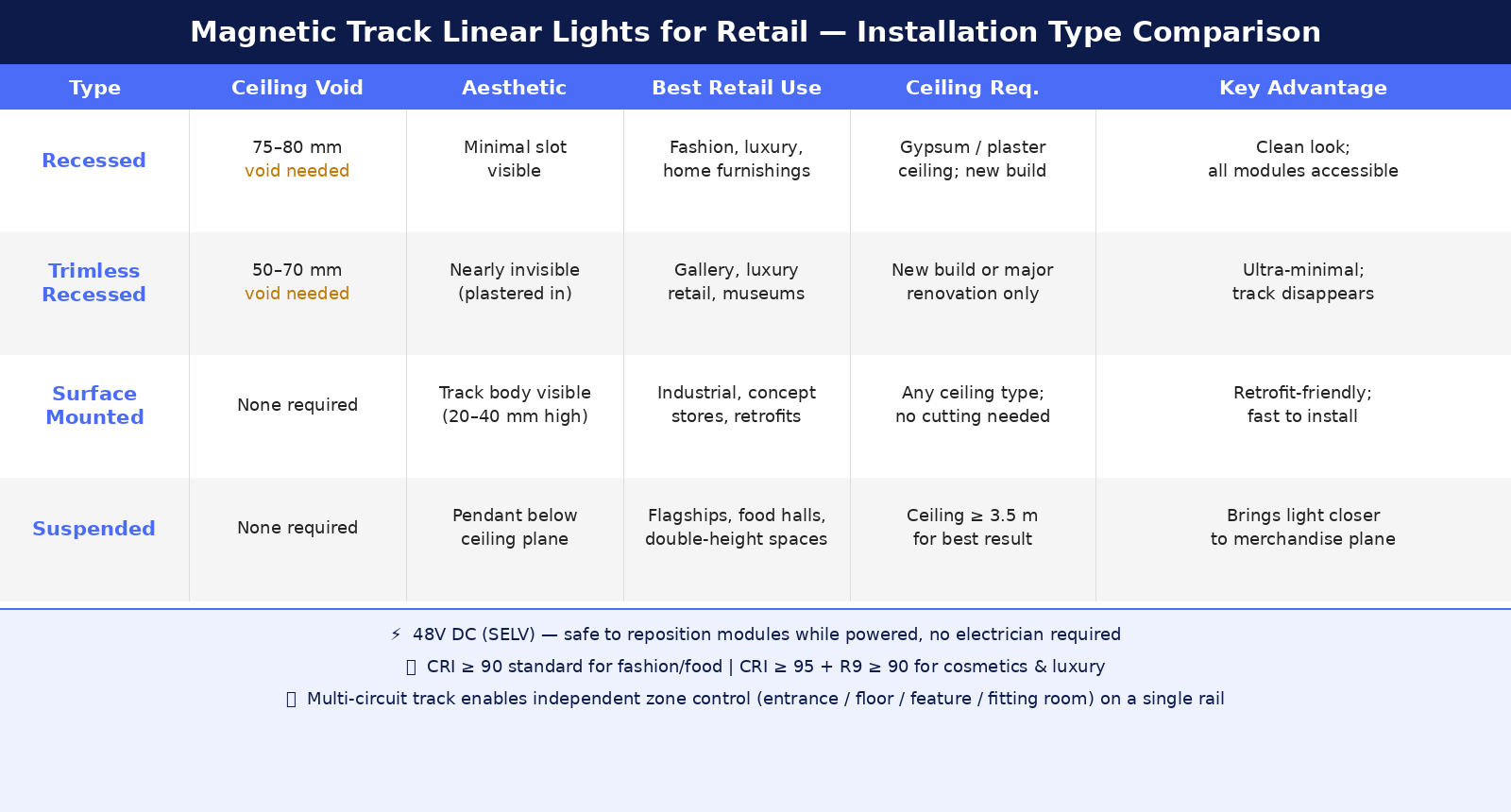
The recessed magnetic track installation integrates the aluminum profile flush with the ceiling plane. Only a narrow linear slot — typically 20–35 mm wide — is visible from the room below, with the fixture modules appearing to emerge directly from the ceiling surface. This configuration delivers the cleanest architectural finish and is the default specification for luxury retail, gallery, and premium hospitality environments. As the Right Lights installation guide confirms, recessed installation requires a ceiling void of 75–80 mm minimum clear depth to accommodate the track profile, electrical connections, and required clearances. This is a non-negotiable structural prerequisite: specifying recessed magnetic track without confirming ceiling void depth is the most common source of project failures at fit-out stage. For retrofit projects in existing buildings where ceiling void is insufficient, surface-mounted track is the appropriate alternative.
Trimless recessed installation takes the clean aesthetic one step further: the track profile is plastered directly into the ceiling with no visible reveal flange, so the slot appears as a precision cut in the plasterboard with no metal border. This finish is specified for ultra-minimalist luxury retail and gallery environments where any visible frame would compromise the design intent. The GRNLED specification guide notes that trimless recessed installation requires 50–70 mm of ceiling void, and that the track must be set into the ceiling structure before plasterboarding — making it a new-build or major renovation specification rather than a retrofit option.
Surface Mounted: The Retrofit-Friendly Option
Surface-mounted magnetic track profiles attach directly to the ceiling slab or existing structure with no ceiling void requirement. The track body is visible below the ceiling plane, typically in a 25–40 mm profile height. For industrial-aesthetic retail environments — exposed concrete ceilings, open warehouse formats, concept stores — the visible track profile reads as an intentional design element rather than a compromise. Surface mounting is also the practical choice for any retrofit project where the ceiling void is too shallow for recessed installation, or where the ceiling structure cannot be cut without structural consequence. The 48V magnetic system guide notes that for concrete ceilings at 3–4 metres height, surface-mounted track is typically the recommended installation approach.
Suspended Magnetic Track: For Double-Height Retail
Suspended magnetic track systems hang below the ceiling on aircraft cable or rod suspension, similar to linear pendant fixtures. This configuration is well-suited to double-height retail spaces — flagship stores, department store atriums, food halls — where ceiling height exceeds 5 metres and a surface or recessed track would be too distant from the merchandise plane to deliver effective accent illumination. Suspended magnetic track brings the light source closer to the product, increases the contrast ratio of accent lighting, and creates an architectural layering effect that separates the ceiling plane from the active retail zone below. The Artemide A.24 magnetic suspension system is representative of the high-design end of this product category, with linear modules in 1176 mm and 2352 mm lengths available in brushed silver, bronze, and copper anodized finishes at 2700K–4000K.
Zone Control and Multi-Circuit Track Configuration
Why Retail Needs Independent Lighting Zones on a Single Track
A single magnetic track run in a retail environment may pass over four functionally different zones: an entrance statement area, a general merchandise floor, a feature display wall, and a fitting room or consultation zone. Each zone has different illuminance targets, different CCT preferences, and different dimming schedules. Running all four zones on a single control circuit means either over-lighting the fitting room or under-lighting the feature display — neither outcome is acceptable. Multi-circuit magnetic track systems solve this by embedding two or more independent power circuits within the same aluminum profile. Modules are assigned to a circuit by their contact pin configuration, allowing zone-by-zone control without running separate track profiles. The KLM lighting system guide highlights multi-circuit control as a key differentiator: “independently manage different lighting zones on the same track” is cited as a primary advantage for retail and office applications.
Dimming and Smart Control Integration
Dimming support varies by magnetic track system and module type. The most widely supported dimming protocols in commercial 48V magnetic track are 0–10V (analogue, supported by most budget and mid-range systems), DALI 2.0 (addressable, required for BMS integration in larger retail estates), and proprietary wireless protocols including Zigbee, Bluetooth, and Casambi. For retail chains operating multiple stores, DALI 2.0 addressability allows central lighting management across the estate — a meaningful energy management and brand consistency tool. For smaller independent stores, a Casambi or Bluetooth mesh system allows scene-based control from a smartphone without additional control wiring, which simplifies commissioning significantly.
The E-Lite 48V specification sheet confirms that DALI 2.0 compatible modules support 2700K–5700K tunable white in addition to dimming, enabling CCT adjustment at commissioning or as part of a time-of-day scene schedule — relevant for retailers who want warmer, more intimate lighting in evening trading hours than the neutral white used during daytime peak.
OEM Customization: Where Standard Products Fall Short for Retail
Housing Profiles, Finishes, and Custom Lengths
Standard 48V magnetic track systems are manufactured in black and white powder coat as the default finish palette. For luxury retail environments — where the track profile itself is a visible architectural element — this limited palette is a constraint. Retail brand standards frequently specify RAL or NCS colours for all ceiling-mounted hardware, and a mismatched track finish in a flagship store is a visible brand consistency failure. OEM customization of aluminum extrusion profiles allows the track housing to be finished in any specified RAL colour, anodized in gold or bronze, or powder-coated in custom metallic finishes.
Beyond finish, retail lighting projects frequently require track lengths that standard products don’t offer. Standard magnetic track profiles are manufactured in 0.5 m, 1.0 m, and 2.0 m sections with field-joinable connectors. For a continuous run of 8.5 metres with no visible joints — a common requirement in a linear merchandise wall — custom track extrusions eliminate connectors mid-run, improving both aesthetics and electrical reliability. Fanxstar’s OEM engineering capability covers custom aluminum extrusion development, multi-circuit track wiring, and pre-production 3D structural rendering for client approval before tooling is committed. Learn more about Fanxstar’s OEM/ODM LED customization process.
Integrated Weatherproof Modules for Mixed-Environment Retail
Contemporary supermarket and food hall design increasingly integrates fresh food display zones — open refrigerated cases, bakery counters, butchery departments — within the same ceiling lighting grid as the general retail floor. Standard IP20 magnetic track modules are rated for dry indoor environments only. For zones where condensation from refrigerated cases creates a regularly humid ceiling environment, or where regular cleaning with water spray is standard practice, IP44 or IP65 rated linear modules within the magnetic track system are required. This is a specification detail that is frequently missed at the design stage and identified only at construction commissioning — at which point retrofitting the appropriate modules is substantially more expensive than specifying correctly from the outset.
Full Specification Checklist for Retail Magnetic Track Projects
| Parameter | Standard Retail Spec | Premium/Luxury Spec |
|---|---|---|
| System voltage | 48V DC | 48V DC |
| CRI (general modules) | CRI ≥ 90 | CRI ≥ 95, R9 ≥ 90 |
| CCT (accent/feature) | 3000K or 4000K fixed | Tunable white 2700–5000K (DALI DT8) |
| Beam angle (accent spots) | 24°–36° | 15°–24° (narrow) + 36°–60° (wall wash) |
| Installation type | Surface or recessed (75–80 mm void) | Trimless recessed (50–70 mm void) |
| Dimming | 0–10V | DALI 2.0 addressable |
| Zone control | Single circuit | Multi-circuit (2–4 per track run) |
| Flicker | IEEE 1789 compliant | IEEE 1789, <0.5% flicker preferred |
| Track finish | Black or white powder coat | Custom RAL / anodized / OEM colour |
| IP rating (food/fridge zones) | IP20 (standard dry zones) | IP44–IP65 for humid/wet food environments |
Frequently Asked Questions
Can magnetic track modules be moved while the power is on?
Yes — this is one of the defining operational advantages of 48V DC magnetic track systems. Because 48V DC is classified as Safety Extra Low Voltage (SELV) under IEC 60364, touching the live conductors in the track poses no electrical hazard. Modules can be slid along the track, repositioned, added, or removed with the system powered, without isolating the circuit. This is the key operational difference between magnetic track and all mains-voltage track systems, where repositioning fixtures with power on is a safety violation.
What ceiling void depth is required for recessed magnetic track?
Standard recessed magnetic track systems require 75–80 mm of clear ceiling void depth — the space between the visible ceiling surface and the structural floor or deck above. This accommodates the track profile body, any electrical junction box or wiring, and the spring-clip or bracket fixings that retain the profile in the ceiling slot. Trimless recessed systems, which plaster directly into the ceiling without a reveal flange, typically require 50–70 mm void. Confirming ceiling void depth is the first structural check that should be completed before specifying any recessed magnetic track system.
What is the maximum run length for a single 48V magnetic track circuit?
Most manufacturers recommend a maximum continuous run of 5 metres per branch circuit to avoid voltage drop affecting the last modules on a long run. For runs exceeding 5 metres, a secondary power feed at the midpoint or end of the run, or an independent driver per 5-metre section, maintains consistent brightness and colour across the full track length. Multi-circuit track profiles allow two to four independent circuits within one aluminum housing, effectively doubling or quadrupling the power capacity of a single visible track line without requiring multiple parallel profiles on the ceiling.
Is CRI 90 always better than CRI 80 for retail?
For any retail environment where product colour accuracy influences purchasing decisions — fashion, cosmetics, fresh food, jewellery, home furnishings — CRI 90 is the appropriate minimum and CRI 95 is preferred for feature displays. CRI 80 is the standard for general commercial and office environments where colour discrimination is less critical. In retail, the step from CRI 80 to CRI 90 represents a perceptible improvement in colour saturation and fabric vibrancy that customers notice, even without a reference comparison. The step from CRI 90 to CRI 95+ is most significant for red tones (R9) — critical for cosmetics, lipstick, fresh meat, and any red-dominant merchandise category.
Can the same magnetic track system work for both ambient and accent lighting?
Yes — this is the primary advantage of magnetic track over separate ambient and accent systems. Linear modules at 120° beam angle provide the ambient floor-level illuminance across circulation zones, while spotlight modules at 15°–36° beam angles on the same track provide directed accent lighting onto display fixtures, mannequins, and feature shelves. The ratio of linear to spotlight modules is adjustable at any point without rewiring or ceiling work. For a typical apparel retail fit-out, a practical starting ratio is roughly 30% linear ambient modules and 70% accent spotlights — but this is adjusted per campaign based on the merchandise mix and the prominence given to hero products.
Magnetic track linear systems deliver the flexibility and aesthetic finish that modern retail environments demand — but the specification choices around CRI, ceiling void, zone control, and OEM finish are where project outcomes are won or lost. Fanxstar’s engineering team works directly with retail developers, lighting designers, and fit-out contractors to deliver certified, application-specific LED solutions with the custom extrusion profiles, finishes, and control configurations that off-the-shelf products don’t offer. Tell us about your retail lighting project and get a free technical consultation.