In a food processing plant or dairy facility, the daily sanitation cycle is one of the most violent events your lighting infrastructure endures. High-pressure hoses firing water at temperatures up to 80°C blast every surface within reach—and fixtures that are not rated to handle this regime fail quickly, often catastrophically. IP69K, defined under ISO 20653, is the only ingress protection rating that certifies resistance to this exact combination of high pressure and high temperature. It is not simply “more waterproof”—it is a fundamentally different class of protection designed for industrial washdown, not rain. For procurement managers, facility engineers, and lighting distributors sourcing for washdown environments in 2026, knowing which manufacturers genuinely deliver IP69K-grade performance—not just a printed rating—is the difference between a sound capital investment and a recurring maintenance headache.
Key Takeaways
-
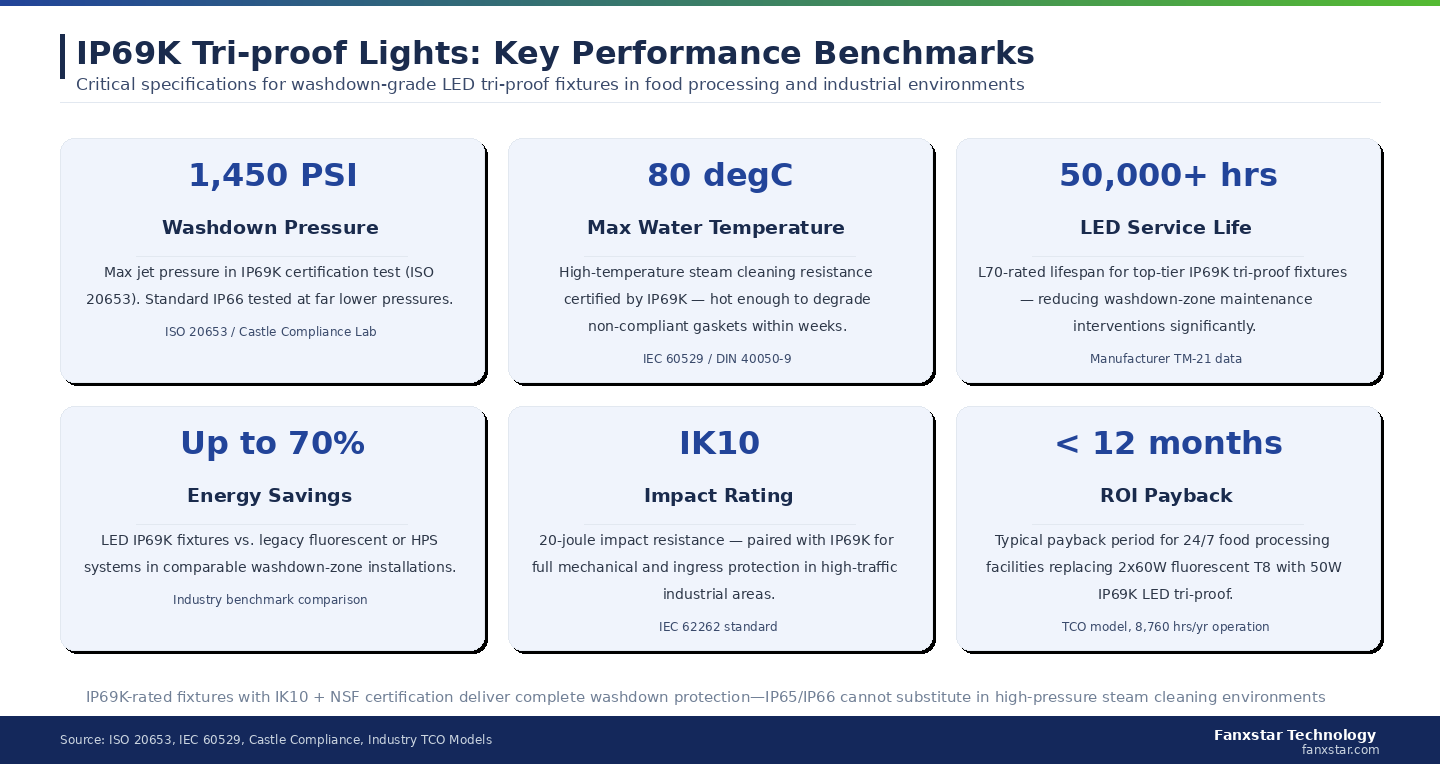
- IP69K requires resistance to 1,450 PSI / 80°C water jets, far exceeding IP65 or IP66 specifications used in standard industrial applications.
- NSF/ANSI 2 certification complements—but does not replace—IP69K; food-zone fixtures need both ratings to satisfy HACCP and FDA requirements.
- 304 or 316L stainless steel end caps and EPDM/silicone gaskets are the material benchmarks separating genuine washdown fixtures from water-resistant impostors.
- IK10 impact resistance (20-joule impact) should accompany IP69K in high-traffic industrial washdown areas where mechanical shock is routine.
- Energy savings of up to 70% versus legacy fluorescent or HPS systems make IP69K LED tri-proof lights a compelling lifecycle investment beyond compliance alone.
- Conduit entry point sealing is the most common failure mode in washdown installations—insist on breather valves and detailed installation guidance from any shortlisted manufacturer.
Why IP69K Is the Non-Negotiable Standard for Washdown Environments
Understanding the IP69K Test Protocol
The IP rating system, managed by the International Electrotechnical Commission, classifies enclosures by their resistance to solids and liquids. The “6” in IP69K means the fixture is completely dust-tight—zero ingress under the full test duration. The “9K” is where this rating diverges dramatically from all others. According to Castle Compliance’s testing laboratory, the IP69K protocol exposes enclosures to water at 1,450 PSI and 80°C, delivered from a nozzle positioned just 175 mm away from the test surface. The fixture must rotate on a turntable at 5 rpm while water is sprayed from four angles for 30 seconds each. No other IP rating simulates this regime—which is precisely why IP69K became the industry benchmark for food processing and heavy industrial washdown long before most buyers understood what it meant.
Historically, the “K” suffix traces back to Germany’s DIN 40050-9 automotive standard, developed for vehicles like cement mixers and dump trucks requiring intensive steam cleaning. Food and beverage engineers adopted it wholesale in the 1990s because it was the only existing standard that certified high-pressure, high-temperature spray resistance. As Castle Compliance’s historical analysis documents, EHEDG (European Hygienic Engineering and Design Group) guidelines explicitly referenced this standard as a prerequisite for open food processing equipment—cementing IP69K as the de facto benchmark across the global food industry.
For buyers in Fanxstar’s weatherproof lighting range and elsewhere, the practical implication is simple: if a fixture is rated only for IP65 or IP66, it will eventually succumb to washdown. Gaskets degrade under thermal cycling, electronics accumulate moisture, and biofilm forms in the warm, humid interior—a direct food safety risk in zones above open product lines.
IP69K vs. IP66 vs. IP68: Why Lesser Ratings Fail Washdown Facilities
IP66 protects against powerful water jets from any direction, which is adequate for rain exposure or occasional hosing. IP68 protects against prolonged submersion in water, but is tested at ambient temperature under low-to-moderate pressure. Neither IP66 nor IP68 involves high-temperature jets, which means their gaskets and seals are validated for conditions that simply do not exist in a food processing washdown bay. IP69K is the only classification where the test engineer fires near-boiling water at close range—the exact scenario your sanitation team recreates every day. Specifying anything lower in a washdown-grade facility is not a cost saving; it is a deferred replacement cost.
Critical Buyer Criteria: Beyond the IP Rating
Material Selection — Stainless Steel End Caps and Chemically Resistant Gaskets
The housing material determines long-term survival in corrosive environments. Standard polycarbonate body tri-proof lights hold up well in IP65 or IP66 applications, but the end caps and mounting hardware face direct chemical assault in washdown zones. Leading IP69K fixtures specify 304-grade stainless steel for general food processing or 316L stainless steel for seafood plants and pharmaceutical environments where chloride concentrations are higher. Gasket material matters equally: EPDM rubber resists most alkaline cleaners and sanitizers, while VMQ silicone gaskets provide superior performance against peracetic acid and sodium hydroxide used in intensive sanitation programs. Buyers should request the technical data sheet specifically for the food-zone variant of any fixture, not the standard version—manufacturers often use different gasket compounds between the two.
Complementary Certifications — IK10, NSF, ENEC, and UL
IP69K addresses liquid and dust ingress. It says nothing about impact resistance, food-contact materials, or electrical safety under territory-specific regulations. A complete procurement specification for washdown environments should layer in additional certifications. IK10 impact protection—resistance to a 20-joule impact—is essential in facilities where forklifts, pallets, or cleaning equipment share the space with overhead lighting. For facilities subject to FDA or USDA oversight, NSF/ANSI 2 certification evaluates the fixture’s physical design—smooth, crevice-free surfaces, non-toxic materials, and geometry that resists biofilm accumulation—beyond what IP ratings cover. In North America, UL or ETL listing is mandatory for code compliance; in Europe, ENEC or CE/ErP applies. Top-tier IP69K manufacturers will carry all of these, not just the IP rating.
Learn more about how Fanxstar maintains product quality and certification depth on the Fanxstar About Us page, including their 42-patent portfolio and ISO9001-2015 quality management certification.
Top Manufacturers of IP69K Tri-proof Lights for Washdown Environments 2026
The following assessment covers manufacturers with verified IP69K-rated product lines and established export capability. Certifications and specifications are drawn from publicly available product documentation and should be independently verified with each supplier for specific project requirements.
Fanxstar Technology — Weatherproof and Industrial LED Specialist
Fanxstar has built its product identity around the narrower, harder problem sets within weatherproof and industrial lighting—exactly the territory where IP69K matters most. Their IP65 and IP66 product range is extensive, and their engineering team supports IP69K-rated configurations through the OEM/ODM customization program, with stainless steel end cap options and multi-function integration (motion sensing, DALI dimming, emergency backup, 0-10V) within a single housing. Operating temperature range extends from -40°C to +70°C, covering cold room washdown scenarios that challenge lesser designs. Certifications include UL/ETL (North America), ENEC/CE/ErP (Europe), SAA (Australia/NZ), and TUV/CB. Fanxstar’s Philips Lumileds and Bridgelux chip sourcing provides traceable photometric data for specifiers requiring LM-79 reports. Their 7-10 year heavy-duty warranty tier is particularly relevant for buyers calculating total cost of ownership in 24/7 food processing operations. For customized IP69K configurations, Fanxstar’s customization program covers private-label, custom dimensions, and specific gasket material selection for different chemical environments.
TUBU
TUBU is a direct competitor in the IP69K tri-proof space with a recognized product line featuring 304 and 316L stainless steel end caps, PC and PMMA housing, and 94V2 fire-rated protection. Their L9 series is positioned specifically for food processing and marine applications. Certifications include ENEC, CB, C-TICK, and TUV. Efficiency ratings reach up to 170 lm/W in their current specification sheets.
ShineLong
ShineLong claims fifteen years of manufacturing experience in the tri-proof segment, with their IP69K customization service covering 2ft to 5ft formats across a 20W–80W power range. Their certification stack includes TUV, VDE, ENEC, UL, ETL, SAA, and UKCA, plus LOWE’S Factory Certification in the US market. The Rancher series specifically targets livestock and food processing environments with ammonia-resistant construction options.
OLAMLED
OLAMLED offers IP69K-rated configurations within their broader tri-proof product line, targeting distributors and contractors with competitive pricing across standard fixture sizes. Their K series has appeared in multiple third-party buyer guides for washdown applications in the food and beverage segment.
GRNLED
GRNLED brings over ten years of tri-proof manufacturing depth, with IP69K variants across more than 50 fixture models. Their product documentation emphasizes corrosion-resistant housing materials and multi-market certification coverage, making them a frequent consideration in European and Australian distributor shortlists.
What to Watch: Emerging and Specialist Suppliers
Unicornlite’s Triumph series features IP69K alongside Bridgelux LEDs and Tridonic drivers, with 316 stainless steel end caps and a 150 lm/W efficiency claim—a combination that appeals to European buyers prioritizing component traceability. For buyers requiring NSF-listed product plus IP69K from a single SKU, US-based suppliers like G&G Industrial and Maes Lighting offer pre-specified food-zone fixtures, though typically at higher landed costs than China-manufactured alternatives.
Application Matrix: Which Washdown Environments Require IP69K
Food and Beverage Processing Plants
This is the primary IP69K application environment. Sanitation cycles in meat processing, dairy, beverage bottling, and fish handling typically involve high-pressure steam or chemical foam applied at temperatures and pressures that directly replicate the IP69K test protocol. NSF/ANSI 2 certification and HACCP compliance require fixtures that are shatterproof, sealed against contamination, and constructed with materials that resist both the cleaning agents and incidental food contact. For specifiers: prioritize smooth, no-gap housing geometry, minimum CRI 80 (CRI 90+ for QC inspection lines), and 5000K color temperature in meat and produce inspection zones. More detail on proven lighting approaches for this sector is available on Fanxstar’s food processing plant application page.
Dairy, Poultry, and Livestock Facilities
Ammonia resistance is an additional requirement in livestock environments—a specification that goes beyond IP69K and requires explicit material testing. End caps in 316L stainless steel and EPDM or silicone gaskets that maintain elasticity after extended ammonia exposure are the standard. Some manufacturers, including ShineLong, offer DLG (German Agricultural Society) ammonia certification—a differentiated credential worth requesting for this segment.
Pharmaceutical and Cleanroom Environments
Cleanrooms combine high-frequency chemical disinfection with zero-tolerance contamination requirements. IP69K fixtures in these spaces must also demonstrate compliance with smooth, non-particle-shedding surfaces. European buyers will look for EHEDG alignment; global pharmaceutical projects often require ISO 14644 cleanroom class documentation in addition to IP69K.
Car Wash Facilities and Industrial Washdown Bays
Commercial car wash tunnels and industrial equipment washing bays replicate washdown conditions closely, though without the food safety regulatory layer. In these environments, IP69K provides the mechanical specification, and IK10 becomes the differentiating criterion given the elevated risk of physical impact from vehicles and equipment.
Procurement Checklist: 7 Questions Before Finalizing Your IP69K Supplier
Use this checklist when evaluating manufacturers at the RFQ stage to separate genuine IP69K capability from marketing inflation:
- Can you provide the IP69K test report from an accredited third-party laboratory (TUV, SGS, Intertek, or equivalent)? — Self-declared ratings without independent test reports are a red flag.
- What are the end cap and gasket materials, and are they specified in the product data sheet? — Ask for the food-zone TDS specifically if the supplier offers variants.
- Does the fixture carry NSF/ANSI 2 listing, and for which food zone classifications? — Non-food contact, splash zone, and food zone have distinct requirements.
- What is the IK impact rating, and how is it tested? — IK08 (5 joules) is insufficient for most washdown bays; insist on IK10 (20 joules).
- Does the fixture include a breather valve, and how is the conduit entry sealed? — Industry data shows conduit entry is the primary site of moisture failure in otherwise well-rated fixtures.
- What certifications apply to your target market—UL/ETL, ENEC/CE, SAA—and are test reports current? — Expired or misapplied certifications create compliance risk at the point of customs clearance or facility audit.
- What is the warranty duration and what does it cover under washdown use conditions? — Standard warranties often exclude damage from “misuse”—confirm washdown environments are explicitly covered.
For distributor-level procurement support or OEM inquiry with full certification documentation, contact the Fanxstar team directly for project-specific pricing and technical specification review.
Frequently Asked Questions
Is IP69K the same as IP68?
No. IP68 and IP69K test for completely different hazards. IP68 certifies resistance to continuous water immersion, typically tested at ambient temperature and moderate pressure. IP69K certifies resistance to high-pressure, high-temperature water jets—the exact conditions of an industrial washdown. A fixture can carry IP68 without passing IP69K, and vice versa. For washdown environments, IP69K is the required specification; IP68 provides no assurance of protection against steam cleaning or pressure hosing.
Do IP69K tri-proof lights also need to be NSF certified for food facilities?
Yes, in most cases. NSF/ANSI 2 certification evaluates fixture design for food safety—smooth surfaces, non-toxic materials, crevice-free geometry—which IP69K does not address. HACCP auditors and FDA/USDA inspectors in food processing facilities typically require both ratings for fixtures installed above open product lines. IP69K alone is sufficient for non-food-contact industrial washdown applications such as car wash bays or equipment cleaning stations.
What is the difference between IP69K and IP69 (without the K)?
Technically, IEC 60529 added an “IP69” rating in 2013 with a water test equivalent to IP69K. The historical term “IP69K” originates from the German DIN 40050-9 automotive standard and remains the dominant designation in food industry specifications, supplier data sheets, and procurement documents globally. In practice, a fixture documented as IP69K and one documented as IP69 (IEC) undergo equivalent water tests—but buyers should request the actual test report to confirm the standard used and the laboratory that conducted it.
Can IP69K fixtures operate in cold storage environments as well?
Yes, but operating temperature range must be verified separately. IP69K certifies protection against washdown conditions; low-temperature performance requires a rated operating minimum on the driver and LED assembly. Leading manufacturers specify fixtures suitable for operation from -40°C to +70°C, covering cold room and blast chiller environments. Always confirm the operating temperature range alongside the IP69K rating when specifying for cold storage washdown applications.
What lumen output and efficacy should I target for food processing washdown areas?
For general food processing floor lighting, IES and EN 12464-1 guidelines suggest a minimum maintained illuminance of 300–500 lux at the task plane, with higher levels (up to 1,000 lux) for inspection and QC areas. At the fixture level, modern IP69K LED tri-proof lights deliver 120–160 lm/W efficacy in a range of formats from 18W to 80W, providing more than adequate output for most facility layouts with significantly lower energy consumption than the fluorescent or HPS systems they replace.