Cold storage lighting is a specialized procurement problem. The temperatures that preserve food, pharmaceuticals, and other temperature-sensitive goods are the same temperatures that destroy conventional lighting fixtures. Fluorescent lamps lose lumen output dramatically below 0°C, fail to start reliably at -20°C, and are effectively unusable at the -40°C environments found in blast freezers and deep industrial cold stores. LED vapor tight fixtures engineered for extreme cold have solved these problems—but not all LED products are created equal, and a fixture marketed as “suitable for cold storage” with a minimum operating temperature of -20°C is useless in a -35°C blast freezer chamber. This guide evaluates the leading vapor tight light suppliers whose products are genuinely validated for operation at -40°C, and explains the engineering criteria that determine whether a cold-rated claim is supported by documentation.
Key Takeaways
- -40°C is the industry benchmark for blast freezers and deep cold industrial applications—fixtures rated only to -20°C will fail or underperform in these environments.
- LED technology outperforms fluorescent at all sub-zero temperatures: LED efficacy is largely unaffected by cold, while fluorescent output drops 20–80% depending on ambient temperature.
- Driver cold-start specification is the critical technical variable—the driver must initialize reliably at the minimum operating temperature, not just run after warm-up.
- Condensation management is as important as IP rating in cold storage: vapor tight housing prevents moisture ingress during temperature transitions.
- LED vapor tight lights deliver 50–70% energy savings versus legacy fluorescent in cold storage, with the additional benefit of reducing refrigeration load due to lower heat output.
- Motion sensor integration provides significant additional energy savings in cold storage aisles where lighting needs are intermittent.
Why -40°C Is the Critical Temperature Benchmark in Cold Storage Lighting
What Happens to Conventional Lighting Below 0°C
Cold storage environments impose conditions that conventional lighting technologies were not designed to handle. Fluorescent lamp output degrades significantly as temperature falls below 10°C—the mercury vapor inside the lamp condenses at the tube ends, reducing the discharge efficiency and lumen output. By -20°C, many fluorescent lamps produce only 20–40% of their rated lumen output, and their ability to initiate a reliable arc discharge is severely compromised. At temperatures approaching -40°C, most fluorescent lamps fail to start entirely. This is not a marginal performance issue—it is a fundamental physical limitation of the discharge lamp mechanism. High-intensity discharge (HID) lamps face similar challenges and additionally require extended warm-up periods (5–15 minutes) before reaching full output, making them impractical for environments where lights are cycled on demand. The US Department of Energy identified this limitation clearly, noting that at low temperatures, LEDs are a natural fit for cold storage and freezer applications precisely because conventional alternatives perform so poorly.
LED Advantages in Cold Environments
LED junction efficiency is largely temperature-independent at operating range and can actually improve slightly at lower ambient temperatures due to reduced thermal stress on the semiconductor. Unlike discharge lamps, LEDs convert 80–90% of input energy directly into light, wasting very little as heat—a particularly valuable characteristic in refrigerated environments where excess heat from lighting fixtures increases the load on the refrigeration system. According to the International Energy Agency, LED lighting achieves 50–60% energy savings compared to fluorescent alternatives, with efficacy exceeding 150 lm/W in current commercial products—more than double the output per watt of equivalent fluorescent technology. A University of Michigan study published in Lighting Research and Technology further confirmed that LED products in linear fixture formats are 18–44% more efficient than T8 fluorescent lamps—and this efficiency gap widens at sub-zero temperatures where fluorescent performance degrades.
Cold storage-specific applications for vapor tight and tri-proof LED fixtures are detailed on the Fanxstar cold storage lighting application page, including typical specification parameters for walk-in coolers, blast freezers, and pharmaceutical
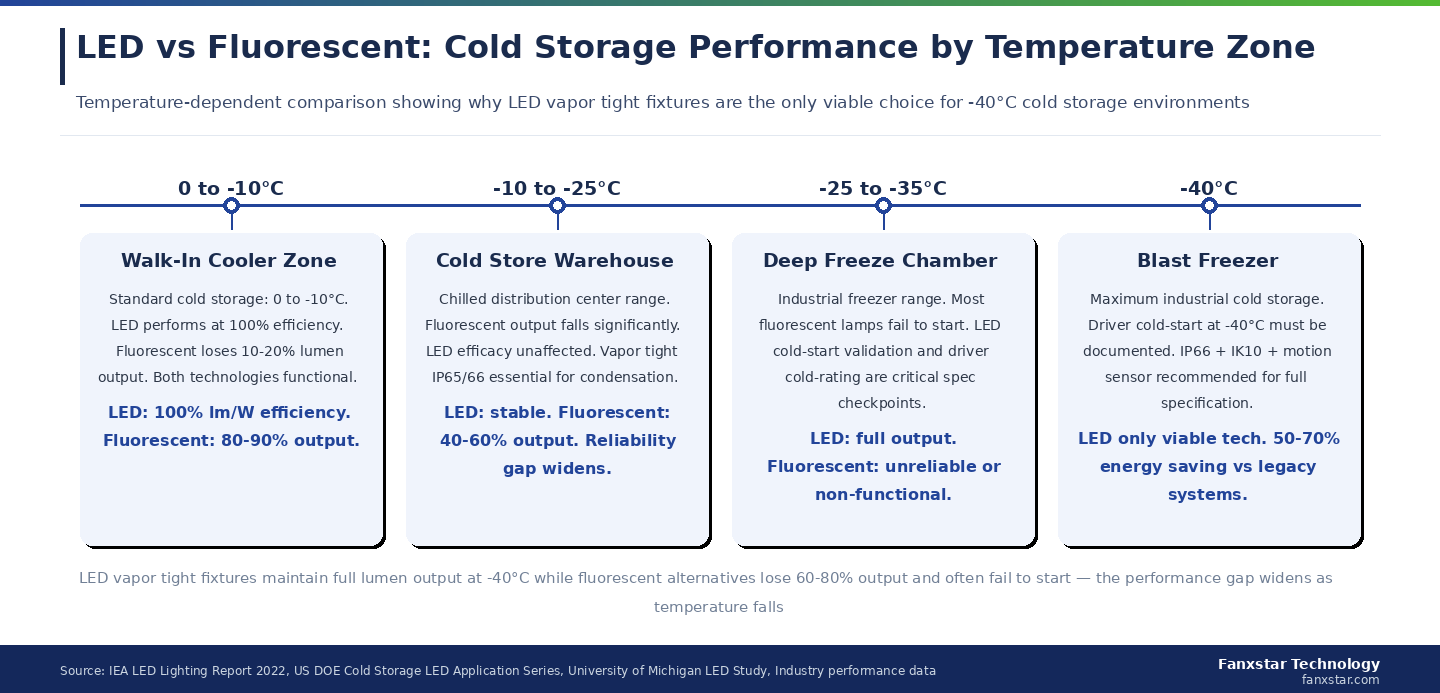
cold chain environments.
Technical Specifications for -40°C-Rated Vapor Tight Fixtures
Driver Cold-Start Specification: The Most Critical Variable
The LED driver—not the LED itself—is the component most likely to fail in extreme cold. Electrolytic capacitors become stiffer and less effective as temperature falls, increasing driver impedance and potentially preventing reliable startup. A fixture marked with a minimum operating temperature of -40°C must have a driver specifically validated for cold-start at that temperature, not just for continuous operation after warm-up from ambient. Procurement specifications should explicitly require cold-start validation documentation, not merely a stated operating range. Request the driver model number and cross-reference the driver manufacturer’s own data sheet for minimum operating temperature—a mismatch between the fixture’s stated spec and the driver’s actual cold-start rating is a common quality gap in budget cold storage fixtures. Isolated constant-current drivers with components rated for extended temperature ranges (often -40°C to +80°C operating) are the standard in genuinely cold-rated products.
IP Rating and Condensation Management
Cold storage environments create a specific moisture challenge: as fixtures experience temperature transitions—particularly when cold storage spaces are opened during loading operations or defrost cycles—warm humid air contacts cold surfaces and condenses. Sealed vapor tight construction with IP65 or higher ratings is the standard approach to preventing condensation from entering the fixture housing. IP66 provides additional protection against direct water jets during defrost cycles, which in some blast freezer configurations involve water. Some manufacturers incorporate pressure-equalizing breather valves in their cold storage fixture designs—allowing internal pressure equalization during temperature cycles without permitting moisture ingress, which can otherwise create a “breathing” effect that draws humid air into the housing over multiple temperature cycles.
Material Performance at Extreme Low Temperature
Polycarbonate housing materials maintain their mechanical properties across the -40°C to +70°C range well—making them well-suited for cold storage vapor tight applications. However, the quality of the PC grade matters: virgin PC with UV stabilization performs better than reground or lower-grade material over extended cycling. Gasket material performance at low temperature is equally important: standard EPDM rubber retains elasticity at -40°C, while lower-grade NBR rubber can become brittle and lose sealing effectiveness. Aluminum housing variants—while not universally used in vapor tight formats—perform well in cold environments from a thermal management perspective, and their conductivity reduces thermal gradients within the housing that can create condensation microenvironments.
Top Suppliers of -40°C-Rated Vapor Tight Lights 2026
Fanxstar Technology — Wide-Temperature Weatherproof and Vapor Tight
Fanxstar’s vapor tight and weatherproof product range is rated for operation from -40°C to +70°C, covering the full spectrum from blast freezer environments to high-ambient industrial spaces within a single product architecture. The -40°C cold-start validation uses drivers selected for their documented cold-temperature performance, with component specifications confirmed through the supply chain rather than assumed from fixture-level claims. Available IP ratings span IP65 to IP66, with IP69K configurations for cold storage environments that combine deep freeze operation with high-pressure washdown requirements. Multi-function integration—motion sensors, DALI dimming, 0-10V control, and emergency battery backup—is available within the cold-rated product line, enabling energy optimization strategies appropriate for intermittent-use cold storage aisles. Efficiency ratings for the current generation reach 120–160 lm/W, delivering significant energy cost reduction against legacy fluorescent installations operating at degraded performance in cold environments. Review the Fanxstar vapor tight fixture range for current specifications. For Fanxstar’s quality management infrastructure and certification portfolio, the About Fanxstar page covers the ISO9001-2015 QMS and 30+ cold-environment-relevant patent contributions.
TUBU
TUBU’s IP69K tri-proof line is rated for extended low-temperature operation in their product documentation, with cold storage and food processing as primary target applications. Their stainless steel end cap designs provide additional corrosion resistance relevant in humid cold storage environments with high-frequency temperature cycling. Driver selection documentation should be requested specifically for cold-start validation in deep freeze applications.
GRNLED
GRNLED’s tri-proof range covers cold storage applications across their standard product lineup, with -40°C minimum operating temperature specified on cold-environment variants. Their extended product range allows distributors to source from a single supplier across cold store, standard warehouse, and outdoor weatherproof applications, simplifying inventory management for multi-site facility projects.
OLAMLED
OLAMLED’s K series includes cold storage configurations specifically positioned for walk-in coolers, blast freezer chambers, and pharmaceutical cold chain environments. Their product documentation addresses the condensation management challenge with IP66-rated housing construction and specified gasket material grades for extended cold temperature cycling.
US and Western Brands: Cold Storage Specialists
For North American projects requiring domestic manufacture or Buy American Act (BAA) compliance, brands including 1st Source Lighting manufacture cold storage LED vapor tight fixtures in the US with -40°C operating ratings and 5-year warranties. These fixtures deliver 60–70% energy savings over HID and fluorescent systems with immediate re-strike capability that HID alternatives cannot match. Unit costs are typically significantly higher than Chinese-manufactured equivalents, but domestic procurement eliminates tariff risk and provides local service support. For European market cold storage projects, leading local brands include specialized industrial lighting manufacturers with ENEC certification and EU ErP compliance documentation.
Application Guide: Matching Fixture Spec to Cold Storage Type
Blast Freezers and Deep Freeze Storage (-35°C to -40°C)
Blast freezers represent the most demanding cold storage lighting environment. Rapid temperature fluctuations during loading cycles, combined with sustained deep freeze operating temperatures, create the harshest conditions for driver cold-start and condensation management. Specify fixtures with documented cold-start at -40°C, IP66 minimum, IK08 or IK10 impact rating (for protection against stock movement impacts), and motion sensor compatibility for energy management during the significant periods when blast freezer chambers are unoccupied. NSF-certified fixtures rated to -40°C and +55°C are available for blast freezers in food processing environments where both hygiene compliance and extreme temperature performance are required simultaneously.
Cold Storage Distribution Centers (0°C to -25°C)
Distribution center cold storage combines medium-low temperature operation with high traffic, regular forklift access, and frequent lighting cycles. IK10 impact resistance is standard in this application given the mechanical risks from material handling equipment. Motion sensor integration delivers meaningful energy savings in large cold stores where aisles are occupied intermittently: industry guidance for cold storage environments recommends motion sensor delay times of 15–20 minutes (longer than standard warehouse settings) to avoid excessive cycling that can reduce driver component life in cold conditions. Linear vapor tight fixtures provide even aisle illumination that works with narrow warehouse racking better than high bay alternatives in standard ceiling height cold stores.
Pharmaceutical Cold Chain Storage (+2°C to +8°C)
Pharmaceutical cold chain storage operates at temperatures above freezing where LED performance challenges are minimal, but regulatory requirements for lighting design add complexity. GMP (Good Manufacturing Practice) facility requirements for illumination levels, emergency lighting, and fixture cleanability are more stringent than general cold storage standards. NSF or equivalent hygienic design certification may be required depending on facility classification. Flicker-free LED operation is particularly important in pharma cold stores where pharmaceutical products and labels undergo visual inspection.
Installation Best Practices for -40°C Cold Storage Lighting
Several installation factors determine whether a correctly specified -40°C vapor tight fixture delivers its rated performance over its full service life. Maintain at least 3 feet of clearance from evaporator coils and defrost air equipment—direct exposure to defrost cycles creates thermal shock conditions that accelerate gasket degradation even in IP66-rated fixtures. Install conduit drip loops to prevent water tracking down conduit runs into the fixture body during defrost cycles. For motion sensor configurations in freezer environments, set occupancy sensor delay times to 15–20 minutes to prevent excessive switching cycles that stress driver components in cold conditions. Confirm that fixture mounting hardware is specified for the operating temperature range—standard steel hardware can become brittle at sustained -40°C exposure.
For a comprehensive quotation and specification support for cold storage lighting projects, contact the Fanxstar technical team with your facility dimensions, temperature range, ceiling height, and any applicable certification requirements.
Frequently Asked Questions
Can a standard IP65 vapor tight light be used in a cold storage freezer?
IP65 provides adequate moisture protection for most cold storage environments, but the critical variable is the fixture’s stated minimum operating temperature—not its IP rating. An IP65 fixture rated to -20°C will fail in a -35°C blast freezer regardless of its moisture protection. Always verify the operating temperature range on the product specification sheet. For blast freezer and deep cold applications, specify a minimum operating temperature of -40°C with documented cold-start validation for the driver.
Do LED vapor tight lights actually save energy in cold storage compared to fluorescent?
Yes, and the energy savings are greater in cold storage than in ambient temperature applications because fluorescent performance degrades at low temperatures while LED performance remains stable. IEA data confirms LED achieves 50–60% energy savings versus fluorescent at standard temperatures—in a cold storage environment where the fluorescent is operating at 40% of rated output, the effective efficiency gap widens substantially. Additionally, LED fixtures generate less heat than fluorescent equivalents for the same lumen output, reducing the refrigeration system’s load and providing a secondary energy benefit beyond the lighting circuit itself.
What motion sensor delay time should I specify for cold storage lighting?
For walk-in freezers and blast freeze chambers, a 15–20 minute delay time is recommended—longer than the 5–10 minute standard for ambient temperature warehouses. Cold storage workers in insulated gear move more slowly and spend longer in each aisle, and the extended delay prevents false off-cycles. More importantly, frequent switching cycles in cold environments accelerate driver component stress—longer delay times extend driver life by reducing the number of cold-start events over the fixture’s service life.
Is fluorescent lighting still used in cold storage, and if so, when?
Fluorescent cold storage lighting still exists in legacy installations where the capital cost of LED retrofit has not been prioritized, and in some markets where fluorescent replacement parts remain cheaper in the short term. However, the regulatory environment is shifting: the EU’s Ecodesign regulations have effectively phased out linear fluorescent lamps as of 2023, and multiple US states are following. For any new cold storage installation or significant renovation, LED vapor tight fixtures are the only technically and commercially sound specification in 2026.