In the modern corporate landscape, the office is no longer just a place to work; it is an ecosystem designed to support the biological and cognitive needs of its occupants. One of the most transformative technologies in this shift is Tunable White Linear Lighting. By allowing facilities to adjust the Correlated Color Temperature (CCT) throughout the day, these systems can mimic the natural progression of daylight, supporting the human circadian rhythm. Research into Human-Centric Lighting (HCL) has proven that dynamic lighting doesn’t just look better—it measurably improves focus, reduces absenteeism, and significantly boosts the bottom line through increased employee output.
This guide provides a technical deep dive into the top tunable white linear solutions from Fanxstar LITOFIS, analyzing how high CRI, low UGR, and advanced DALI DT8 controls create the ultimate modern workspace.
Key Takeaways
-
Productivity Uplift: Dynamic CCT adjustment can improve workplace focus by up to 18% and reduce employee headaches by nearly 27%.
-
Circadian Alignment: Utilize cool blue-enriched light (5000K-6500K) in the morning for alertness and warm light (2700K-3000K) in the late afternoon to support wellness.
-
Technical Standard: Specify DALI-2 DT8 drivers for seamless “single address” control of both brightness and color temperature.
-
Visual Comfort: Target a Unified Glare Rating (UGR) of < 19 and a Color Rendering Index (CRI) of Ra > 90 for high-precision office tasks.
-
Energy ROI: Combine tunable white LEDs with daylight harvesting sensors to achieve up to 60% energy savings annually.
The Science of Tunable White: Why It Matters
Melanopic Lux and the Circadian Rhythm
Human eyes contain non-visual photoreceptors called intrinsically photosensitive Retinal Ganglion Cells (ipRGCs). These cells are sensitive to blue light and dictate our internal “biological clock.” Cool white light suppresses melatonin production, signaling to the brain that it is time for high focus. Conversely, warm white light triggers the body to prepare for rest. In an office environment where people spend 8 to 10 hours indoors, static 4000K lighting can lead to “biological boredom” and fatigue. Professional tunable white linear fixtures break this cycle by introducing dynamic variations that keep the mind alert and the body balanced.
The Economics of Wellness
Studies published by the Lawrence Berkeley National Laboratory indicate that the ROI of HCL goes far beyond energy savings. In a large-scale insurance office, individual lighting controls led to a 2.8% increase in processing accuracy. While that percentage sounds small, for a company with 1,000 employees, the avoided payroll costs can exceed $350,000 per year. Improving visual comfort in offices is an investment in human capital.
|
Time of Day |
Ideal CCT Range |
Biological Impact |
Task Suitability |
|---|---|---|---|
|
Morning (8am – 11am) |
5000K – 6000K |
Melatonin Suppression |
Critical Thinking / Onboarding |
|
Midday (11am – 3pm) |
4000K – 4500K |
Sustained Alertness |
Standard Workflow |
|
Afternoon (3pm – 6pm) |
2700K – 3500K |
Cortisol Reduction |
Collaboration / Wind-down |
Technical Criteria: Selecting Professional Linear Systems
UGR < 19: The “Glare-Free” Standard
One of the primary causes of “office fatigue” is glare. When a light source is too bright and unshielded, it reflects off computer screens and glass partitions. Professional UGR19 LED linear lights utilize micro-prismatic diffusers that direct the light downward toward the task area while shielding the raw LED chip from the direct line of sight. This is mandatory for any modern office seeking WELL or LEED building certifications.
CRI vs. TM-30-18: Color Accuracy
While a CRI of 80 is acceptable for warehouses, modern offices demand Ra > 90. This ensures that skin tones look natural and printed materials are easy to read. Advanced tunable white modules also prioritize “R9” values (deep reds), which are essential for visual vibrancy. High-performance LED linear lights provide a stable, high-CRI output across the entire tuning range, from 2700K up to 6500K.
|
Specification |
Standard Office Level |
High-End “WELL” Office Level |
|---|---|---|
|
Glare Rating |
UGR < 22 |
UGR < 19 (Mandatory) |
|
Color Rendering |
Ra > 80 |
Ra > 90 (R9 > 50) |
|
Flicker Index |
< 0.1 |
< 0.01 (Certified Flicker-Free) |
|
SDCM (Color Consistency) |
< 5-Step MacAdam |
< 3-Step MacAdam |
Top Rated Tunable White Solutions: Fanxstar LITOFIS Reviews
1. Batman B1-CCT: The Visual Comfort King
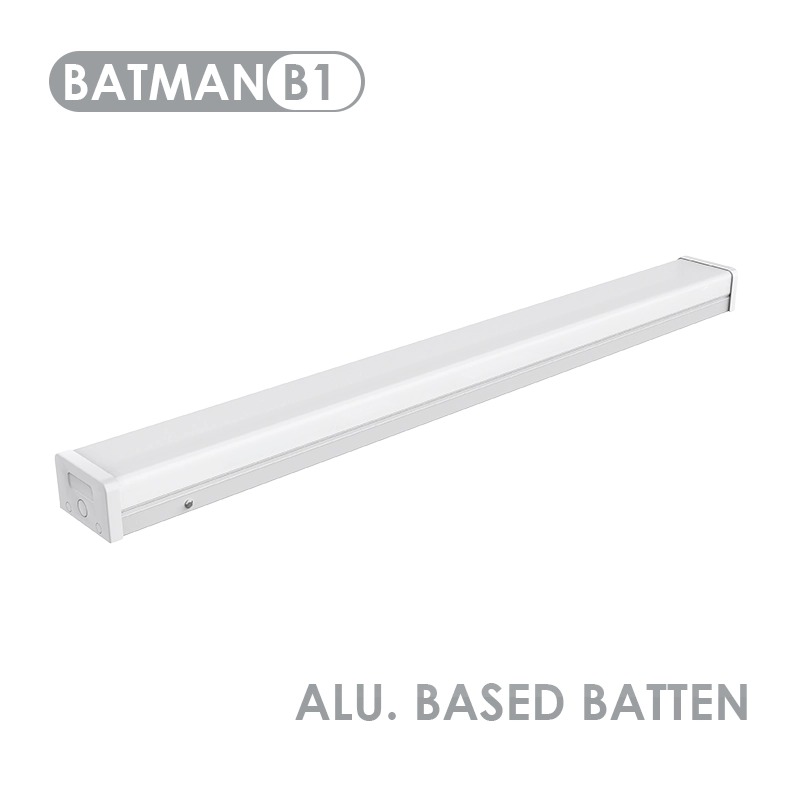
The Batman B1-CCT is designed to replace outdated T5/T8 fluorescent battens with a modern, no-shadow aesthetic. It features a Tri-CCT switch (3000K/4000K/5700K) allowing for quick site-level adjustments. Its diffused optic provides a wide 155-degree glow that eliminates harsh shadows on the ceiling and walls.
-
Best For: Open-plan offices and retail showrooms.
-
Pro: Modular design allows for driver or LED strip replacement without removing the fixture.
2. Trilamp A8D/DA: Advanced Digital Tunability
The Trilamp A8D/DA represents the pinnacle of digital lighting control. Supporting the DALI 2.0 DT8 protocol, it allows for seamless color tuning from 2700K to 6500K via a single DALI address. This reduces the complexity of building automation and allows for precise scheduling of circadian scenes.
-
Best For: Smart offices and collaborative conference rooms.
-
Feature: Professional dimming from 0.01% to 100%.
3. Batman B2 All-Powerful: Scaling for Industrial-Style Offices
For large-scale continuous lines of light, the B2 All-Powerful is the engineering leader. Its visual splicing cover ensures that even in a 50-meter run, there is no visible gap or light leak. Combined with high-efficacy (185 lm/W) and smart sensors, it offers the fastest ROI in the Fanxstar catalog.
“Static lighting is a relic of the industrial age. Tunable white is the biological baseline for the 21st-century workplace.”
Implementation Strategy: Control and Connectivity
A tunable white light is only as good as its control system. Modern offices generally utilize two primary methods for managing CCT:
-
Wired DALI DT8: The global standard for commercial buildings. It provides bidirectional feedback, allowing the BMS to monitor fixture health and energy usage in real time.
-
Wireless Mesh (Zigbee/Bluetooth): Ideal for retrofit projects where pulling new control wires is too expensive. Users can adjust their local lighting via a smartphone app or a wall-mounted BLE switch.
Practical Installation Tips: Avoiding Glare and Shadows
-
Orientation: Always install linear fixtures parallel to the long axis of the desks to minimize “Veblen” reflections on monitors.
-
Lux Levels: Aim for 300 lux on general surfaces and 500 lux on dedicated work planes. Avoid “over-lighting,” which can be as fatiguing as under-lighting.
-
Daylight Harvesting: Pair your tunable white lights with photosensors. This ensures the lights dim when the sun is bright, maximizing energy savings while maintaining the target lux.
|
Office Zone |
Recommended Fixture |
Control Type |
|---|---|---|
|
Executive Offices |
Trilamp A8D (Tunable) |
DALI-2 / App Control |
|
Standard Cubicles |
Batman B1-CCT |
Manual Tri-CCT Switch |
|
Large Open Atriums |
Batman B2 Seamless |
Automated Circadian Control |
|
Break Rooms |
Trilamp A16 Linkable |
Occupancy Sensing |
Conclusion: Future-Proofing Your Workspace
The transition to tunable white linear lighting is a technical and economic necessity. By aligning your office environment with the biological needs of your team, you create a workspace that is healthier, more productive, and significantly more efficient. The LITOFIS series from Fanxstar provides the engineering rigor and design flexibility needed to meet the highest architectural standards. Whether you are aiming for LEED certification or simply seeking to reduce your operational overhead, high-efficacy tunable LEDs are the key to a sustainable corporate future.
FAQ
What is ‘Tunable White’ vs ‘CCT Selectable’?
Tunable white allows for smooth, continuous color adjustment (e.g., 2700K to 6500K) via a remote or BMS. CCT Selectable typically uses a physical switch on the fixture to choose between 3 specific settings (e.g., 3K, 4K, 5K) during installation.
Does tunable white save energy?
Directly, it uses the same amount of power as standard LED. However, because HCL systems often include advanced dimming and sensors, they typically result in a 30-50% lower energy bill than static systems.
Is a special driver needed for tunable white?
Yes. You must use a “Dual Channel” or “DT8” (Device Type 8) driver that can manage two independent strings of LEDs (Warm and Cool) within a single housing.
Can I install tunable white lights in an old office?
Absolutely. If the existing wiring cannot support DALI, you can use wireless Bluetooth Mesh controls which allow you to tuning CCT without any new wiring.
What is the ‘ WELL Building Standard’ for lighting?
WELL is a certification that prioritizes health. For lighting, it requires specific melanopic light levels, UGR < 19, and minimal flicker to ensure long-term occupant wellness.