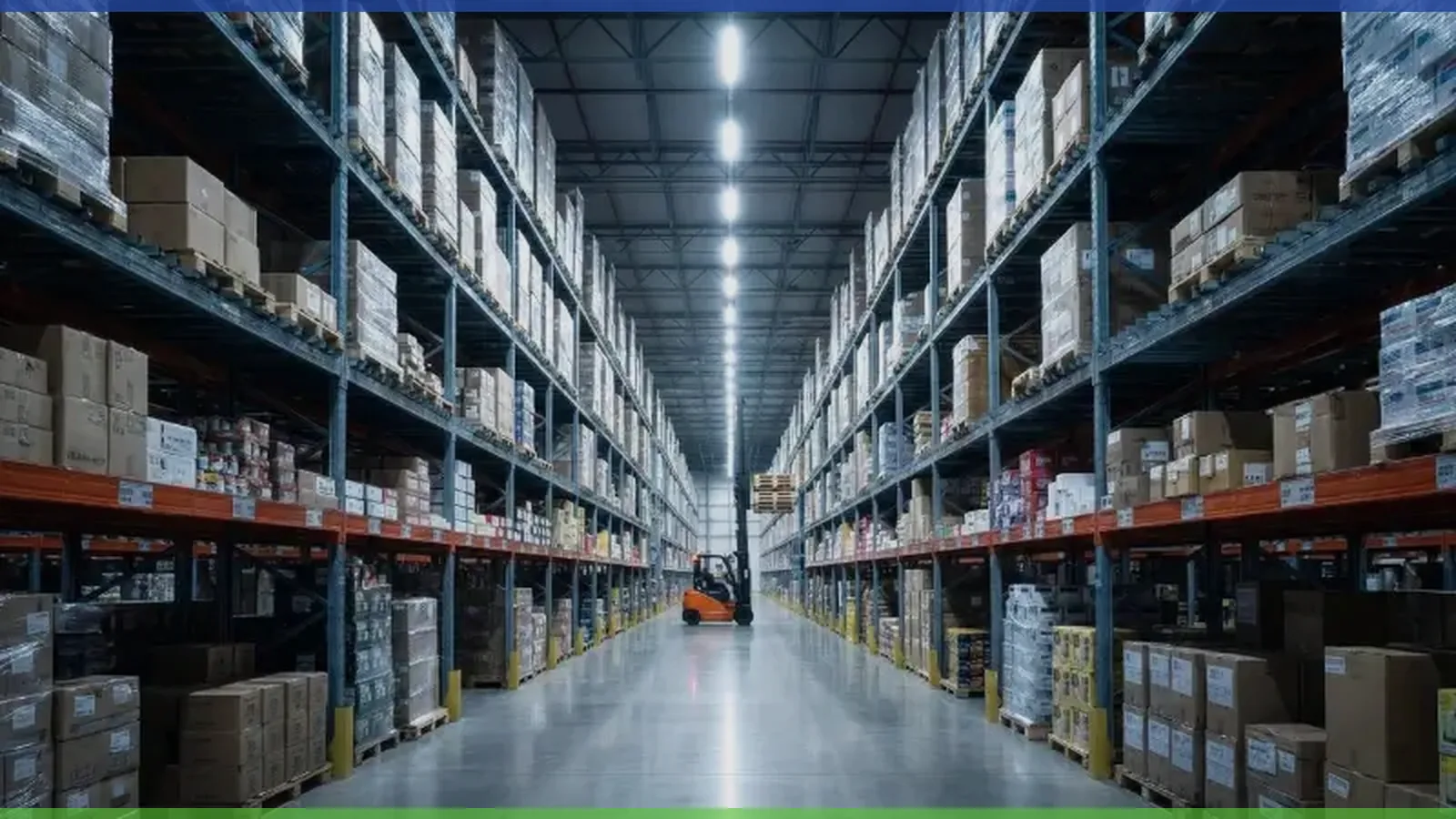
A hypermarket’s lighting system works harder than almost any other commercial installation. Running 12 to 16 hours daily across sales floors that can span 10,000 m² or more, with ceiling heights between 5 m and 9 m, the luminaires must simultaneously satisfy competing demands: adequate horizontal illuminance for staff tasks, strong vertical illuminance to pull product off the shelf face, food-specific color rendering for fresh zones, glare control for customer comfort, and energy efficiency metrics that justify the capital cost. Continuous row LED linear systems — also called LED linear trunking systems — have become the dominant solution for hypermarket general lighting precisely because they address all of these requirements in a single, field-configurable platform.
This guide explains how to specify a continuous row lighting system correctly: from ceiling-height-driven optic selection to zone-by-zone CCT and lux targets, through DALI control integration and the procurement criteria that separate engineering-grade systems from commodity offerings.
Key Takeaways
- Optic selection drives shelf illuminance — a double-asymmetric (bi-asymmetric) lens distributes light to both shelf faces simultaneously from a single row positioned over the aisle centre; single-asymmetric serves wall-perimeter runs.
- Zone-specific CCT and CRI requirements are non-negotiable — meat and fresh produce demand CRI ≥ 90 (R9 ≥ 50 for reds), general aisles accept CRI ≥ 80; mixing CCT in a single trunking run creates visual inconsistency that damages brand perception.
- EN 12464-1 targets for retail: 300–500 lx maintained on the horizontal plane for general aisles, with fresh food and checkout zones requiring 500–750 lx; uniformity ratio U₀ ≥ 0.60 across the task area.
- DALI 2.0 trunking with multi-circuit rails enables zone-level scene control — promotional endcaps at 150% ambient, overnight security at 20% — without rewiring as the planogram changes.
- Procurement red flags: lumen-per-watt claims measured at the driver input, not the luminaire output; IP ratings tested on modules but not the assembled trunking; missing ENEC or CE luminaire-level certification.
Why Hypermarkets Choose Continuous Row Systems Over Discrete Fixtures
The Aisle Geometry Problem
A standard hypermarket gondola aisle is 2.0–2.5 m wide, flanked by shelving reaching 1.8–2.2 m high. When a discrete downlight or high-bay is mounted directly above the aisle centre, it delivers strong horizontal illuminance on the floor but delivers relatively little light to the vertical shelf face — the surface where the customer’s eye actually lands. Research into retail visual behaviour consistently shows that shelf-face luminance drives purchase engagement more directly than floor-level brightness.
A continuous row system positioned above the aisle centre, fitted with a bi-asymmetric lens, solves this structurally. The lens projects the majority of luminous flux sideways into both shelf faces simultaneously, typically in a pattern described as ±25° double asymmetric or 90° × 15° (wide-by-narrow). The result: vertical illuminance on the shelf face can reach 60–80% of the horizontal floor illuminance, which lighting designers target as the minimum ratio for adequate product visibility.
Flexibility as the Planogram Changes
Hypermarkets replan their layouts seasonally. A conventional hard-wired batten system requires an electrician every time a gondola row shifts. A pre-wired trunking rail with 5-wire or 7-wire conductors — carrying phase, neutral, earth, plus DALI+ and DALI− signal wires — allows individual modules to be repositioned along the rail without touching electrical connections. The module simply clips off, slides to the new position, and clips back. This operational flexibility has made trunking the preferred infrastructure choice for all major European grocery retailers.
Optic Selection by Store Zone and Ceiling Height
The Four Standard Lens Profiles
| Lens Type | Beam Profile | Best Application | Mounting Height |
|---|---|---|---|
| Diffused / wide flood | 90–120°, symmetric | Checkouts, entrance, low gondola areas (shelf ≤ 1.5 m) | 3.0–4.5 m |
| Single asymmetric | 25–30° toward one side | Wall perimeter shelving, refrigerated case rows | 3.5–5.0 m |
| Bi-asymmetric (double asymmetric) | ±25° to both sides, narrow longitudinal spread | Central gondola aisles — standard hypermarket workhorse | 3.5–5.5 m |
| Narrow spot / 30–60° | Concentrated downward beam | Refrigerator top lighting, frozen aisle case tops, >6 m ceiling aisles | 5.5–9.0 m |
The choice is not permanent — a key advantage of trunking is that the optic module clips separately from the LED/driver module. Replacing a bi-asymmetric lens with a diffused lens in an area repurposed from a gondola zone to an open display takes minutes per fixture, with no rewiring or luminaire replacement.
Calculating Mounting Height vs. Row Spacing
For a bi-asymmetric lens with a ±25° throw angle at a 4.0 m suspension height, the illuminated shelf-face width extends roughly 1.8–2.0 m to each side. This matches a standard 2.0–2.5 m gondola aisle well, with one row positioned over each aisle centre. At a 5.0 m mounting height with the same lens, the throw widens to approximately 2.3–2.5 m per side — beginning to overlap into adjacent aisles — which is why narrower asymmetric angles (±15° or 60° × 15° flat beam) are preferred above 5.0 m. A Dialux or Relux simulation using the manufacturer’s IES/LDT photometric file is the only reliable way to confirm spacing before procurement; specifying without simulation is a project risk.
Zone-by-Zone Photometric and Color Specification
Recommended Parameters by Zone
| Store Zone | Maintained Lux (Ēm) | Uniformity (U₀) | CCT | CRI / R9 | UGR Limit |
|---|---|---|---|---|---|
| Entrance / transition | 300–400 lx | ≥ 0.60 | 3500–4000 K | CRI ≥ 80 | ≤ 22 |
| General gondola aisles | 300–500 lx horizontal; 200–350 lx vertical shelf face | ≥ 0.60 | 3500–4000 K | CRI ≥ 80 | ≤ 22 |
| Fresh produce / fruit & veg | 500–750 lx | ≥ 0.60 | 3000–3500 K | CRI ≥ 90, R9 ≥ 50 | ≤ 19 |
| Meat / seafood counter | 500–750 lx | ≥ 0.60 | 2700–3000 K (meat); 5000–6000 K (seafood on ice) | CRI ≥ 90, R9 ≥ 50 | ≤ 19 |
| Bakery / deli display | 400–600 lx | ≥ 0.60 | 2700–3000 K | CRI ≥ 90 | ≤ 19 |
| Frozen / refrigerated aisle | 300–500 lx | ≥ 0.60 | 4000–5000 K | CRI ≥ 80 | ≤ 22 |
| Checkouts | 500–750 lx | ≥ 0.70 | 4000 K | CRI ≥ 80 | ≤ 19 |
| Promotional endcaps | 750–1000 lx (target ≥150% of adjacent aisle) | ≥ 0.50 | 3500–4000 K | CRI ≥ 80 | ≤ 22 |
These targets align with EN 12464-1 requirements for retail workplaces and are consistent with guidance from industry resources including CIBSE LG5 (The Commissioning Code for Lighting) and the IES Lighting Handbook retail section. The UGR limits in particular are frequently under-specified — checkout operators spending 8-hour shifts under a luminaire have a genuine visual comfort interest in UGR ≤ 19, which requires micro-prismatic or batwing diffuser optics rather than a bare opal cover.
Why the CRI R9 Value Matters More Than the Summary CRI
The general CRI (Ra) is an average of 8 test color samples, none of which includes a saturated red. R9 — the 9th special color rendering index — directly measures how a source renders saturated red. For meat counters, produce sections, and flower displays, R9 is the decisive parameter: a source with Ra = 90 but R9 = 20 will render fresh meat as brownish and produce as dull. Demand R9 ≥ 50 from any supplier claiming high-CRI suitability for fresh food zones, and verify this on the LM-80 or third-party test report, not the catalog summary.

Controls Architecture: DALI 2.0 in a Multi-Zone Hypermarket
Why DALI 2.0 Replaced 1–10V in Retail
The 1–10V analog dimming signal requires a dedicated control wire pair per dimming zone, meaning a hypermarket with 20 independently controllable zones needs 20 separate wiring runs from the control panel. DALI (Digital Addressable Lighting Interface) 2.0, standardized under IEC 62386, transmits digital commands over a shared two-wire bus. Each DALI device has an individual address; the controller can address it individually, in groups, or as a broadcast. A single DALI bus supports up to 64 devices, and multiple buses can be networked under a central DALI gateway.
For a hypermarket, this means scenes — “trading hours full brightness,” “promotional endcap accent,” “overnight security 20%,” “cleaning crew task lighting” — can be programmed and triggered from a building management system (BMS) or a standalone DALI controller, without rewiring as zones are redefined when the planogram changes. The trunking rail’s pre-wired 5-wire configuration (L, N, PE, DALI+, DALI−) carries all of this from rail segment to rail segment; the installer doesn’t lay separate control cables.
Occupancy and Daylight Harvesting Integration
Hypermarkets that integrate PIR/microwave occupancy sensors into the trunking system typically report aisle-level energy savings of 20–35% on top of the base LED savings, by dropping aisles not currently occupied to 50% output and returning to 100% within 1–2 seconds of motion detection. Near glazed facades or skylights, daylight-harvesting sensors can maintain a constant lux target while reducing driver output proportionally — a technique that also extends LED and driver life by reducing average operating temperatures. The key specification requirement: ensure the driver in each trunking module is DALI 2.0 compliant (not legacy DALI 1 / IEC 62386 Part 101 only), and confirm the input device capability class (DT6 for LED drivers with color temperature tuning if tuneable white is required).
Trunking System Procurement: What to Specify and What to Verify
The Specification Checklist
| Parameter | Minimum Requirement | Verification Method |
|---|---|---|
| Luminaire efficacy | ≥ 130 lm/W (luminaire level, not driver input) | LM-79 test report from accredited lab |
| Lumen maintenance | L80B20 ≥ 50,000 hours | LM-80 LED module report + TM-21 projection |
| CRI (general zones) | Ra ≥ 80 | LM-79 photometric report |
| CRI R9 (fresh food zones) | R9 ≥ 50 | Spectral power distribution data with Ri values |
| IP rating — trunking modules | IP40 general; IP65 for refrigerated / wet prep areas | IEC 60529 test certificate on the assembled module |
| DALI compliance | IEC 62386 Part 207 (DALI 2.0 LED driver DT6) | DiiA certification or third-party test report |
| CE marking | Luminaire-level CE (LVD + EMC directives) | Declaration of Conformity + test reports |
| Rail wiring | 5-wire minimum; 7-wire recommended for DALI + emergency | Technical datasheet / factory sample inspection |
| IES/LDT photometric files | Required per optic variant for Dialux simulation | Provided by manufacturer; verify against LM-79 lumen data |
| Modular replaceability | Driver, LED module, and optic independently replaceable | Physical inspection; ask for exploded assembly drawing |
The Lumen Measurement Trap
The single most common misrepresentation in trunking system quotations is the lm/W figure. A driver operating at 90% efficiency feeding an LED module rated at 160 lm/W component-level will produce a system-level output closer to 130–140 lm/W after accounting for driver losses, thermal derating at operating temperature, and optical losses through the diffuser or lens. Demand LM-79 luminaire-level test data: the photometric report must document lumens out of the complete luminaire (not the bare LED module) at the rated ambient temperature, typically 25°C. Compare this figure to the quoted wattage and calculate the true luminaire efficacy yourself.
Refrigerated and Wet-Zone Linear Lighting
Where Standard Trunking Stops and Weatherproof Linear Takes Over
Standard trunking modules are rated IP40 — adequate for the dry gondola aisles that make up the majority of a hypermarket’s floor area. Refrigerated case rows, wet fish counters, produce misting sections, and food preparation areas behind the service counter require a different product class: weatherproof linear battens or tri-proof LED battens with IP65 or IP66 ratings, capable of withstanding direct spray cleaning.
For these zones, the key additional specifications are: operating temperature range (refrigerated aisles can reach −10°C at floor level; a fixture rated to −20°C or below provides appropriate margin), IK rating (IK08 or IK10 for fixtures exposed to trolley/forklift traffic), and food-safe diffuser materials. Polycarbonate (PC) diffusers, unlike acrylic (PMMA), resist the hydrocarbon-based cleaning detergents used in food processing environments without yellowing or crazing over time.
In practice, most hypermarket lighting designs use continuous trunking for the general sales floor and transition to weatherproof linear battens in the fresh food perimeter, with the two systems coordinated in CCT and mounting geometry to maintain visual coherence at the zone boundary.
Energy and Financial Case: Linear Trunking vs. Previous T5/T8 Fluorescent
A representative hypermarket with 8,000 m² of sales floor previously lit with T5 fluorescent trunking (at approximately 35 W/m² system load including gear losses) carries a connected lighting load of around 280 kW. Replacing this with a modern LED trunking system at 12–15 W/m² reduces the connected load to 96–120 kW — a reduction of 57–66%. At an electricity cost of €0.15/kWh (a conservative European commercial tariff) and 5,500 operating hours per year, the annual energy saving is approximately €145,000–€150,000. Against a typical LED trunking retrofit cost of €120,000–€180,000 (materials and installation combined for a 8,000 m² sales floor, excluding fresh-food zone weatherproof fixtures), the simple payback period is 12–15 months. DALI occupancy-sensing integration adds 15–25% to upfront controls cost but typically reduces the payback to under 12 months by delivering additional energy savings during off-peak periods.
These figures should be treated as indicative. Local electricity tariffs, legacy fixture wattages, operational hours, and installation labour rates vary significantly. A full energy audit using actual metered consumption from the existing system is always the basis for a reliable ROI calculation for a specific project.
OEM and Custom Specification Considerations
Lighting distributors and project developers specifying continuous row systems for hypermarket chains face a recurring challenge: the chain’s store design team specifies a particular CCT, CRI level, and trunking geometry for brand consistency, but the project’s budget requires manufacturing-level flexibility rather than a fixed-brand catalogue product. This is precisely where OEM customization of the trunking module architecture delivers value.
Key OEM considerations for retail chains include CCT and power selectability within a single module SKU — avoiding the inventory management burden of stocking separate SKUs for 3000K, 4000K, and 3500K variants across the same project — as well as custom trunking rail lengths to match exact aisle column grids without visible end gaps. Manufacturers with in-house lens tooling can also produce custom bi-asymmetric optics matched to a specific gondola height and aisle width, a meaningful advantage when the chain has non-standard shelf heights or unusually wide aisles.
Fanxstar’s linear lighting range and OEM/ODM customization capabilities address exactly this specification need — including selectable CCT/power within one fixture (the “SKUs-IN-ONE” approach), custom rail lengths, and CE-certified assemblies with DALI 2.0 driver compatibility for European retail projects.
Frequently Asked Questions
What is the difference between a continuous row system and individual linear battens for a hypermarket?
A continuous row (trunking) system uses a pre-wired rail as the electrical backbone, with individual LED modules clipping on and off without additional wiring. Individual battens are self-contained fixtures wired independently at both ends. The trunking system is preferable for hypermarkets because modules can be repositioned along the rail as gondola layouts change without any electrical work, DALI control wiring is built into the rail, and the visual result is a seamless band of light with no visible gaps or reflector breaks between modules. Individual battens are cost-effective for static, low-complexity installations where layout changes are infrequent.
Is IP40 sufficient for a hypermarket, or do I need higher-rated trunking?
IP40 is sufficient for dry gondola aisles — the majority of a hypermarket’s floor area. Any zone that is subject to direct water spray, humidity condensation, or regular wet cleaning — refrigerated case runs, fresh fish counters, produce misting areas, food prep zones behind service counters — requires IP65 or higher. Using IP40 modules in wet zones creates a maintenance liability: ingress over time degrades the driver and LED module, accelerating lumen depreciation and ultimately causing premature failure. Specify the IP level by zone, not a single specification for the entire store.
What mounting height is best for bi-asymmetric trunking in a standard 4 m hypermarket?
At a 4.0 m finished ceiling with a 0.3 m suspension drop (3.7 m above floor), a bi-asymmetric ±25° lens provides effective shelf illuminance from floor level to approximately 2.2 m shelf height on both sides of the aisle — covering most standard gondola heights well. If ceiling height is 4.5–5.0 m, consider a slightly narrower bi-asymmetric angle (±20° or a 90° × 10° flat-beam variant) to maintain adequate shelf-face luminance without excessive spill into adjacent aisles. Always validate with an IES file simulation before committing to rack and suspension hardware.
Can continuous row trunking be used in the refrigerated frozen food aisle?
Yes, but only with modules specifically rated for low-temperature operation. Standard LED drivers begin to exhibit reduced output and efficiency below 0°C; a refrigerated aisle reaching −10°C at floor level requires a driver cold-start rated to at least −20°C. Additionally, the lens and housing materials must be rated for temperature cycling between cleaning and operation phases. Specify cold-start temperature on the datasheet, and verify it is a tested parameter, not a generic “−20°C to +50°C” claim carried over from a non-refrigerated version of the same product.
How do I compare efficacy claims from different trunking suppliers?
Request LM-79 luminaire-level test reports from an accredited photometric laboratory (labs with ILAC/DAkkS/UKAS accreditation for LM-79 testing). The report documents total luminous flux out of the complete assembled luminaire at rated operating temperature. Divide documented lumens by documented input wattage for the true luminaire efficacy figure. Ignore component-level (LED module only) efficacy claims entirely — they cannot be compared directly to a system specification.
Specifying continuous row LED lighting for a hypermarket involves integrating photometric design, controls architecture, zone-specific color quality requirements, and procurement verification into a single coherent system. Fanxstar’s engineering team works directly with lighting distributors, retail fit-out contractors, and EPC firms to deliver CE-certified, application-specific linear LED systems — including custom trunking geometry, DALI 2.0-ready configurations, and weatherproof variants for fresh-food zones. Tell us about your project and get a free technical consultation.