Choosing Zigbee 3.0 for a commercial lighting project sounds straightforward until you’re on-site commissioning a 300-fixture warehouse and discover that half your luminaires won’t pair properly, the gateway keeps dropping nodes in the cold aisle, and your facility manager has no idea how to recover the mesh after a power event. The spec sheet said “Zigbee 3.0 compatible.” It didn’t say anything about fixture-level IP ratings, driver integration quality, or whether the hardware can handle a -25°C cold storage environment.
This guide is written for procurement managers, electrical contractors, and project developers who need to select Zigbee 3.0-enabled commercial fixtures correctly the first time — covering protocol fundamentals, fixture selection criteria, deployment traps, and how Zigbee compares to DALI and Wi-Fi in real commercial contexts.
Key Takeaways
- Zigbee 3.0’s mesh architecture makes it well-suited for medium-to-large commercial spaces, but fixture hardware quality — IP rating, driver stability, and operating temperature — determines whether it actually performs reliably.
- For projects above 200 fixtures, DALI 2.0 remains the more deterministic wired choice; Zigbee 3.0 wins on retrofits and installations where running new control cabling is prohibitive.
- Selecting an OEM manufacturer that integrates the Zigbee module at the driver level — rather than adding a clip-on controller — delivers dramatically better mesh stability and warranty coverage.
What Zigbee 3.0 Actually Means for Commercial Fixtures
The Protocol Basics Every Specifier Needs to Know
Zigbee is an IEEE 802.15.4-based wireless protocol designed specifically for low-power, low-data-rate device communication in mesh networks. Unlike Wi-Fi, which routes all traffic through a central access point, Zigbee operates as a self-organizing mesh where each router node can relay signals to other nodes, extending range and maintaining network resilience if individual fixtures fail or go offline.
The “3.0” designation matters because earlier Zigbee profiles (ZLL — Zigbee Light Link, ZHA — Zigbee Home Automation) created inter-vendor compatibility problems despite both claiming “Zigbee” compliance. Zigbee 3.0 unified these profiles under a single application layer standard, meaning certified Zigbee 3.0 fixtures from different manufacturers should interoperate through a common gateway. In practice, “should” requires validation — not all firmware implementations are equally robust — but the certification requirement meaningfully reduces the worst compatibility failures that plagued earlier deployments.
Key operating parameters for commercial applications: Zigbee operates on the 2.4 GHz ISM band with a typical per-hop range of 10–100 metres depending on environment. In a dense industrial building with steel racking and metal cladding, effective range per hop drops significantly. Mesh routing compensates — each router node extends coverage — but this places a minimum density requirement on fixture placement that must be planned at the design stage, not discovered during commissioning.
How Zigbee Compares to DALI and Wi-Fi in Commercial Settings
| Parameter | Zigbee 3.0 | DALI 2.0 (Wired) | Wi-Fi (2.4 GHz) |
|---|---|---|---|
| Topology | Wireless mesh | Wired bus (18/2 cable) | Star (AP-dependent) |
| Max nodes per controller | Hundreds (mesh) | 64 per bus universe | 32–64 (AP congestion) |
| Installation complexity | Low (no extra cable) | High (dedicated cabling) | Low (uses existing WiFi) |
| Interference sensitivity | Moderate (2.4 GHz) | Low (dedicated wire) | High (shared band) |
| Fault feedback / monitoring | Yes (via gateway) | Yes (native bidirectional) | Limited |
| Best use case | Retrofits, mid-scale commercial | Large commercial / institutional | Small offices, retail |
| Cost premium (controls) | Low–medium | Medium–high | Low |
It is worth noting that the industry is increasingly combining both approaches. The Zigbee Alliance and DALI Alliance (DiiA) have been actively developing gateway specifications to allow wired DALI networks and wireless Zigbee IoT infrastructure to operate as a unified system — meaning hybrid deployments that use DALI drivers within luminaires but expose them to Zigbee network management are increasingly viable and certified.
The 5 Fixture Selection Criteria That Actually Matter
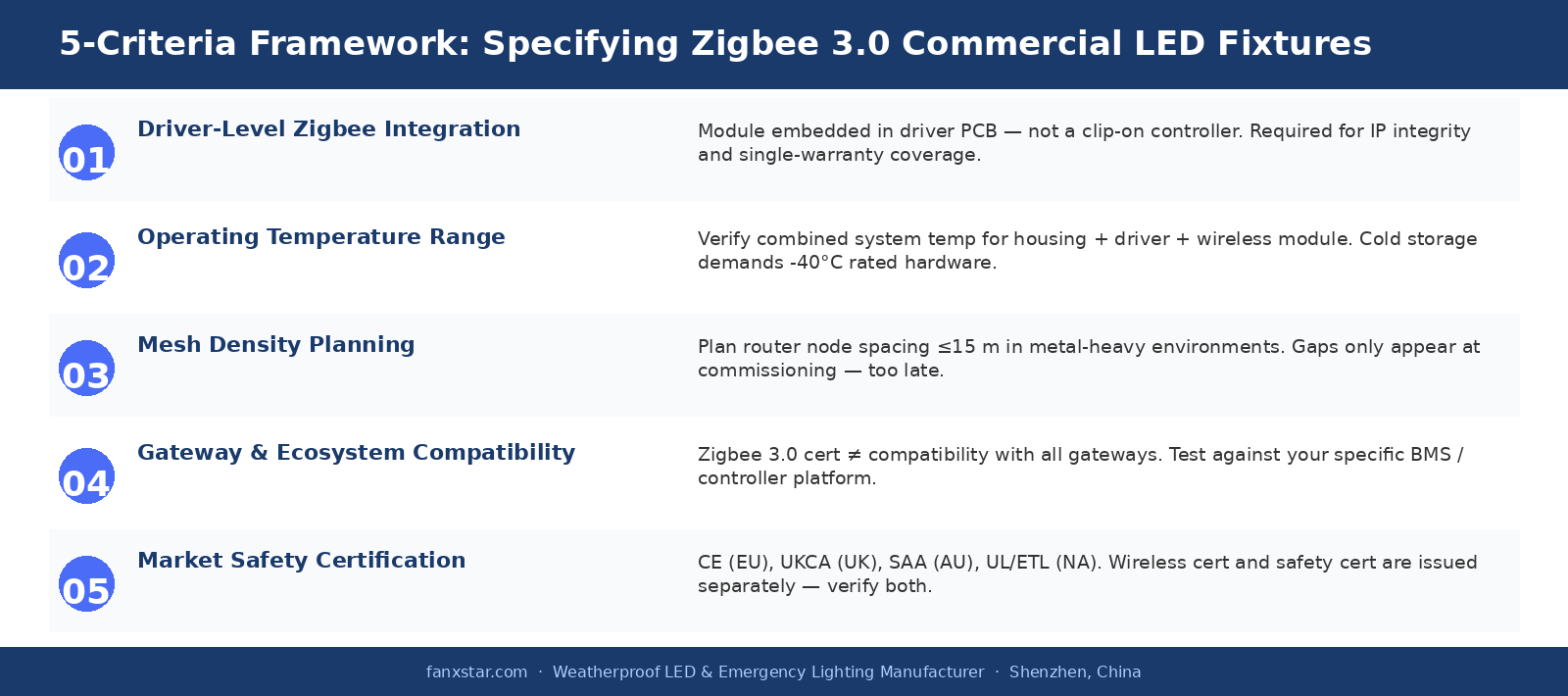
1. Driver-Level vs. Controller-Level Zigbee Integration
The most important specification question is not “is this fixture Zigbee 3.0 certified?” but rather “where in the fixture does the Zigbee module live?” There are two approaches in the market:
Driver-integrated Zigbee: The Zigbee 3.0 chipset is embedded directly in the LED driver PCB. The driver handles both power conversion and wireless communication as a single, sealed unit. This is the more reliable approach for demanding environments — there are no secondary connector points, no clip-on receiver susceptible to vibration, and the driver warranty covers both functions simultaneously.
Add-on controller integration: A separate Zigbee receiver module is wired inline between the main power supply and the driver (or between the driver and the LEDs). This approach is common in consumer-grade products and lower-cost commercial fixtures. It adds a failure point, typically has a lower environmental rating than the fixture itself, and may not maintain IP integrity if the module is not factory-sealed into the housing.
For industrial and commercial environments — warehouses, parking structures, cold storage, food processing — driver-integrated Zigbee in a fixture with at least IP65 rating is the minimum acceptable specification. For any environment involving washdown, water jets, or submersion risk, IP66 or IP67 rated housing is required.
2. Operating Temperature Range
Commercial Zigbee modules typically specify a storage temperature range and an operating temperature range. These are not the same. A module rated -20°C to +70°C storage may only operate reliably from -10°C to +55°C under load. In a cold storage facility running at -25°C, a fixture that “passes” a basic shelf temperature spec will fail in service.
Verify the fixture’s complete system operating temperature — not just the LED module or the housing, but the driver and wireless module combined. For deep-freeze cold chain applications, look specifically for fixtures with tested and warranted performance at -40°C. This specification is not marketing language; it requires active thermal management in the driver design and, often, low-temperature-rated conformal coating on the PCB.
3. Mesh Density Planning and Router Node Count
A Zigbee mesh requires a sufficient density of router-capable nodes (i.e., mains-powered fixtures) to maintain reliable mesh paths to all end devices. Battery-powered sensors and switches act as end devices and rely on router nodes to relay their messages. In a large warehouse or multi-floor commercial building, the ratio of router nodes to end devices and the physical spacing between routers is a network design question — not just a fixture quantity question.
A common planning error is spacing fixtures too far apart in high-bay areas, creating mesh gaps that only appear during commissioning when certain zones refuse to join the network. The practical guideline for open industrial environments is to plan for router node spacing of no more than 10–15 metres in metal-heavy or obstructed environments. In open-plan offices or retail with minimal obstruction, 20–30 metre spacing is generally adequate.
4. Gateway and Ecosystem Compatibility
Zigbee 3.0 certification confirms the fixture can interoperate with other certified Zigbee 3.0 devices — it does not guarantee it will work with every gateway or building management system (BMS) integration. Before specifying fixtures for a commercial project, confirm the gateway platform that will be used and verify that the fixture manufacturer has tested their firmware against that specific gateway.
Common commercial gateway platforms include Tuya-based industrial controllers, Samsung SmartThings, and custom BMS gateways with Zigbee interfaces. For enterprise-grade building management integration (connecting to BACnet, KNX, or Modbus systems), a dedicated Zigbee-to-BMS protocol gateway is typically required as an intermediary layer.
5. Certification for Target Market
Zigbee 3.0 certification covers the wireless protocol. It does not certify the fixture for the electrical safety standards of your target market. For EU commercial projects, CE marking and relevant EN standards apply. For UK, UKCA and BS EN compliance. For Australian projects, SAA certification is required. For North American projects, UL or ETL listing covers safety.
A common procurement error is sourcing Zigbee-certified fixtures from manufacturers who hold the wireless certification but lack the safety certification for the installation country. Verify both independently.
Where Zigbee 3.0 Performs Best in Commercial Settings
Warehouse and Cold Storage Facilities
Large warehouse facilities are among the strongest use cases for Zigbee-controlled LED lighting, primarily because the combination of occupancy sensing with daylight harvesting — both easily integrated as Zigbee end devices — can deliver significant energy savings in spaces with irregular occupancy patterns. Warehouses operating 24/7 on fixed-schedule lighting represent one of the least efficient lighting configurations in commercial real estate, and the ability to implement aisle-by-aisle occupancy dimming via Zigbee without running separate control cabling is a compelling ROI driver.
Cold storage creates additional fixture requirements. Standard Zigbee modules are not rated for sub-zero operation. For frozen storage (-20°C and below), fixture selection must specifically address cold-rated drivers, low-temperature LEDs, and cold-resistant cable entry glands. Fixtures rated for -40°C operating temperature with IP66 sealing represent the appropriate specification for deep-freeze cold chain environments.
Parking Structures and Multi-Level Car Parks
Multi-level car parks benefit from Zigbee-enabled occupancy sensing for significant energy savings: real-world energy savings calculations for car park LED upgrades demonstrate measurable reductions in operating costs when occupancy-based dimming is deployed effectively. The Zigbee mesh’s ability to maintain communication through concrete slabs (with adequate router density) makes it workable in multi-level structures, though each level may need its own gateway connection point rather than relying on mesh propagation across floor slabs.
Food Processing and Industrial Wash-Down Environments
Food processing facilities combine challenging environmental requirements — high-pressure washdown, chemical cleaning agents, temperature cycling, high humidity — with lighting control needs (occupancy, production-zone dimming, inspection lighting). Zigbee-controlled fixtures in these environments require IP66 or IP67 rated housings with factory-sealed driver-integrated wireless modules. Clip-on Zigbee receivers are not appropriate for washdown environments regardless of their stated IP rating, as the connection point between the receiver and the fixture is a seal integrity vulnerability.
Where Zigbee Has Limits: Be Honest with Your Client
Large-Scale Projects with Complex Fault Monitoring Requirements
For commercial or institutional projects above approximately 200–300 individually addressable luminaires where fault monitoring, energy sub-metering per fixture, and deterministic dimming response are critical requirements — hospital operating theatres, large-format retail, airport terminals — DALI 2.0’s bidirectional, wired communication offers more reliable fault reporting and deterministic control response than Zigbee’s wireless mesh. DALI 2.0 allows each driver to report its own fault status, energy consumption, and run hours directly to the building management system without relying on mesh path integrity.
This doesn’t mean Zigbee is the wrong choice for large projects — but it means the choice should be made deliberately with eyes open to the trade-offs, not by defaulting to Zigbee because it doesn’t require cable.
Environments with Dense 2.4 GHz RF Congestion
Warehouses and industrial facilities with high density of Wi-Fi access points, industrial wireless equipment, and Bluetooth devices operating on the same 2.4 GHz band can create interference conditions that reduce Zigbee mesh reliability. Channel planning (Zigbee supports channels 11–26 within the 2.4 GHz band, allowing it to avoid most Wi-Fi channels) can mitigate this, but it requires deliberate network design and is not automatic.
OEM Zigbee Integration: What to Ask a Manufacturer
For distributors and project developers sourcing Zigbee-capable luminaires from OEM manufacturers, the fixture datasheet is the starting point, not the endpoint. The following questions should be part of any pre-order technical review:
Is the Zigbee module driver-integrated or add-on? What is the operating temperature range of the complete luminaire system (housing + driver + wireless module)? What Zigbee certification number does the module hold — and can you provide the certification document? Which gateway platforms has the firmware been tested against? Is the fixture’s IP rating maintained with the Zigbee antenna exit point sealed? What is the warranty position if the wireless module fails — is it covered under the fixture warranty or treated as a separate component?
Manufacturers who have invested in genuine Zigbee 3.0 integration at the driver level will answer these questions quickly and specifically. Those who have bolt-on wireless as an afterthought typically provide vague or incomplete answers to questions three through six.
Fanxstar’s weatherproof LED line includes models with integrated smart control module options — combining IP66-rated industrial housing with driver-level wireless integration for demanding environments. For projects requiring Zigbee-enabled weatherproof fixtures with cold-resistant specifications, explore Fanxstar’s weatherproof LED solutions or review our OEM customization capabilities for application-specific Zigbee integration requirements.
Frequently Asked Questions
Can Zigbee 3.0 fixtures work alongside DALI 2.0 drivers in the same installation?
Yes — hybrid installations are both technically feasible and increasingly common. The approach uses DALI 2.0 drivers within each luminaire for precise local dimming and fault reporting, while a Zigbee-to-DALI gateway translates Zigbee wireless commands into DALI bus instructions. The Zigbee Alliance and DALI Alliance have jointly developed gateway specifications supporting this integration. In practice, it allows an existing wired DALI infrastructure to be managed wirelessly via Zigbee controllers and BMS systems, without replacing the DALI drivers.
How many Zigbee 3.0 fixtures can one gateway handle?
Most commercial-grade Zigbee gateways support 50–200 directly-paired devices, though the practical ceiling for a stable, responsive mesh is typically lower — around 100–150 luminaires per coordinator gateway in a well-designed installation. For larger installations, multiple gateways connected to a central building management system is the standard architecture. The mesh network itself can extend far beyond these numbers, but gateway processing capacity and response time become limiting factors at scale.
What IP rating is required for Zigbee luminaires in outdoor or washdown environments?
For outdoor commercial environments with weather exposure, IP65 is the minimum — providing dust-tight protection and resistance to low-pressure water jets from any direction. For environments with direct water jet spray (loading docks, car wash facilities, food processing plants with washdown protocols), IP66 is required. For environments with high-pressure washdown or frequent water immersion, IP67 or IP68 ratings are appropriate. The Zigbee module must be rated consistently with the fixture housing — a mismatch between the two (IP66 housing with an IP54 Zigbee add-on) is a common specification error.
Does Zigbee 3.0 work with Matter-compatible smart building systems?
Zigbee 3.0 and Matter are related but not the same standard. Matter runs over Wi-Fi/Ethernet and Thread — Thread is a low-power IP-based mesh protocol that is technically similar to Zigbee but not directly compatible. However, many Matter controllers and Thread border routers support Zigbee device integration via protocol bridges. Apple HomePod, Google Nest Hub, and Amazon Echo devices act as Thread border routers and can bridge to Zigbee devices depending on the specific gateway implementation. For commercial BMS applications, Matter support is still maturing; most enterprise-grade deployments continue to use dedicated Zigbee gateways with BACnet or Modbus upstream integration.
Specifying Zigbee-capable fixtures for a commercial or industrial project? The right fixture for a Zigbee deployment isn’t just about protocol compliance — it’s about matching IP rating, operating temperature, driver integration quality, and target-market certifications to your specific environment.
Fanxstar’s engineering team works directly with distributors and project developers to configure weatherproof and industrial-grade LED solutions with appropriate smart control integration. Tell us about your project and get a free technical consultation.