The driver selection decision is where most DALI 2.0 lighting projects succeed or fail — before a single luminaire is installed. Specify the wrong device type and you’ll need two DALI addresses to achieve what one DT8 driver handles natively. Ignore D4i when your client wants predictive maintenance data and you’ll be retrofitting drivers six months after handover. Choose a driver with “DALI-2 compatible” printed on the box rather than “DALI-2 certified” from DiiA’s product database and you’re exposing the entire system to interoperability failures that no amount of commissioning will fix.
This guide covers the DALI-2 certification hierarchy, how to read device type specifications (DT6, DT8, D4i), what to verify before specifying drivers for linear and tri-proof luminaire systems, and why the distinction between DALI-2 certification and DALI-2 compliance matters more than most procurement teams realize.
Key Takeaways
- DALI-2 certification (from DiiA) involves independently verified testing — not self-declaration. Always request the DiiA product database listing, not just a datasheet claim.
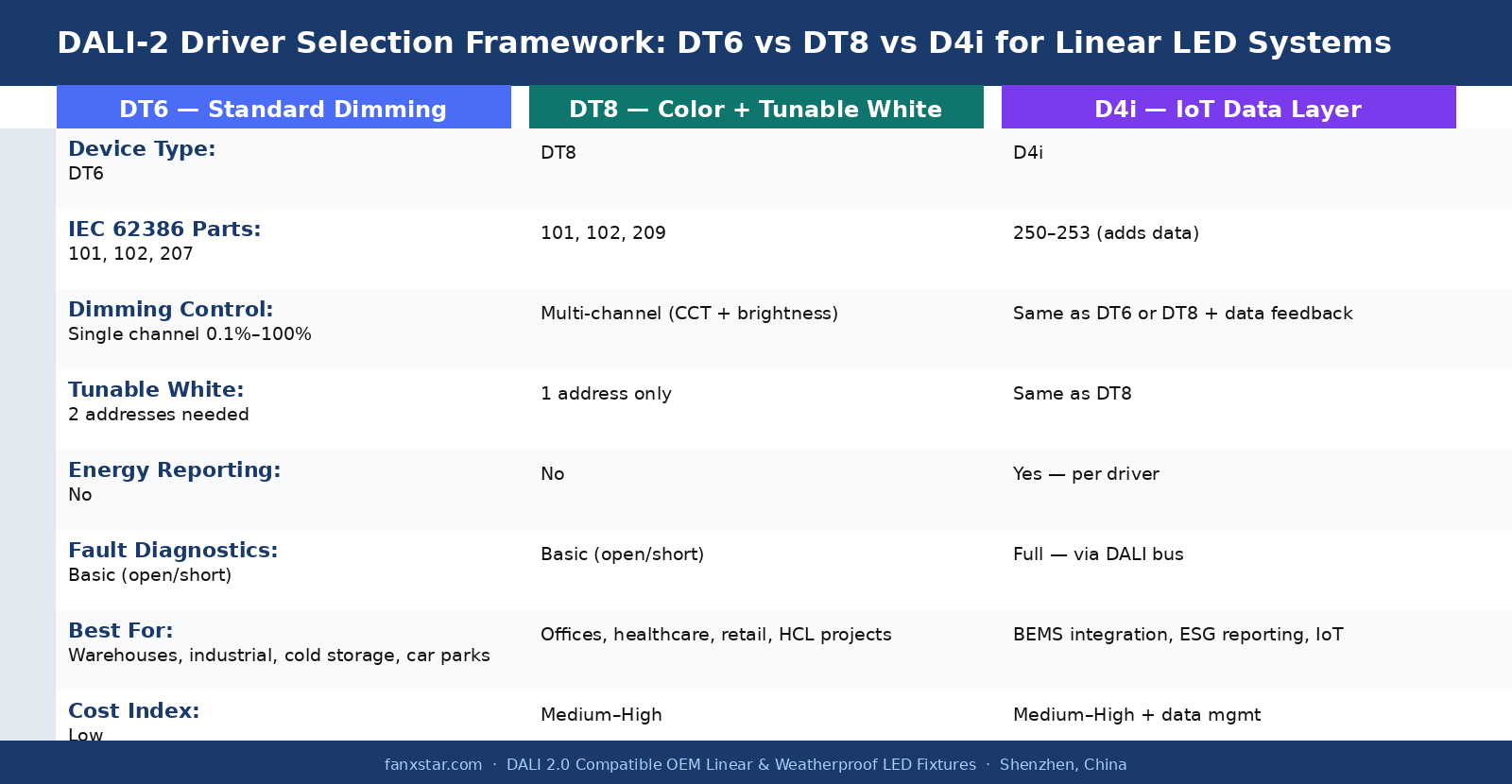
- DT6 is the right choice for most industrial and warehouse linear lighting; DT8 is the correct choice when tunable white or human-centric lighting is required, as it manages both channels with a single DALI address.
- D4i extends DALI-2 with per-driver energy reporting, fault diagnostics, and IoT data — essential for facilities with BEMS integration, ESG energy monitoring, or planned predictive maintenance programs.
DALI-2 Certification: What It Actually Means
Registered vs. Certified: The Distinction That Matters in Procurement
The DALI ecosystem has two distinct compliance levels that are often confused in product literature. The original DALI version-1 standard allowed manufacturers to “register” products through self-declaration — the manufacturer tested their own product against the DALI standard and declared compliance. No independent verification was required. This created a market where products labeled “DALI” could have significant interoperability problems despite technically passing internal tests.
DALI-2 certification fundamentally changes this by requiring independent verification of test results by DiiA before certification is granted. Every DALI-2 certified driver has been tested against the full IEC 62386 Part 101, 102, and 207 (for LED drivers) requirements, with results independently checked by the alliance. DALI version-1 registered products can still carry the original DALI logo — but they have not been through the same independent verification process.
The practical implication: when specifying drivers for a commercial or industrial linear lighting system, require DALI-2 certification and verify the product listing in the DiiA product database at digitalilluminationinterface.org/products. A “DALI-2 compatible” claim on a datasheet is not the same as DiiA certification. A listing in the database is the definitive confirmation.
The IEC 62386 Standard Structure: What Each Part Covers
Understanding the IEC 62386 part numbering is essential for reading DALI-2 driver datasheets accurately. The standard is structured in three layers:
Part 101 — General requirements: defines the physical and data link layer for all DALI devices. Any DALI-2 certified device must comply. Part 102 — Control gear requirements: defines how dimming controllers (including LED drivers) communicate with application controllers. Again, mandatory for DALI-2 LED driver certification. Part 207 — LED module control gear: the LED-specific extension of Part 102, covering the behavior specific to LED drivers. Together, Parts 101, 102, and 207 define the minimum requirements for a DALI-2 certified LED driver.
Device types DT6 and DT8 are defined in Parts 207 and 209 respectively. D4i certification extends the standard with Parts 250, 251, 252, and 253, which govern data feedback from the driver to the control system.
DT6 vs DT8: Which Device Type Does Your Linear System Need?
DT6: Single-Channel Dimming — the Right Choice for Most Industrial Linear Applications
DT6 is the most widely deployed DALI product type in the current market, and for good reason. LED drivers meeting this specification deliver on/off control and 0.1%–100% smooth dimming for single-color-temperature luminaires via a single DALI address. For warehouse lighting, industrial tri-proof fixtures, linear battens in logistics facilities, and most commercial office general illumination — where the requirement is dimming a fixed CCT output efficiently — DT6 is the technically correct and commercially optimal choice.
DT6 drivers supporting PUSH dimming (also written DALI + PUSH in some datasheets) add local dimming via a standard pushbutton without a DALI controller — useful for zones that need manual override without full BMS integration. This hybrid capability makes DT6 particularly flexible for industrial environments where some control zones need smart control while others remain on manual operation.
DT8: Dual-Channel Control for Tunable White and Human-Centric Lighting
DT8 drivers are defined under IEC 62386-209 and are designed specifically for color and color temperature control. The key functional difference is address efficiency: a DT8 driver controls both brightness and color temperature (tunable white) from a single DALI address, whereas achieving the same result with DT6 requires two separate DALI addresses — one for each LED channel (warm white and cool white). In a DALI bus with a hard ceiling of 64 addresses per bus universe, this halves your effective luminaire count for tunable white applications if DT6 is used instead of DT8.
DT8 is the appropriate specification for healthcare facilities, educational environments implementing human-centric lighting protocols, retail spaces with color-accurate display lighting requirements, and commercial offices where circadian-rhythm-aware lighting is part of the WELL or LEED specification. DT8 systems typically cost 20–40% more than equivalent DT6 setups, making the type selection a deliberate budget decision, not a default.
DT6 and DT8 drivers can be mixed on the same DALI bus without conflict, as both use the same physical and data link layer. However, the application controller must support the DT8 command set (Part 209) to take advantage of DT8 color control capabilities.
D4i: Data-Enabled Drivers for IoT-Ready Lighting Infrastructure
D4i is a DALI-2 certification extension, not a separate standard. A D4i certified driver complies with DALI-2 Parts 250, 251, 252, and 253, which enable the driver to report structured data about its own operation to the lighting control system. D4i drivers provide real-time feedback on light fixture status, energy consumption, and fault diagnostics via DALI bus communication, with the data structured to feed directly into building energy management platforms.
The practical application of D4i in linear lighting systems covers three use cases. First, energy sub-metering: each driver reports its actual power consumption independently, enabling granular energy accounting by zone, floor, or production area — valuable for facilities with ISO 50001 energy management obligations or ESG carbon reporting. Second, predictive maintenance: driver operating temperature, run hours, and lumen depreciation signals can trigger planned maintenance before fixture failure, eliminating the unplanned downtime cost of reactive maintenance cycles. Third, commissioning validation: DALI Part 252 allows luminaire data (light output, CCT, power) to be read back from the driver during commissioning, confirming the installed system matches the design specification.
Specifying DALI-2 Drivers for Linear and Tri-Proof Luminaires
Form Factor and Physical Fit
Linear luminaires — whether standard LED battens, tri-proof IP65/IP66 fixtures, or aluminum-profile linear systems — impose strict physical constraints on the driver. The two most common linear driver form factors are:
Non-isolated slim-line drivers: Typically 25–30mm in height, designed to fit inside a narrow linear housing. Non-isolated topology (where the output shares a reference with the AC input) is appropriate for enclosed, earthed luminaire housings but requires the LED circuit to be inaccessible to users. Most commercial tri-proof and batten fixtures use non-isolated drivers for their profile advantage. Isolated drivers: Output is electrically isolated from the AC supply, allowing SELV (Safety Extra Low Voltage) output circuitry and safer access to the LED side. Required for luminaires where the LED circuit may be user-accessible (e.g., strip-light systems, some architectural profiles). Isolated drivers are typically physically larger and more expensive.
For tri-proof and vapor-tight industrial fixtures — the core weatherproof product category for warehouses, cold storage, and food processing — non-isolated slim-line DALI-2 drivers in the 25–80W range are the standard specification. Confirm the physical height constraint with the luminaire manufacturer before ordering drivers for customized or OEM fixture builds.
Input Voltage Range and Dimming Floor
Commercial linear systems in Europe and most export markets operate from 220–240V AC, but for global OEM products, a wide input range of 90–305V AC covers single-phase supplies in North America, EU, and Asia-Pacific without driver variants. Confirm the input range of any driver specified for multi-market OEM production to avoid market-specific SKU proliferation.
The dimming floor — the minimum achievable output before the driver goes to off — matters significantly in occupied spaces. Most DALI-2 certified drivers specify a minimum dimming level of 1% or 0.1%. The difference is meaningful in practice: a 1% floor means some residual light output is always visible at minimum setting, while a 0.1% floor approaches true off via dimming. For conference rooms, hospitality environments, and certain industrial inspection zones, the dimming floor specification must be confirmed against the project requirement, not assumed from the DALI-2 certification level alone.
Built-in DALI Bus Power vs. External Bus Supply
DALI networks require a bus power supply providing 16V DC at up to 250mA on the two-wire bus. In traditional DALI installations, this is provided by a dedicated external bus power supply — an additional component in the control cabinet. Many current DALI-2 and D4i certified drivers include an integrated bus power supply, eliminating the external component requirement. Drivers with built-in DALI bus power simplify the system and boost installation flexibility, particularly in linear luminaire builds where space in the control compartment is limited.
When specifying multiple drivers on a single DALI bus, confirm that only one bus power supply is active on the bus at a time. Multiple active bus power sources on the same DALI universe is a common commissioning error that creates bus voltage instability and unreliable device addressing.
Key Verification Points Before You Specify
| Verification Point | Why It Matters | How to Check |
|---|---|---|
| DiiA Product Database listing | Confirms independent certification — not self-declaration | Search digitalilluminationinterface.org/products by brand/model |
| Device Type (DT6 / DT8) | Wrong type wastes DALI addresses or limits color control | Confirm explicitly in datasheet — “DT6” or “DT8” must be stated |
| D4i certification (if required) | Enables energy data, fault reporting, IoT integration | Request DiiA D4i certification document separately from DALI-2 cert |
| NFC programmability | Allows site-level parameter changes without dedicated programmer hardware | Confirm NFC app compatibility and supported parameters |
| Emergency lighting compatibility | DALI Part 202 / 202a certification required for maintained emergency systems | For emergency-capable fixtures, verify DT1 (emergency) certification separately |
| Interoperability testing with target controller | DALI-2 certification does not guarantee compatibility with all masters | Request a small-scale pilot before full project commitment |
| Driver physical dimensions vs. fixture housing | Slim-line drivers (≤25mm H) required for most linear tri-proof profiles | Confirm H×W×L against luminaire housing compartment dimensions |
DALI-2 in Weatherproof and Industrial Linear Fixtures: Where It Adds Real Value
Industrial Tri-Proof and Vapor-Tight Applications
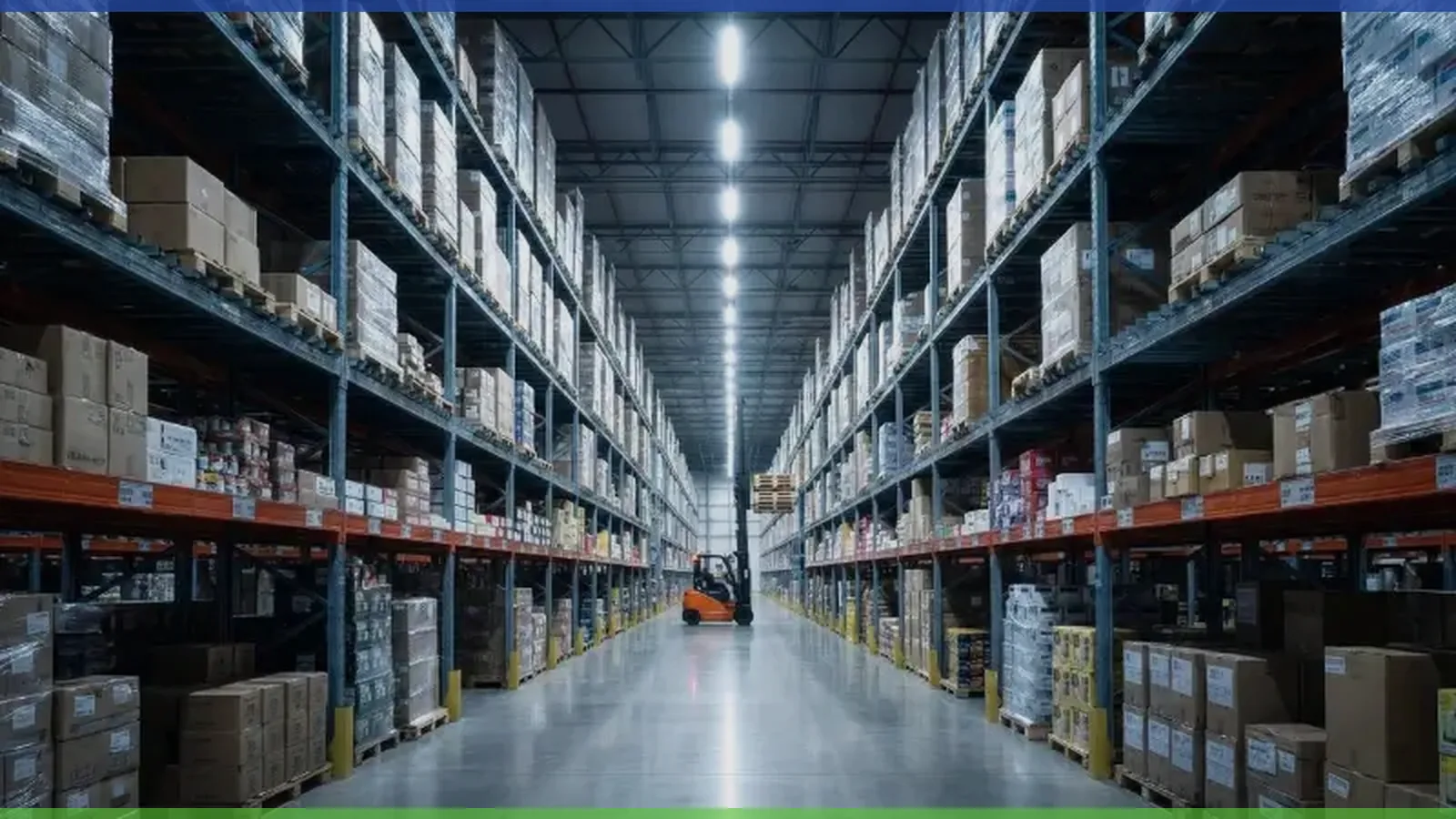
DALI-2 integration in weatherproof linear fixtures — tri-proof lights, vapor-tight battens, IP65/IP66 linear industrial fittings — adds a layer of system intelligence that basic 0-10V or switched circuits cannot match. In a large warehouse or food processing facility running dozens of DALI-2-equipped linear fixtures, the ability to remotely monitor each driver’s operational status, receive fault alerts before failures occur, and generate zone-level energy consumption reports transforms the lighting infrastructure from a utility cost into a managed asset.
The practical requirement is that the driver must be appropriately rated for the installation environment. DALI-2 certification covers control protocol compliance; the driver’s own IP rating, operating temperature, and safety certification must match the installation environment independently. For cold chain warehouses, confirm the driver operates reliably at the minimum ambient temperature (down to -40°C for deep-freeze applications). For washdown environments, the driver must either be housed within the sealed IP66+ fixture enclosure or carry its own matching IP rating.
Fanxstar’s linear and tri-proof weatherproof ranges are designed for OEM integration with DALI 2.0 driver options — see our customization capabilities for driver-level integration in IP65/IP66 rated linear housings, or explore the weatherproof product range for standard configurations.
Emergency Lighting Integration via DALI-2
DALI-2 has a defined device type for emergency lighting: DT1, specified under IEC 62386 Part 202/202a. DALI-enabled emergency drivers allow the building management system to perform automated self-test functions, record test results, and report emergency battery status — replacing the manual functional test process with automated compliance logging. For commercial buildings in EU and UK markets where BS EN 50172 / EN 1838 emergency lighting testing documentation is required, DALI-based automated testing significantly reduces the ongoing compliance management burden. Our emergency lighting range includes options with integrated self-test functions compatible with DALI-based building management workflows.
Frequently Asked Questions
Can DALI-2 DT6 and DT8 drivers be used on the same bus?
Yes — DT6 and DT8 drivers are fully interoperable on the same DALI bus. Both comply with Parts 101 and 102 of IEC 62386, which define the shared physical and communication layer. A DALI-2 application controller that supports both Part 207 (DT6) and Part 209 (DT8) commands can address and control both driver types on a single bus simultaneously. The controller must be programmed to use DT8 commands for DT8 devices and DT6 commands for DT6 devices — mixing the command types for the wrong device type results in undefined behavior, not hardware damage.
What is the maximum number of luminaires per DALI-2 bus?
A standard wired DALI universe supports a maximum of 64 control gear addresses (DALI addresses 0–63) plus 64 input device addresses. This means a single DALI controller can directly address 64 independently dimmable luminaires. For larger installations, multiple DALI universes managed by a single application controller are the standard architecture — commercial DALI controllers typically manage 2–32 universe outputs. The DALI+ wireless specification, launched in 2024 for Thread-based IP networking, extends DALI networks beyond the physical bus constraint to span multiple buildings via IP infrastructure.
Does DALI-2 certification cover emergency lighting driver requirements?
DALI-2 certification for emergency lighting drivers requires compliance with additional standard parts beyond the standard LED driver certification. Emergency battery luminaire drivers must comply with IEC 62386-202 and 202a (DT1), which cover self-contained emergency lighting behavior, test functions, and fault reporting. This certification is maintained separately from standard DT6/DT8 DALI-2 certification — a driver can be DALI-2 certified for general dimming (DT6) and separately DALI-2 certified for emergency (DT1). When specifying maintained or non-maintained emergency fittings with DALI control, confirm both certifications are present in the DiiA database.
What is the difference between CLO and D4i on a DALI-2 driver?
CLO (Constant Lumen Output) is a driver function — not a certification level. A driver with CLO automatically increases current output over the luminaire’s lifetime to compensate for LED lumen depreciation, maintaining consistent illuminance levels without manual adjustment. D4i is a data certification extension that allows the driver to report its operational data (including the CLO compensation level it is currently applying) back to the building management system. In high-value commercial or institutional settings, specifying drivers with both CLO and D4i provides both automatic performance maintenance and transparent data reporting of that maintenance activity to asset management platforms.
Designing a DALI-2 enabled linear lighting system? Specifying drivers is only one layer of a successful DALI project — fixture housing, IP rating, operating temperature, and application controller compatibility all need to align. Our engineering team has hands-on experience integrating DALI 2.0 drivers in IP65/IP66 linear and tri-proof luminaire builds for European and global B2B clients.
Submit your project specification for a free technical review.