Ceiling lights alone do not solve workshop lighting. The moment a worker stands at a bench, their own body casts a shadow directly onto the working surface — the very area requiring the most light. Under-cabinet battens mounted on the underside of shelving or wall-hung storage units solve this problem directly: they bring the light source close to the work plane, eliminate task shadows, and do so in a form factor slim enough not to interfere with the workspace below. Choosing the right fixture, however, requires more thought than simply picking the brightest LED bar that fits. This guide covers the full specification path: lux targets, mounting geometry, IP ratings, CCT selection, driver quality, and linkability for professional and commercial workshop environments.
Key Takeaways
- Target 500–750 lux at the bench surface for most woodworking, metalworking, and assembly tasks — this requires calculating the fixture’s lumen output at the actual mounting-to-bench-surface distance, not relying on rated lumens alone.
- Mount under-cabinet battens 15–25mm set back from the cabinet’s front face to minimise direct glare into the worker’s eyes while maximising coverage across the bench depth.
- For workshops with any exposure to dust, metalworking swarf, or occasional moisture, an IP44 or IP65-rated batten is the correct specification — not an IP20 fixture intended for dry residential use.
- 4000K–5000K CCT with CRI ≥ 90 is the appropriate target for professional workshop environments; the higher CCT improves contrast for fine detail work and colour judgement on materials like wood grain, paint, and metal finish.
The Fundamental Problem Under-Cabinet Battens Solve
Why Ceiling Lighting Creates Bench Shadows
In any workshop where wall-hung cabinets or shelving units are installed above a bench, ceiling-mounted lights — even well-designed high-bay or batten fixtures — produce a persistent shadow zone directly at the front of the work surface. The physics is straightforward: the cabinet overhang intercepts the ceiling light’s beam before it reaches the bench. The shadow is typically deepest at the back of the bench nearest the wall and shallowest at the front edge — which is an unfortunate inversion of where the most demanding work happens. Workers dealing with this shadow either lean to the side, install angled spotlights at awkward angles, or simply accept reduced visibility. Under-cabinet battens eliminate the problem at its source by placing the light below the obstruction, aimed directly down at the bench.
The Shadow-Free Geometry of Under-Cabinet Mounting
Workshop lighting guides consistently recommend pairing overhead battens with under-cabinet task lighting to achieve zero shadows on the work surface. When a batten is mounted at approximately cabinet-underside height — typically 400–700mm above the bench surface — the light source is far enough below the ceiling that it is not obstructed by the worker’s head, but close enough that the beam delivers high illuminance at the bench with minimal loss. This geometry also means a relatively modest lumen output achieves the target lux level, compared to the much higher output needed from a ceiling fixture to overcome the inverse-square-law losses at greater mounting distances.
Lux Targets for Different Workshop Tasks
Task-Based Illuminance Requirements
The correct lux target depends on what work is being done at the bench. Standard workshop lighting guidance breaks down illuminance requirements by task complexity: general assembly and tool use requires 500–750 lux; precision work including fine woodworking, intricate parts assembly, and soldering requires 1000–1500 lux; and inspection and quality control tasks require 2000 lux or more. For most professional workshops — woodworking, metal fabrication, electronics assembly, and repair — the 500–750 lux range is the practical baseline, with supplemental spotlighting added for specific inspection stations.
The important distinction is that lux is measured at the work surface, not at the fixture. Industrial lux guidance specifies measuring at work-plane height — for bench work, this means at bench-top level, not at floor level. A fixture’s rated lumen output must be converted to lux at the specific mounting distance using the formula: Lux = Lumens / Area (m²), adjusted for beam angle and fixture spacing. A 2000-lumen batten mounted 400mm above the bench at 120° beam angle illuminates approximately a 0.8m × 0.8m area at around 400 lux. For 750 lux over a 1.2m bench run, two such fixtures spaced 600mm apart would be appropriate.
Quick Lumen Sizing Guide
As a practical starting point: for a standard 600mm-deep workshop bench, a 4-foot (1200mm) LED batten delivering 2500–3500 lumens mounted at 500mm mounting height will typically achieve 500–700 lux across the full bench depth. This range accounts for the reflectance of a typical painted or laminate bench surface (approximately 50–70%). Dark-surface benches (raw timber, black steel) absorb more light and require either higher output or closer mounting. Task lighting specialists recommend targeting 200–500 lumens per foot of bench run as a practical sizing rule for under-cabinet applications. For a 1.2m (4-foot) bench, this equates to 800–2000 lumens minimum from under-cabinet sources — in addition to whatever ceiling lighting contributes.
Mounting Position and Geometry
How Far from the Front Face?
The mounting position of an under-cabinet batten significantly affects both task coverage and glare. If the fixture is mounted at the very front edge of the cabinet underside, the light source falls into the worker’s direct line of sight when they look up — causing glare. If it is mounted too far back against the wall, the beam misses the front portion of the bench where the worker’s hands are. Mounting guidance from task lighting specialists recommends positioning the fixture slightly set back from the front edge — typically 15–25mm — to hide the LED source from direct sightlines while keeping the beam centred on the work surface. For a 600mm-deep bench with cabinets mounted 450–500mm above, this set-back keeps the fixture hidden from normal working eye level while directing the beam across the full bench depth.
Additionally, setting the fixture 6–12mm back from the cabinet face creates a subtle shadow line along the cabinet front that makes the light source appear architectural rather than exposed — a small aesthetic detail that matters in fitted workshop and commercial joinery environments where visual finish is part of the specification.
Fixture Length and Spacing for Continuous Coverage
For bench runs longer than a single fixture, linkable battens allow multiple units to be daisy-chained from a single power supply, maintaining continuous illumination without breaks. Most commercial under-cabinet battens support linkability up to a stated maximum (commonly 5–15 fixtures per chain, depending on wattage). The fixture length should match or exceed the bench segment being lit — using a 600mm fixture over a 900mm bench segment will create dark zones at the outer edges. Where the bench run exceeds available fixture lengths, position the fixtures to overlap their beam coverage by 20–30%, not to leave a gap between them. LED task lighting layout guidance specifies that with 120° beam angles, a spacing-to-mounting-height ratio of approximately 1.2:1 ensures overlapping coverage without dark zones.
IP Ratings: Matching Protection Level to Workshop Environment
Why IP20 Is Wrong for Most Workshops
Many under-cabinet battens marketed for kitchens or offices carry an IP20 rating — no dust protection and no moisture protection. In a professional workshop environment, this is typically the wrong specification. Wood dust, metal swarf, grinding sparks, solvents, and intermittent moisture from washing parts or cleaning down the bench are all present to varying degrees. An IP20 batten will admit airborne dust into the driver and LED compartment over time, causing premature failure. Even in a clean metalworking environment, airborne metal particles are conductive — they settle on circuit boards and create short circuits far faster than dust does in a residential kitchen.
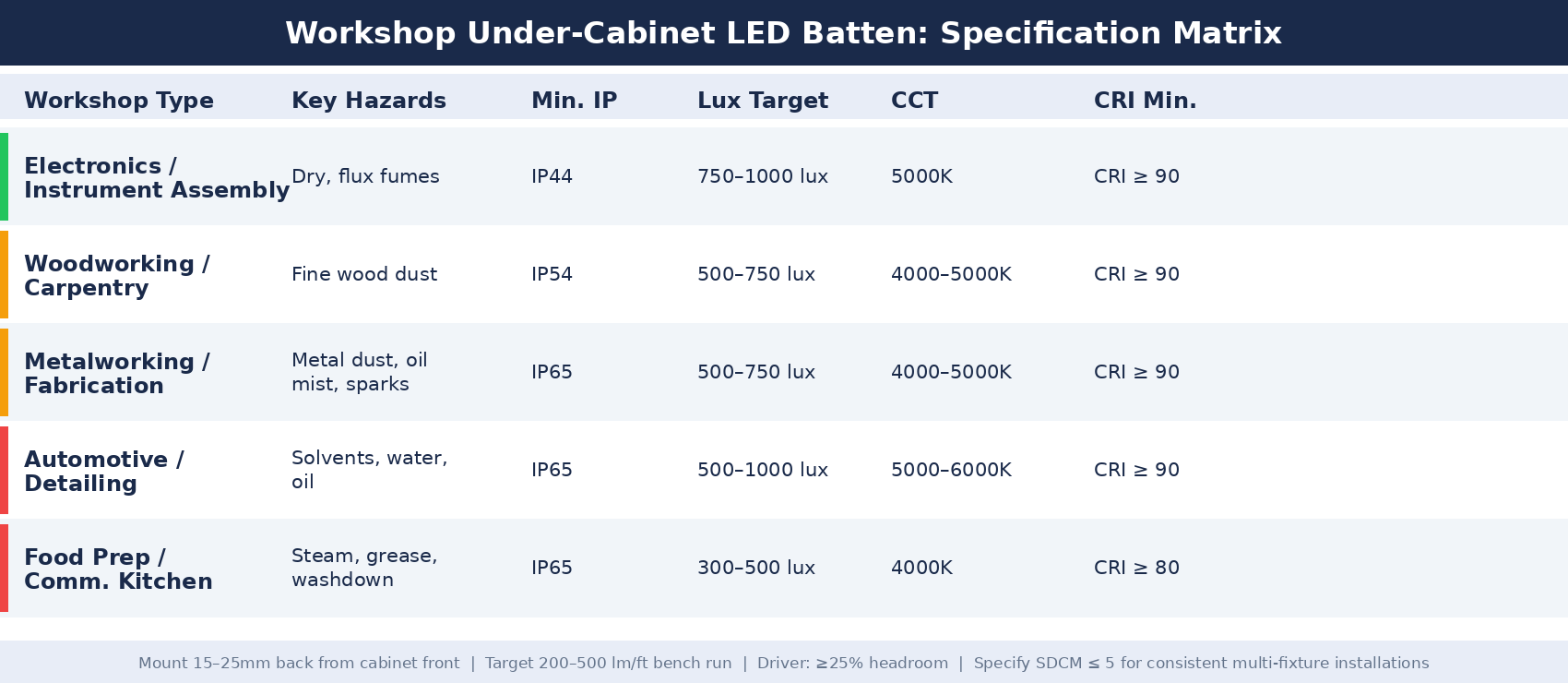
The appropriate IP specification depends on the specific workshop environment. A clean electronics assembly or instrument-making bench in a temperature-controlled room can accept IP44 (splash-protected). A woodworking bench with regular sanding produces fine airborne dust requiring IP54 minimum. A metalworking or welding bench, or any bench near a sink or washdown area, requires IP65 — a fully dust-tight and jet-wash-resistant fixture. Fanxstar’s weatherproof LED product range offers IP65 and IP66 rated linear battens designed for exactly these industrial environments — with sealed gaskets and dust-tight construction that withstand the conditions a standard residential under-cabinet light cannot.
| Workshop Type | Hazards Present | Min. IP Rating | Lux Target | CCT Rec. |
|---|---|---|---|---|
| Electronics / Instrument assembly | Dry, fine flux fumes | IP44 | 750–1000 lux | 5000K |
| Woodworking / Carpentry | Fine wood dust | IP54 | 500–750 lux | 4000–5000K |
| Metalworking / Fabrication | Metal dust, oil mist, sparks | IP65 | 500–750 lux | 4000–5000K |
| Automotive repair / Detailing | Solvents, water, oil | IP65 | 500–1000 lux | 5000–6000K |
| Food prep / Commercial kitchen | Steam, grease, washdown | IP65 | 300–500 lux | 4000K |
CCT and CRI: Getting the Visual Quality Right
Why 4000K–5000K Is the Right Range for Workshop Bench Lighting
Workshop environments benefit from a cooler colour temperature than residential spaces. Experienced workshop lighting practitioners consistently recommend 4000K–5000K for task surfaces where fine detail work, material inspection, and colour-sensitive assessment are required. At 4000K, a neutral white light provides clear contrast without the blue-heavy tint of 6000K+ fixtures that can cause eye fatigue over long work sessions. At 5000K, the light is close enough to natural daylight to make wood grain, paint sheen, metal finish, and material colour judgements reliable. For automotive detailing and paint matching specifically, 5000K is the minimum acceptable CCT — assessing paint colour under warm 3000K or 3500K light produces systematic colour errors.
Consistent colour temperature across all fixtures is also important. If a workshop has a mix of 4000K ceiling lights and 3000K under-cabinet battens, the transition between ambient and task light creates a visual distraction and makes it hard to judge materials correctly in different positions. Specify the same CCT for both ceiling and under-cabinet fixtures in a new installation, and add SDCM ≤ 5 (ideally ≤ 3) as a procurement requirement to ensure batch consistency.
CRI Requirements for Workshop Applications
CRI ≥ 90 is the appropriate specification for most workshop bench lighting. Below CRI 90, coloured materials — wood stains, paint finishes, metal platings, electronic component colour-coding — will be rendered with visible inaccuracy, increasing the risk of errors on colour-sensitive work. For applications involving colour-critical assessment (paint matching, stain colour selection, finish inspection), CRI ≥ 95 with R9 ≥ 80 brings the specification in line with what has been described for print shop and graphic arts environments. Standard LED under-cabinet battens often achieve only CRI 80 — check the datasheet before specifying and reject fixtures that do not state the CRI value explicitly.
Driver Quality, Dimming, and Linkability
Why Driver Quality Matters Under Cabinets
The driver in an under-cabinet batten is in an enclosed, limited-airflow environment — exactly the conditions that accelerate driver failure. A low-quality driver running at 100% load in a poorly ventilated cabinet underside will run hot, and heat is the primary driver failure mechanism. The same 20–25% wattage headroom rule that applies to LED profiles and ceiling fixtures applies here: specify drivers rated for at least 25% more than the actual connected load. This reduces thermal stress, extends service life, and reduces the risk of flickering as the driver degrades. Workshop lighting guides recommend selecting drivers with 20–30% wattage headroom for longer life and cooler operation.
For professional workshop installations, a flicker-free driver — one with active power factor correction and low ripple current — is important for the same reasons described in the print shop context: sustained task work under flickering light causes visual fatigue and headaches even when the flicker is sub-visible. If dimmability is required (for example, adjusting brightness when transitioning between detailed work and general tasks), confirm TRIAC or 0–10V dimmer compatibility with the specific fixture before installation, as incompatible dimmers can introduce flicker even in otherwise flicker-free products.
Linkability for Long Bench Runs
Commercial workshops often have bench runs of 3–6 metres or more. Installing individual fixtures with separate power supplies along a long run creates multiple connection points and potential failure points. Linkable battens allow multiple units to be daisy-chained from a single power supply point — typically located in the cabinet above. Most commercial under-cabinet battens support linkable runs up to a stated maximum. Standard commercial light bars typically support up to 10–15 linked units per circuit. For longer bench runs or multiple workstations, zone the circuit so that each 3–4 metre run has its own power supply — this also allows independent switching of different bench sections, which is practical in multi-user workshop environments.
OEM and Custom Under-Cabinet Battens for Commercial Fitouts
When Standard Products Are Not Enough
Standard under-cabinet battens meet most residential and light commercial needs, but professional and industrial workshop fitouts regularly encounter requirements outside the standard product range: a specific overall height to fit within a 25mm cabinet-underside recess, an integrated motion sensor for energy saving in infrequently used areas, IP65 rating combined with a selectable CCT, or a specific length that standard 600/900/1200mm fixtures do not cover. These requirements are common in commercial joinery shops, laboratory bench fitouts, food processing workstations, and production line benches where the fixture must integrate with purpose-built cabinetry.
Custom LED batten development for under-cabinet applications is exactly the type of brief that Fanxstar’s OEM/ODM engineering team handles regularly — specifying extrusion cross-sections, LED strip selection (CRI, CCT, wattage), driver integration, and certification requirements from a single development brief. Fanxstar’s customisation process delivers prototypes in 3–5 working days from approved specification, and the full development path from drawing to mass production includes 100% aging tests to verify performance consistency before shipping. For distributors supplying fitted workshop or laboratory bench markets, this capability converts a commodity supply relationship into a differentiated product partnership.
IP65 Linear Battens from Fanxstar’s Weatherproof Range
For workshop environments requiring IP65 or higher — metalworking, food processing, automotive — Fanxstar’s weatherproof LED batten range provides a factory-certified starting point. With operating temperature ranges from -40°C to standard industrial maximums and IK10 impact resistance ratings on selected models, these fixtures are engineered for the kinds of incidental mechanical stress that occur when tools are dropped, surfaces are cleaned, and dust is blown off cabinets with compressed air. The weatherproof LED batten range covers standard lengths from 0.6m to 1.5m+ and is available with selectable CCT options, allowing a single SKU to cover both 4000K and 5000K requirements across different customer applications — the SKUs-IN-ONE approach that reduces distributor inventory complexity.
Frequently Asked Questions
How many lumens do I need for an under-cabinet workshop batten?
It depends on mounting height and bench depth, but a practical starting rule is 200–500 lumens per foot of bench run for under-cabinet task light supplementing ceiling illumination. For a standard 1.2m (4-foot) bench needing 500 lux at the surface with the batten mounted 400–500mm above, a fixture delivering 2000–3000 lumens is typically appropriate. Always verify the actual lux at bench level with the specific fixture’s photometric data rather than relying on lumen output alone — beam angle and mounting distance both affect the delivered illuminance significantly. For precision work requiring 750–1000 lux, step up to a higher-output fixture or reduce the mounting height.
Can I use an under-cabinet kitchen light in a workshop?
For dry, dust-free workshops — electronics assembly in a clean room, instrument-making, or light craft work — an IP44-rated kitchen-grade under-cabinet light can work. For any workshop with dust (woodworking, fabrication), moisture (automotive, food processing), or chemicals (painting, staining), a residential kitchen fixture rated IP20 or IP44 will fail early or create a safety risk. Specify a minimum IP54 for dusty environments and IP65 for wet or industrial environments. The cost difference between a basic under-cabinet light and a properly rated industrial fixture is modest relative to the cost of early replacement and potential safety issues.
What’s the best way to control under-cabinet workshop battens — switched or always-on?
For multi-user professional workshops, zone switching is the most practical approach: link all battens along a single bench run to one switch, and separate different bench areas onto different circuits. This allows a worker to turn on only the light for their active bench without illuminating the entire workshop. For high-traffic areas or shared spaces, PIR (passive infrared) motion sensors integrated with under-cabinet battens provide automatic activation — available as factory-integrated options on some models or as separate sensor accessories. If dimming is needed for multi-purpose spaces (task mode versus ambient mode), verify the specific batten’s dimmer compatibility before specifying. Contact Fanxstar’s technical team for guidance on under-cabinet and weatherproof LED batten solutions for professional workshop environments.
Specifying under-cabinet or bench-task LED battens for commercial workshop fitouts?
Fanxstar’s weatherproof LED range and OEM/ODM customisation service supports lighting distributors and project developers with IP65-rated linear battens, selectable CCT, and custom-length options for professional workshop, food processing, and laboratory bench environments. Tell us your project requirements and get a free technical consultation.