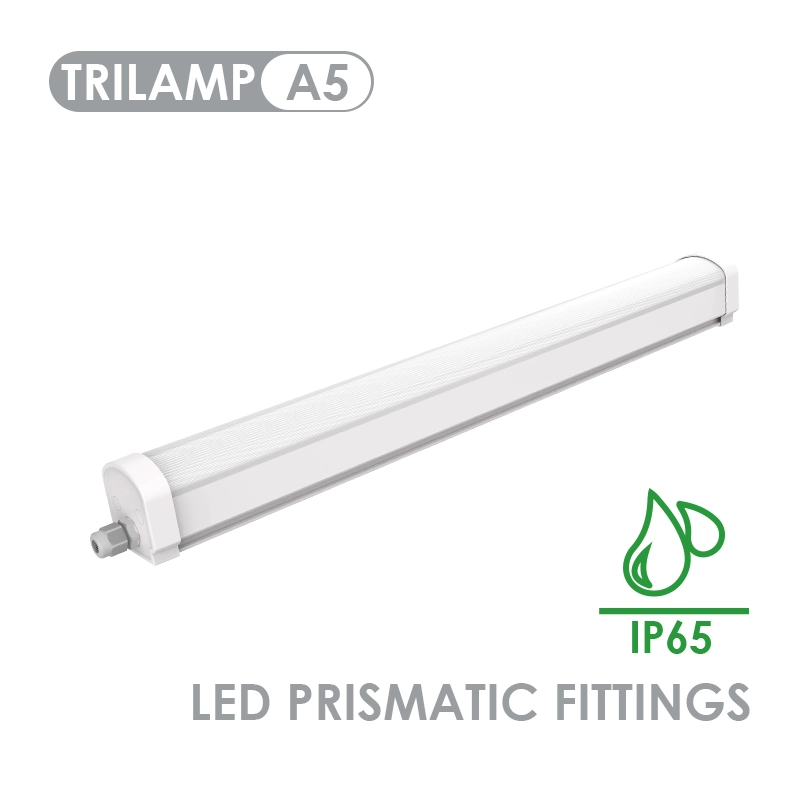
Hubbell Lighting is a division of Hubbell Incorporated (NYSE: HUBB), a publicly listed US-based electrical products manufacturer with over $5 billion in annual revenue. Their commercial and industrial lighting portfolio — delivered through brands including Hubbell, Holophane, Kim Lighting, and Dual-Lite — represents the premium end of North American and international industrial LED supply. Fanxstar is a China-based specialist manufacturer of weatherproof and tri-proof LED fixtures, selling factory-direct to B2B buyers across Europe, Australia, and North America.
For a procurement manager evaluating weatherproof LED fixtures for warehouse, cold storage, food processing, or parking facilities, the comparison between a premium brand-name manufacturer and a certified export-focused factory is a question that recurs in almost every sourcing cycle. This article provides a detailed, honest comparison across the dimensions that actually determine project outcomes: specification depth, certifications, pricing model, and the specific operating environments where each supplier is the stronger choice.
Key Takeaways
- Hubbell’s industrial LED range excels in North American market specification compliance (UL, DLC) and the premium project segment where the Hubbell brand on a submittal document has tender value.
- Fanxstar tri-proof fixtures match or exceed Hubbell specification depth in IP rating, IK impact resistance, operating temperature range, and efficacy — at factory-direct pricing with EU, AU, and global certifications pre-built in.
- The price gap between comparable specifications is typically 30–55% in favor of Fanxstar when comparing FOB pricing — buyers sourcing for European or Australian markets can achieve meaningful project cost savings without sacrificing specification or compliance.
What “Tri-proof” Means and Why It Matters
By Julie Zhu, LED Lighting Specialist at Fanxstar Technology · 2026
The term “tri-proof” describes LED fixtures engineered to resist three concurrent environmental hazards: water ingress (IP65 or above), dust ingress (IP6X), and physical impact (IK ratings). The category overlaps substantially with what North American manufacturers call “vapor tight” fixtures — sealed linear LED luminaires designed for wet, dusty, and high-impact environments.
The tri-proof category is particularly relevant for cold chain logistics facilities, food processing plants, parking structures, car washes, outdoor covered walkways, and industrial manufacturing environments. In these applications, the fixture must reliably maintain illumination performance across cycles of condensation, pressure washing, chemical cleaning, and occasional physical impact — the LED driver, PCB, and seal integrity all matter in ways that do not apply to standard commercial installations.
Both Hubbell and Fanxstar manufacture products that qualify as tri-proof or vapor tight. The meaningful differences emerge in the engineering choices embedded in each company’s product, the certification framework each has built for different geographic markets, and the economics of the supply chain each buyer is actually accessing.
Specification Depth: The Numbers That Matter
IP Rating and Seal Engineering
IP66 is the standard rating for serious industrial tri-proof applications — it confirms complete dust-tightness (IP6X) and protection against powerful water jets from any direction (IPX6). Some cold storage and food processing applications specify IP69K for products exposed to high-pressure, high-temperature steam cleaning. Both Hubbell’s vapor tight range and Fanxstar’s tri-proof range achieve IP65/IP66 as standard. Fanxstar additionally offers IP68-rated models in its weatherproof range for seawater and submersion environments — relevant for aquaculture, dock facilities, and marine-adjacent industrial settings.
The practical difference in IP seal engineering is often visible in the gasket specification and housing construction. Fanxstar’s aluminum tri-proof range uses die-cast aluminum housings with EPDM gasket sealing — a combination that maintains seal integrity across the -40°C to +50°C operating range demanded by cold chain environments. The aluminum housing also provides better thermal dissipation than polycarbonate alternatives, directly influencing LED driver longevity in high-ambient temperature environments such as food processing plants.
Cold Temperature Performance: -40°C Operation
Standard LED driver electronics begin to exhibit failures below -20°C — cold-weather starting issues, output instability, and accelerated capacitor degradation are common in facilities operating below this threshold. Cold chain logistics facilities — blast freezers, controlled atmosphere fruit stores, pharmaceutical cold storage — routinely operate at -25°C to -35°C, with peak temperatures reaching -40°C in some applications.
Hubbell’s standard vapor tight range specifies operation to approximately -20°C on most product series. Cold-temperature-rated variants exist but represent a specialized sub-range rather than a baseline specification. Fanxstar’s A16LT series is engineered specifically for deep-freeze environments down to -40°C, with cold-start-rated drivers, modified capacitor specifications, and housing designed for thermal cycling stress — qualifying for demanding cold chain applications without requiring a premium cold-rated variant.
For procurement managers sourcing lighting for blast freezer or frozen storage facilities, the specification gap between a standard vapor tight fixture and a genuine -40°C-rated tri-proof is the difference between a 3-year replacement cycle and a 7–10-year service life. The total cost of ownership calculation frequently favors the correctly specified product at a higher initial price — though in this comparison, the correctly specified product is also the lower-priced one.
Efficacy and Energy Performance
Hubbell’s industrial LED vapor tight range typically achieves efficacy in the 100–140 lm/W range depending on product series and configuration. This is competitive for commercial-grade fixtures and qualifies for DesignLights Consortium (DLC) listing relevant to North American utility rebate programmes. Fanxstar’s tri-proof range achieves 130–160 lm/W across the standard commercial range, with high-efficacy variants available up to 180 lm/W — driven by Philips Lumileds and Bridgelux LED chip specifications and premium driver electronics from established driver brands.
For large-scale installations — a 200-fixture warehouse retrofit or a 500-space parking structure — the efficacy difference translates directly into energy cost. At 10 lm/W efficacy advantage over 200 × 40W fixtures operating 14 hours per day, the annual energy savings at €0.20/kWh amounts to approximately €800/year. Over a 10-year service life, this compounds with avoided maintenance costs into a meaningful project-level financial differential.
Specification and Price Comparison Table
| Spec Point | Hubbell Vapor Tight (typical) | Fanxstar Tri-proof (comparable) |
|---|---|---|
| IP Rating | IP65/IP66 | IP65/IP66 (IP68 variants available) |
| IK Rating | IK08 (series-dependent) | IK10 standard |
| Min. Operating Temp | -20°C (standard); -40°C (specialty) | -40°C (A16LT series standard) |
| Efficacy | 100–140 lm/W | 130–180 lm/W |
| Warranty | 5 years (standard range) | 7–10 years |
| North America Certs | UL, DLC (strong) | ETL (available); DLC (selected series) |
| EU Certifications | CE (varies by series) | CE, ENEC, TÜV standard |
| AU Certification | Limited | SAA standard |
| OEM Programme | Not available | Full OEM/ODM |
| Pricing Model | Distributor; brand premium | Factory-direct; 30–55% lower FOB |
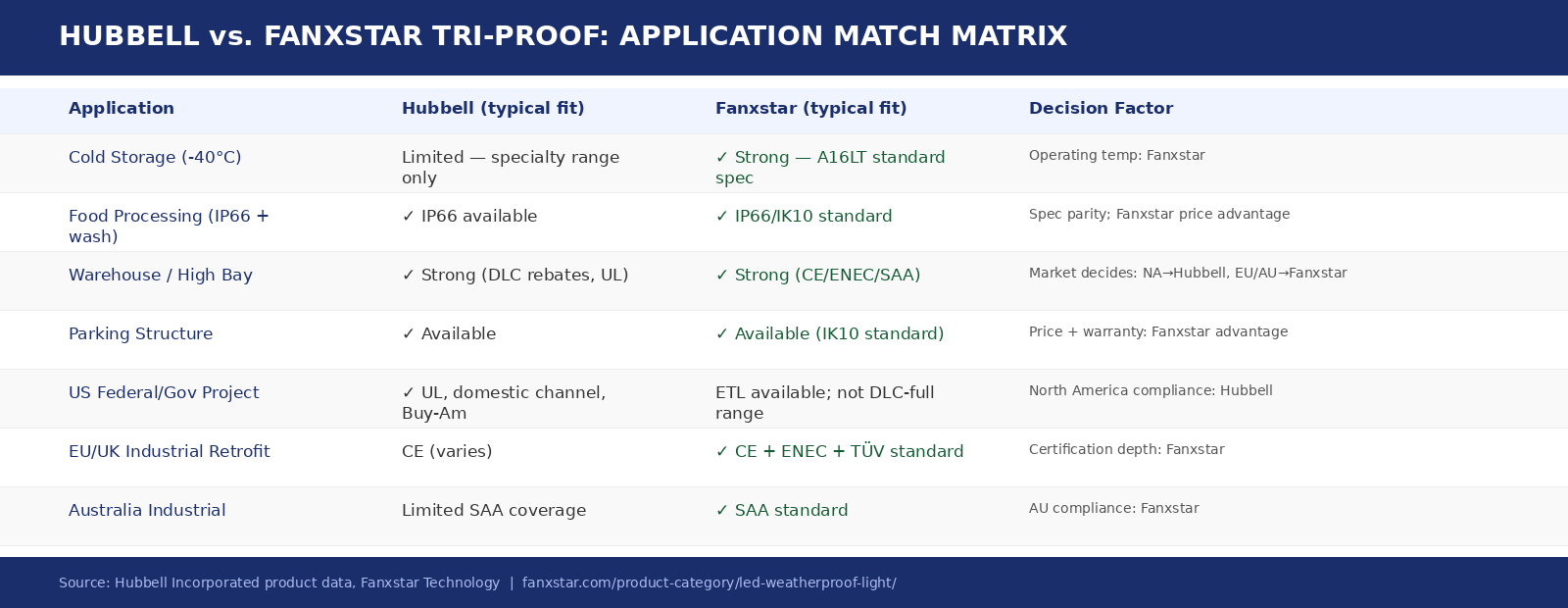
Certifications by Target Market
North America: Hubbell’s Home Advantage
For buyers sourcing products for the US and Canadian markets, Hubbell holds a structural advantage: UL listing, DLC listing (enabling utility rebate programme access), and established distributor relationships with US electrical wholesale houses. For projects where the specification document requires “UL Listed” and the project is subject to Buy American provisions or similar domestic preference requirements, Hubbell is simply the easier compliance path.
DLC listing is particularly important for North American buyers accessing utility rebate programmes. While ETL-certified products from Fanxstar meet the safety standard, DLC listing requires separate qualification through the DesignLights Consortium — available on selected Fanxstar series but not as broadly as in Hubbell’s North American-optimized range.
Europe and Australia: Fanxstar’s Certification Depth
For EU, UK, and Australian markets, the certification picture reverses. Fanxstar’s tri-proof range carries CE, ENEC, TÜV, SAA, and CB certifications as standard — built into the product development process because these are the primary markets Fanxstar serves. Hubbell’s EU certification coverage is present but less systematically deep, reflecting the company’s primary focus on the North American market.
For a UK or Spanish facility manager sourcing weatherproof fixtures for a food processing plant or cold chain warehouse, CE and ENEC certification on the tri-proof fixture is the baseline requirement. Fanxstar’s weatherproof LED range delivers this as standard — with the additional benefit of SAA certification for AU-market buyers managing facilities across both European and Asia-Pacific operations.
The energy savings available from upgrading to certified, high-efficacy LED tri-proof fixtures can be substantial — Fanxstar’s real-world energy savings calculator provides concrete examples for car park environments that translate directly to cold storage and warehouse applications. For a technical comparison of Fanxstar’s weatherproof range against your current specification, explore the full product catalogue.
When Hubbell Is the Right Choice
Hubbell Lighting is the correct specification choice for large North American commercial and industrial projects where UL listing, DLC qualification for utility rebates, and the brand authority of a Hubbell submittal document are material to the project outcome. Government facilities, federally-funded construction, and projects with established Hubbell distributor relationships all fit this profile. Hubbell’s Holophane brand in particular carries strong specification authority in the North American industrial sector for high-bay and harsh-environment applications.
For buyers whose total cost calculation includes the value of an established US distributor’s technical support, warranty processing through local channels, and the simplicity of a domestic supplier relationship, Hubbell delivers genuine value that is not purely captured in unit price comparison.
When Fanxstar Is the Right Choice
Fanxstar is the stronger specification for projects in EU, UK, or Australian markets where CE/ENEC/SAA certification coverage, -40°C cold-start operation, IK10 impact resistance, and 7–10-year warranty depth are required. The 30–55% price advantage over comparable Hubbell specification at FOB pricing translates into significant project cost reductions at scale — without requiring a sacrifice in specification quality or certification compliance.
For projects requiring both industrial-grade weatherproof fixtures and emergency lighting from a single certified supply partner — common in cold chain, food processing, and industrial manufacturing facilities — Fanxstar’s combined weatherproof and emergency range allows consolidated supply with consistent certification coverage across both product categories. Contact Fanxstar’s engineering team to discuss your project specification and receive a detailed technical consultation.
Frequently Asked Questions
What is the difference between IP65 and IP66 for tri-proof fixtures?
IP65 and IP66 both provide complete dust-tightness (IP6X). The difference is in water protection: IP65 protects against low-pressure water jets from any direction, while IP66 protects against powerful high-pressure water jets from any direction. For environments with regular pressure washing — food processing facilities, cold chain logistics areas, car washes — IP66 is the minimum appropriate specification. IP65 is sufficient for damp industrial environments without high-pressure cleaning. Fanxstar’s tri-proof range is available in IP65 and IP66 configurations; always specify IP66 for food processing and pressure-washed environments.
Does IK10 matter for warehouse lighting?
IK10 is the highest impact protection rating in the IK scale, specifying resistance to 20 joules of impact energy — equivalent to a 5 kg mass dropped from 400mm. For warehouse environments with forklift operations, overhead product movement, or sports facilities, IK10 is meaningful protection against fixture damage from accidental impact. IK08 (10 joules) is the more common baseline for many products, and is adequate in lower-risk environments. If forklift traffic passes within range of overhead fixtures or products are moved on overhead conveyors, IK10 specification reduces fixture replacement frequency and the safety risk of damaged fixtures in active warehousing environments.
How does Fanxstar’s 7–10 year warranty compare to industry standard?
Five years is the current industry standard warranty for commercial LED fixtures from major brands. Fanxstar’s 7–10 year warranty on the heavy-duty weatherproof range reflects confidence in the engineering choices underlying the product: premium LED packages with validated LM-80 test data, aluminum PCB substrate for thermal management, high-quality driver electronics, and EPDM gasketing with tested seal longevity. Longer warranties do carry procurement risk — they are only meaningful if the manufacturer is solvent and accessible for warranty claims. Fanxstar’s European offices in Spain and the Netherlands provide a local warranty claim contact point that removes the traditional risk associated with China-origin manufacturer warranties.
Can I mix Hubbell and Fanxstar fixtures in the same installation?
Yes, from an electrical and safety compliance perspective, certified LED fixtures from any manufacturer can be used in the same installation provided each fixture carries the required certifications for the market. The practical considerations are aesthetic consistency (luminaire form factor and optical distribution) and maintenance logistics. Mixing suppliers does complicate maintenance stock management — keeping two product families in spare inventory is less efficient than a single-supplier approach. For new-build or complete retrofit projects, a single-supplier specification for the tri-proof category simplifies both procurement and long-term maintenance.