Exporting LED lighting to multiple countries without the CB Scheme means repeating the same safety testing cycle in every target market — a process that can consume months of lead time and tens of thousands of dollars in redundant testing fees. The IECEE CB Scheme solves this problem at the structural level: a single test, conducted once to an internationally recognized IEC standard, produces a CB Test Certificate and CB Test Report that more than 50 countries accept as the basis for their national certifications. For weatherproof, emergency, and industrial LED manufacturers targeting Europe, Australia, the Middle East, and North America simultaneously, understanding the CB Scheme is not optional — it is a competitive requirement.
Key Takeaways
- The CB Scheme covers 50+ countries and allows a single IEC test to serve as the foundation for national certifications across Europe, Asia-Pacific, the Americas, the Middle East, and Africa.
- LED lighting products fall under the IECEE “LITE” category, tested primarily to the IEC 60598 series, with IEC 60598-2-22 covering emergency luminaires specifically.
- National deviations — local market differences from the base IEC standard — must be declared and covered during the original CB test to avoid additional testing later.
- The total CB process typically runs 4–8 weeks, producing a certificate with no fixed expiry date, though it should be renewed when product design or applicable standards change.
What the CB Scheme Is — and Why It Exists
The Structural Problem It Solves
Historically, every country maintained its own product safety testing and certification requirements. A lighting manufacturer selling into Germany, Australia, Saudi Arabia, and Japan faced four separate testing programs, four sets of sample submissions, four documentation packages, and four different review timelines. The cost and administrative burden — particularly for smaller manufacturers and OEM partners — created a genuine barrier to international trade.
The IECEE CB Scheme was developed to solve this directly. Administered by the International Electrotechnical Commission’s conformity assessment body (IECEE), the scheme operates under a multilateral agreement among participating National Certification Bodies (NCBs). The core principle, sometimes called “test once, use everywhere,” means a manufacturer who obtains a CB Test Certificate from any recognized NCB can present that certificate to NCBs in other member countries to obtain local certification — typically without repeating the full testing process. According to TÜV Rheinland, NCBs in CB Scheme countries are required to prioritize certification applications that arrive with an existing CB certificate, meaning CB-certified manufacturers reach the front of the queue.
Scope and Participating Countries
The CB Scheme currently covers more than 50 countries — a list that spans the most critical B2B lighting markets globally. European participants include Germany, France, the Netherlands, the UK, Spain, Italy, Belgium, and a dozen more EU member states. Outside Europe, key participants include India, China, South Korea, Japan, Singapore, Thailand, Saudi Arabia, South Africa, Kenya, Canada, the USA, Mexico, and Argentina. For any LED lighting manufacturer whose distribution footprint crosses three or more of these markets, the CB Scheme is almost always the most cost-efficient starting point for a certification strategy.
How the CB Scheme Applies to LED Lighting
The LITE Category and IEC 60598
Within the IECEE system, LED lighting products fall under the product category designated “LITE” — Lighting Systems. The primary governing standard for luminaires is the IEC 60598 series, which is structured in two parts: Part 1 covers general requirements and tests applicable to all luminaire types, and Part 2 covers specific requirements for individual product categories. The most relevant Part 2 sub-standards for industrial and commercial LED manufacturers include:
| Standard | Product Type | Relevance to Industrial/Commercial Buyers |
|---|---|---|
| IEC 60598-1 | General requirements (all luminaires) | Foundation standard; applies to every product submission |
| IEC 60598-2-1 | Fixed general-purpose luminaires | Weatherproof battens, tri-proof fixtures, vapor tight units |
| IEC 60598-2-3 | Road and street lighting | Outdoor industrial perimeter and infrastructure lighting |
| IEC 60598-2-5 | Floodlights | Yard, facility, and industrial area floodlighting |
| IEC 60598-2-22 | Emergency lighting luminaires | Exit signs, emergency battens, bulkheads — all self-contained emergency products |
The IEC 60598-1 standard underwent a significant revision — the 10th edition (BS EN IEC 60598-1:2024) introduced updated surge protection device requirements and structural changes to clause organization that affect technical documentation requirements. Manufacturers with older CB certificates should verify their documentation remains current against the latest edition. According to BSI Group, the updated standard brings enhanced requirements that will affect most users of the previous edition.
Beyond Safety: Additional IEC Standards in the LITE Category
A complete CB submission for LED lighting typically involves more than just IEC 60598. Depending on the product, testing may also reference IEC 62471 (photobiological safety — particularly important for high-intensity industrial and grow lighting applications), IEC 61347 (lamp controlgear — essential for LED drivers and emergency battery control gear), and IEC 62384 (DC or AC supplied electronic control gear for LED modules). For manufacturers of emergency lighting with integrated battery management systems, IEC 61347-2-7 (battery-supplied electronic controlgear for self-contained emergency luminaires) will apply directly to the control gear within the unit.
The CB Certification Process — Step by Step
Stage 1: Application and Document Preparation
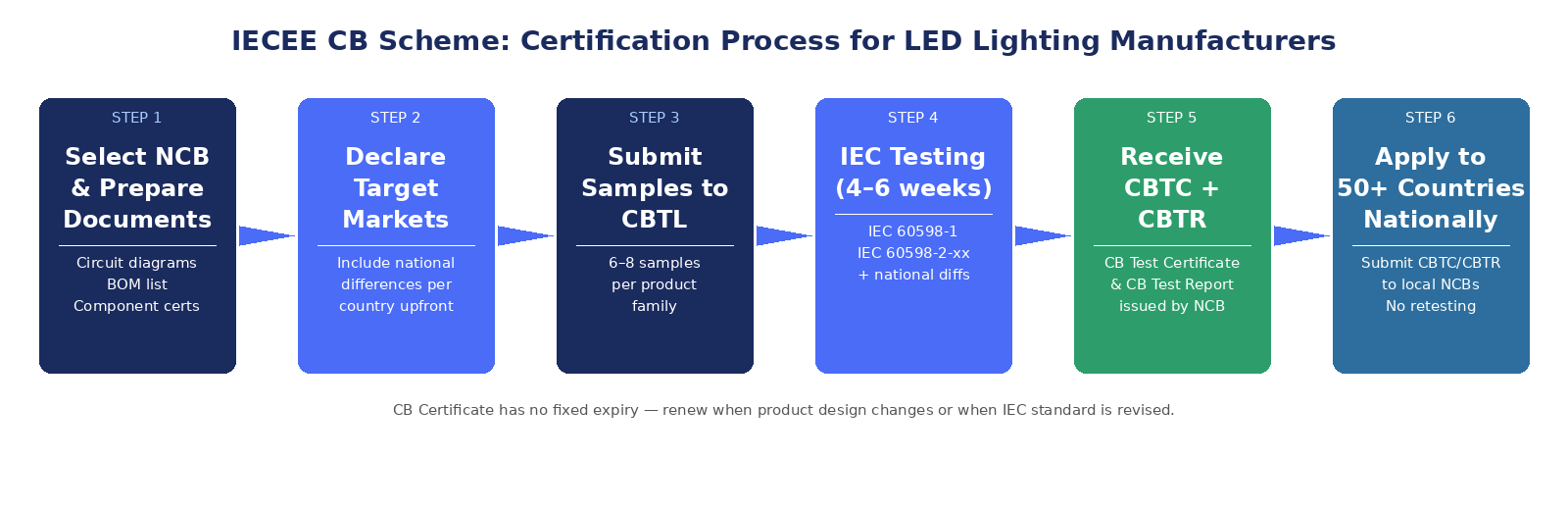
The process begins with selecting an IECEE-recognized National Certification Body (NCB). Manufacturers are free to apply to any NCB globally — common choices for China-based manufacturers include bodies operating in China, Germany, the UK, Singapore, and the Netherlands. The application must be accompanied by a complete technical file, which for LED lighting typically includes: an application form and declaration of conformity, the product manual and specifications, circuit diagrams and PCB layout drawings, a list of key components with their own certifications, a BOM (bill of materials), and compliance labels. JJR Lab notes a critical requirement at this stage: manufacturers must declare which target countries they intend to sell into, so that those countries’ national differences can be incorporated into testing from the outset. Attempting to add national differences after the initial CB test report is issued typically requires additional testing and increases costs significantly.
Stage 2: Testing in a CB Test Laboratory (CBTL)
Actual product testing is conducted by an IECEE-accredited CB Test Laboratory (CBTL). The laboratory evaluates the product against the applicable IEC standards and, critically, against any national differences relevant to the declared target markets. For example, a manufacturer targeting both the EU and Saudi Arabia in the same CB application will have the report cover both the standard EU group deviations and the Saudi Arabia-specific requirements simultaneously — eliminating the need for separate testing later. The testing phase typically runs 4 weeks, with the certification phase adding another 2 weeks, for a total process of approximately 6–8 weeks from sample submission to certificate issuance, depending on testing complexity and whether any corrective actions are needed. Sample quantities are usually 6–8 units per product type, and all critical components — including LED drivers and battery modules — must themselves carry valid IEC certifications, or they will be tested as part of the product submission.
Stage 3: Receiving the CB Test Certificate and CB Test Report
A successful test results in two documents: the CB Test Certificate (CBTC) and the CB Test Report (CBTR). These are the core documents that unlock market access. The CBTC confirms that the product passed testing to the stated IEC standards; the CBTR provides the detailed technical evidence, including any national differences evaluated. Together, they can be submitted to NCBs in any of the 50+ CB member countries to obtain local certifications — typically with administrative review only, not full retesting. According to Blue Asia Labs, the CB certificate has no fixed expiry date, but it effectively becomes invalid if the product design changes significantly or if the applicable IEC standard is revised and the manufacturer has not updated the certificate accordingly.
National Differences: The Most Commonly Misunderstood Element
What National Differences Are
The CB Scheme is built on IEC standards, but not every participating country adopts those standards without modification. A “national difference” is a deviation a country has formally recorded — a requirement that either goes beyond the base IEC standard or modifies it for local technical, safety, or regulatory reasons. These deviations must be evaluated during CB testing to make the certificate useful in that market. If they are not covered during the initial test, they must be addressed through supplementary testing before the NCB in that country will issue a local certification. Common national differences in the lighting context include voltage and frequency requirements, specific marking and labeling language rules, and country-specific temperature class requirements for certain installation environments.
Why Declaring Target Markets Upfront Matters
This is the most practical operational lesson for lighting manufacturers using the CB Scheme for the first time. The temptation to obtain a “basic” CB certificate first and add markets later is understandable — but the cost structure argues strongly against it. Incorporating national differences into the original CB test report is far more efficient than retrofitting them post-certification. For manufacturers supplying European, Australian, and Middle Eastern buyers simultaneously, a CB application that covers EU group deviations, Australian (SAA/RCM) differences, and Saudi Arabia (SASO) requirements from a single test round is achievable — and represents a substantially lower total certification cost than sequential market-by-market testing. In our experience working with distributors and project developers across these regions, buyers increasingly require evidence of CB-backed certifications as part of their procurement qualification process, particularly in government and large commercial infrastructure projects.
CB Scheme vs. Standalone National Certifications: When to Use Each
When the CB Scheme Is the Right Starting Point
The CB Scheme delivers its greatest value when a manufacturer is targeting three or more markets simultaneously, has a stable product design that will not change significantly in the near term, and is working with IEC-harmonized target markets. For LED lighting manufacturers exporting from China to Europe, Australia, and the Gulf region, the CB Scheme is almost universally the most efficient path — especially when all three market groups are declared in the original application. Intertek notes that a single CB Scheme test report opens doors across North America, Europe, the Middle East, and Asia-Pacific simultaneously, which is difficult to match through any other single certification mechanism.
When Standalone Certification May Still Be Required
The CB Scheme reduces but does not always eliminate the need for national certifications. Some markets require a formal national mark or registration even after accepting a CB certificate — they use the CBTC to streamline their own review process rather than simply accepting it at face value. The US (UL/ETL listing), Canada (CSA/cUL), and Australia (RCM) all follow this model: the CB certificate accelerates their evaluation, but the local mark must still be formally applied for and issued by the relevant authority. Manufacturers should treat the CB Scheme as a foundation layer — it dramatically reduces the cost and time required to obtain national marks, but it does not replace the obligation to engage with the NCB in each target market.
Practical Considerations for LED Lighting OEM Manufacturers
Component Certification Requirements
A fully certified LED luminaire at the system level requires that its critical sub-components also carry appropriate IEC certifications. LED drivers, emergency battery control gear, and battery packs all need their own CB or equivalent certifications before the complete luminaire can be submitted. For manufacturers developing custom LED products — including custom power supplies, proprietary battery management systems, or integrated control gear with DALI 2.0 functionality — verifying the certification status of each major sub-component before the luminaire-level CB application begins is essential. Missing component certifications at the start of a CB application significantly extend the timeline and cost of the process.
Maintaining Certificate Validity After Product Changes
CB certificates cover specific product configurations as tested. If a manufacturer changes a critical component — substituting an LED driver, updating the PCB design, modifying the battery chemistry in an emergency luminaire, or changing the optical assembly — the NCB must be notified and a re-assessment may be required. According to Blue Asia Labs, similar models with identical electrical and mechanical structures can be grouped under a single CB certificate, but each must be declared during the original application. Grouping strategies are an important cost-saving tool for manufacturers with multiple SKUs in the same product family — for example, weatherproof fixtures available in multiple wattages and CCT options that share the same core electrical design.
Fanxstar’s OEM/ODM engineering team works directly with clients to structure product families in ways that maximize the efficiency of certification programs — grouping variants under a single CB application wherever the electrical and mechanical structure permits, and planning component selection around existing certified sub-assemblies where possible.
CB Scheme for Emergency Lighting: Specific Considerations
IEC 60598-2-22 and What It Tests
Emergency luminaires require CB testing against both IEC 60598-1 (general requirements) and IEC 60598-2-22 (particular requirements for emergency lighting). The 5th edition of IEC 60598-2-22, published in 2021, constitutes a full technical revision of the previous edition and is now the active standard. It covers all critical emergency luminaire performance parameters: battery backup duration under rated conditions, maintained and non-maintained operating modes, self-contained operation following mains failure, photometric output during emergency mode, battery marking and replacement requirements, and the classification of luminaires as emergency escape lighting, high-risk task area lighting, or standby lighting. For emergency luminaires with DALI 2.0 digital control integration and self-test functionality — features increasingly demanded by EU commercial building specifiers — the CB test report must adequately cover the behavior of those systems under the emergency operating scenarios defined in the standard.
Cross-Standard Complexity for Combination Fixtures
A weatherproof emergency fixture — for example, a vapor tight LED batten with an integrated emergency battery compartment designed for use in food processing or cold storage environments — requires CB evaluation against both IEC 60598-2-1 (fixed general-purpose luminaires) and IEC 60598-2-22 (emergency luminaires), in addition to the general IEC 60598-1 requirements. This dual-standard submission is more complex than a single-category fixture, and manufacturers should plan for longer testing windows and more comprehensive documentation. For Fanxstar’s emergency lighting range, including IP-rated emergency battens designed for industrial environments, CB certification to both standards simultaneously is the recommended strategy for EU and UK market access.
Frequently Asked Questions
Does a CB certificate replace CE marking for EU market access?
No — CE marking and CB certification are complementary but distinct. A CB Test Report can serve as part of the technical file supporting CE conformity under the Low Voltage Directive (LVD 2014/35/EU) and, for luminaires, under the Ecodesign and Energy Labeling Regulations. However, CE marking is a manufacturer’s self-declaration that their product meets applicable EU directives, and the process requires its own Declaration of Conformity and technical documentation. The CB report accelerates and strengthens the evidence base for CE conformity, but it does not automatically produce a CE mark. Most EU-focused manufacturers obtain both — using the CB process to generate the rigorous IEC test data that underpins their CE technical file.
How many samples are required for CB testing?
For most lighting products, 6–8 samples per product type or model family are typical. The exact quantity depends on the NCB’s requirements, the complexity of the test program, and the number of target markets being covered. If the same CB test round is covering national differences for multiple markets, additional samples may be required to conduct destructive tests. Manufacturers should confirm sample requirements directly with their chosen CBTL or NCB before production planning — submitting insufficient samples is one of the most common causes of project delays.
What happens when the IEC standard is updated after I have a CB certificate?
When a new edition of a relevant IEC standard is published, IEC typically establishes a transition period of 1–2 years during which both the old and new editions are recognized. After that transition deadline, CB certificates issued against the old edition may no longer be accepted by NCBs for new national certification applications. Manufacturers need to plan certificate renewals ahead of transition deadlines — ideally by initiating re-testing against the new standard before the old certificate lapses. The 2024 revision of IEC 60598-1 is the most immediately relevant active transition for the majority of luminaire manufacturers.
Can one CB certificate cover an entire product family?
Yes, with careful planning. Similar models sharing an identical electrical design and mechanical construction can typically be grouped into a single CB application as a “product family” or “model range.” The key requirement is that all variants are declared at the time of application — adding models to an existing certificate after the fact may trigger a re-assessment rather than a simple administrative update. Structuring LED product families to maximize certification grouping is a practical OEM/ODM planning discipline that significantly reduces per-SKU certification costs for distributors managing large product portfolios.
Is the CB Scheme sufficient for the Middle East and GCC markets?
CB certification is recognized by Saudi Arabia, the UAE, and other GCC countries as a pathway to obtaining local certifications such as SASO (Saudi Arabia) and ESMA (UAE). However, these markets have their own additional energy efficiency and performance requirements — particularly for lamps and lighting equipment — that go beyond the basic IEC 60598 safety scope. The CB report covers the safety testing layer; manufacturers targeting GCC markets should also plan for compliance with applicable energy efficiency regulations specific to each country. Declaring GCC markets in the original CB application and covering any Saudi or UAE-specific national differences during that initial test round is the most efficient approach.
Selecting the right certification strategy for a new LED product line — especially one targeting multiple markets simultaneously — requires evaluating product design, component certification status, target market requirements, and OEM grouping opportunities together. Fanxstar’s engineering team works directly with distributors and project developers to structure certification-ready product programs from the design stage. Tell us about your target markets and product requirements — we’ll help you map the most efficient path from production to market access.