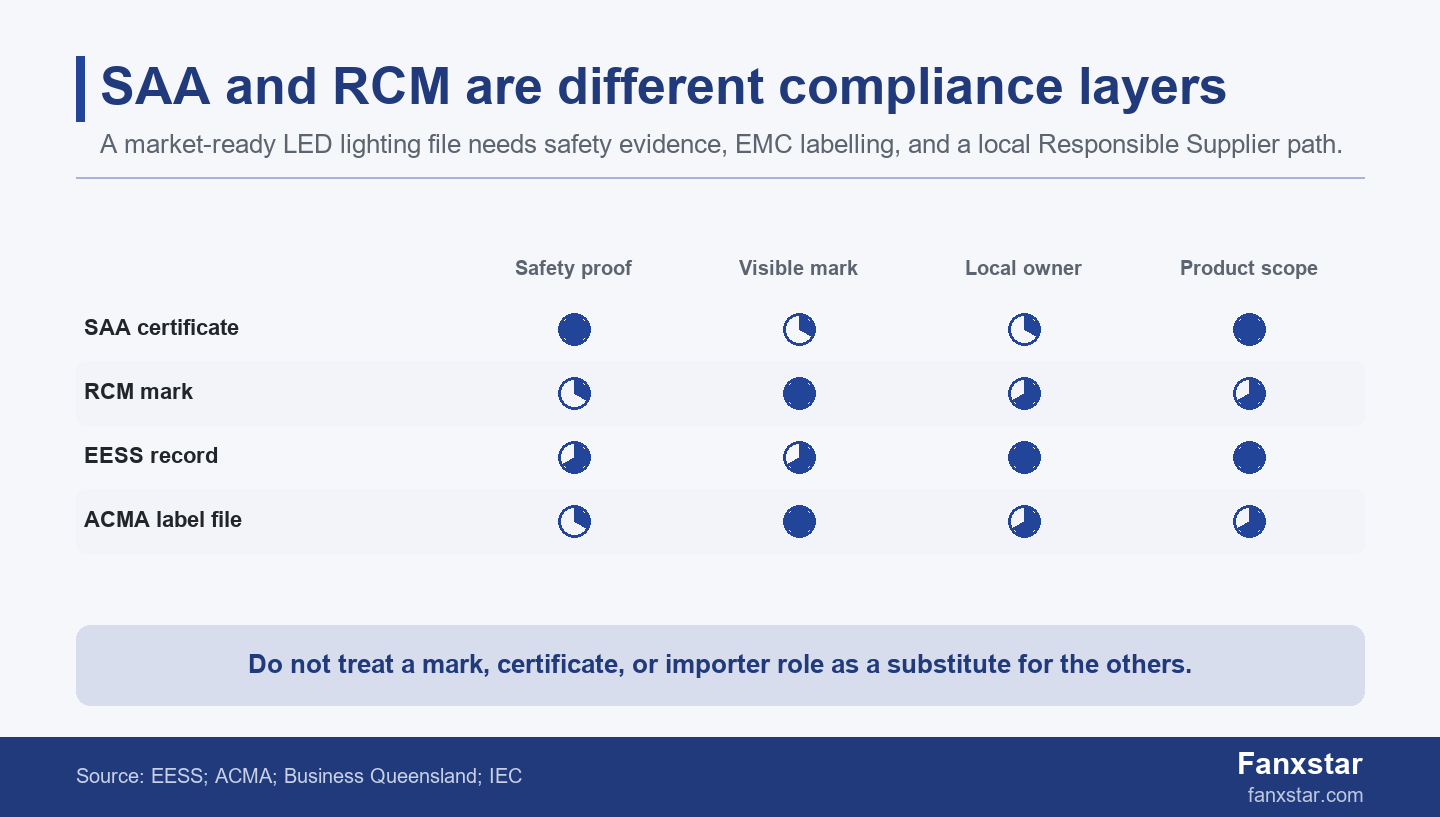
SAA and RCM are not competing labels for LED lighting in Australia and New Zealand; SAA is one safety-evidence route, RCM is the visible compliance mark, and EESS plus ACMA rules decide who can place the product on the market. The search phrase ‘SAA vs RCM’ is useful only if the buyer stops treating the two terms as alternatives. For LED lighting, the market-entry file usually needs safety evidence, EMC or labelling evidence, a visible RCM label, and a Responsible Supplier path.
According to EESS RCM guidance, the RCM represents compliance with two independent schemes: EESS and ACMA labelling requirements. According to EESS guidance on ACMA requirements and RCM use, further marking information sits in AS/NZS 4417.1 and AS/NZS 4417.2. Those statements make the buyer rule clear: RCM is the mark; the supporting evidence sits behind it.
Australian and New Zealand compliance decisions should be confirmed with accredited certification bodies, local Responsible Suppliers, and qualified compliance professionals. The procurement goal here is to ask the right evidence questions before an LED luminaire, emergency light, or weatherproof fixture is shipped.
Key Takeaways
- SAA and RCM are not substitutes: SAA is commonly discussed as safety certification evidence, while RCM is the visible compliance mark applied after applicable obligations are satisfied.
- EESS risk level matters because Level 1, Level 2, and Level 3 equipment create different evidence and registration burdens.
- An overseas manufacturer cannot simply self-register as the EESS Responsible Supplier without an Australian or New Zealand legal entity path.
- For LED lighting, safety, EMC, IP rating, emergency battery, label, manual, and model identity must all describe the same shipped version.
- Fanxstar buyers should send the target market, product category, certificate expectation, Responsible Supplier route, and customization changes before approving samples.
SAA, RCM, and EESS in Plain Buyer Language
RCM is the visible mark, not the whole file
According to EESS RCM guidance, in-scope electrical equipment must not be sold unless it is marked with the RCM in compliance with AS/NZS 4417.1 and 4417.2 and the EESS. The same page says the RCM represents both EESS and ACMA labelling requirements. A buyer should therefore ask what evidence supports the mark, not simply whether the mark can be printed.
For LED lighting, the supporting file can include safety test reports or certificates, EMC evidence, product label artwork, installation instructions, wiring diagrams, component approvals, IP test evidence, and model photos. If the RCM is printed on a product whose document file describes a different driver, housing, battery, or lens, the mark is not decision-ready.
This distinction matters in sourcing conversations. A supplier may say the product has SAA, another may say it has RCM, and a third may say it is EESS ready. The buyer should translate all three claims into one question: who is the Responsible Supplier, what product is registered or supported, what standard applies, and what exact model can be labelled?
SAA is usually a safety-evidence conversation
In market language, SAA often refers to a safety approval or certificate route for electrical products. It is important, but it does not replace the market mark, importer responsibility, ACMA obligations, or evidence matching. A certificate is useful only when it covers the exact product family, variant, rating, and application being shipped.
According to EESS guidance on ACMA requirements and RCM use, Responsible Suppliers receive AS/NZS 4417.1 when they register because it includes the correct RCM dimensions. That detail does not turn SAA into RCM; it reinforces that the mark and the evidence path are connected but different. The buyer should keep the terms separate in the RFQ.
EESS Risk Level Decides How Much Evidence Is Needed
Level 1, Level 2, and Level 3 are not marketing tiers
According to EESS in-scope equipment guidance, in-scope electrical equipment is classified into three levels. The same page defines in-scope equipment by voltage range and by whether the product is designed or marketed as suitable for household, personal, or similar use, even if it is also designed for commercial or industrial use. That wording can matter for LED products sold through mixed channels.
According to Business Queensland guidance, even Level 1 equipment requires the Responsible Supplier to be registered and have access to evidence that the equipment is electrically safe and meets the relevant standard. For Level 2 and Level 3, the burden rises. The buyer should not assume that a commercial lighting project has no EESS relevance just because it is not a consumer lamp shelf item.
The safe RFQ phrase is: identify the product category and risk level before quoting the mark. A fixed industrial luminaire, self-ballasted LED lamp, portable luminaire, emergency luminaire, driver, or accessory may create different evidence questions. The supplier should not answer every lighting request with one generic RCM paragraph.
Declared product definitions need exact model matching
According to the EESS definitions and risk-level PDF, the scheme organizes risk classifications into Level 1, Level 2, and Level 3 and lists defined equipment classes. That kind of document is why model identity matters. A buyer needs to know whether the offered product is a luminaire, lamp, power supply, emergency product, portable type, or another defined class.
Lighting products are easy to modify. A custom housing, driver substitution, emergency battery addition, sensor module, cable entry change, or label revision can move the shipped product away from the tested file. If the buyer wants Fanxstar ODM changes for Australia or New Zealand, the certificate and label question should be asked before sample tooling or mass production.
| Layer | What it proves | What it does not prove |
|---|---|---|
| SAA or safety certificate | The product has safety evidence for a defined standard and model scope. | It is not the visible market mark by itself. |
| RCM mark | The product is labelled as compliant under relevant Australian and New Zealand requirements. | It is not a standalone test report. |
| EESS registration | The responsible supplier and certain equipment records exist in the scheme. | It does not make an overseas factory the local legal supplier. |
| ACMA file | EMC, radio, or telecom labelling duties are addressed where applicable. | It does not replace electrical safety evidence. |
| Product technical file | Model, driver, battery, IP rating, label, and instructions match the shipped unit. | It does not remove local importer obligations. |
Responsible Supplier Duties Are a Commercial Constraint
An overseas factory is not automatically the EESS Responsible Supplier
According to EESS Responsible Supplier guidance, the Responsible Supplier must be a legally identifiable Australian or New Zealand entity or person who manufactures or imports in-scope equipment. The same page says an overseas company cannot be registered on the EESS database to become a Registered Responsible Supplier. This is one of the most important buyer checks for China-sourced LED lighting.
The implication is practical. A Chinese manufacturer may provide test reports, samples, production control, and technical support, but the Australian or New Zealand market entry path still needs a local legal entity role. The importer, distributor, subsidiary, or other eligible entity must understand the recordkeeping and declaration duties. If that role is not assigned, the product may have useful evidence but no complete market path.
For buyers, this should be settled in the quotation stage. Ask who will be the Responsible Supplier, who keeps the technical file, who labels the product, who handles changes, and who responds if the regulator asks for evidence. Waiting until goods are ready to ship turns compliance into a crisis.
ACMA and EESS share the mark but not every duty
According to EESS guidance on ACMA requirements and RCM use, RCM marking information is connected to AS/NZS 4417.1 and AS/NZS 4417.2, while supplier and product registration questions belong with EESS. This is exactly why the mark confuses exporters. The same RCM symbol can sit over different obligations, including electrical safety and ACMA-related labelling streams where applicable.
For LED lighting, EMC evidence is commonly part of the file because drivers and electronic controls can create emissions questions. If the product includes wireless controls, sensors, radio modules, or networked components, the ACMA side may become more complex. The buyer should not assume a safety certificate covers EMC or radio obligations.
Based on our analysis, the lowest-risk purchase file separates the question into four owners: the factory provides model evidence, the certification body confirms the relevant safety route, the Responsible Supplier holds the local declaration and records, and the buyer checks that the shipped product still matches the approved file. When one party tries to own every layer verbally, the evidence path becomes fragile.
| Decision signal | Buyer implication |
|---|---|
| 1 mark | RCM is the visible mark, but it points to multiple obligations. |
| 3 EESS levels | Risk level changes the evidence and registration path. |
| 1 local entity | Responsible Supplier must be Australia or New Zealand based. |
| 2 evidence streams | Safety and ACMA labelling need separate attention where applicable. |
| 0 generic claims | SAA, RCM, and EESS must be tied to exact model scope. |
| 1 change record | ODM changes should be checked before shipment. |
LED Lighting Evidence That Buyers Should Request
The evidence package should follow the exact product version
A buyer should request the model code, rated input, power, driver information, emergency battery if present, IP rating, installation instructions, label artwork, certificate or test report, EMC evidence, and Responsible Supplier plan. The file should show the same product that will be shipped, not a similar product family.
According to IEC 60598-2-22:2021, emergency luminaires have their own particular standard scope. That matters when an Australia or New Zealand project combines RCM, SAA language, IP ratings, and emergency battery backup. Emergency function is not a small accessory when it affects product safety evidence.
Weatherproof and industrial LED luminaires add more details. If the project is a cold room, parking garage, food processing area, tunnel, or wet utility corridor, the buyer should connect safety evidence with IP rating, corrosion exposure, cable entry, ambient temperature, and maintenance access. A general lighting certificate may not answer the real site question.
Fanxstar ODM changes should be framed as compliance questions
Fanxstar’s relevant starting points include weatherproof LED lighting product platform, LED emergency lighting product range, and Fanxstar custom LED lighting ODM service. For Australia and New Zealand, buyers should send the target market, expected RCM path, product category, Responsible Supplier arrangement, voltage, plug or wiring method, emergency function, IP rating, and any custom change request.
Useful customization questions are precise. Can the driver change and remain inside the certificate file? Does an emergency battery option need a different test report? Does a sensor module affect EMC? Does a lens or housing change affect IP evidence? Does the label need to show the model exactly as registered? These questions prevent late-stage market entry delays.
The release rule is strict: approve the sample only when safety evidence, RCM labelling, Responsible Supplier path, technical file, and production model match. A cheap sample without this alignment is not market-ready evidence.
FAQ
Is SAA the same as RCM?
No. SAA is commonly used to describe safety approval or certification evidence, while RCM is the visible compliance mark. A product may need safety evidence, EMC evidence, EESS registration steps, and a Responsible Supplier path before the RCM can be used correctly.
Can a Chinese LED lighting factory register as the Responsible Supplier?
Not by default. EESS says the Responsible Supplier must be an Australian or New Zealand legal entity or person, and an overseas company cannot register as the EESS Responsible Supplier. The local importer, distributor, or subsidiary path should be defined before shipment.
Do all LED luminaires need SAA certification?
Not all LED products follow the same pathway. The requirement depends on product type, EESS risk level, applicable AS/NZS standards, and the route chosen by the Responsible Supplier or certification body. Buyers should classify the exact model first, then ask what evidence is required.
What should Fanxstar buyers send for Australia or New Zealand compliance review?
Send the target market, product category, voltage, model code, emergency function if any, IP rating, driver or sensor changes, label expectation, and Responsible Supplier route. This lets Fanxstar discuss whether an existing platform, sample, or ODM change can support the intended evidence path.