India’s LED lighting market is one of the fastest-growing in the world — driven by government infrastructure programs, rapid urbanization, and a policy-led shift away from inefficient lighting under initiatives like the UJALA scheme. But accessing that market is not as simple as meeting the technical spec and booking a freight forwarder. The Bureau of Indian Standards (BIS) operates a mandatory product certification regime that covers most LED luminaires and lamps. Customs authorities enforce it at the border. Products without valid BIS registration cannot legally be imported, sold, or distributed in India — and shipments without documentation are seized.
For a Shenzhen-based LED manufacturer already holding CE, ENEC, and SAA certifications for European and Australian markets, BIS adds a structurally different layer of compliance. Unlike CE’s self-declaration model, BIS requires third-party lab testing, a local Authorized Indian Representative (AIR), and in most cases a physical factory audit by BIS officials. This article explains both certification routes available to foreign manufacturers, the specific Indian Standards that apply to LED luminaires, and the practical steps to navigate the process efficiently.
Key Takeaways
- Most LED luminaire categories require mandatory BIS CRS registration under India’s Compulsory Registration Scheme before import or sale is permitted. This is a legal requirement, not a voluntary mark.
- Foreign manufacturers follow the FMCS route (Foreign Manufacturers Certification Scheme), which requires an Authorized Indian Representative, a BIS factory audit at your China facility, and testing at a BIS-recognized laboratory in India.
- The relevant Indian Standards for LED luminaires are IS 10322 (Part 5) with multiple sections covering different luminaire types — fixed general purpose, road/street, emergency, and more. Each product category and each manufacturing location requires a separate registration.
- The CRS registration process typically takes 2–4 months for foreign manufacturers once samples and documents are ready; FMCS licensing (for ISI mark) takes 6–9 months due to factory audit scheduling.
- BIS certificates have fixed validity periods — CRS registrations are valid for 2 years; FMCS/ISI mark licenses are issued for 1 year and renewed annually. Missing renewal means loss of market access.
Understanding India’s BIS Certification Framework
Why BIS Exists — and Why It Has Real Teeth
BIS is India’s national standards body, operating under the BIS Act of 2016. Unlike many standards bodies that focus on voluntary certification, BIS administers mandatory product registration for categories where consumer safety, energy efficiency, or national infrastructure are at stake. LED lighting falls squarely into this mandate — it is classified under India’s Electronics and Information Technology Goods (Requirements for Compulsory Registration) Order, 2012, administered by the Ministry of Electronics and Information Technology (MeitY).
The consequences of non-compliance are concrete: customs clearance is denied at the point of import for products lacking valid BIS registration; products found in trade without BIS marks can be seized from distributors; and penalties apply to importers who attempt to sell non-registered products. For government tenders and the Government e-Marketplace (GeM) — which represents a significant portion of India’s commercial LED procurement — valid BIS CRS certification is a mandatory eligibility requirement. There is no workaround.
Two Certification Routes: CRS vs. FMCS
India’s BIS framework offers two primary certification pathways relevant to LED manufacturers, which are often confused but serve different purposes:
| Parameter | CRS (Compulsory Registration Scheme) | FMCS (Foreign Manufacturers Certification Scheme) |
|---|---|---|
| Mark issued | CRS Registration (Scheme II) | ISI Mark (Standard Mark, Scheme I) |
| Governing body | MeitY (electronics products) | FMCD at BIS Headquarters, New Delhi |
| Factory audit required? | No (testing + document verification only) | Yes — BIS officer visits factory in China |
| Timeline | 2–4 months (testing + portal review) | 6–9 months (audit scheduling adds significant lead time) |
| Certificate validity | 2 years (renewable) | 1 year (renewable annually; 5-year renewal possible but rare) |
| Applicable to | Electronics & IT goods notified by MeitY — includes most LED luminaires | Products under Quality Control Orders (QCOs) — ISI mark applications |
| AIR required? | Yes — mandatory for foreign manufacturers | Yes — mandatory; holds legal responsibility in India |
For most LED luminaire categories covered by IS 10322, the applicable route is CRS registration under Scheme II — the more streamlined of the two pathways. FMCS is primarily used when a product category is under a Quality Control Order requiring the ISI mark, or when a manufacturer strategically wants the ISI mark for competitive positioning in Indian tenders. Both require an Authorized Indian Representative, but only FMCS requires a physical factory audit in China.
Indian Standards That Apply to LED Luminaires
IS 10322 (Part 5): The Core Standard for LED Luminaires
The primary Indian Standard for LED luminaires is IS 10322, Part 5 — Particular Requirements for Luminaires. It is structured into multiple sections, each covering a specific luminaire application type. For a manufacturer supplying industrial, weatherproof, emergency, and street lighting products, multiple sections are likely to apply, and each requires a separate BIS registration number. This is a critical planning point: a single factory cannot consolidate all product types under one certificate.
| IS Standard | Product Category | Relevant for Fanxstar Range |
|---|---|---|
| IS 10322 (Part 5/Section 1): 2012 | Fixed General Purpose LED Luminaires (Fancy & Non-Fancy) | Weatherproof battens, vapor tight fixtures, bulkheads, bay lights |
| IS 10322 (Part 5/Section 3): 2012 | LED Luminaires for Road and Street Lighting | Outdoor street and area lighting |
| IS 10322 (Part 5/Section 7): 2013 | LED Lighting Chains | Decorative chain lighting |
| IS 10322 (Part 5/Section 8): 2013 | LED Luminaires for Emergency Lighting | Emergency battens, exit signs, emergency spotlights, bulkheads with battery |
| IS 16102 (Part 1): 2012 | Self-Ballasted LED Lamps (safety requirements) | LED bulb replacements |
| IS 16103-1 | LED Modules (performance requirements) | Independent/built-in LED modules |
A practical note on IS 10322 (Part 5/Section 1): it classifies luminaires into two sub-types — Non-Fancy Type (bay lights, well glass, bulkhead, batten, etc.) and Fancy Type (chandeliers and decorative luminaires). Fanxstar’s weatherproof and industrial range falls under Non-Fancy Type, but BIS requires separate registration numbers even for these two sub-types within the same section. For manufacturers with a diverse product range, mapping each product model to the correct IS section is a foundational step before beginning any application.
What IS 10322 Testing Covers
Testing under IS 10322 is conducted by BIS-recognized or accredited laboratories in India. The test scope covers the areas you would expect from an IEC 60598-based standard — IS 10322 is harmonized with IEC 60598, which means the technical requirements are broadly similar to those tested for CE marking in Europe. However, there are Indian-specific requirements and measurement tolerances that can differ, and test reports obtained for CE marking cannot simply be submitted to BIS in lieu of IS-specific test reports. Testing must be performed against the Indian Standard specifically.
Test categories under IS 10322 include: electrical safety (insulation resistance, dielectric strength, leakage current); photometric performance (luminous flux, efficacy in lm/W, color temperature, CRI); thermal performance (operating temperature testing, t-mark requirements for thermoplastics); mechanical construction (impact resistance for outdoor types, IP rating verification); and electromagnetic compatibility (EMC testing, conducted and radiated emissions). For emergency lighting under IS 10322 (Part 5/Section 8), battery backup duration and emergency activation tests are added.
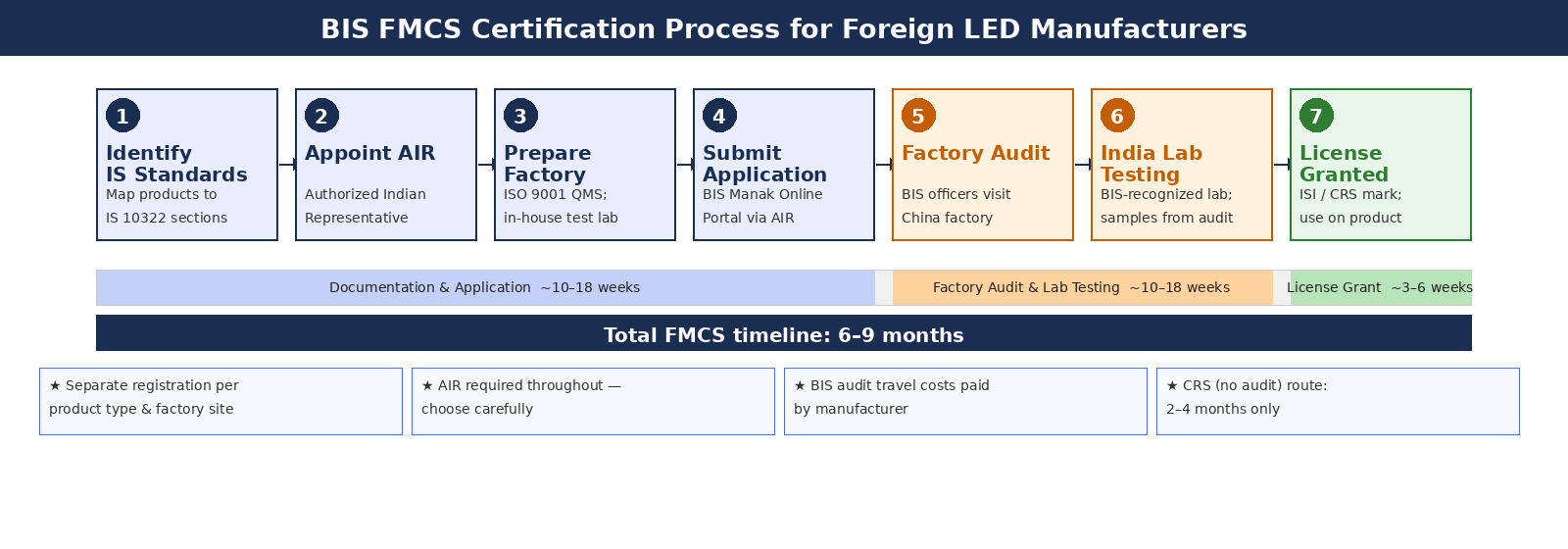
The FMCS Process: Step by Step for Foreign Manufacturers
Step 1: Identify Applicable Standards and Appoint an AIR
Before any application can begin, a foreign manufacturer must appoint an Authorized Indian Representative (AIR). The AIR is a company or individual registered in India who acts as the legal liaison with BIS, submits and manages the application on the manufacturer’s behalf, and holds legal responsibility for the certified product in the Indian market. The AIR cannot be a trader or distributor without explicit authorization — they must have proper Indian business registration and meet BIS’s criteria for educational and technical competency.
Selecting the right AIR matters beyond paperwork. BIS communicates exclusively with the AIR during the application process — including for factory audit scheduling, document deficiency notices, and post-certification surveillance. An AIR with prior BIS FMCS experience significantly reduces the time lost to avoidable communication delays.
Step 2: Factory Preparation and In-House Testing
One of the more demanding requirements of FMCS — the one that catches manufacturers unfamiliar with BIS — is that the factory must have an in-house testing laboratory with calibrated equipment capable of testing the product against the relevant Indian Standard. BIS officials will verify the factory’s testing infrastructure during the audit. This is not merely a paper requirement: auditors check that test instruments are calibrated, that quality control personnel can demonstrate use of the equipment, and that the production process is documented and consistently followed.
For manufacturers already holding ISO 9001-2015 certification — as Fanxstar does — this factory readiness requirement is substantially easier to demonstrate. ISO 9001 documentation provides the quality management system evidence that BIS auditors look for. A valid ISO 9001 certificate is strongly recommended as supporting documentation for any BIS FMCS application.
Step 3: Online Application Submission via Manak Online Portal
Applications are submitted through BIS’s Manak Online Portal (manakonline.in). The AIR files the application on the manufacturer’s behalf. Required documents typically include: the BIS application form; business registration documents; product technical specifications; Declaration of Conformity to the relevant Indian Standard; trademark registration certificate or brand authorization letter; a valid ISO 9001 certificate; and details of the manufacturing process and in-house testing capabilities.
BIS reviews the application for completeness. If deficiencies are found, BIS communicates by email to the AIR. This review stage can take 4–8 weeks, and responsiveness to BIS deficiency notices significantly affects the overall timeline. Every clarification request that takes two weeks to answer instead of two days adds to a process that is already measured in months.
Step 4: BIS Factory Audit
Once the application passes initial scrutiny and fees are remitted, BIS schedules a factory audit at the manufacturing facility outside India. Two BIS officials travel to the factory — in the case of Chinese manufacturers, BIS’s regional presence and audit scheduling logistics make this one of the most time-sensitive steps. Travel and accommodation costs for the BIS auditors are borne by the manufacturer; this is a budgeted cost that manufacturers must plan for.
During the audit, BIS officials verify manufacturing infrastructure and production processes; assess in-house testing capabilities and calibration status; draw product samples directly from the production line; and confirm that the factory can consistently produce products conforming to the relevant IS. Products from the production line — not pre-prepared samples — are sealed by the auditors and sent to a BIS-recognized laboratory in India for independent testing.
Step 5: Independent Laboratory Testing in India
The samples drawn during the factory audit are tested at a BIS-recognized laboratory in India. Testing at labs outside India — including the manufacturer’s own test lab or a third-party lab in China — does not satisfy this requirement. UL Solutions, for example, operates BIS-recognized test facilities in India that are both NABL accredited and authorized to conduct testing for BIS CRS and FMCS purposes, providing a recognized third-party option for manufacturers seeking credibility in both UL and BIS processes simultaneously.
The lab test report, combined with the satisfactory factory audit report, forms the basis for BIS’s grant of license decision. If the factory audit is satisfactory but the product test fails, the manufacturer must address the non-conformances and resubmit — which typically means another factory visit to draw new samples.
Step 6: License Grant and Marking Requirements
Once both the audit and lab test reports are satisfactory, BIS processes the grant of license. The manufacturer pays the license fee and advance minimum marking fee, and BIS issues the formal Letter of Grant of Licence — the document that authorizes use of the ISI mark (for FMCS) or CRS logo (for Scheme II) on certified products.
Marking requirements are precise: for CRS registration, the CRS logo must be printed along with the registration number on both the product and its packaging. The marking must also include product specifications, brand details, and a reference to the BIS portal enabling authenticity verification. All marking must conform to BIS’s specified color scheme and size requirements. Products found marked incorrectly — including unauthorized use of the BIS mark — are treated as non-compliant.
Practical Planning: Costs, Timeline, and Common Pitfalls
Realistic Timeline for the Full Process
Based on industry experience with the FMCS route, manufacturers should plan for the following phases:
| Phase | Duration | Key Dependencies |
|---|---|---|
| AIR appointment and document preparation | 2–4 weeks | AIR selection, trademark documents, ISO cert |
| Online application submission and BIS review | 4–8 weeks | Responsiveness to BIS deficiency queries |
| Factory audit scheduling and execution | 6–12 weeks | BIS officer availability; travel logistics |
| Indian laboratory testing | 4–6 weeks | Lab queue time; sample arrival from China |
| BIS review and license grant | 3–6 weeks | Fee payment, document completeness |
| Total (FMCS route) | 6–9 months | Factory readiness and AIR responsiveness are the biggest variables |
The CRS-only route (without factory audit) for products under Scheme II is faster — typically 2–4 months — but still requires Indian lab testing and AIR management. For manufacturers planning Indian market entry, the absolute earliest a product can realistically be available for legal sale under FMCS is 6 months from the start of the process. Building this timeline into business development planning — not treating BIS as an afterthought — is the difference between a successful market entry and a delayed launch.
Per-Product Registration: The SKU Multiplication Factor
A point that surprises many manufacturers: each product type, each IS section, and each manufacturing location requires a separate BIS registration number. A factory in Dongguan producing weatherproof battens (IS 10322-5-1), road lighting (IS 10322-5-3), and emergency luminaires (IS 10322-5-8) needs at minimum three separate registrations, each requiring its own test report and registration fee. If a second factory in Huizhou produces some of the same products, separate registrations are required for that site too.
This per-SKU, per-site structure is one of the main reasons experienced exporters to India recommend starting BIS applications for the highest-volume, highest-value product categories first, rather than attempting to certify an entire range simultaneously. Prioritization is not just practical — it is essential for managing cost and timeline risk.
What Happens If You Skip BIS
The consequences extend beyond a rejected shipment. Under India’s BIS Act, distributing or selling products required to bear the BIS mark without a valid license is a legal offense. For importers acting as AIR, personal legal liability attaches. Products found in trade can be seized. The manufacturer’s AIR may be disqualified from future BIS applications. For a manufacturer building a long-term position in the Indian market, the risk of a compliance shortcut outweighs any short-term cost savings. India’s enforcement has become materially stricter over the 2020–2025 period as BIS expanded market surveillance and QCO coverage.
BIS and Fanxstar’s Emergency Lighting Range: A Specific Note
IS 10322 (Part 5/Section 8): 2013 covers LED luminaires for emergency lighting — making BIS registration mandatory for Fanxstar’s emergency batten, bulkhead, and spotlight products before they can be imported into India. This section includes self-contained emergency luminaires and central battery system-compatible designs. Given that Fanxstar’s emergency range already carries IEC 60598-2-22-based certifications for EU and UK markets, the IS 10322-5-8 testing scope is technically familiar — the primary incremental cost is the BIS process itself (AIR, lab testing in India, audit) rather than fundamental product redesign. For distributors and project developers active in India’s commercial building and infrastructure sector, BIS-registered emergency lighting from a factory with existing European certifications represents a strong compliance package. Explore the full Fanxstar emergency lighting range for a current overview of the product portfolio.
Frequently Asked Questions
Can an importer or distributor apply for BIS certification on behalf of a foreign manufacturer?
No. BIS certification is issued in the name of the manufacturing entity, not the trader, importer, or distributor. An importer can serve as the Authorized Indian Representative (AIR) — the legal liaison who manages the application process — but the BIS license or CRS registration is issued to the manufacturer. This means the manufacturer’s name, manufacturing address, and quality system are the subject of the certification, and any changes to these require BIS notification.
My products already have CE certification. Can I use the CE test reports for BIS?
CE test reports cannot be directly substituted for IS 10322 test reports, even though IS 10322 is largely harmonized with IEC 60598. BIS requires testing to be performed specifically against the Indian Standard by a BIS-recognized laboratory. However, holding CE certification is practically valuable: the product has already been through similar photometric, electrical safety, and EMC testing, and the factory quality system is documented. This reduces the risk of unexpected test failures and speeds up internal preparation time. Some BIS-recognized labs in India can reference IEC test data during review, but a formal IS-specific test report remains mandatory.
How many BIS registrations do I need for a typical weatherproof and emergency LED range?
Each product type (IS standard section) and each manufacturing location require a separate registration. For a typical Fanxstar-style product range targeting Indian industrial customers — weatherproof battens, emergency luminaires, and road lighting, produced across two factory locations — this translates to a minimum of 6 separate BIS registrations. Engaging an experienced BIS consultant to map your product portfolio to the correct IS sections before beginning any applications avoids costly misdirected applications.
What is an Authorized Indian Representative, and how do I select one?
An AIR is an Indian-registered company or individual legally responsible for the BIS-certified product in India. They submit the application, communicate with BIS on the manufacturer’s behalf, receive deficiency notices, and coordinate the factory audit. A good AIR has direct experience with BIS FMCS applications in the LED/electronics category, existing relationships with BIS-recognized laboratories in India, and responsive communication practices. The AIR cannot be changed mid-application without notifying BIS and potentially restarting portions of the review process.
What happens to my BIS registration when I renew my product certifications or change component suppliers?
Any change to the product design, bill of materials, or manufacturing process that could affect conformity to the Indian Standard must be reported to BIS. Minor changes may be accommodated through a change notice; significant changes that affect safety or performance may require re-testing and re-evaluation. This is where the BIS FMCS model differs most from the CE self-declaration model: there is no manufacturer self-assessment of change impact. BIS determines what constitutes a significant change, and failure to report changes can result in suspension of the license.
Planning LED Product Entry into the Indian Market?
Fanxstar’s manufacturing operations are ISO 9001-2015 certified and our engineering team has direct experience navigating international certification processes across EU, UK, Australian, and North American markets. Our OEM/ODM customization capabilities — including product documentation and compliance support — are designed to help B2B partners enter new markets efficiently.
Explore OEM/ODM & Compliance Support → | Discuss Your India Market Requirements →