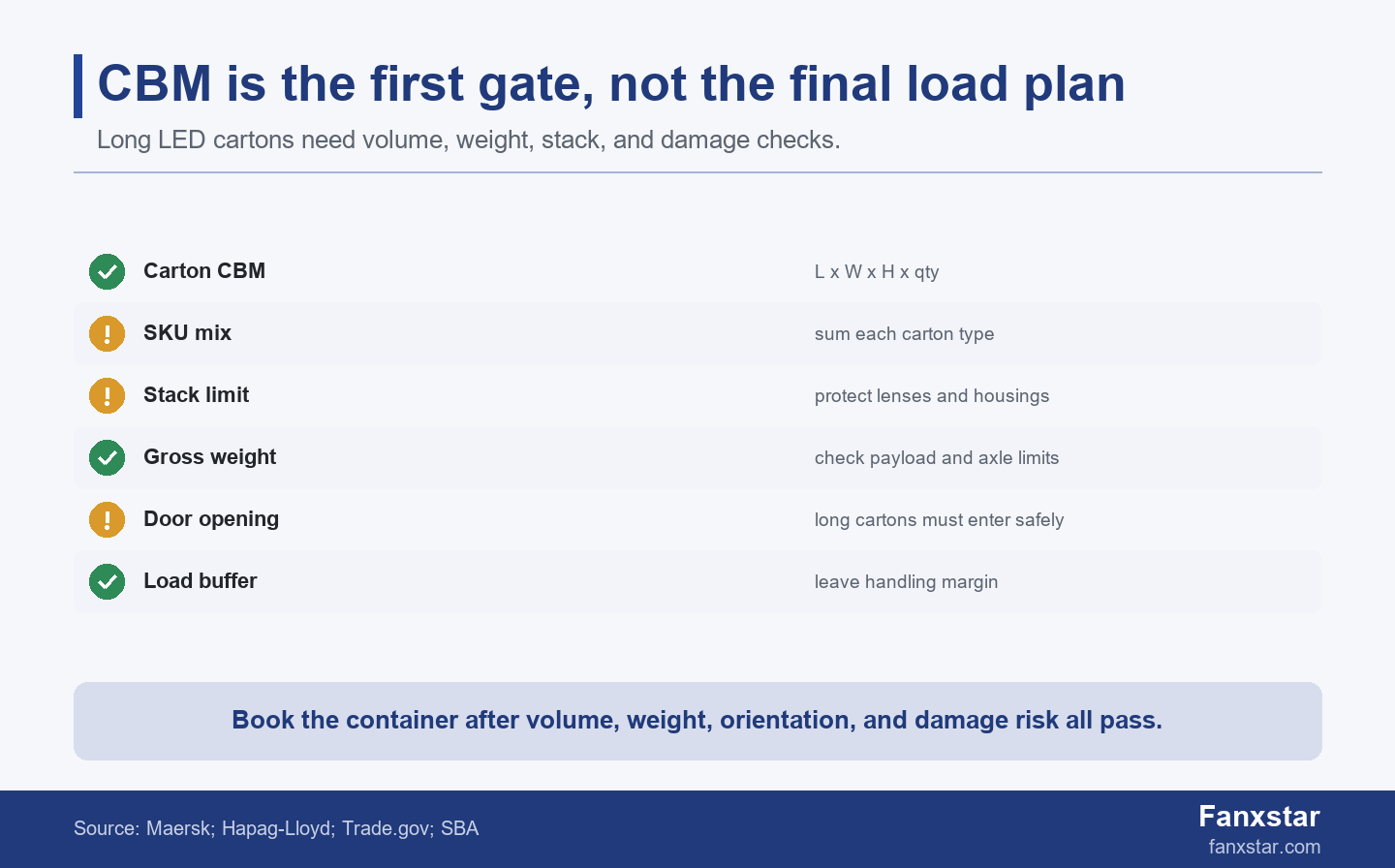
A CBM calculator is useful, but it is not a container loading plan by itself. For LED lighting shipments, the buyer also has to check long carton orientation, lens protection, stackability, SKU mix, gross weight, pallet rules, and loading buffer before choosing LCL, a 20 foot container, a 40 foot container, or 40 foot high cube shipping.
Maersk dry container specifications list 20 foot, 40 foot, and 40 foot high cube dry container volumes, while IncoDocs seafreight CBM guidance keeps the calculation tied to measured length, width, and height. The right decision is therefore not simply the biggest CBM number that fits on paper.
Key Takeaways
- CBM for 1 carton is length x width x height in meters; total shipment CBM is the sum across every carton type and quantity.
- Container volume is theoretical. LED lighting buyers need a practical loading buffer for cartons, pallets, door access, handling, and damage prevention.
- Long linear fixtures, vapor tight lights, emergency fittings, and mixed SKUs can load inefficiently even when the total CBM looks acceptable.
- Before booking freight, compare CBM, gross weight, stackability, SKU mix, container door opening, and the cost difference between LCL, 20 foot container, 40 foot container, and 40 foot high cube options.
How to calculate CBM for LED lighting cartons
Use outside carton dimensions, not product dimensions
The basic formula is simple: CBM per carton = length in meters x width in meters x height in meters. If the carton is 1.25 m x 0.22 m x 0.18 m, the carton volume is 0.0495 m3. If there are 300 cartons, the line-item volume is 14.85 m3. If a second SKU uses a different carton, calculate that line separately and add it to the total.
LED lighting buyers often make the first error before opening a calculator. They use the luminaire length or a catalog size instead of the export carton. That misses foam, corner protection, manuals, accessories, extra cable space, end caps, and carton wall thickness. The freight forwarder and factory load the carton, not the bare fixture.
FedEx dimensional weight guidance makes the same practical point for parcel shipping: length, width, and height drive dimensional calculations, and right-sized packaging can reduce waste while protecting the product. For sea freight, the unit changes, but the discipline is the same. Measure the real outside package.
Mixed LED orders need line-item CBM
| Input | Buyer action | Common error |
|---|---|---|
| Carton length, width, height | Measure outside carton dimensions in meters or convert from centimeters. | Using fixture length without packaging, foam, end caps, or pallet allowance. |
| Quantity by carton type | Calculate each SKU or carton family separately and add the results. | Averaging carton size across mixed fixtures. |
| Gross weight | Compare cargo weight with payload, road, rail, and local handling limits. | Assuming volume is the only container constraint. |
| Stackability | Confirm maximum layers, carton crush risk, lens protection, and pallet rules. | Planning 100 percent cubic fill with fragile long LED cartons. |
| Loading orientation | Check whether long cartons fit through door openings and can turn safely. | Discovering the orientation problem after the container arrives. |
A common Fanxstar-style export order may combine IP65 vapor tight fixtures, linear battens, emergency lights, motion sensor accessories, and spare drivers. Those cartons do not share the same cube, weight, or stack limit. A single average carton size can hide overflow risk.
The safer spreadsheet has one row per carton type: product, model, carton dimensions, units per carton, carton quantity, CBM per carton, total CBM, gross weight per carton, stack limit, and whether the carton can be palletized. This lets the buyer see both the total volume and the fragile line items that control the loading pattern.
Container capacity: why theoretical CBM is not the final answer
Use carrier volume as the ceiling, then add a practical buffer
| Container type | Maersk listed volume | Buyer planning note |
|---|---|---|
| 20 foot container dry | 33 m3 | Good for smaller mixed shipments when weight, carton length, and local trucking limits fit. |
| 40 foot container dry | 67 m3 | Often better cost per cubic meter for volume-led LED lighting orders. |
| 40 foot high cube | 76 m3 | Useful for bulky cartons, but height does not solve all stackability or damage-risk limits. |
Maersk lists dry container internal volumes, but the listed volume is not a promise that every carton can be packed to the last cubic meter. LED cartons may need air space, pallet space, aisle handling, load bars, corner protection, and orientation control. Some cartons cannot be stacked to the roof without damaging lenses, clips, housings, or cardboard.
A practical planning method is to calculate total CBM, compare it with the carrier-listed volume, then apply a loading buffer based on carton strength and loading pattern. The buffer should be decided with the factory and forwarder. Do not publish a universal usable CBM number as if it applies to every carton. Long, fragile, palletized, and mixed-SKU cargo will all behave differently.
Weight and local transport limits can override volume
Hapag-Lloyd container specification guidance notes that road and rail weight limits should be checked locally and discusses concentrated loads. That is relevant even when LED fixtures are not extremely heavy. Drivers, emergency batteries, metal housings, pallet concentration, and uneven loading can create a different constraint than cube.
A container that fits by CBM can still fail by gross weight, axle limit, floor loading, local trucking rule, or warehouse handling capability. The buyer should ask the forwarder whether the shipment is volume-limited, weight-limited, pallet-limited, or handling-limited. Each answer changes the best container choice.
Worked example for a lighting buyer
Compare 20 foot container, 40 foot container, and 40 foot high cube options before confirming the PO
Assume a distributor orders 240 cartons of vapor tight fixtures at 1.25 m x 0.22 m x 0.18 m and 180 cartons of linear battens at 1.35 m x 0.18 m x 0.16 m. The vapor tight line is 11.88 m3. The linear batten line is 6.9984 m3. Total carton volume is about 18.88 m3 before pallets, protection, loading inefficiency, and spare parts.
That volume may look comfortable for a 20 foot container on paper. But if the buyer adds emergency kits, sensor accessories, palletization, or a no-crush stacking rule, the margin can shrink. If the next PO version becomes 35 m3, the 20 foot decision may change. The correct time to review the container is before the purchase order is locked, not after the production cartons are sealed.
IncoDocs seafreight CBM guidance and iContainers cubic meter calculator guidance both keep the buyer focused on measured dimensions. For LCL ocean freight, volume can influence chargeable weight. For FCL, the charge is container-based, but the buyer still has to make the cargo physically and legally fit. That is why a CBM calculator should be linked to a forwarder quote, not used as a standalone answer.
LED lighting packaging changes can move the freight decision
A small carton change can move the shipment across a booking threshold. Adding thicker foam around a lens may reduce damage risk but increase cube. Changing from 10 pieces per carton to 8 pieces per carton may improve handling but add cartons. A longer fixture variant may stop loading crosswise and force a new orientation. These are commercial decisions, not just warehouse details.
For Fanxstar orders, useful product references include A14 vapor tight LED fixtures, B1 LED linear battens, M4F fresh linear fixtures, and weatherproof LED lighting platforms. The buyer should ask for carton dimensions with the quotation and require an updated packing list whenever the fixture length, accessory set, or protection method changes.
The buyer insight is that carton redesign can be cheaper than freight overflow. If 1 carton grows from 0.050 m3 to 0.058 m3, 600 cartons add 4.8 m3 to the shipment. That difference can move a borderline 20 foot container booking into LCL overflow or force a 40 foot container. The packaging decision should therefore be reviewed before the buyer negotiates the final freight mode.
Maersk container type guidance also reminds buyers to check which container types are actually offered on the trade lane. A 40 foot high cube plan is not helpful if sailing availability, destination trucking, or warehouse unloading makes that option impractical for the order date.
According to Maersk dry container specifications, a 20 foot dry container lists 33 m3, a 40 foot dry container lists 67 m3, and a 40 foot high cube lists 76 m3. According to Hapag-Lloyd container specifications, local road and rail weight limits still need checking. According to Maersk container type guidance, container availability includes multiple dry and high cube options rather than a single universal choice.
How CBM connects to documents, customs, and receiving
The packing list should match the freight quote
International Trade Administration import documentation guidance lists common import documents such as commercial invoices, bills of lading, packing lists, insurance proof, and certificates of origin. For a lighting buyer, the packing list is where the CBM calculator becomes a shipping record. It should show carton quantity, carton dimensions, gross weight, net weight, and product identity in a way the forwarder and consignee can read.
A common problem is that the quotation says 28 m3, the proforma invoice says 800 pieces, the packing list says 96 cartons, and the warehouse photos show a different carton size. None of those facts is automatically wrong, but they need to reconcile. If they do not, the buyer may discover overflow, wrong freight billing, or warehouse receiving confusion after production is complete.
The operational insight is to freeze a 3-file match before shipment: sales order, packing list, and forwarder booking. The sales order says what was bought. The packing list says how it is packed. The booking says how it will move. If the total CBM, carton count, or gross weight differs across those 3 files, the shipment is not release-ready.
According to iContainers CBM guidance, cubic meter calculation starts with length, width, and height in meters. According to Freightos CBM guidance, freight mode changes how volume and chargeable weight are interpreted. According to FedEx dimensional weight guidance, right-sized packaging can improve efficiency and reduce damage risk, so carton design still matters even when the shipment moves by ocean freight.
According to SBA import and export guidance, businesses should understand import and export rules before international sales. The decision rule is to treat CBM, gross weight, packing list, and booking confirmation as one release file rather than four separate clerical tasks.
Use a load-photo checkpoint for long lighting cartons
Long LED lighting cartons deserve photo evidence. Before the container doors close, ask for photos showing carton orientation, pallet or floor loading method, end protection, empty space, label visibility, and whether heavy cartons are placed below lighter cartons. This is not about micromanaging the factory. It is about preventing lens damage, bent housings, crushed cartons, and mixed-SKU search problems at destination.
If the shipment is split between LCL and FCL, label the split clearly. The buyer should know which cartons are inside the 20 foot container or 40 foot container and which cartons are moving separately. Otherwise the installation team may receive part of the fixtures without the emergency kits, sensors, or accessories needed to finish the site.
A buyer checklist before container booking
Turn the calculator into a release gate
Before booking, ask the supplier for a packing list with SKU, carton size, carton quantity, gross weight, net weight, units per carton, pallet plan, and stack limit. Ask the forwarder to review the chosen container against door openings, payload, local transport limits, and warehouse receiving method. If the shipment contains fragile diffusers, lenses, emergency batteries, or long housings, add a photo-based loading plan.
The final decision should answer 4 questions: does it fit by CBM, does it pass by weight, can it be loaded without damage, and does the freight mode match the cost and timing target? If any answer is unclear, the buyer should hold the booking. Container problems are cheapest when solved in a spreadsheet and most expensive when solved at the loading dock.
FAQ
What is the CBM formula?
CBM per carton is length x width x height in meters. Total shipment CBM is the sum of every carton type multiplied by its carton quantity. Use outside export carton dimensions, not bare fixture size.
Can a 33 m3 shipment fit into a 20 foot container?
Not automatically. A 20 foot container may list around 33 m3 of volume, but usable loading depends on carton dimensions, stackability, pallets, handling space, damage protection, weight, and door access. Ask the forwarder and factory to review the load plan.
Why do LED lighting cartons load inefficiently?
Many LED fixtures are long, fragile, lens-protected, or mixed by SKU. The cartons may not stack tightly, may require foam or pallet space, and may have orientation restrictions. That reduces usable volume compared with a simple cube calculation.
Should buyers choose LCL or FCL by CBM only?
No. CBM is important, but the decision should also include freight rate, timing, handling risk, customs documents, damage risk, gross weight, and whether splitting the shipment creates backorder or installation problems.