Your lighting fixtures are manufactured, tested, and ready to ship. The pallet they sit on seems like a logistical afterthought — until your 40-container shipment of LED weatherproof lights arrives in Rotterdam and the consignee’s warehouse racking system is sized for 800mm-wide Euro pallets, not the 1000mm standard pallets you loaded in Shenzhen. Re-palletizing at destination adds cost, delay, and damage risk. Choosing the right pallet before loading is a decision that costs nothing extra and can save hundreds of dollars per shipment. This guide explains the differences that matter for industrial lighting exporters.
Key Takeaways
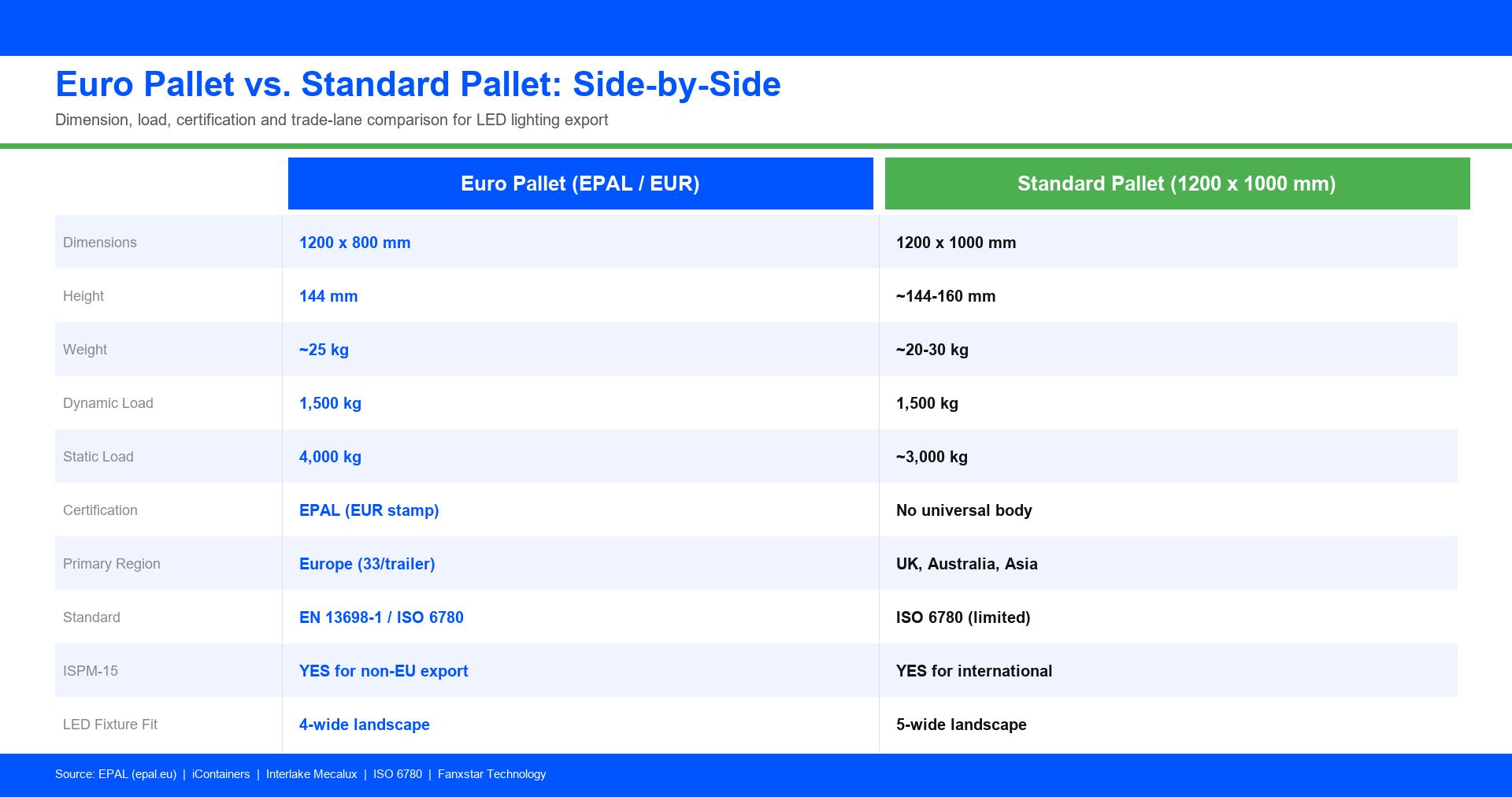
- Euro pallets (EPAL) measure 1200 × 800 mm — the default standard across Europe, sized to fit European truck widths and warehouse racking systems.
- Standard pallets (1200 × 1000 mm) offer a larger surface area, common in the UK, Australia, and Asian export lanes.
- All wooden pallets for international export require ISPM-15 treatment — heat treatment (HT) or methyl bromide (MB) marking; untreated pallets are detained at customs.
- A 20-foot container fits 11 Euro pallets (single-layer) vs. 9–10 standard pallets — the extra positions directly affect your freight cost per unit.
- EPAL pallet quality is certified and exchangeable across 450+ million pallets in circulation across Europe, simplifying reverse logistics.
Why Pallet Choice Matters for LED Lighting Export
Pallet Dimensions Drive Container Utilization
LED fixtures — weatherproof tri-proof lights, emergency twin-spots, industrial vapor-tight luminaires — typically ship in master cartons measuring 600–1200mm long and 200–400mm wide. How efficiently these cartons stack on a pallet, and how many loaded pallets fit in a container, is directly determined by pallet dimensions. A 200mm difference in pallet width (800mm Euro vs. 1000mm standard) changes how many carton columns fit across the pallet surface and how many pallets can be positioned side-by-side in a 20-foot or 40-foot container.
Per the iContainers EPAL pallet specifications guide, a standard European trailer can carry up to 33 Euro pallets (two abreast in a 2.4m-wide trailer with 800mm × 2 = 1600mm, leaving clearance) but may accommodate only 26–28 standard 1000mm pallets. For container shipping from China to Europe, this difference directly impacts the freight cost per pallet position.
Destination Warehouse Compatibility
European distributors — electrical wholesalers, lighting distributors, project contractors — operate warehouses with racking systems sized to the Euro pallet footprint. An 800mm beam spacing is standard across European industrial racking. A 1000mm standard pallet placed in a Euro-rack either overhangs the beams (creating a safety hazard and racking damage risk) or requires the distributor to re-palletize on arrival. Most European buyers will specify “EPAL pallets only” in their purchasing terms. Ignoring this requirement is a fast way to trigger a costly non-conformance at goods receipt.
Euro Pallet (EPAL) Deep Dive
Specifications and Construction
The EPAL Euro pallet measures 1200 × 800 × 144mm and weighs approximately 25 kg. It is constructed from 11 planks of hardwood, 9 solid wood blocks, and 78 nails, assembled to the EN 13698-1 quality standard and ISO 6780 international pallet specification. Per the Interlake Mecalux Euro vs. US pallet analysis, Euro pallets support a dynamic (in-motion) load of 1,500 kg and a static load of up to 4,000 kg — more than sufficient for even the heaviest industrial lighting consignments.
Every genuine EPAL pallet carries the EUR logo burned into the center block, plus the EPAL logo and manufacturer code on the left block. The marking includes the production country code and inspection marks. Counterfeit Euro pallets (distinguishable by 1cm-thick planks instead of 2cm) exist in the market — their load ratings and interchangeability are unreliable, and European distributors will reject them.
The EPAL Pallet Exchange System
A unique advantage of the EPAL system is the pallet pool exchange. Across Europe, EPAL pallets are exchanged on a 1:1 basis between trading partners — the consignee provides empty EPAL pallets in exchange for full ones. This significantly reduces pallet logistics costs for repeat shipments. Over 450 million EPAL pallets are in active circulation, per Pallet Company Pro’s international pallets guide, making pallet availability and exchange predictable across the European supply chain. For a Chinese manufacturer with regular European distribution partners, EPAL compliance builds long-term logistics efficiency.
When to Use Euro Pallets for LED Lighting Export
Specify EPAL Euro pallets when: (1) the consignee is in Germany, France, Spain, Netherlands, Belgium, or any EU member state; (2) the buyer’s purchase order specifies EPAL pallets; (3) the goods will be received into European warehouse racking; or (4) the shipment may be repacked or redistributed within Europe using pallet exchange logistics. For Fanxstar’s weatherproof lighting export orders to European distributors, EPAL pallets are the standard configuration for all FCL and LCL shipments.
Standard Pallet (1200 × 1000 mm) Deep Dive
Specifications and Regional Use
The “standard pallet” in international trade typically refers to the 1200 × 1000mm format used in the UK, Australia, parts of Asia, and for general export where the destination does not mandate Euro pallet dimensions. Per Reuseabox’s Euro vs. standard pallet comparison, standard pallets carry a similar dynamic load of 1,500 kg but lack the uniform certification structure of EPAL. Quality and construction consistency varies significantly by supplier.
The larger 1000mm width provides more surface area per pallet — useful for irregular-shaped or oversized LED fixture cartons that extend beyond the 800mm Euro pallet width. For explosion-proof or industrial-grade lighting fixtures with large-diameter housings, the extra 200mm of pallet width can eliminate overhang issues.
Standard Pallet vs. North American (GMA) Pallet
North American (GMA/grocery) pallets measure 1219 × 1016mm (48″ × 40″) — slightly larger than the standard 1200 × 1000mm international pallet. Per Mecalux’s pallet comparison analysis, GMA pallets are optimized for US grocery and retail supply chains and are the dominant US warehouse format. For LED lighting shipments to the US market, GMA pallets or “standard” 48×40 pallets are the practical choice — most US warehouse receiving docks and racking systems are sized around this format.
ISPM-15: The Non-Negotiable Treatment Requirement
What ISPM-15 Requires
ISPM-15 (International Standards for Phytosanitary Measures No. 15) is the international standard governing wooden packaging materials — pallets, crates, dunnage — in international trade. Nearly every country in the world requires that wooden pallets entering their territory bear evidence of phytosanitary treatment, protecting against wood-boring insects and plant pests that can be transported in untreated wood.
Approved treatments include: Heat Treatment (HT) to a core temperature of 56°C for 30 continuous minutes, and Dielectric Heating (DH). Methyl bromide (MB) treatment was previously common but is being phased out globally due to ozone-depleting properties. The treatment must be performed by an approved facility and the pallet stamped with the IPPC (International Plant Protection Convention) mark, which includes: country code, producer/treatment code, treatment type (HT/DH), and the IPPC wheat symbol.
Consequences of Non-Compliant Pallets
Wooden pallets without a valid ISPM-15 mark are detained at the port of entry by customs phytosanitary authorities. Options for the importer: (1) re-export the goods at seller’s expense; (2) treat pallets at destination (if an approved facility is available at the port) at buyer’s expense; or (3) re-palletize onto compliant pallets at the container devanning point. All three options add cost, delay, and potential damage. For a 40-foot container of LED weatherproof fixtures awaiting customs clearance in Hamburg, a phytosanitary detention is a significant commercial and reputational event.
The practical standard: all wooden export pallets should carry a valid ISPM-15 HT mark. EPAL-certified pallets manufactured from kiln-dried hardwood in approved facilities carry this certification as standard. When sourcing pallets from non-certified manufacturers, request the ISPM-15 treatment certificate for every batch. Contact the Fanxstar logistics team to confirm phytosanitary documentation requirements for your destination country before booking export shipments.
Container Loading: How Pallet Type Affects Capacity
| Container Type | Euro Pallets (1200×800) | Standard Pallets (1200×1000) | US/GMA Pallets (1219×1016) |
|---|---|---|---|
| 20-foot Dry (5.9m × 2.35m floor) | 11 pallets (single-layer) | 9–10 pallets | 9 pallets |
| 40-foot Dry (12m × 2.35m floor) | 24 pallets (single-layer) | 20–21 pallets | 20 pallets |
| 40-foot High Cube (2.69m height) | 24 pallets + double-stack where height allows | 20–21 pallets + partial double-stack | 20 pallets |
Pallet Loading Best Practices for LED Fixtures
Calculating the Right Carton Layout
Before committing to pallet type, map out the carton configuration: how many cartons per layer, how many layers per pallet. For a 600 × 300 × 200mm LED weatherproof fixture carton on a Euro pallet (1200 × 800mm), the configuration is 2 cartons wide (600mm × 2 = 1200mm) × 2 cartons deep (300mm + 300mm… actually 2 × 300mm = 600mm, leaving 200mm unused) or you can rotate: 3 × 200mm wide = 600mm. Mapping this on paper before loading prevents overhang and underutilization. Most freight forwarders can provide CBM-optimized pallet loading plans if you supply carton dimensions and weight.
Securing Loads: Stretch Wrap and Corner Protection
For international ocean freight, palletized LED fixtures require: (1) stretch wrap to consolidate the load and prevent individual carton movement; (2) corner protectors (L-profile cardboard or plastic) on all four vertical edges where strapping runs; (3) pallet strapping in at least two directions for loads exceeding 500 kg; and (4) “Do Not Stack” labels if the carton stacking limit has been reached. For emergency lighting fixtures with LiFePO4 batteries, battery documentation and UN specification packaging requirements apply — standard stretch-wrap palletization is insufficient without the required UN38.3 documentation in the shipping documents.
Choosing the Right Pallet for Each Trade Lane
Use this as a practical guide: Europe (all EU markets, Germany, Spain, Netherlands, France, Belgium, Scandinavia) → EPAL Euro pallet (1200 × 800mm, HT-treated). United Kingdom → Standard pallet (1200 × 1000mm, HT-treated); Euro pallets also accepted. Australia and New Zealand → Standard 1165 × 1165mm or 1100 × 1100mm (check with freight forwarder); ISPM-15 mandatory. United States and Canada → GMA 1219 × 1016mm (48″ × 40″), ISPM-15 mandatory. Middle East (UAE, Saudi Arabia, Qatar) → Generally accept standard 1200 × 1000mm or Euro pallets; consignee may specify.
Common Questions
Can we use plastic pallets to avoid ISPM-15 requirements?
Yes. Plastic pallets are exempt from ISPM-15 phytosanitary treatment requirements because they do not carry the biological risk of wood-boring insects. They are increasingly used for repeat export lanes where pallet exchange programs are not practical, or for temperature-controlled shipments where wood moisture retention is a concern. The trade-off: plastic Euro pallets cost more than wood EPAL pallets (typically 2–4x the purchase price), they cannot participate in the EPAL exchange system, and they are heavier than standard wood pallets — reducing the net payload per container. For high-volume OEM/ODM customers with regular repeat export lanes, the logistics simplification of plastic pallets sometimes justifies the cost premium.
What if our cartons overhang the pallet edge?
Overhang beyond 50mm on any side of the pallet is generally not accepted by carriers or warehouse receiving teams. Overhang creates instability, increases damage risk during handling, and may exceed the consignee’s racking specifications. If carton dimensions don’t fit cleanly on the chosen pallet without overhang, options are: (1) change to a wider pallet format; (2) redesign the carton orientation on the pallet; or (3) use a custom pallet size. Most Chinese pallet manufacturers can produce custom dimensions for export-specific requirements.
Do we need to return Euro pallets to the supplier?
Under the EPAL exchange system, pallets are not returned to the original sender — they are exchanged with the consignee on a 1:1 basis (full pallet in, empty pallet out). If your European distributor participates in EPAL exchange, they will provide empty certified EPAL pallets in exchange for your loaded ones. If no exchange arrangement exists, the buyer retains the pallets and may sell or dispose of them locally. Unlike specialized handling equipment, pallet return logistics are not typically arranged between Chinese exporters and European buyers.
What documentation is needed for pallets in the commercial invoice?
Pallets are typically declared in the packing list and commercial invoice as part of the gross weight and CBM calculation. The pallet weight (approximately 25 kg per EPAL, 20–30 kg per standard) must be included in the gross weight declared to the carrier. The commercial invoice should state “wooden pallets: ISPM-15 HT treated” when applicable. For fumigation certificates (required by some Middle Eastern countries), a separate phytosanitary certificate issued by the exporting country’s agricultural authority may be required in addition to the ISPM-15 pallet stamp.