A customs audit notification arrives by mail — or increasingly, by email from your customs broker forwarding a CBP Form 28 (Request for Information) or Form 29 (Notice of Action). The document request covers all imports of LED lighting fixtures for the past three years. You have 30 days to respond. This is not an unusual scenario for mid-to-large lighting distributors and importers. According to Camtom’s 2026 CBP Focused Assessment preparation guide, focused assessments examine classification, valuation, country of origin, trade program eligibility, and record-keeping across all major compliance areas. The importers who handle audits well are not those who were never wrong — they are those who kept organized records and can demonstrate reasonable care. This guide explains exactly what those records are and how to maintain them.
Key Takeaways
- US CBP requires 5 years of import records under 19 CFR Part 163 — this covers commercial invoices, entry summaries, packing lists, purchase orders, and correspondence.
- CBP penalties for recordkeeping failures run up to $10,000 per entry for unintentional violations and up to $100,000 per entry for willful violations (per Great Lakes Customs Law’s 19 U.S.C. § 1509 analysis).
- Common audit triggers include HS code misclassification, valuation discrepancies, and country-of-origin errors — all preventable with proper pre-shipment documentation.
- EU and global customs authorities have equivalent post-clearance audit powers — document retention requirements are similar across major import markets.
- A proactive prior disclosure to CBP reduces penalties significantly compared to having violations discovered during an audit.
What Is a Customs Audit and Why Does It Happen?
Post-Entry vs. Pre-Release Examination
Most importers are familiar with pre-release customs examination — the physical inspection or document review that occurs before goods are released from the port. A customs audit is different: it happens after goods have already cleared, sometimes years later, and covers a broad sweep of historical entries rather than a single shipment. Per Magnetic Precision’s post-entry audit guide, a post-entry audit (also called a compliance assessment or regulatory audit) is CBP’s formal review to verify that import declarations, documentation, and trade practices were accurate and compliant with US customs regulations.
For LED lighting importers, post-entry audits are a real operational risk. The lighting industry has been subject to increased enforcement attention due to antidumping and countervailing duty (AD/CVD) proceedings on certain LED products from China, as well as broader CBP enforcement emphasis on correct country-of-origin marking and HS code classification accuracy. A distributor importing significant volumes of weatherproof fixtures, emergency lighting, or motion sensor lights over multiple years is within the normal audit risk profile.
What Triggers a Customs Audit
Audits are not random — CBP selects importers based on calculated risk signals. Common triggers include: consistent use of the same (potentially incorrect) HS codes across a large import volume; significant discrepancy between declared customs value and market data; origin claims that attract scrutiny under ongoing trade remedy investigations; anomalies in the ratio of product value to freight cost; and referrals from other enforcement actions or partner government agencies. An importer who frequently uses vague descriptions like “lighting components” or “electrical parts” on commercial invoices, rather than specific product descriptions with HS codes, creates audit exposure through documentation inconsistency.
The Core Documents You Must Have
Commercial Invoice
The commercial invoice is the foundation of every customs entry and the primary document in any audit. It must accurately state: seller and buyer name and address, country of origin of goods, complete description of goods (specific enough to determine HS classification), quantity, unit price, total value, currency, Incoterms, and payment terms. Per the CBP Importing into the United States guide, frequent invoicing errors include: incomplete product descriptions, undervaluation, incorrect country of origin, and missing Incoterms — all of which can trigger audit findings and penalty exposure.
For LED lighting specifically: “LED light fixture” is not a compliant description. “LED Weatherproof Tri-proof Light, IP65, 50W, 4000K, 220-240V, aluminum housing with polycarbonate diffuser, HS 9405.11.40” is. The description must be specific enough for a customs officer with no prior knowledge of the shipment to correctly classify the goods. This level of specificity is not just good compliance practice — it is the standard Fanxstar applies to all commercial invoice documentation for weatherproof lighting exports.
Packing List
The packing list provides the physical breakdown of the shipment: how many cartons, which products in each carton, gross and net weight per carton, and carton dimensions. Customs authorities use the packing list to verify that the commercial invoice accurately describes the contents of the shipment — a packing list that lists 50 cartons while the invoice claims 40 is an immediate discrepancy. Under US CBP regulations, packing lists must be retained for at least 60 days from the end of the release period; however, retaining them for the full 5-year period consistent with other records is strongly recommended for audit preparedness.
Bill of Lading (B/L) or Air Waybill
The transport document establishes the carrier’s receipt of the goods and provides the legal chain of title during transit. In a customs audit, the bill of lading is cross-referenced against the commercial invoice and customs entry to verify: consignee identity, port of loading (confirming origin claims), shipment date (confirming the correct duty rate applied at the time of importation), and cargo description. Any inconsistency between the B/L description and the invoice description is an audit finding. Bills of lading should be retained for the full 5-year period.
Certificate of Origin
Country of origin is one of the three most common audit findings (alongside classification and valuation), and the Certificate of Origin is the primary supporting document. For LED lighting manufactured in China, the Certificate of Origin is typically a Form A (GSP certificate) or a standard Chamber of Commerce certificate. For goods claiming preferential tariff treatment under trade agreements — CPTPP, RCEP, EU-specific FTA forms (EUR.1, Form A) — the specific agreement-required form must be used and its content must match the commercial invoice exactly: product description, HS code, declared origin, and parties must be consistent.
The Maersk mandatory shipping documents guide notes that the Certificate of Origin is used by customs to apply the correct tariffs and determine whether goods qualify for preferential treatment under trade agreements — making it a critical document not just for compliance but for cost optimization in tariff management.
Entry Summary (CBP Form 7501 / Customs Entry)
In the US, the Customs Entry Summary (CBP Form 7501) is the formal declaration filed by the importer or customs broker that determines duty liability. It includes the HTS (Harmonized Tariff Schedule) classification, declared value, country of origin, and calculated duties. Maintaining a copy of every entry summary filed on your behalf is mandatory and forms the audit trail that CBP uses to verify consistency across shipments. If your customs broker files entries on your behalf without providing you copies, request them systematically — you are legally responsible for the accuracy of entries filed in your name, regardless of whether a broker prepared them.
Regulatory and Certification Documents
CE Declaration of Conformity (European Union)
For LED lighting exported to EU markets, the CE Declaration of Conformity is both a market access requirement and a customs compliance document. It declares that the product meets applicable EU Directives — Low Voltage Directive (LVD 2014/35/EU), Electromagnetic Compatibility Directive (EMC 2014/30/EU), and RoHS Directive (2011/65/EU). EU customs authorities can request DoC during import clearance and during post-clearance audits conducted by national market surveillance authorities. Maintaining a complete DoC file — including the underlying technical documentation, test reports, and notified body certificates where applicable — is required for CE-marked products.
For Fanxstar emergency lighting products, the EN 1838 standard compliance documentation and DALI 2.0 certification records form part of the technical file maintained for CE purposes. These documents may be requested by EU customs or market surveillance authorities at any point during the product’s market presence.
Product Safety Certifications (UL, ETL, SAA, TUV)
For markets with mandatory third-party certification requirements — UL/ETL for the US, SAA for Australia, TUV/CB for global acceptance — the certification documents must be maintained and current. Customs authorities in these markets can request certification evidence as part of import clearance or post-clearance audit. An expired UL certificate on a product continuing to be imported creates immediate compliance exposure. Maintain a certification tracking register with: product model, certification body, certificate number, scope, issue date, and expiry date. Schedule renewal reviews 6 months before expiry.
HS Code Classification: The Most Common Audit Finding
Why HS Code Errors Are So Common
The Harmonized System (HS) code determines the duty rate applied to every imported product. For LED lighting, the classification landscape is complex: different fixture types, different applications, and different installed components can land in different HS chapters — Chapter 85 (electrical machinery), Chapter 94 (furniture and lamps), or even Chapter 90 (optical instruments) for specialized medical or grow lighting applications. Many importers and their brokers default to the most familiar code used for a previous similar product, without rigorously verifying whether a new product model falls in the same classification. Per the Camtom CBP focused assessment guide (2026), classification errors are one of the three most frequent audit findings — CBP tests a sample of entries and independently reclassifies the goods, and any difference becomes a finding.
Maintaining Classification Support Documentation
For each product model, maintain a classification worksheet documenting: the HS code selected, the tariff chapter heading and subheading applied, the product specification that supports the classification decision, any CBP binding ruling obtained (or reference to published rulings on similar products), and the date of the classification decision. If your product line expands — as is common when adding new wattages, CCT options, or certifications — update the classification file for each new variant. A product that was correctly classified at 9405.11 in 2021 may need re-evaluation if its specifications changed in 2023. Contact our team to obtain accurate product technical specifications for classification support documentation.
The 5-Year Record Retention Rule
What the Law Requires in the US
Under 19 CFR Part 163 and 19 U.S.C. § 1508, importers must maintain import-related records for five years from the date of entry. As confirmed by Krenz & Hannan International’s CBP audit guide, this five-year retention period aligns exactly with CBP’s statute of limitations for penalty actions — meaning a CBP audit can reach back five years and will expect complete, organized records for every entry in that window. Failure to produce records carries penalties up to $10,000 per entry for non-willful violations. Electronic storage is acceptable under CBP regulations provided records are accessible and reproducible on demand.
What Records Specifically to Keep
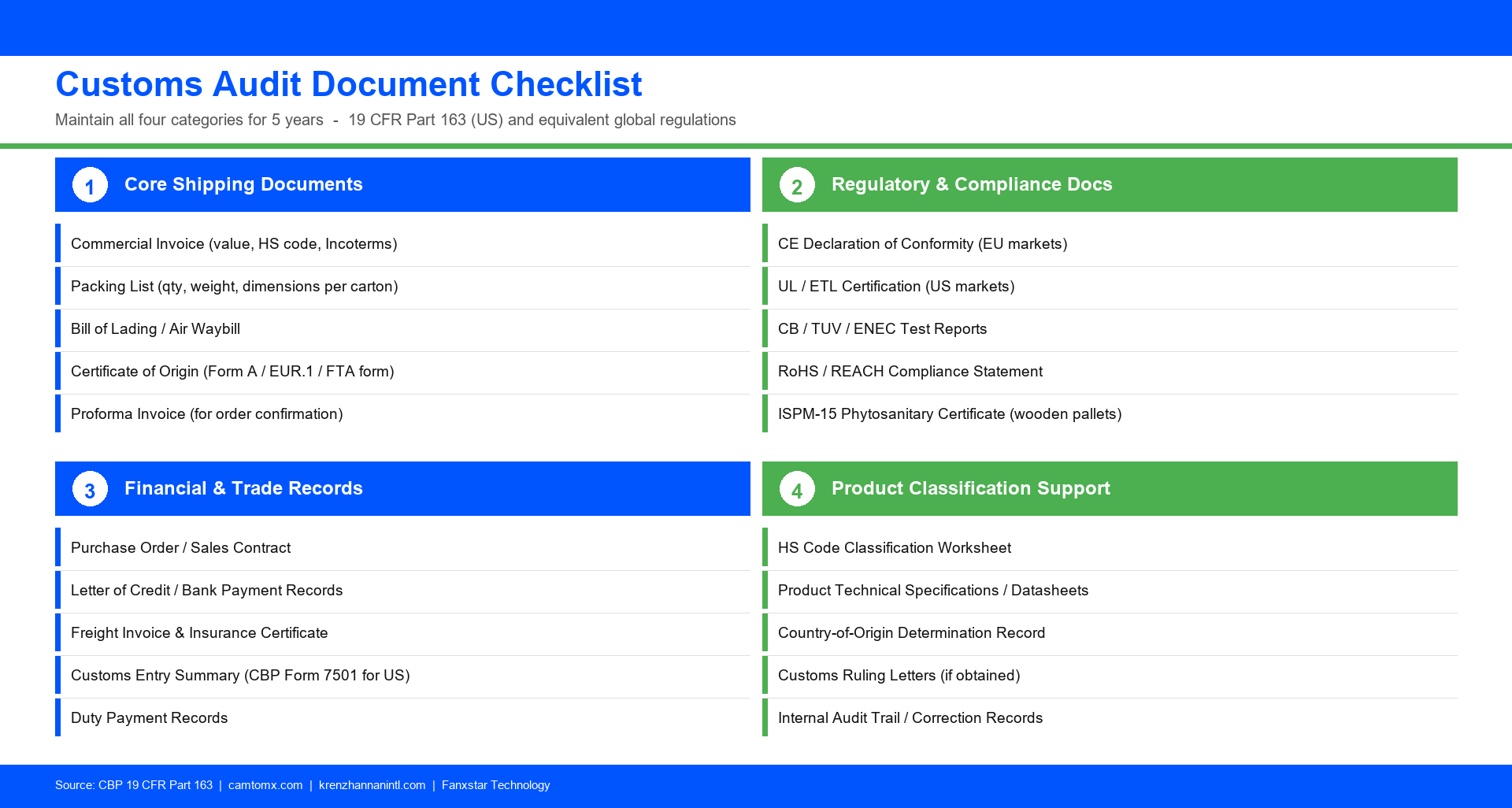
The required records for each import entry include: commercial invoice, packing list, bill of lading, customs entry summary (Form 7501 or equivalent), any customs bonds, proof of origin documents (Certificate of Origin, FTA certificates, USMCA/CUSMA certifications), duty payment records, customs broker correspondence and instructions, and any CBP ruling letters or binding ruling requests related to the imported products. Organizing these records by entry date and shipment reference — rather than by calendar year or product category — makes responding to a CBP document request far more efficient.
How to Respond to a Customs Audit Notification
Step 1 — Do Not Ignore It
A CBP Form 28 (Request for Information) or Form 29 (Notice of Action) has a defined response deadline — typically 30 days. Missing this deadline or providing an incomplete response escalates the matter and significantly increases penalty exposure. Immediately notify your customs broker and, for significant volume importers, engage a customs attorney or trade consultant. The audit notification is not an accusation of wrongdoing — it is a compliance verification process. Most importers who respond promptly with organized documentation resolve audits without penalty.
Step 2 — Gather Records Systematically
Pull all records for the entries covered in the audit notification period. Organize by entry number and date. Verify that all required documents are present and internally consistent: the commercial invoice description must match the packing list, which must match the bill of lading, which must match the customs entry summary. Any inconsistency identified in your own review should be addressed proactively in your response — a voluntary prior disclosure of a known error, made before CBP formally identifies it, substantially reduces the applicable penalty under 19 U.S.C. § 1592.
Step 3 — Address Classification and Valuation Questions Specifically
CBP auditors will independently verify your HS code classifications against the product specifications. Prepare a classification support memo for each product type in the audit scope: product description, technical specification, the classification reasoning applied, and any reference rulings. If your classification was conservative (paying more duty than strictly required) that is not an audit issue; if it was aggressive (understating duty), be prepared to defend it with technical documentation. Similarly, if assists (tooling, design, engineering provided to the foreign manufacturer) were not included in the customs value, this is a common valuation finding — review your supplier relationships for any assists that may have been omitted.
Common Questions
Are all LED lighting importers at equal audit risk?
No — audit risk is not uniformly distributed. Importers with high volumes, inconsistent classification records, prior compliance violations, or goods that fall within active trade remedy investigations (AD/CVD orders) carry meaningfully higher audit probability. For LED lighting from China, the existence of historical antidumping investigations on certain LED products means that importers of affected product categories should maintain particularly rigorous origin and classification documentation. The absence of a compliance program — written procedures, classification review, internal audit — is itself an audit finding under the “reasonable care” standard.
What is the difference between a CF-28 and a CF-29?
A CBP Form 28 (Request for Information) is an administrative request — CBP is asking for documentation to review an entry, not alleging any violation. A CBP Form 29 (Notice of Action) is more serious: it notifies the importer that CBP intends to take action on an entry — reliquidation at a higher duty rate, assessment of unpaid duties, or formal penalty proceedings. A CF-28 is often the first step; if your response is adequate, the matter may close there. A CF-29 requires a formal response and, for significant duty amounts, engagement of customs legal counsel.
Can using a customs broker protect me from audit liability?
No. The importer of record bears legal responsibility for the accuracy of customs declarations regardless of who prepared them. Using a licensed customs broker demonstrates reasonable care, which can mitigate penalties, but does not transfer legal liability. If your broker filed incorrect classifications or values on entries prepared from information you provided, CBP will look to you — not the broker — for duty recovery and potential penalties. This is why maintaining internal classification records and reviewing entry summaries before they are filed are essential compliance practices, not optional exercises.
What documentation is specifically important for explosion-proof and hazardous location LED fixtures?
For ATEX/IECEx certified explosion-proof LED lighting, additional documentation is required beyond standard commercial documents: the ATEX/IECEx certificate number and issuing body must appear on the commercial invoice and be available for customs inspection; the technical file supporting the Ex certification must be maintained by the manufacturer; and for US import, any UL 844 or equivalent certification for Class I/II/III Division hazardous locations must be documented and current. Import of non-certified explosion-proof fixtures into ATEX or UL-regulated markets carries not only customs compliance risk but also significant product liability exposure.
How long should we retain export records as a Chinese manufacturer?
Chinese exporters are subject to Chinese customs record retention requirements under the Customs Law of the People’s Republic of China, which generally requires retention of import/export records for 3 years (and up to 5 years for certain categories). However, if you export to US importers who are subject to CBP audit, your commercial documents — invoices, packing lists, purchase orders, production records, origin-supporting records — may be requested by CBP through the importer as part of a post-entry audit. Maintaining organized export records for at least 5 years is practical best practice for Chinese manufacturers who regularly export to major markets, regardless of domestic retention minimums.