Cleanroom, pharmaceutical, and healthcare lighting fails when a fixture is treated as a brightness device instead of a cleanability, contamination-control, and maintenance-risk component. The useful specification begins with surface geometry, gasket exposure, ceiling interface, and service access, then adds lux levels and controls. In a partial YMYL environment, the lighting supplier should prove material and cleanability boundaries without pretending that a luminaire validates a medicine, device, or infection-control program.
That boundary makes the buyer safer and also makes the ODM quotation more concrete.
Key Takeaways
- Specify the cleanability boundary first: Smooth surfaces, gasket exposure, lens edge, ceiling interface, and access method shape the risk before lux calculations become useful.
- Use standards as scope boundaries: ISO 14644 classification, GMP rules, and healthcare infection-control references help buyers ask for evidence, but they do not turn a luminaire into a validation program.
- Separate lighting from medical claims: Fanxstar products are not medical devices. Consult healthcare professionals.
- Make maintenance part of the RFQ: Driver access, latch design, tool requirements, and ceiling disturbance can change controlled-zone exposure time.
- Use ODM sampling to prove risk: The sample should prove ceiling fit, cleanable geometry, ingress boundary, photometric task, and document scope.
Start With The Contamination Boundary
Cleanroom lighting is a contamination-control component before it is a brightness device.
According to ISO 14644-1, cleanrooms are classified by airborne particle concentration. That fact matters for lighting buyers because the luminaire sits inside the ceiling or controlled zone and becomes part of the facility surface system. A sealed white fixture is not automatically cleanroom-ready; the RFQ has to define whether the housing is flush, teardrop, surface mounted, or suspended, and whether its edge detail creates a ledge, gasket exposure, or maintenance disturbance.
Cleanroom Class Changes The Ceiling Interface
According to ISO 14644-4, cleanroom design and start-up requirements are connected to construction details and controlled-environment operation. The practical lighting consequence is that ceiling integration cannot be left for the installer to solve. A flush panel fixture such as a cleanroom panel concept may fit one ceiling grid, while a teardrop style may be chosen where the airflow and cleaning strategy require a different profile. In practice, the buyer should ask for fixture drawings, mounting details, cable routing, and service access before approving a sample. If those details arrive only after pricing, the project has already confused catalog selection with cleanroom engineering.
Pharmaceutical Areas Need Evidence Boundaries
According to EudraLex Volume 4, EU GMP requirements sit inside a broader pharmaceutical quality system. The same boundary appears in US cGMP rules: 21 CFR 211.44 requires adequate lighting in drug manufacturing areas, while 21 CFR 211.56 addresses sanitation. These sources do not say a fixture alone creates compliance. They tell the buyer to ask how the fixture supports cleanable facility operation. This means material notes, ingress test scope, lens retention, screw exposure, and cleaning assumptions belong in the RFQ evidence pack.
A practical pharmaceutical lighting evidence pack can be divided into 3 layers: facility requirement, luminaire evidence, and project-specific installation note. The facility requirement belongs to the owner or validation team; the luminaire evidence belongs to the supplier; the installation note belongs to the project handoff. This separation prevents a sales claim from being mistaken for a GMP conclusion. It also gives the buyer a cleaner comparison method: 2 suppliers can be compared by the same drawing, material, cleaning, and access checklist instead of by different brochure phrases.
Healthcare Language Requires A Clear Limit
According to CDC environmental infection-control guidance, healthcare environments require coordinated control of surfaces, air, water, cleaning, and facility practices. Lighting content should respect that boundary. A luminaire may support cleanability, illumination, and maintenance planning, but it does not diagnose, treat, disinfect a room by itself, or replace infection-control policy. For Fanxstar, that means healthcare and medical-lighting language should stay concrete: sealed housing, smooth diffuser, mounting method, color quality, glare control, service access, and document scope. Fanxstar products are not medical devices. Consult healthcare professionals.
The same discipline protects healthcare buyers. A hospital support area, clinic back room, and clean corridor may all need comfortable light and cleanable surfaces, but the decision owner is different in each case. The lighting supplier can specify diffuser, glare, CCT, driver access, and housing geometry; the healthcare team decides infection-control procedures and clinical suitability. A useful quotation should therefore include 1 visible disclaimer, 1 product evidence pack, and 1 maintenance note rather than letting medical words drift into unsupported performance claims.
Application Matrix For Cleanroom, Pharmaceutical, And Healthcare Zones
The product family should follow the controlled-zone task, not a generic clean white fixture label.
Fanxstar pharmaceutical lighting application and Fanxstar medical lighting product category give buyers a starting point, but the real selection still depends on zone function. The table below converts the title promise into an RFQ screen.
| Zone Type | Main Lighting Task | Cleanability Risk | ODM Evidence To Request | Product Direction |
|---|---|---|---|---|
| Laminar-flow cleanroom area | Uniform task visibility without disrupting the ceiling plane | Edges, gasket exposure, service entry, and surface ledges | Ceiling drawing, material note, IP boundary, installation section | G1 Cleanpal flush panel reference |
| Pharmaceutical production room | Adequate light for inspection, operation, and cleaning checks | Lens retention, screw exposure, wipe-down compatibility | Photometric layout, cleanable housing details, document scope | G1 or G2 platform by ceiling and airflow condition |
| Healthcare support space | Comfortable visibility for staff workflow and routine cleaning | Overstated medical claims and unclear maintenance access | Glare control, color quality, maintenance method, disclaimer | Medical lighting category with clear non-device boundary |
| Clean corridor or gowning area | Wayfinding, visual comfort, and easy surface cleaning | Dust ledges, exposed fasteners, hard-to-reach drivers | Mounting drawing, driver access method, cleaning assumption | Flush or low-profile sealed fixture |
The decision rule is to assign each room to a surface and access risk before asking for a price. If a buyer deletes the cleanability column, the table still looks like a normal lighting schedule, but the most important controlled-environment question disappears. That is why the RFQ should ask for drawings, document scope, and service method in the same line as lumen output. The lamp that wins on wattage may lose when the facility team calculates cleaning burden, airflow disturbance, or ceiling access.
ODM Specification Gates Before Sampling
An ODM sample is only useful when it proves the controlled-zone risk it was ordered to test.
A cleanroom sample should not be approved because it turns on, looks white, and fits the catalog photo. The sample needs a job. For Fanxstar custom LED lighting ODM service, that job may be confirming a ceiling cutout, an optics option, a lens material, a driver access method, a cable entry, or a product family adaptation that avoids new-tooling risk. The buyer should define the pass condition before the sample ships.
Gate 1 Locks Geometry And Surface Detail
The first gate asks whether the physical shape matches the controlled environment. The G1 Cleanpal reference is useful when a flush ceiling relationship is needed; the G2 teardrop reference is useful when a different airflow or cleanability profile is required. Neither model should be treated as a universal answer. The buyer should request the housing drawing, lens edge detail, latch or screw arrangement, and installation section. The hidden cost of skipping this step is late ceiling rework: a fixture can meet the electrical brief yet still create ledges, conflicts with grid hardware, or access problems that are expensive to fix after site coordination.
Gate 2 Defines Ingress, Material, And Cleaning Assumptions
The second gate prevents a common specification shortcut: writing an IP rating without naming the cleaning reality. Wiping, low-pressure cleaning, washdown, disinfectant exposure, and vapor presence are different assumptions. According to FDA cGMP resources, quality systems depend on process control and documentation, so a lighting RFQ should request the actual evidence that supports the intended use. In practice, this includes material notes, ingress test scope, gasket design, cable-entry method, and any cleaning limitation the buyer must hand to the facility team.
A useful RFQ uses 4 columns for this gate: cleaning action, material exposure, evidence requested, and exclusion. For example, wet wipe, vapor exposure, and occasional rinse are not the same condition. A supplier that can state both the supported condition and the excluded condition is easier to qualify because the buyer can hand the limits to the facility team. The decision rule is simple: if the cleaning method cannot be written in one sentence, the sample is not ready for release.
Gate 3 Turns Service Access Into A Risk Control
The controlled-zone scenario estimate uses 180 luminaires. If each hard-to-access fixture adds 8 minutes of ceiling-adjacent work, one pass creates 1440 minutes, or 24 person-hours, inside or next to the controlled zone. If documented access reduces that to 3 minutes, the pass falls to 540 minutes, or 9 person-hours. This means access design can shift the service event by 15 controlled-zone person-hours under the stated assumptions. The calculation is illustrative, but it gives buyers a reason to treat driver access and latch design as controlled-zone decisions.
For an ODM buyer, the 15-hour difference is not only a labor number. It can affect production scheduling, gowning coordination, ceiling access permits, and the number of times a controlled room is disturbed. A sample should therefore show the access path with the same seriousness as the light output. If the driver, latch, or cable entry cannot be serviced according to the buyer’s room routine, a lower unit price may only move cost from purchasing into operations.
RFQ Checklist For Cleanroom And Healthcare Lighting Buyers
The RFQ should make evidence comparable before price is compared.
A strong RFQ for cleanroom, pharmaceutical, or healthcare LED lighting should ask for room type, ceiling type, mounting geometry, cleaning method, ingress expectation, material assumptions, lux and uniformity target, glare and color requirements, driver access, cable entry, certification or test scope, sample pass condition, and packaging requirements. For procurement teams, the key insight is that each field changes either controlled-zone risk or sampling relevance. A vague RFQ invites generic catalog answers; a bounded RFQ lets a platform-based ODM supplier identify the closest existing base product and the real customization work.
Product reference set from the local Fanxstar image library: G1 Cleanpal and G2 teardrop cleanroom lighting should anchor cover-image generation and sample discussion. Buyers can move from the pharmaceutical lighting application page to contact Fanxstar for an ODM lighting quote when the room type and evidence boundary are ready.
According to the evidence logic above, the final RFQ should carry at least 6 comparable attachments: room schedule, ceiling interface drawing, cleaning assumption, photometric target, service-access note, and certificate scope. That 6-part packet gives the buyer a stronger way to compare 2 or 3 ODM suppliers because every quotation has to answer the same controlled-zone questions.
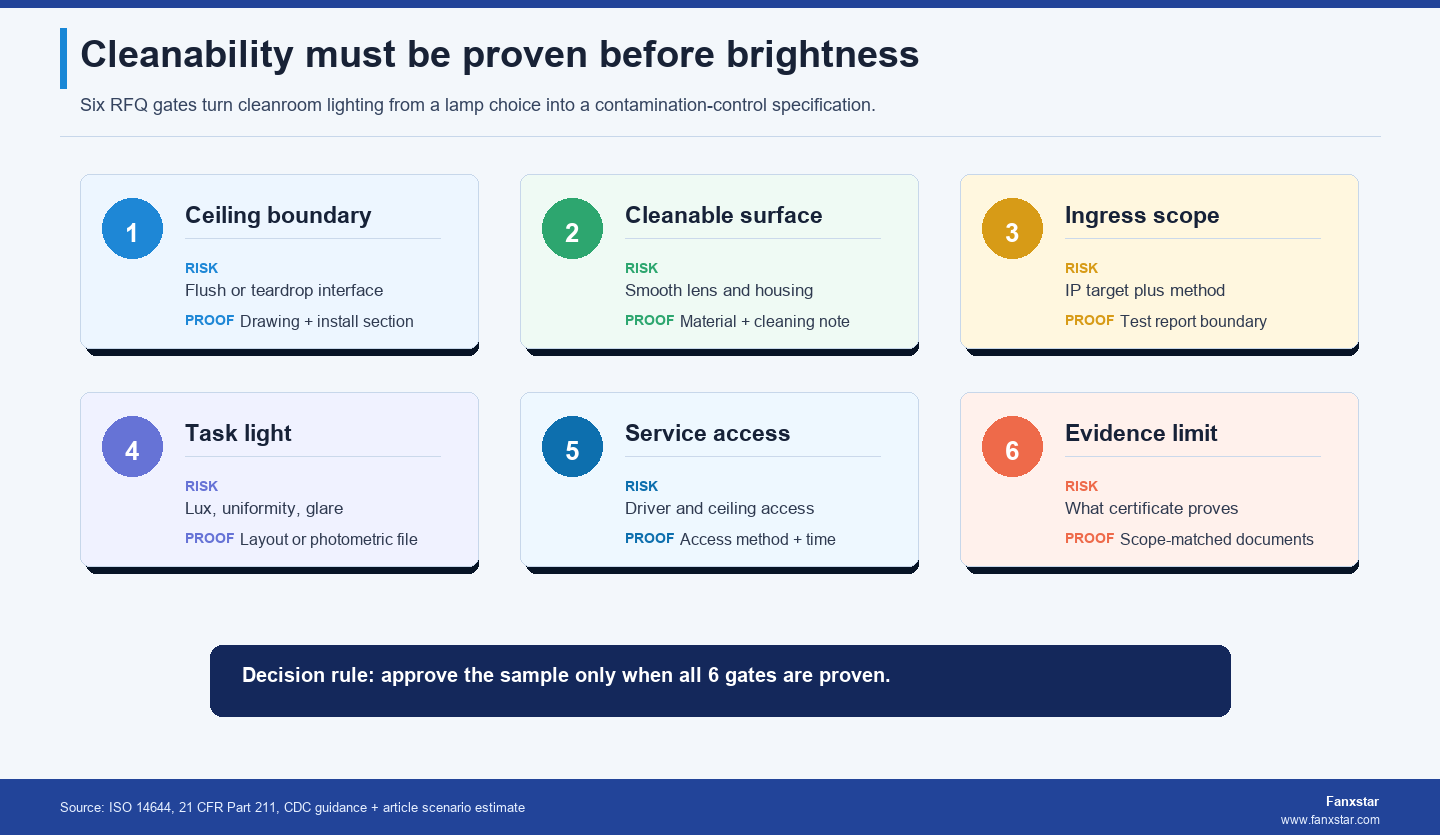
Specification Depth Check Before Final Supplier Comparison
For cleanroom, pharmaceutical, and healthcare LED lighting, the missing depth is usually not another product adjective. It is the buyer’s ability to prove why a fixture belongs in controlled rooms where contamination control, visual task quality, cleaning chemistry, and maintenance access overlap. A fixture that looks bright enough can still fail the room because it creates a cleaning gap, an undocumented material exposure, or a maintenance event inside a controlled boundary. A stronger specification therefore keeps the commercial comparison downstream of the evidence file, not upstream of it.
Treat the clean boundary, the task plane, the cleaning method, and the maintenance path as four separate acceptance gates.
Lock The Acceptance Gates Before Sampling
The practical sequence is to decide the site boundary first, the product family second, and the sample evidence third. For Fanxstar, the relevant starting points can include sealed panels, vapor-tight battens, cleanroom-ready linear fixtures, and medical-area luminaires, but the quote should not treat those product names as the acceptance test. The acceptance test is the buyer’s written answer to what must be visible, cleanable, maintainable, safe, documented, and reviewable in the real installation.
If 60 fixtures need 10 minutes of extra review because material, gasket, driver access, and cleaning notes are mixed together, the review consumes 600 minutes, or 10 hours, before the buyer has solved a single photometric issue. Based on our analysis of this review path, a small front-end evidence checklist can be more valuable than another round of catalog comparison. Calculated from the scenario estimate, every repeated clarification task becomes a hidden procurement cost when it is multiplied across the fixture schedule. It turns the specification from “which light is best” into “which product can pass the exact room, route, cleaning, maintenance, and documentation condition that will decide acceptance.”
Keep The Evidence Pack Tied To The RFQ
The RFQ should request one sample mounted in the real ceiling or wall detail, one cleaning review, one maintenance access check, and one document pack that separates hygiene evidence from electrical evidence. It should also state the responsibility boundary: Fanxstar can support the product and ODM evidence pack, while final suitability remains tied to the buyer's cleanroom class, healthcare policy, installer method, and local authority review. That wording protects both sides. The buyer gets a reviewable package, and the supplier avoids making a compliance promise that belongs to the project authority or operating procedure.
- Regulatory or standards boundary: According to ISO 14644-1, use it to test whether a fixture that looks bright enough can still fail the room because it creates a cleaning gap, an undocumented material exposure, or a maintenance event inside a controlled boundary Use this source when the RFQ turns cleanroom, pharmaceutical, and healthcare LED lighting into a product claim.
- Safety or operating requirement: According to ISO 14644-4, use it to test whether a fixture that looks bright enough can still fail the room because it creates a cleaning gap, an undocumented material exposure, or a maintenance event inside a controlled boundary Use this source when the RFQ turns cleanroom, pharmaceutical, and healthcare LED lighting into a product claim.
- Design evidence: According to EudraLex Volume 4, use it to test whether a fixture that looks bright enough can still fail the room because it creates a cleaning gap, an undocumented material exposure, or a maintenance event inside a controlled boundary Use this source when the RFQ turns cleanroom, pharmaceutical, and healthcare LED lighting into a product claim.
- Maintenance evidence: According to 21 CFR 211.44, use it to test whether a fixture that looks bright enough can still fail the room because it creates a cleaning gap, an undocumented material exposure, or a maintenance event inside a controlled boundary Use this source when the RFQ turns cleanroom, pharmaceutical, and healthcare LED lighting into a product claim.
- Procurement evidence: According to 21 CFR 211.56, use it to test whether a fixture that looks bright enough can still fail the room because it creates a cleaning gap, an undocumented material exposure, or a maintenance event inside a controlled boundary Use this source when the RFQ turns cleanroom, pharmaceutical, and healthcare LED lighting into a product claim.
- Audit trail: According to CDC environmental infection-control guidance, use it to test whether a fixture that looks bright enough can still fail the room because it creates a cleaning gap, an undocumented material exposure, or a maintenance event inside a controlled boundary Use this source when the RFQ turns cleanroom, pharmaceutical, and healthcare LED lighting into a product claim.
Related Fanxstar Guides
- Cold Storage & Food Processing LED Lighting Guide
- AI Data Center & Smart Warehouse LED Lighting Guide
- Specialty Agriculture & Biotech LED Lighting ODM Guide
Cleanroom Lighting RFQ Action Card
- Map the room class and ceiling interface.
- Define cleaning method and material exposure.
- Request photometric layout and glare boundary.
- Document driver access and service time.
- Match certificates to the actual use scope.
Frequently Asked Questions
Is cleanroom lighting the same as medical lighting?
No. Cleanroom lighting describes controlled-environment requirements such as cleanability, ceiling integration, and particle-control boundaries. Medical or healthcare lighting can involve staff visibility and hygiene needs, but Fanxstar products are not medical devices and do not replace healthcare professional judgment.
Which Fanxstar products fit cleanroom projects?
The G1 Cleanpal and G2 teardrop references are the most relevant starting points in the local product library. The final selection depends on ceiling type, cleanability target, mounting detail, optics, driver access, and document scope.
What should a buyer send before requesting a sample?
Send room type, ceiling drawing, cleaning method, ingress expectation, lux and uniformity target, color requirement, service access limit, certification expectation, and the exact risk the sample must prove.