In AI data centers and smart warehouses, lighting is part of the reliability and controls layer, not a decorative lumen package. A data hall converts every lighting watt into heat that the facility must manage, while a smart warehouse turns every sensor choice into a traffic and safety decision. The procurement brief should therefore link luminaires, drivers, controls, maintenance access, and commissioning evidence before price comparison begins.
That is where platform-based specialty LED lighting ODM becomes more useful than a generic fixture catalog.
Key Takeaways
- Specify facility load path: In a data hall, lighting power becomes heat and maintenance access; in a smart warehouse, lighting controls affect traffic and safety.
- Do not buy by lumens alone: Driver reliability, service method, sensor zoning, glare, cable routing, and commissioning proof decide whether the system fits.
- Separate data hall and warehouse logic: Data centers prioritize reliability and thermal boundaries, while warehouses prioritize occupancy patterns, aisle visibility, and material handling.
- Use calculation as a procurement filter: 300 luminaires at 40 W create a 12 kW lighting load before cooling impact is considered.
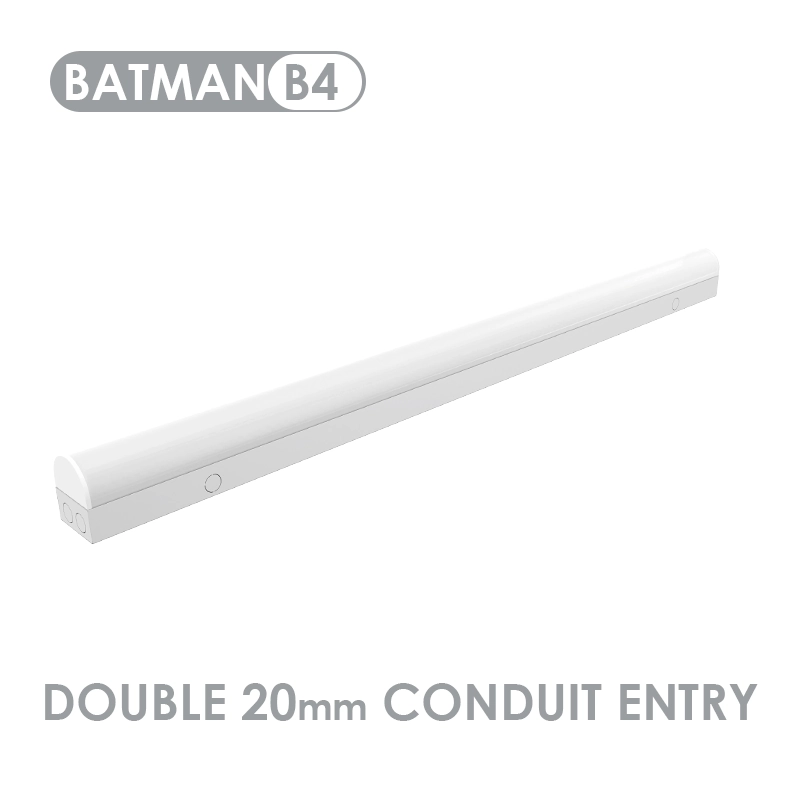
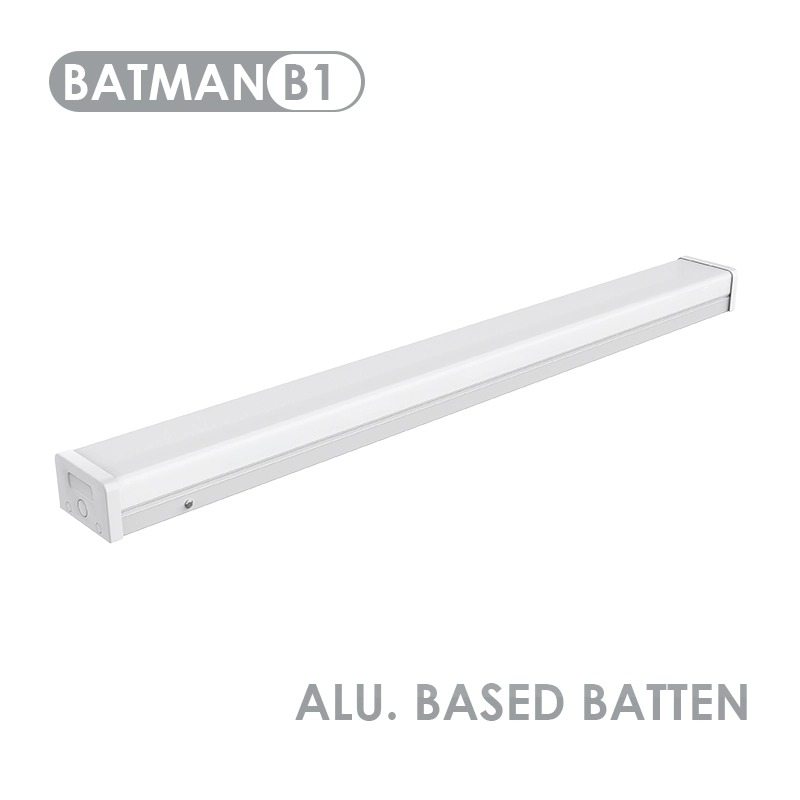
- Make ODM sampling operational: B1, M4N, L1/L3, and B4 style references should prove access, controls, mounting, and document scope.
Start With The Reliability Load Path
Data center and smart warehouse lighting should be specified as facility infrastructure, not as a loose lumen package.
According to FEMP energy efficiency in data centers, data center efficiency depends on integrated facility systems. Lighting is a small share compared with compute and cooling, but it still becomes part of the load path: electrical power becomes heat, heat affects cooling, service work affects access, and controls affect operations. In a smart warehouse, the same fixture family may be evaluated through a different lens: aisle traffic, forklift paths, occupancy zones, sensor behavior, and maintenance height.
AI Data Centers Need Low-Interruption Service
Fanxstar LED lighting for AI data centers should be discussed around reliability, low maintenance, driver access, and compatibility with facility workflows. According to Better Buildings Data Centers resources, data center performance work looks at the facility as a system. That matters because even a simple luminaire can create avoidable entry into controlled rows if driver replacement, sensor service, or cable troubleshooting is hard. The RFQ should ask where the driver sits, how the fixture is accessed, and what documentation the facility team needs before sampling.
The sample should therefore prove access as well as light. A data hall buyer can ask 4 operational questions before approving the fixture: where is the driver, how is the diffuser removed, what happens if a sensor fails, and how much work happens above or near active equipment. The answers do not replace facility engineering, but they make the supplier comparison sharper. A slightly higher-cost fixture can be the better procurement decision if it reduces entry frequency or makes service predictable.
Smart Warehouses Need Sensor Zones That Follow Traffic
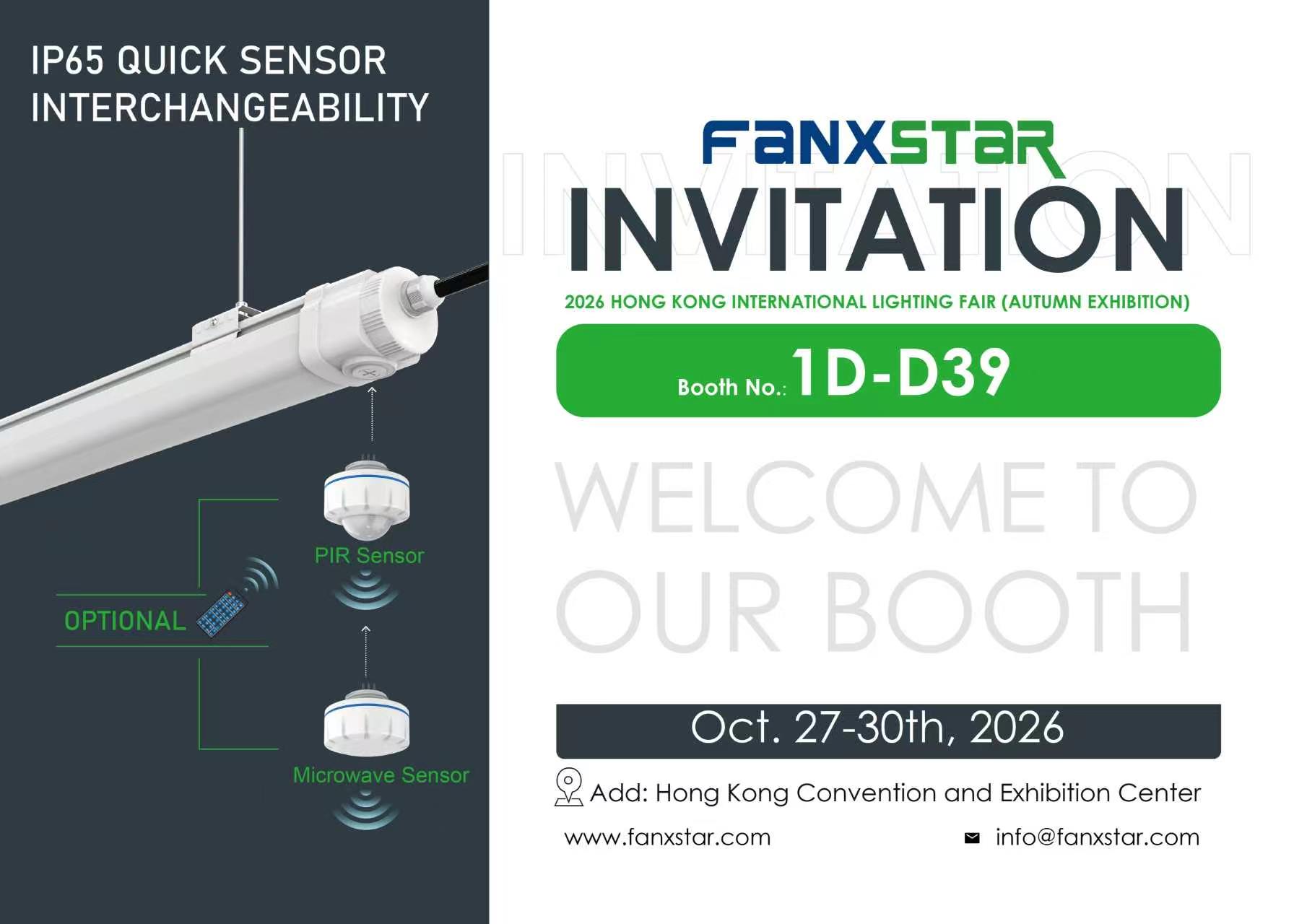
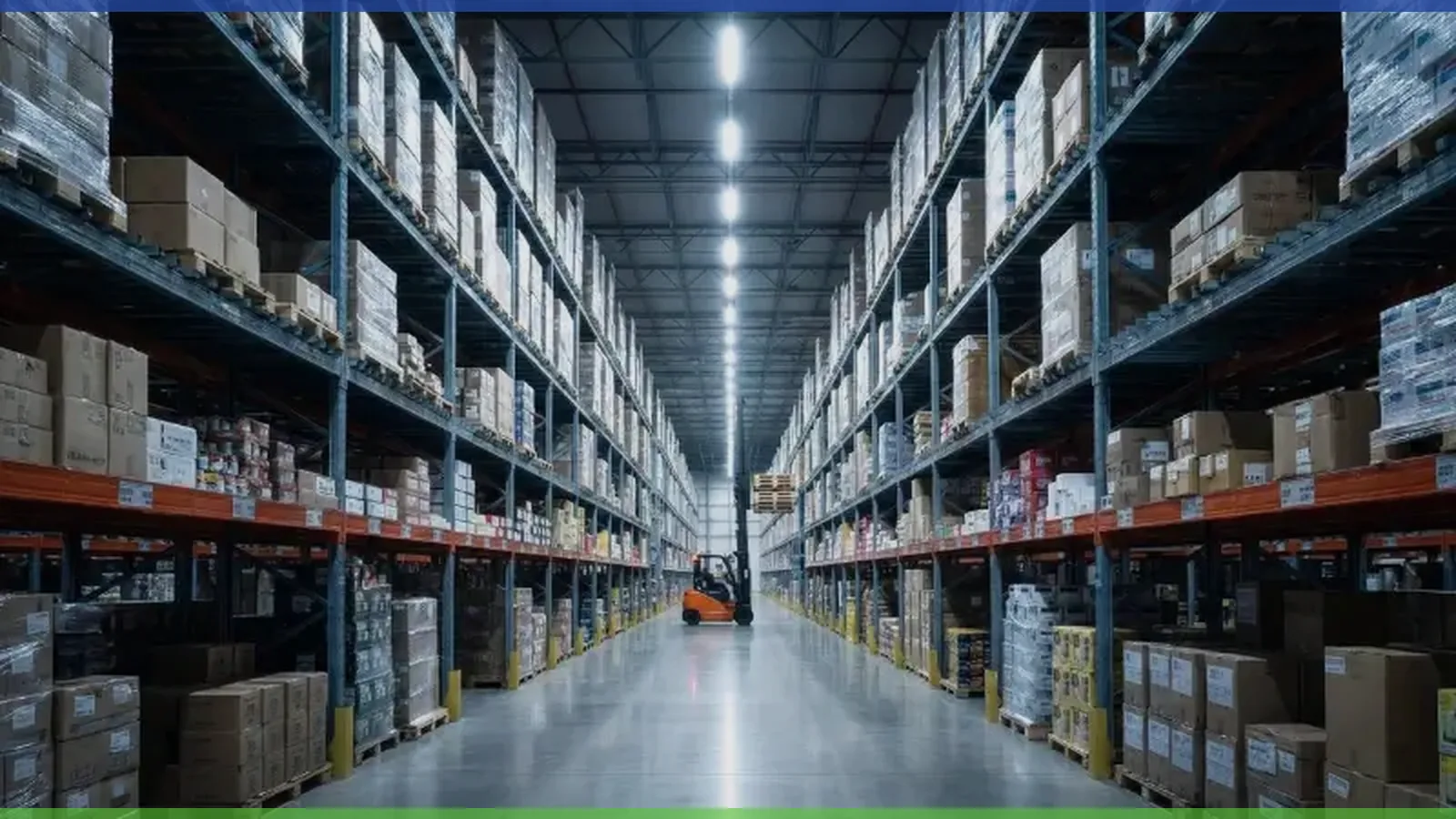
Fanxstar warehouse logistics lighting should begin with aisle pattern, picking zone, loading bay, rack height, pedestrian paths, and sensor coverage. According to OSHA warehousing hazards and solutions, warehouse risk includes traffic, materials handling, and worker movement. Lighting controls should therefore follow operations. A microwave or PIR sensor that works in a corridor can misbehave in a tall rack aisle if the detection zone, mounting height, forklift movement, or delay time is wrong. That is why sensor evidence belongs in the sample plan.
A smart warehouse RFQ should define at least 6 zones: receiving, staging, high-bay storage, picking aisle, pedestrian crossing, and loading dock. Each zone can need a different delay time, mounting height, or detection pattern. This is why a sensor product photo is not enough. The buyer needs a short commissioning assumption that explains where the sensor looks, what movement it should ignore, and how the light behaves when the aisle is empty but adjacent traffic is active.
Thermal And Reliability References Set The Boundary
According to ASHRAE datacom technical resources, data environments have specialized thermal and reliability requirements. A lighting supplier should not claim to design the cooling system, but it should respect the boundary by providing power, driver, mounting, control, and service information clearly. According to DOE solid-state lighting resources, LED performance should be considered with system-level efficiency and controls. In practice, the lighting brief should include power load, expected operating hours, sensor schedule, dimming behavior, emergency boundary, and access plan.
The boundary also protects the supplier from overclaiming. A lighting provider can state input power, operating temperature range, driver type, control option, expected access method, and sample evidence. The data center team decides redundancy, security workflow, cooling model, and maintenance permission. A clean RFQ keeps those 2 roles separate. It asks the supplier to reduce uncertainty in the luminaire package while leaving facility-level thermal and reliability decisions with the proper engineering owner.
Application Matrix For AI Data Centers And Smart Warehouses
The product direction changes when the buyer moves from data reliability to logistics traffic.
The matrix below maps common facility zones to the product questions a B2B buyer should settle before comparing models. It keeps the title promise focused on design and procurement rather than catalog browsing.
| Facility Zone | Main Risk | Control Question | ODM Evidence To Request | Fanxstar Product Direction |
|---|---|---|---|---|
| AI data hall | Unplanned maintenance entry, heat contribution, driver access | Should lights dim, stay manual, or integrate with access zones? | Power load, driver access, photometric layout, wiring method | B1, L1, or L3 linear platform by mounting and output |
| Server service corridor | Glare, shadow near racks, service interruption | How should occupancy or manual override behave? | Lens, CCT, low-glare diffuser, control method | Linear batten or direct-light platform |
| Smart warehouse aisle | Forklift visibility, rack shadows, false sensor triggers | What is the detection zone and delay time? | Sensor layout, mounting height, dimming profile, emergency override | B4, A1S, or A18S sensor lighting references |
| Loading and staging area | Impact, dust, vehicle movement, high switching frequency | Does the control schedule match dock traffic? | Ingress, impact boundary, sensor proof, bracket detail | Weatherproof or motion-sensor platform |
The table prevents a common procurement mistake: using the same high-level phrase, efficient LED lighting, for two different operating systems. In a data hall, the hidden cost is service disruption and heat. In a warehouse, the hidden cost is traffic conflict or sensor behavior that annoys workers. The fixture family can overlap, but the sample evidence should not. Each zone needs its own pass condition.
Scenario Estimate: Lighting Power Becomes Facility Load
The cheapest luminaire can become expensive if its load, heat, and access cost are invisible in the RFQ.
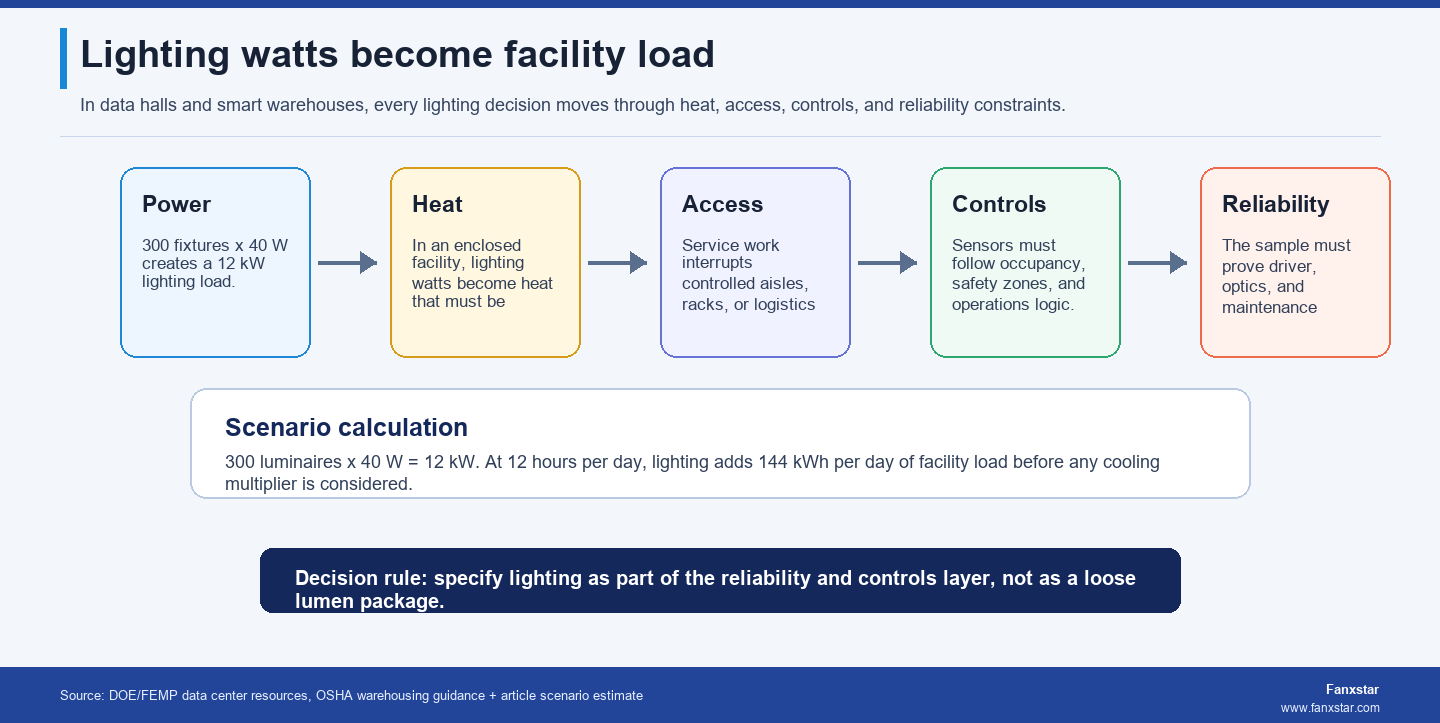
The scenario calculation uses 300 luminaires at 40 W each. 300 x 40 W equals 12000 W, or 12 kW. At 12 operating hours per day, the lighting system adds 144 kWh per day of facility load before any cooling multiplier is considered. This is not a PUE model and it does not claim a site-specific result. It is a procurement filter. If the buyer cannot see the lighting load, control schedule, and service access in the RFQ, the comparison is not complete.
Controls Must Be Commissioned Around Occupancy, Not Specified As A Suffix
According to DLC lighting controls resources, controls can change how lighting systems operate, but the control choice has to match the application. In a smart warehouse, occupancy is not a simple office motion problem. Forklifts, autonomous carts, high racks, pedestrian zones, dock doors, and shift changes all influence detection behavior. In a data center, controls may be limited by security, access, monitoring, or facility policy. The supplier should therefore provide sensor option, detection assumptions, mounting height limit, delay time, dimming curve, and override behavior as evidence.
The control note should name the default output, low-output level, hold time, override method, and failure behavior. Those 5 fields turn a sensor option into an operations decision. In a warehouse, they prevent dark aisles and nuisance switching. In a data center, they prevent unexpected behavior near controlled access areas. If the supplier cannot state these assumptions, the sample may still be electrically correct but operationally unproven.
Material Handling And Storage Conditions Keep The Warehouse Brief Practical
According to 29 CFR 1910.176, material handling and storage have workplace safety requirements. Lighting cannot replace warehouse procedure, but poor lighting can make the work harder to see and harder to control. The RFQ should specify rack height, aisle width, forklift path, dust or damp exposure, mounting height, emergency boundary, and whether sensors should dim, switch, or communicate. That prevents the sample from proving only that the fixture is bright while leaving the operational risk untouched.
The lighting sample should be evaluated where the work happens: at rack face, floor path, loading edge, and maintenance height. A buyer can request 3 simple checks during sampling: visibility at the task plane, sensor response in the target aisle, and access method for replacement. These checks are not a full lighting design, but they force the product to prove the warehouse risk instead of only proving that it is bright in open space.
RFQ Checklist For Data Center And Smart Warehouse Buyers
The RFQ should connect luminaires to facility load, access, controls, and evidence.
Ask for zone type, mounting height, ceiling or rack conflict, power load target, operating hours, driver access method, sensor technology, detection zone, dimming behavior, emergency boundary, glare limit, CCT or CRI target, ingress requirement, cable routing, commissioning evidence, and sample pass condition. For an AI data center, prioritize load, heat, access, and reliability documentation. For a smart warehouse, prioritize traffic pattern, sensor behavior, vertical illuminance, service height, and fixture impact or dust exposure.
Relevant Fanxstar starting points include Fanxstar LED linear lighting platform, Fanxstar motion sensor LED lighting, and Fanxstar custom LED lighting ODM service. Once the facility load path and sensor zones are clear, buyers can contact Fanxstar for an ODM lighting quote with a concrete sample task.
The final sample request should separate 3 proof paths. The electrical proof confirms load, driver, wiring, and dimming behavior. The access proof confirms how a technician reaches the fixture without disrupting racks or aisle traffic. The controls proof confirms sensor zone, hold time, low-output level, and override method. When those 3 paths are visible, the buyer can compare suppliers on operational fit rather than catalog wattage alone.
Specification Depth Check Before Final Supplier Comparison
For AI data center and smart warehouse LED lighting, the missing depth is usually not another product adjective. It is the buyer’s ability to prove why a fixture belongs in high-bay, aisle, equipment, loading, and maintenance zones where lighting becomes part of a reliability load path. Lighting is sometimes treated as a small auxiliary load even though glare, controls, emergency access, driver heat, and service interruption can affect the operational plan. A stronger specification therefore keeps the commercial comparison downstream of the evidence file, not upstream of it.
Separate task visibility, automation compatibility, power/load impact, and maintenance access before locking the fixture family.
Lock The Acceptance Gates Before Sampling
The practical sequence is to decide the site boundary first, the product family second, and the sample evidence third. For Fanxstar, the relevant starting points can include linear battens, high-bay-adjacent utility fixtures, sensor-ready weatherproof lights, emergency battens, and ODM control variants, but the quote should not treat those product names as the acceptance test. The acceptance test is the buyer’s written answer to what must be visible, cleanable, maintainable, safe, documented, and reviewable in the real installation.
If 300 fixtures average 38 W instead of 32 W, the lighting difference is 1.8 kW whenever the zone is active. The number is illustrative, but it shows why procurement should compare load, control logic, and service behavior together. Based on our analysis of this review path, a small front-end evidence checklist can be more valuable than another round of catalog comparison. Calculated from the scenario estimate, every repeated clarification task becomes a hidden procurement cost when it is multiplied across the fixture schedule. It turns the specification from “which light is best” into “which product can pass the exact room, route, cleaning, maintenance, and documentation condition that will decide acceptance.”
Keep The Evidence Pack Tied To The RFQ
The RFQ should request one aisle mockup, one sensor behavior test, one driver/access review, one emergency route check, and one spare-part statement. It should also state the responsibility boundary: Fanxstar can supply product and ODM evidence, while facility power, automation, and uptime decisions require the buyer's engineering and operations teams. That wording protects both sides. The buyer gets a reviewable package, and the supplier avoids making a compliance promise that belongs to the project authority or operating procedure.
- Regulatory or standards boundary: According to FEMP energy efficiency in data centers, use it to test whether lighting is sometimes treated as a small auxiliary load even though glare, controls, emergency access, driver heat, and service interruption can affect the operational plan Use this source when the RFQ turns AI data center and smart warehouse LED lighting into a product claim.
- Safety or operating requirement: According to Better Buildings Data Centers, use it to test whether lighting is sometimes treated as a small auxiliary load even though glare, controls, emergency access, driver heat, and service interruption can affect the operational plan Use this source when the RFQ turns AI data center and smart warehouse LED lighting into a product claim.
- Design evidence: According to OSHA warehousing hazards and solutions, use it to test whether lighting is sometimes treated as a small auxiliary load even though glare, controls, emergency access, driver heat, and service interruption can affect the operational plan Use this source when the RFQ turns AI data center and smart warehouse LED lighting into a product claim.
- Maintenance evidence: According to ASHRAE datacom technical resources, use it to test whether lighting is sometimes treated as a small auxiliary load even though glare, controls, emergency access, driver heat, and service interruption can affect the operational plan Use this source when the RFQ turns AI data center and smart warehouse LED lighting into a product claim.
- Procurement evidence: According to DOE solid-state lighting resources, use it to test whether lighting is sometimes treated as a small auxiliary load even though glare, controls, emergency access, driver heat, and service interruption can affect the operational plan Use this source when the RFQ turns AI data center and smart warehouse LED lighting into a product claim.
- Audit trail: According to DLC lighting controls resources, use it to test whether lighting is sometimes treated as a small auxiliary load even though glare, controls, emergency access, driver heat, and service interruption can affect the operational plan Use this source when the RFQ turns AI data center and smart warehouse LED lighting into a product claim.
Related Fanxstar Guides
- Commercial Infrastructure LED Lighting Guide
- Cold Storage & Food Processing LED Lighting Guide
- Cleanroom & Pharmaceutical LED Lighting Guide
Data Center And Warehouse RFQ Action Card
- Calculate lighting load before comparing wattage.
- Define driver access and maintenance boundary.
- Map sensor zones to traffic and security.
- Separate data hall and warehouse proof paths.
- Request commissioning assumptions with the sample.
Frequently Asked Questions
Is lighting a major data center energy load?
Lighting is usually smaller than IT and cooling loads, but it still becomes heat, maintenance access, and control complexity. It should be included in the facility load and reliability discussion.
Should smart warehouses use motion sensor lights everywhere?
No. Sensor zones should follow traffic patterns, aisle geometry, forklift movement, pedestrian routes, dock activity, and emergency behavior. A sensor should be commissioned as part of operations, not added as a suffix.
Which Fanxstar product references fit these applications?
B1, L1, L3, and M4N are useful linear lighting references; B4, A1S, and A18S are useful sensor-light references. The final choice depends on mounting height, controls, access, and exposure.