The fastest way to make a specialty agriculture lighting project fail is to specify the lamp before specifying the organism, the enclosure, and the cleaning or water-contact risk. A grow light, an aquaculture tube, and a biotech photobioreactor light may all use LEDs, but they do not solve the same engineering problem.
A useful ODM brief starts with the biological target, then translates that target into delivered light, spectrum, distribution, waterproofing, controls, and service access. Wattage matters only after those conditions are fixed. For a lighting brand, importer, or project contractor, that order changes the RFQ from “send me a grow light price” into “show me the platform that can survive this environment and deliver this light pattern repeatedly.”
Key Takeaways
- Start with the organism: Plant canopy, fish tank, algae reactor, poultry house, and biotech chamber applications need different light quantity, duration, spectrum, and distribution assumptions.
- Separate biology from enclosure risk: A suitable spectrum does not compensate for weak waterproofing, hard-to-clean housings, poor cable entry, or uncontrolled mounting geometry.
- Do not buy by wattage alone: Buyers need delivered-light evidence, optical layout, mounting distance, control method, and environmental limits.
- Use standards as boundaries, not slogans: Horticultural programs such as the DLC horticultural lighting program and safety references such as UL horticultural lighting services help buyers ask for the right evidence. According to DLC, Horticultural Technical Requirements V4.0 became effective on April 18, 2025, which makes current test evidence more useful than old catalog language.
- ODM value is platform adaptation: The strongest supplier is not always the one with the brightest catalog fixture; it is the one that can adapt optics, enclosure, wiring, sensors, and documentation without turning every project into a new mold.
The Specification Should Start With Biology, Not Product Category
Specialty agriculture lighting is not one market with different labels; it is several biological environments that happen to use LED fixtures.
Plant production, aquatic species, algae cultivation, and biotech experiments all convert light into a biological or operational outcome. The buyer’s mistake is to treat the fixture as the starting point. The better starting point is the living system: what needs the light, where the light must arrive, how long it must run, and what environmental stress the fixture must survive.
Plants Need Delivered Light, Duration, and Uniformity
For vertical farming and controlled-environment agriculture, light quantity and duration are often more important than a simple wattage comparison. According to the University of Minnesota Extension, plant lighting decisions involve intensity, duration, distance, and spectrum. That matters because the plant does not experience the label on the driver; it experiences photons at the canopy over time. If a product sheet says 100 W but the mounting height, beam pattern, rack spacing, and lens losses are unclear, the buyer still cannot know whether the target crop receives the intended light.
The RFQ should therefore ask for the target crop or application, canopy distance, expected PPFD range, photoperiod, fixture spacing, and dimming or control method. For a private-label product line, those details also decide whether one SKU can serve several rack designs or whether the importer needs separate versions for seedlings, leafy greens, strawberries, or under-canopy use.
Aquaculture Needs Light That Fits Species Behavior and Water Exposure
Aquaculture lighting adds a different layer of complexity. Light can affect feeding, growth, maturation, visibility, and welfare, depending on species and life stage. A study review in Aquaculture highlights intensity, photoperiod, and spectrum as relevant lighting variables for fish culture. The practical consequence is simple: an aquaculture RFQ should never stop at “IP68 tube light.” It should identify whether the application is tank illumination, algae growth support, marine display, or research use.
Water chemistry, cleaning frequency, cable routing, and submersion depth also change the product requirement. A sealed light that survives a freshwater tank may not be the right answer for saltwater, chemical cleaning, or a tube that must be removed repeatedly for maintenance. That is why aquaculture and algae lighting often need product geometry, end-cap design, material selection, and cable-entry decisions alongside spectrum.
Biotech and Algae Systems Need Distribution Control
Biotech and algae lighting creates the hardest specification problem because the light often has to move through a medium. Research from PubMed Central discusses photolimitation, photosaturation, photoinhibition, self-shading, and light-dark cycles in microalgae photobioreactors. Those are not decorative scientific terms. They explain why a bright external lamp can still perform poorly if the culture depth, density, mixing, or reactor geometry prevents light from reaching the active growth zone.
For ODM buyers, the lesson is that biotech lighting should be discussed as a system component. The RFQ should include reactor shape, light path, operating temperature, cleaning method, cable routing, and maintenance access. According to Oklahoma State University Extension, photobioreactor design has to consider efficient illumination, CO2 supply, oxygen removal, scalability, and self-shading. That reinforces the need to specify the light with the process environment rather than as a standalone commodity.
Application Matrix: Match the Fixture Platform to the Environment
The right product platform is the one whose optical pattern, enclosure, and service method match the application, not the one with the longest generic feature list.
Fanxstar’s specialty LED grow lights cover vertical farming and aquaculture-algae product families, but a buyer should still map each use case before choosing a model. The table below gives a practical first screen for ODM discussions.
| Application | Main Biological Target | Fixture Risk | ODM Questions to Ask | Relevant Product Direction |
|---|---|---|---|---|
| Vertical farming racks | Canopy light quantity, uniformity, photoperiod, spectrum | Heat buildup, narrow rack spacing, glare, driver access | What PPFD target, mounting distance, dimming method, and spectrum family are assumed? | Vertical farming LED lights, such as linear rack or under-canopy concepts |
| Aquaculture tanks | Species behavior, visibility, photoperiod, water exposure | Submersion, corrosion, cable sealing, cleaning | Is the light above water, splash-zone, or submerged? What water chemistry and cleaning routine apply? | Aquaculture and algae LED lighting, including sealed tube formats |
| Algae or photobioreactor systems | Light penetration, self-shading control, culture productivity | Medium depth, cleaning, heat transfer, service access | How far must light travel through the medium, and can internal or distributed illumination reduce dark zones? | IP68 tube or distributed lighting concepts, selected by reactor geometry |
| Poultry or animal housing | Photoperiod, dimming, stress reduction, cleaning | Dust, humidity, ammonia exposure, impact, washdown | What dimming schedule, housing chemistry, mounting height, and cleaning method are expected? | Sealed agricultural linear fixtures with control compatibility |
| Biotech and research chambers | Repeatable light condition, process documentation, cleanability | Small enclosure heat, repeatability, material compatibility | What tolerance, documentation, CCT or spectrum target, and validation method does the buyer need? | Custom specialty lighting platform with documented optical and electrical configuration |
Based on this comparison, the first decision is not “which lamp is best.” It is whether the project behaves more like a canopy-light problem, a water-contact problem, a reactor-distribution problem, or a cleanable controlled-environment problem. The decision rule is simple: classify the environment before selecting the model. That classification determines the right product family and prevents the RFQ from mixing incompatible expectations.
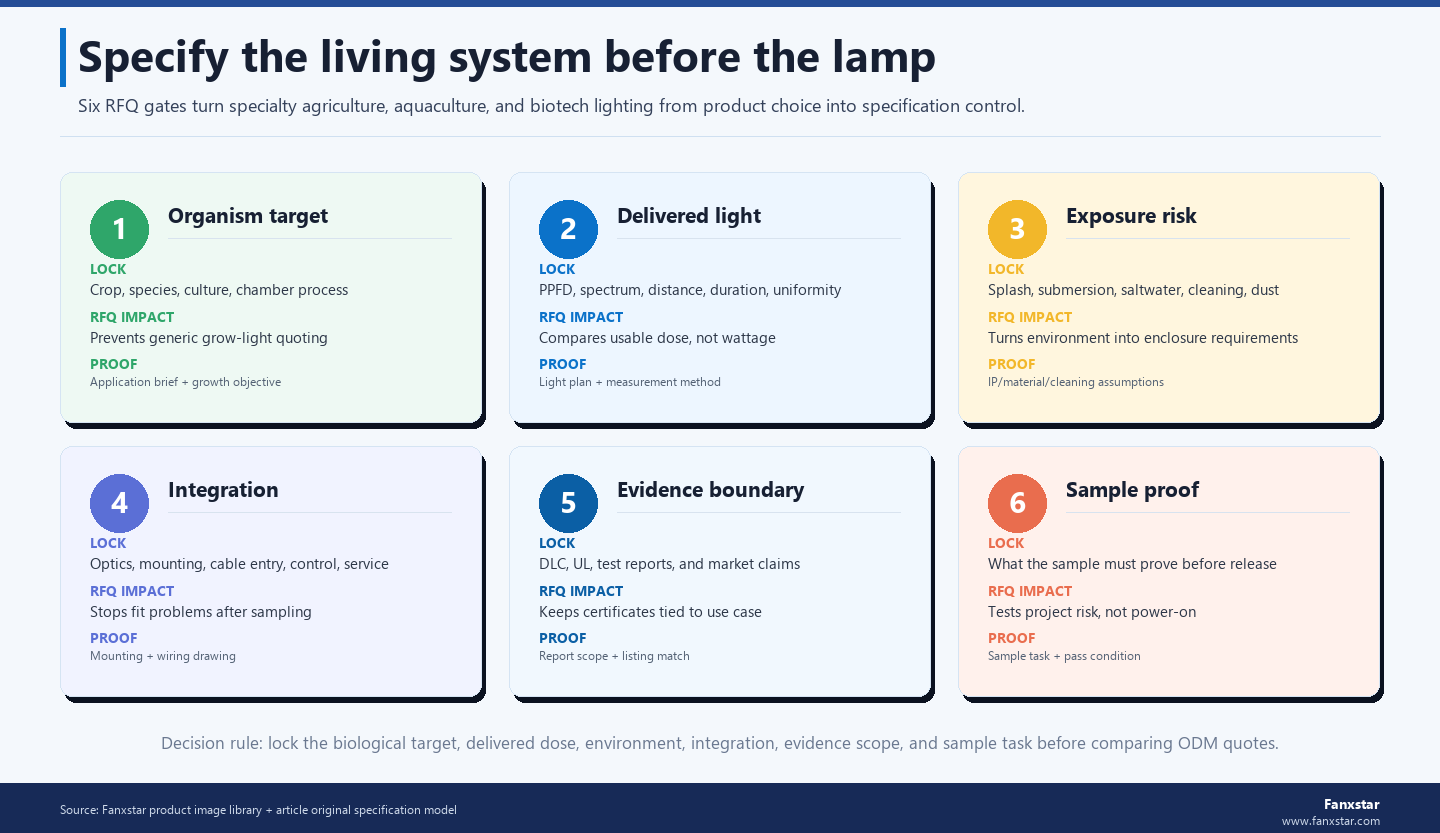
What an ODM Specification Must Lock Before Sampling
An ODM sample is only meaningful when the buyer and supplier agree what problem the sample is proving.
Specialty lighting projects fail when the sample is treated as a visual approval item rather than an engineering proof. The buyer likes the shape, the supplier confirms wattage, and the project moves forward before anyone has tested whether the light distribution, enclosure, cable entry, mounting, or controls fit the final environment. A better sampling brief locks six specification layers before the first sample.
Layer 1: Biological Assumption
The biological assumption names what the light must influence. For plants, that may be canopy growth, flowering, color, or under-canopy penetration. For aquaculture, it may be tank visibility, photoperiod management, or algae support. For biotech, it may be repeatable illumination for a reactor or chamber. According to University of Minnesota Extension guidance, plant-lighting outcomes depend on intensity, duration, distance, and spectrum, so the biological target has to be named before the fixture can be evaluated. In practice, this layer keeps the supplier from recommending a visually similar product that solves the wrong problem. It also gives the buyer a way to reject irrelevant catalog suggestions without turning the discussion into a subjective design debate.
Layer 2: Delivered-Light Target
The delivered-light target turns the biological assumption into measurable lighting language. In plant applications, the buyer may use PPFD, DLI, spectrum range, photoperiod, mounting distance, and uniformity. According to Cornell CEA lighting resources, controlled-environment lighting decisions connect LED lights, light quality, light quantity, controls, and cost. That is the right way to think about procurement: a fixture is only one part of the operating system. For aquaculture or biotech, the delivered-light target may need a different metric, but the principle is the same: define what must arrive at the active zone.
Layer 3: Enclosure and Ingress Risk
IP65, IP66, and IP68 language is useful only when the buyer also describes the exposure pattern. A splash-zone fixture, a washdown fixture, and a submerged marine tube carry different risks. For algae and aquatic systems, the cable entry and end-cap design can matter as much as the lens. For poultry or food-adjacent agricultural spaces, dust, humidity, ammonia, and cleaning chemicals may matter more than the headline IP rating. The risk is that a supplier can honestly quote an IP-rated product while still missing the real exposure mode. The RFQ should describe the worst normal operating condition, not only the ideal installation.
Layer 4: Optical and Mechanical Integration
The optical and mechanical layer defines how the product physically works in the facility. It includes beam angle, lens type, mounting bracket, wiring direction, daisy-chain needs, driver location, fixture length, and maintenance access. This is where ODM work becomes valuable. A platform-based product can often adapt CCT, optics, sensors, cable entry, or electronics without starting every project from zero. Fanxstar’s custom LED lighting ODM service is relevant here because the buyer is not only buying a finished lamp; the buyer is asking how far an existing platform can be adapted for a specialty use case.
Layer 5: Safety, Verification, and Market Access
Safety and verification should be discussed early, especially for horticultural and private-label programs. According to UL, horticultural luminaires and growing systems create safety considerations not fully covered by general-use luminaire standards. According to the UL 8800 standard scope, the category covers horticultural luminaires, hardware, and systems intended for plant-growth environments. The practical buyer takeaway is not to turn a standard name into a slogan. It is to ask what product family, test report, market, and application boundary the supplier can actually document. For an importer, that boundary can decide whether the same housing is acceptable as a general sealed fixture, a private-label grow light, or a project-specific specialty product.
Layer 6: Sampling Success Criteria
Sampling should answer a defined question. A vertical farming sample might prove mounting, dimming, thermal behavior, and canopy uniformity. An aquaculture sample might prove sealing, cable routing, and cleaning access. A biotech sample might prove repeatable light distribution in a chamber. According to Oklahoma State University’s photobioreactor design guidance, illumination interacts with CO2 supply, oxygen removal, scalability, and self-shading; that kind of dependency is exactly why a biotech sample needs a defined test condition. The key insight is that a sample without success criteria often proves only that a lamp can turn on. If the criteria are vague, the sample can look successful while leaving the real project risk untouched.
An Illustrative Photon-Hour Calculation for Buyers
A lower-priced fixture is not cheaper if it forces the buyer to recover missing delivered light with longer runtime, extra fixtures, closer mounting, or lower production assumptions.
Consider a simple vertical farming rack example. Assume the target is 150 umol/m2/s at canopy for 16 hours per day. The target daily photon-hours are:
150 umol/m2/s x 16 hours = 2,400 umol-hour/m2/day
If a cheaper fixture or poorly matched optical layout delivers 20 percent less usable light at the canopy, the missing delivery is:
2,400 x 20 percent = 480 umol-hour/m2/day
At the same 150 umol/m2/s target, that shortfall is equivalent to:
480 / 150 = 3.2 hours of target light per day
Based on our analysis, the buyer’s real decision is not whether the lower-price lamp saves money on the purchase order. The decision is whether the buyer can recover 3.2 hours of target-light equivalent without creating other costs: longer photoperiod, more fixtures, tighter mounting, more heat, more driver load, or lower biological performance expectations. This is an illustrative calculation, not a crop-yield prediction, but it shows why delivered-light evidence belongs in the RFQ before price negotiation. According to DLC, horticultural LED adoption can create large energy savings at market scale; for one buyer, that same logic only becomes useful when efficiency is tied to delivered light in the actual rack.
How to Evaluate Supplier Fit for Specialty Agriculture ODM
A supplier is ready for specialty agriculture ODM when it can discuss the application environment in the same detail as the product specification.
The best supplier conversation sounds less like a catalog presentation and more like an engineering intake. A buyer should expect questions about organism type, installation geometry, cleaning, water contact, control method, market certification, and sample goals. If the supplier asks only about wattage, length, quantity, and target price, the project may still be possible, but the buyer has to carry more engineering risk.
Use a Product Platform, Not a Blank-Slate Custom Project, When Possible
Blank-slate development can be justified for a large proprietary program, but most importers and distributors need a faster path. A platform-based ODM approach starts from a proven housing, driver, lens, or sealed tube concept and adapts the parts that matter: CCT, spectrum, optics, sensor, cable entry, mounting, labeling, and packaging. This reduces tooling exposure and makes sampling more useful because the buyer is testing a controlled variation of an existing platform rather than an unproven new product. In practice, the buyer should ask which parts are platform-fixed and which parts can change, because that answer predicts cost, lead time, and engineering risk better than a broad “customizable” claim.
Ask for Evidence That Matches the Use Case
Evidence should follow the application. For a vertical farming line, ask for optical layout, PPFD assumptions, thermal data, dimming compatibility, and spectrum information. For aquaculture, ask for sealing, material, cable-entry, and submersion assumptions. For biotech, ask how the fixture layout handles self-shading, cleaning, and repeatability. According to DLC, its horticultural lighting QPL is tied to tested product performance and technical requirements, which makes verified product data commercially relevant for grow-light buyers. The “so what” is that tested performance can reduce the gap between a supplier claim and a buyer’s market-access requirement.
Reject Overly Broad Claims
A claim such as “suitable for agriculture, aquaculture, and biotech” is too broad unless it is supported by application boundaries. A light can be useful in several markets, but not under every temperature, humidity, salt, chemical, or cleaning condition. Strong suppliers narrow the claim: above-water or submerged, vertical rack or greenhouse, fresh water or seawater, research chamber or commercial production, standard platform or customized version. Narrow claims are more useful because they can be verified. The decision rule for buyers is to ask the supplier to name at least one condition where the product should not be used; if the supplier cannot state a boundary, the claim is probably still marketing language.
RFQ Checklist for Agriculture, Aquaculture, and Biotech Lighting
The RFQ should make the supplier prove application fit, not just quote a fixture.
Use the checklist below when preparing a specialty lighting inquiry. It gives the supplier enough detail to recommend a platform, decide whether customization is needed, and avoid quoting a product that looks close but fails in the field.
| RFQ Field | What to Provide | Why It Changes the Quote |
|---|---|---|
| Application type | Vertical farming, aquaculture, algae, poultry, biotech, greenhouse, chamber, or other | Determines biological assumptions and product family |
| Target organism or process | Crop, species, algae culture, research process, or facility task | Defines spectrum, photoperiod, distribution, and risk boundaries |
| Installation geometry | Rack size, tank depth, reactor shape, mounting distance, ceiling height, or bracket needs | Changes optics, length, fixture spacing, and mounting hardware |
| Environment | Humidity, submersion, washdown, saltwater, dust, chemicals, temperature, cleaning frequency | Controls enclosure, cable entry, material, and gasket decisions |
| Electrical and controls | Voltage, dimming, timer, sensor, driver location, wiring direction, emergency needs | Determines electronics integration and market version |
| Market and documentation | Target country, certification needs, private-label requirements, datasheet format | Prevents late-stage market-access surprises |
| Sample success criteria | What the sample must prove: sealing, beam, mounting, output, dimming, cleanability, or packaging | Turns a sample from a visual approval into a project-risk test |
The comparison reveals a useful rule: if a field changes either biology, enclosure, optics, controls, or documentation, it belongs in the first RFQ. Waiting until after price approval usually transfers the risk into sampling delays, redesign, or a product that cannot be confidently sold into the intended application.
For buyers who already know the application but need help turning it into a platform-based sample, Fanxstar can review the lighting environment through its biotech and aquaculture LED lighting solutions path and related specialty lighting categories. For project-specific quotations, prepare the RFQ fields above before using the Fanxstar contact page.
Product Reference Directions for Future Cover and Scene Images
Generated scene images should preserve real fixture geometry first; the background can be creative, but the product body should not drift away from the actual model.
For agriculture and biotech content, the local Fanxstar image library should be used as a visual anchor. The V10, V40, and V80 product images are useful references for aquaculture, algae, and marine growth concepts because they show sealed tube forms, waterproof housings, and end-cap geometry. The V9, V20, V30, and VC150 product images are better references for vertical farming or specialty grow-light scenes.
When generating a cover for this topic, the prompt should not invent a futuristic light bar that Fanxstar does not sell. It should preserve tube length, lens style, end caps, cable direction, and waterproof geometry, then place the product into a plausible application scene such as a rack farm, algae reactor, or clean aquaculture room. That workflow makes the article’s visual promise match the real product portfolio.
Related Fanxstar Guides
- Cleanroom & Pharmaceutical LED Lighting Guide
- Cold Storage & Food Processing LED Lighting Guide
- AI Data Center & Smart Warehouse LED Lighting Guide
Specialty Agriculture ODM RFQ Action Card
- Define the organism, crop, species, or process.
- Lock delivered light, spectrum, distance, and duration.
- Name water, salt, cleaning, or dust exposure.
- Request optical, cable, mounting, and control evidence.
- Approve samples only against a written pass condition.
Frequently Asked Questions
Is a horticultural LED light the same as a general waterproof LED fixture?
No. A waterproof fixture may survive moisture, but horticultural lighting also needs an application-specific light target, spectrum, photoperiod, mounting geometry, and often safety or market-access evidence. Waterproofing is one requirement, not the whole specification.
Can one LED product work for vertical farming and aquaculture?
Sometimes one platform can be adapted for both markets, but the final versions should not be assumed identical. Vertical farming focuses on canopy delivery, rack geometry, spectrum, heat, and controls. Aquaculture adds water exposure, corrosion, cable sealing, tank geometry, and species or life-stage assumptions.
What should an importer send before asking for a custom lighting quote?
Send the application type, target organism or process, mounting geometry, environmental exposure, electrical requirements, target market, certification expectations, branding needs, and sample success criteria. That information helps the ODM supplier recommend a platform instead of guessing from wattage and length.
Why is IP rating not enough for aquaculture and algae lighting?
IP rating describes ingress protection under defined test conditions, but it does not describe every real application risk. Saltwater, cleaning chemicals, cable strain, mounting direction, submersion duration, culture depth, and maintenance access can all change whether the product is appropriate.
How should buyers compare two specialty LED lighting quotes?
Compare the application assumptions behind the quote before comparing price. A stronger quote should state the intended environment, optical layout, enclosure rating, material choices, control method, documentation boundary, sample plan, and what customization is included. If those assumptions differ, the prices are not truly comparable.