Cold storage and food processing lighting fails when low-temperature survival and sanitation exposure are specified as separate problems. A freezer-ready luminaire can still be the wrong product if condensation, washdown, lens breakage, clips, or cable entry are not defined in the same RFQ. For B2B buyers, the strongest specification is the one that names the operating temperature, cleaning method, ingress boundary, and service routine before comparing wattage or price.
That order keeps food-safety language inside facility requirements while turning the lighting quote into a practical engineering decision.
Key Takeaways
- Specify the overlap zone: Cold storage and food processing fixtures must be screened for both low-temperature operation and cleaning exposure when the site has both risks.
- Do not let IP rating replace the cleaning brief: The RFQ should name condensation, washdown, chemical exposure, clips, cable entry, lens retention, and shatter concern.
- Protect food-safety boundaries: Lighting choices support hygienic facility operation, but they do not certify the food process or replace regulatory compliance review.
- Count service minutes: Slow access can multiply worker exposure in cold or controlled food zones.
- Use platform-based ODM sampling: A14, D3, and A10 references should be matched to temperature, sanitation, and mounting reality before private-label decisions.
Treat Temperature And Cleaning As One Exposure
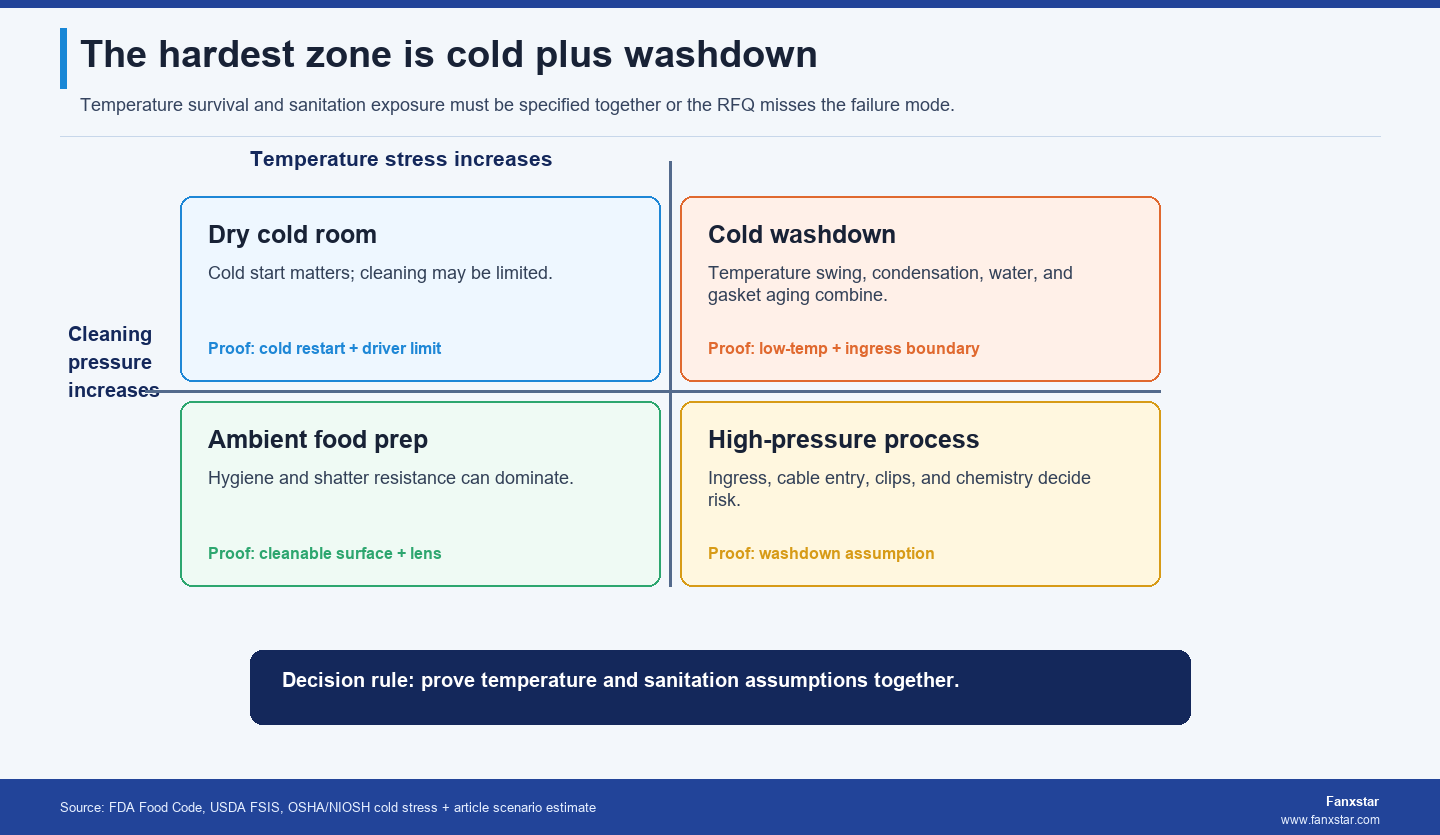
The hardest food and cold-storage lighting problem is not cold or washdown; it is cold plus washdown.
According to FDA Food Code 2022, food facilities operate inside a physical and sanitary environment, not as isolated equipment purchases. Lighting is one part of that environment. For procurement, the practical consequence is that a freezer aisle, a chilled packing room, and a food process plant need different evidence even when all three use sealed LED luminaires. The wrong question is whether the product is simply waterproof. The better question is whether the product survives the specific combination of temperature, condensation, cleaning routine, impact risk, and service access.
Low Temperature Changes Start-Up And Service Risk
Cold storage lighting should begin with operating temperature, restart expectation, driver location, and maintenance access. A low-temperature downlight such as the Fanxstar D3 reference belongs in a different discussion from a broad vapor-tight linear fixture. According to OSHA cold stress guidance and NIOSH cold stress information, cold environments can create worker exposure concerns. That does not make a luminaire a safety program, but it does make service time relevant. If a fixture is hard to open, reach, or restart, the maintenance plan becomes part of the specification.
The RFQ should also separate operating temperature from storage temperature. A luminaire may sit in a minus 40 C zone, restart after a door-open event, or move between chilled and ambient conditions during service. Those are 3 different stresses. The buyer should ask whether the driver, lens, gasket, clips, and cable entry are being discussed under the same temperature assumption. When the temperature line is vague, the supplier cannot know whether the sample needs to prove continuous running, cold restart, or condensation recovery.
Food Processing Adds Sanitation And Lens Risk
According to 9 CFR Part 416, sanitation in regulated meat and poultry establishments is a facility and operational requirement. The lighting buyer should translate that idea into luminaire evidence: smooth surfaces, lens retention, clip material, gasket design, cable entry, and washdown assumption. According to the USDA FSIS sanitation performance standards compliance guide, sanitation performance depends on maintaining sanitary conditions; lighting should not create debris traps or service patterns that fight that goal. In practice, ask what the fixture can tolerate, and what it cannot.
The lens and clip system deserves its own line item because it is where lighting and sanitation physically meet. A sealed housing still fails the procurement logic if clips trap residue, a lens is hard to inspect, or cable entry faces the cleaning stream. A 2-part evidence request works well: ask what the fixture is designed to tolerate, then ask what routine would void the assumption. That second answer often reveals whether the product belongs in a cold room, a damp utility area, or a true process washdown zone.
Food-Safety Claims Need A Narrow Boundary
Food-processing lighting content should avoid implying that a light fixture validates a food-safety system. According to 21 CFR Part 117, preventive controls for human food sit inside a regulated facility and process context. Lighting supports visibility, cleanability, and maintenance planning; it does not certify sanitation outcomes by itself. The buyer should therefore request clear documentation for fixture materials, ingress tests, lens retention, operating temperature, and cleaning assumptions. The supplier should state limits openly because those limits help the facility team decide whether the product belongs in a freezer, a wet process room, or a dry packing zone.
Application Matrix For Cold Storage And Food Processing
The right sealed luminaire is the one whose failure mode matches the room, not the one with the longest waterproof label.
Fanxstar cold storage LED lighting solutions and Fanxstar food processing plant LED lighting solutions should be mapped by room condition before product selection. The matrix below separates four common procurement cases.
| Zone | Main Risk | Temperature Question | Sanitation Question | Fanxstar Product Direction |
|---|---|---|---|---|
| Freezer aisle | Cold start, driver stress, worker access time | What is the minimum operating and restart condition? | Is cleaning dry, wipe-down, or wet? | D3 low-temperature downlight or sealed cold-room platform |
| Cold loading dock | Condensation, impact, door cycles, vehicle traffic | How often does the temperature swing? | Are fixtures exposed to spray or only humidity? | A14 vapor-tight or A10 heavy industrial waterproof platform |
| Food process room | Washdown, lens retention, clip corrosion, cable entry | Is the room chilled or ambient? | What cleaning pressure and chemistry are assumed? | A14 vapor-tight or A10 aluminum waterproof reference |
| Fresh food retail back area | Hygiene, visibility, product color, easy service | Are chilled displays or prep rooms involved? | Is the exposure routine cleaning or wet process? | Vapor-tight, fresh linear, or waterproof downlight by location |
The table shows why a single word such as waterproof is not enough. A freezer aisle can fail through cold start and slow access, while a food process room can fail through cleaning exposure and lens retention. Based on these differences, the buyer should classify each room by temperature plus cleaning method before asking for wattage, length, sensor option, or price. That classification is the shortest path from an inquiry to a sample that proves the right risk.
ODM Specification Gates Before Sampling
The sample must prove the overlap risk, not only the catalog rating.
For Fanxstar vapor tight LED light fixtures, Fanxstar waterproof LED downlights, and heavier waterproof platforms, the buyer should state the pass condition before sampling. A fixture that looks robust in a warehouse can still be weak in a chilled washdown room if the clips, lens, cable gland, or driver limit are mismatched. ODM value appears when the existing platform can be adapted to the exposure without turning every order into a new mold.
Gate 1 Defines Operating Temperature And Restart
The first gate is the actual thermal condition. A product marked for low temperature should be checked against the buyer’s minimum ambient condition, restart requirement, installation orientation, driver location, and operating schedule. A minus 40 C reference is useful only when the rest of the fixture system, including gasket behavior and cable routing, matches the room. The hidden cost of skipping this gate is not just product failure. It is delayed service in a cold zone, repeated worker entry, and a buyer who cannot tell whether the problem is driver choice, condensation, wiring, or product selection.
Gate 2 Defines Cleaning, Condensation, And Cable Entry
The second gate is the cleaning profile. According to NSF food equipment standards information, hygienic environments require attention to equipment and cleanability boundaries. For lighting, the buyer should specify dry cleaning, wipe-down, low-pressure wash, high-pressure wash, chemical exposure, and rinse frequency. That list sounds operational, but it changes the product: lens material, clips, gasket compression, cable entry, end-cap detail, and housing material. If the RFQ only asks for IP65, the supplier cannot know whether the site expects occasional damp cleaning or daily process washdown.
Condensation should be treated as a repeating event, not a one-time accident. Door cycles, defrost routines, product movement, and night cleaning can create repeated moisture exposure even when the room is not a full washdown zone. The buyer should ask for the cable-entry direction, end-cap detail, gasket compression method, and clip material because those 4 details decide whether moisture becomes a service problem. This is where product geometry matters more than a generic waterproof phrase.
Gate 3 Counts Service Time As Controlled-Zone Exposure
The scenario calculation uses 120 luminaires in a cold or food-processing zone. If each fixture adds 6 extra minutes because latches are slow, access is awkward, or the driver path is unclear, one cycle creates 720 minutes, or 12 hours, of controlled-zone work. At 2 service or cleaning-related access cycles per month, that becomes 24 hours per month. The decision implication is direct: access design belongs in the RFQ next to ingress and temperature. It affects labor, downtime, worker exposure, and cleaning coordination.
The 24-hour monthly estimate is useful because it turns a small design choice into an operational discussion. A tool-light latch, external driver access, or clearer mounting bracket may not change the headline wattage, but it can change how long technicians stay inside a cold or hygienic area. The limitation is equally important: the calculation does not prove food safety. It simply shows why service minutes, cleaning coordination, and worker exposure should be compared before a buyer approves a private-label sample.
RFQ Checklist For Cold Storage And Food Buyers
A useful RFQ names the room, the temperature, the cleaning method, and the sample proof.
Ask for room type, minimum ambient temperature, restart condition, mounting height, door-cycle or condensation condition, cleaning pressure, cleaning chemistry, lens retention requirement, cable-entry direction, impact risk, emergency or sensor requirement, and the evidence pack the buyer needs for internal approval. A strong sample request also states the pass condition: for example, prove low-temperature restart, prove washdown-adjacent sealing, prove easier latch access, or prove a specific mounting conversion.
Product reference set from the local Fanxstar image library: A14 vapor-tight, D3 low-temperature downlight, and A10 heavy industrial waterproof lighting should anchor cover-image generation and product discussion. When the exposure map is ready, the buyer can use Fanxstar custom LED lighting ODM service or contact Fanxstar for an ODM lighting quote with the assumptions already defined.
According to the room-risk logic above, a serious buyer should send at least 5 operating facts with the inquiry: minimum temperature, cleaning pressure, cleaning chemistry, mounting height, and service-access limit. Those 5 facts help the supplier decide whether A14, D3, A10, or a modified platform is the closest sample path, and they keep the conversation focused on the actual cold-plus-cleaning exposure.
Related Fanxstar Guides
- Cleanroom & Pharmaceutical LED Lighting Guide
- Commercial Infrastructure LED Lighting Guide
- AI Data Center & Smart Warehouse LED Lighting Guide
Cold And Food Lighting RFQ Action Card
- State minimum temperature and restart condition.
- Describe cleaning pressure, chemistry, and frequency.
- Check lens, clip, gasket, and cable entry risk.
- Separate freezer, dock, prep, and washdown zones.
- Approve samples against both temperature and sanitation.
Frequently Asked Questions
Can one vapor-tight fixture serve both cold storage and food processing?
Sometimes, but only if the same model matches the minimum temperature, condensation condition, cleaning method, lens retention need, cable entry, and mounting detail. The RFQ should prove the overlap rather than assume it.
Is an IP65 light enough for a food process plant?
IP65 can be a useful starting point, but it does not describe chemical exposure, high-pressure cleaning, lens retention, shatter concern, clip material, or sanitation workflow. The cleaning brief must be written separately.
Which Fanxstar references are most relevant?
A14 is a vapor-tight reference, D3 is a low-temperature downlight reference, and A10 is a heavier waterproof industrial reference. The final choice depends on the room and the cleaning or temperature profile.