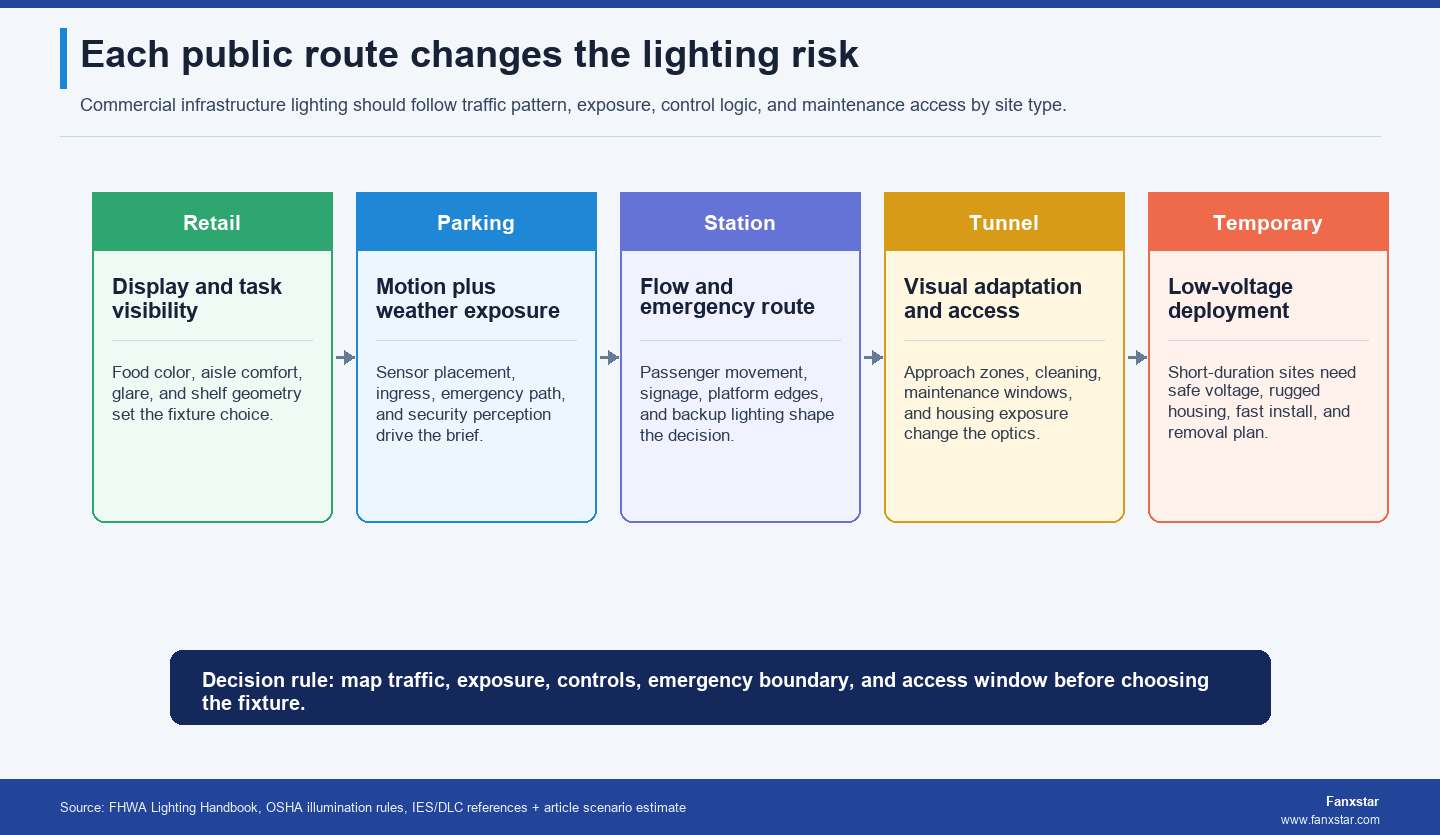
Commercial infrastructure lighting fails when a retail aisle, parking deck, station canopy, tunnel approach, and temporary site are treated as the same public-area luminaire problem. The fixture may look similar across those spaces, but the failure mode changes with traffic pattern, exposure, emergency responsibility, control logic, and maintenance access. A useful B2B specification starts by mapping the public route, then chooses product platforms and sensors that match each segment.
That approach turns a broad infrastructure inquiry into a quotation that can be sampled and inspected.
Key Takeaways
- Map the route first: Retail, parking, station, tunnel, and temporary sites share public movement, but each site creates a different failure mode.
- Controls are site-specific: Motion sensors in parking garages, emergency lighting in stations, and temporary low-voltage fixtures need different assumptions.
- Visibility sources are boundaries: OSHA, FHWA, IES, and local codes should guide the evidence request without turning the supplier into the project engineer.
- ODM value is adaptation: Platform-based changes to optics, sensors, mounting, emergency function, or cable entry can matter more than a new housing.
- Energy calculations need safety limits: Sensor savings are useful only when occupancy, visibility, and emergency requirements remain protected.
Segment The Public Route Before Selecting Fixtures
Commercial infrastructure lighting should be specified as a route-risk system, not a basket of public-area lamps.
A retail aisle, parking deck, station canopy, tunnel, and temporary site all need people to see and move safely, but that similarity hides the real specification work. According to IES standards information, lighting practice relies on application-specific recommendations and methods. In practice, the buyer should first name the route segment and its failure mode: poor product color, glare near vehicles, dark pedestrian path, tunnel adaptation, or temporary-site voltage and deployment risk. Only then should product family, optics, sensors, and emergency function be compared.
Retail Lighting Protects Product Visibility And Staff Workflow
Fanxstar LED lighting for fresh food retail should be specified around product appearance, aisle comfort, shelf geometry, and cleaning access. A fresh linear fixture such as the M4F reference is not competing only on wattage. It is competing on color impression, glare control, mounting continuity, and how quickly the retail team can service the line without disrupting display areas. The practical rule is to define what the shopper or staff member must see first. After that, the supplier can discuss CCT, diffuser, beam, driver, and product length as platform choices.
Parking Garages Need Exposure And Sensor Logic Together
Fanxstar parking garage LED lighting solutions sit at the intersection of damp exposure, security perception, vehicle movement, pedestrian paths, and controls. According to DLC lighting controls resources, networked and sensor controls can change lighting operation, but the sensor should not be specified as a generic add-on. It needs a detection zone, mounting height, dimming behavior, override condition, emergency boundary, and fail-safe expectation. In practice, A1S or A18S style motion-sensor weatherproof references belong in a route map that names entrances, ramps, pedestrian crossings, and low-traffic zones.
A parking garage RFQ should include at least 5 route details: entrance ramp, pedestrian path, blind corner, low-traffic bay, and emergency route. Each detail changes sensor timing and fixture placement. A microwave sensor that reacts well near a straight lane may be less suitable near a stairwell door if the delay time or detection angle creates unwanted dimming. The buyer should ask for a sensor behavior note, not only a sensor option, because controls are judged by how people experience the route.
Stations And Tunnels Add Continuity And Visibility Boundaries
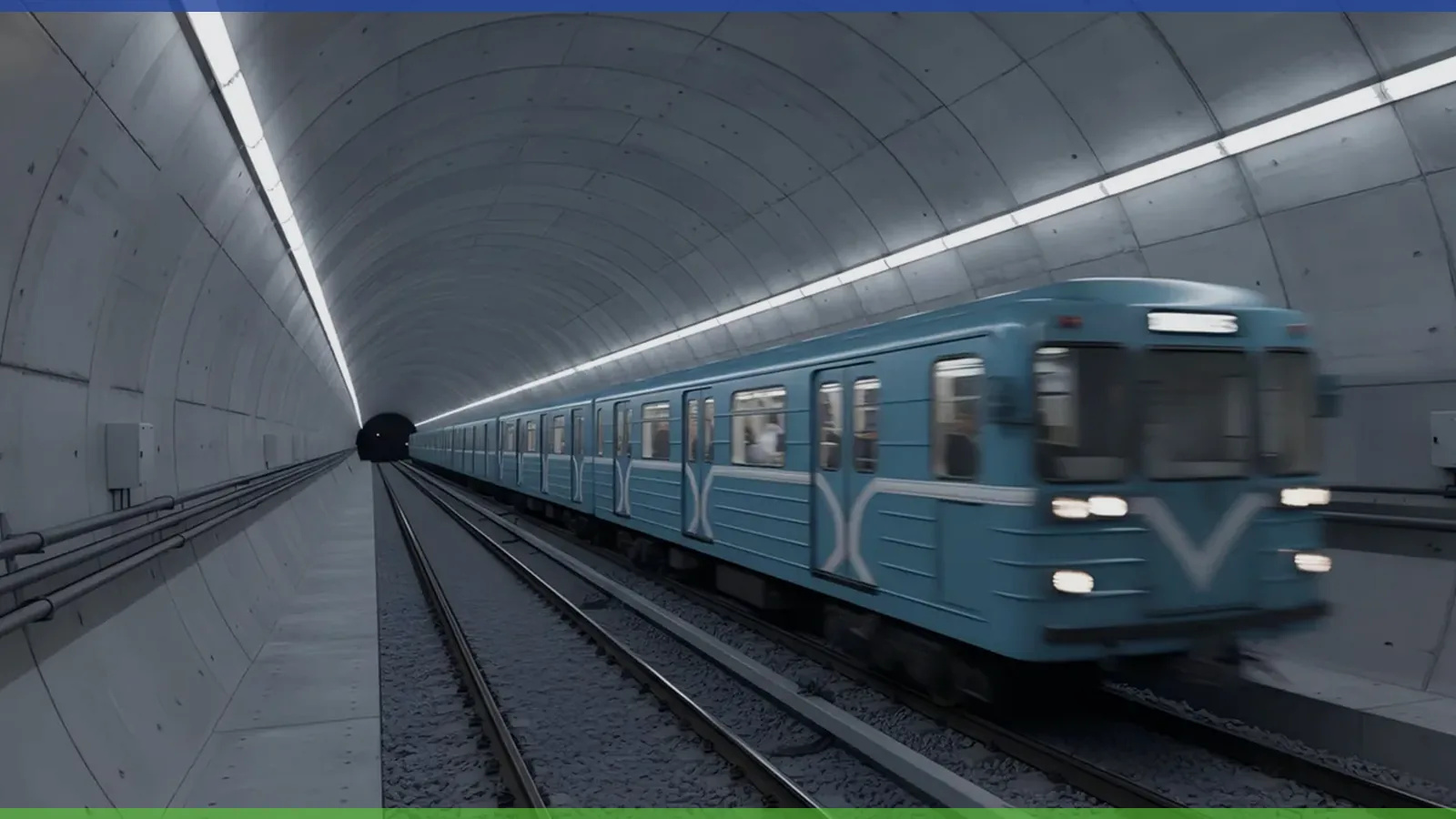
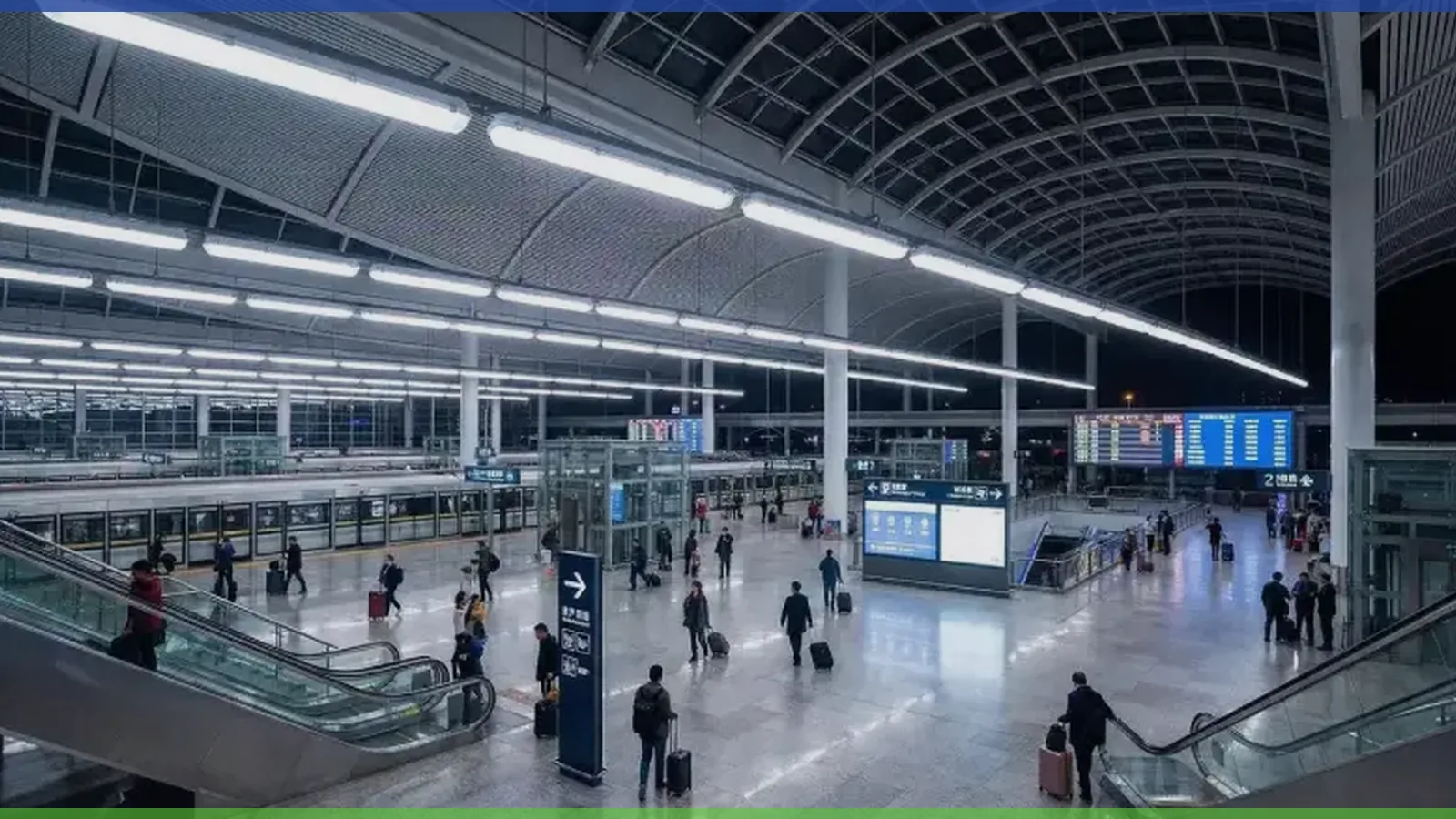
According to the FHWA Lighting Handbook, roadway lighting decisions relate to visibility, safety, and application conditions. Tunnels and station-adjacent infrastructure make that point obvious: users move through transitions, edges, signage, and possible emergency routes. Fanxstar tunnel LED lighting solutions should therefore be discussed with mounting location, approach condition, cleaning method, emergency backup, and maintenance window. The fixture is not only a line of light; it is part of a visual continuity system that must remain serviceable.
A station or tunnel project also has a maintenance-window problem. The fixture may be difficult to reach, cleaning vehicles may need scheduled access, and any replacement work can interrupt traffic. That means housing durability, bracket detail, cable routing, and module replacement are part of the visibility decision. A 1-hour access window and a 6-hour access window lead to different product preferences. The ODM supplier should know which reality applies before recommending optics, emergency function, or a sealed linear platform.
Temporary Sites Need Deployment Rules, Not Permanent-Site Assumptions
Temporary commercial infrastructure can include construction-adjacent areas, service corridors, event back-of-house zones, and short-duration public routes. According to 29 CFR 1926.56, construction areas have illumination requirements, so temporary lighting should not be treated as casual accessory hardware. A7 low-voltage weatherproof temporary lighting references are useful when the RFQ names voltage, cable path, mounting method, removal plan, impact exposure, and wet-location boundary. The decision is not whether the lamp is temporary; it is whether the temporary system can be deployed and removed safely.
Temporary-site buyers should define the project duration, expected handling frequency, voltage limit, cable protection, connector type, and removal responsibility. A light that is rugged enough for permanent installation may still be awkward for a temporary route if brackets are slow or cables are exposed to repeated movement. Conversely, a quick-fit temporary product is not automatically suitable for a long wet-location deployment. The practical procurement test is whether 2 installers can deploy, inspect, and remove the system without inventing a site-specific workaround.
Application Matrix For Commercial Infrastructure
The same fixture family becomes a different product decision when the public route changes.
The matrix below gives procurement teams a way to classify commercial infrastructure inquiries before sending a sample request. It deliberately connects each site to one failure mode and one Fanxstar product direction.
| Site Type | Primary Failure Mode | Control Or Emergency Question | ODM Evidence To Request | Fanxstar Direction |
|---|---|---|---|---|
| Fresh retail and supermarket | Wrong color impression, glare, uneven aisle or display light | Does dimming or zoning affect product appearance? | Optics, CCT, diffuser, mounting length, sample display check | M4F fresh linear and LED linear batten platforms |
| Parking garage | Dark pedestrian path, damp exposure, poor sensor coverage | What happens at low occupancy or emergency condition? | Sensor layout, dimming logic, ingress scope, mounting height | A1S or A18S motion sensor weatherproof fixtures |
| Station canopy or route | Continuity failure, signage conflict, emergency path confusion | Which emergency or exit-sign requirement is local? | Backup function, exit sign scope, mounting and cable path | E5/E6 exit signs and emergency lighting products |
| Tunnel or underpass | Adaptation, wall/ceiling exposure, difficult maintenance window | How is cleaning and access scheduled? | Photometric layout, corrosion or ingress assumption, service plan | Linear weatherproof or tunnel-focused platform |
| Temporary site | Unsafe deployment, cable damage, unclear removal plan | Is low-voltage operation or quick-fit mounting required? | Voltage, cable, connector, bracket, IP boundary, removal method | A7 weatherproof temporary lighting reference |
The table makes price comparison more honest. A sensor that is valuable in a parking garage may be irrelevant in a retail display row. An emergency exit sign that is central to a station route is not a substitute for tunnel photometrics. A temporary fixture that solves deployment risk may be the wrong answer for a permanent damp location. The buyer should therefore compare product families only after the route segment and failure mode are named.
Controls, Emergency Boundaries, And Energy Need One Decision Logic
Controls reduce waste only when the visibility and emergency boundary remain protected.
According to FEMP energy-efficient lighting resources, lighting decisions should account for energy, controls, and performance. Commercial infrastructure buyers often ask for motion sensors because the energy story is easy to understand. The harder specification is deciding where dimming is acceptable, where full output is needed, and where emergency behavior is governed by local code or life-safety review. According to OSHA emergency exit information, exit requirements are a workplace responsibility, so lighting suppliers should support documented product scope rather than overclaiming compliance.
Scenario Estimate: Parking Controls Can Save Energy But Not Skip The Safety Brief
The scenario calculation uses 100 parking garage luminaires at 60 W each for 12 operating hours per day. Baseline energy is 100 x 60 W x 12 h = 72 kWh per day. A sensor profile with 2 hours at 100 percent output and 10 hours at 30 percent output uses 100 x 60 W x (2 h + 10 h x 0.30) = 30 kWh per day. The difference is 42 kWh per day under these assumptions. The decision rule is not simply to dim everything; it is to put the sensor profile, emergency override, and visibility requirement in the RFQ so the saving does not create a route-risk problem.
Local Code And Professional Design Stay Outside The Supplier Claim
According to NFPA codes and standards information, life-safety and electrical requirements need code-specific confirmation. A lighting supplier can provide product data, emergency function options, wiring diagrams, photometric files, and test reports, but it should not replace the project designer, engineer, inspector, or authority having jurisdiction. For Fanxstar content, that boundary is commercially useful because it builds trust. It tells buyers exactly what the ODM supplier can control: product platform, sample, sensor option, emergency component, private label detail, packaging, and evidence pack.
This boundary helps conversion because it clarifies the supplier role. Fanxstar can support product selection, sample development, private-label detail, photometric files, wiring information, sensor options, and emergency product data. The local project team still owns code interpretation, final lighting design, and inspection acceptance. When those responsibilities are separated, the RFQ becomes easier to answer: the supplier proves the product platform, while the buyer or engineer confirms that the platform fits the local project.
RFQ Checklist For Retail, Parking, Station, Tunnel, And Temporary Sites
A commercial infrastructure RFQ should read like a route map before it reads like a wattage list.
Ask for site type, traffic pattern, mounting height, surface condition, ingress requirement, glare concern, color requirement, sensor zone, emergency or exit-sign boundary, cable routing, service window, voltage condition, sample pass condition, and target product family. The key insight is that each field changes the product differently. Retail changes optics and color. Parking changes sensor and ingress. Stations change emergency and wayfinding. Tunnels change visibility and access. Temporary sites change voltage, cable, and deployment method.
Relevant Fanxstar starting points include Fanxstar motion sensor LED lighting, Fanxstar LED emergency lighting product range, and Fanxstar custom LED lighting ODM service. When the route map is ready, buyers can contact Fanxstar for an ODM lighting quote with fewer assumptions left for the supplier to guess.
Specification Depth Check Before Final Supplier Comparison
For commercial infrastructure LED lighting, the missing depth is usually not another product adjective. It is the buyer’s ability to prove why a fixture belongs in retail routes, parking garages, station corridors, tunnel-adjacent areas, and temporary utility zones. Public infrastructure projects often fail when one fixture schedule tries to cover pedestrian comfort, emergency routing, damp exposure, maintenance access, and energy controls at the same time. A stronger specification therefore keeps the commercial comparison downstream of the evidence file, not upstream of it.
Segment the route by public risk, environment, control behavior, and service access before comparing luminaire price.
Lock The Acceptance Gates Before Sampling
The practical sequence is to decide the site boundary first, the product family second, and the sample evidence third. For Fanxstar, the relevant starting points can include weatherproof linear lights, parking garage luminaires, emergency battens, bulkheads, and sensor-ready utility fixtures, but the quote should not treat those product names as the acceptance test. The acceptance test is the buyer’s written answer to what must be visible, cleanable, maintainable, safe, documented, and reviewable in the real installation.
If a 120-fixture project leaves sensor logic and emergency-route boundaries unclear, even five minutes of extra review per location creates 600 minutes of coordination time, or 10 hours, before installation questions are resolved. Based on our analysis of this review path, a small front-end evidence checklist can be more valuable than another round of catalog comparison. Calculated from the scenario estimate, every repeated clarification task becomes a hidden procurement cost when it is multiplied across the fixture schedule. It turns the specification from “which light is best” into “which product can pass the exact room, route, cleaning, maintenance, and documentation condition that will decide acceptance.”
Keep The Evidence Pack Tied To The RFQ
The RFQ should request one route mockup, one sensor behavior note, one emergency boundary check, one mounting/access review, and one replacement-part plan. It should also state the responsibility boundary: Fanxstar can help turn the route map into product options and ODM samples, while the final public-safety and code decisions stay with the project team. That wording protects both sides. The buyer gets a reviewable package, and the supplier avoids making a compliance promise that belongs to the project authority or operating procedure.
- Regulatory or standards boundary: According to IES standards information, use it to test whether public infrastructure projects often fail when one fixture schedule tries to cover pedestrian comfort, emergency routing, damp exposure, maintenance access, and energy controls at the same time Use this source when the RFQ turns commercial infrastructure LED lighting into a product claim.
- Safety or operating requirement: According to DLC lighting controls resources, use it to test whether public infrastructure projects often fail when one fixture schedule tries to cover pedestrian comfort, emergency routing, damp exposure, maintenance access, and energy controls at the same time Use this source when the RFQ turns commercial infrastructure LED lighting into a product claim.
- Design evidence: According to FHWA Lighting Handbook, use it to test whether public infrastructure projects often fail when one fixture schedule tries to cover pedestrian comfort, emergency routing, damp exposure, maintenance access, and energy controls at the same time Use this source when the RFQ turns commercial infrastructure LED lighting into a product claim.
- Maintenance evidence: According to 29 CFR 1926.56, use it to test whether public infrastructure projects often fail when one fixture schedule tries to cover pedestrian comfort, emergency routing, damp exposure, maintenance access, and energy controls at the same time Use this source when the RFQ turns commercial infrastructure LED lighting into a product claim.
- Procurement evidence: According to FEMP energy-efficient lighting resources, use it to test whether public infrastructure projects often fail when one fixture schedule tries to cover pedestrian comfort, emergency routing, damp exposure, maintenance access, and energy controls at the same time Use this source when the RFQ turns commercial infrastructure LED lighting into a product claim.
- Audit trail: According to OSHA emergency exit information, use it to test whether public infrastructure projects often fail when one fixture schedule tries to cover pedestrian comfort, emergency routing, damp exposure, maintenance access, and energy controls at the same time Use this source when the RFQ turns commercial infrastructure LED lighting into a product claim.
Related Fanxstar Guides
- AI Data Center & Smart Warehouse LED Lighting Guide
- Cold Storage & Food Processing LED Lighting Guide
- Cleanroom & Pharmaceutical LED Lighting Guide
Infrastructure Lighting RFQ Action Card
- Map traffic route and visibility task.
- Define exposure, mounting, and service window.
- Specify sensor behavior, override, and emergency boundary.
- Separate retail, parking, station, tunnel, and temporary sites.
- Request sample proof for the route segment.
Frequently Asked Questions
Can one commercial fixture family cover retail, parking, station, tunnel, and temporary sites?
A shared platform can help, but each site needs its own optics, controls, ingress, emergency boundary, voltage, and service assumption. The RFQ should classify the route segment before selecting the product family.
Are motion sensors always the best upgrade for parking garages?
No. Sensors can reduce empty-zone energy use, but the dimming profile must protect visibility, pedestrian routes, emergency conditions, and user confidence. The sensor logic belongs in the lighting design brief.
What should temporary lighting buyers check first?
Check voltage, cable path, connector protection, mounting method, wet-location exposure, removal plan, and local illumination requirements before choosing a temporary weatherproof model.