Eaton is one of the most recognized names in emergency lighting globally — a multinational power management company with divisions spanning electrical, hydraulic, and aerospace systems, and an emergency lighting portfolio that includes the Crouseco, Ceag, and Cooper Safety brands inherited through decades of acquisitions. Fanxstar is a Shenzhen-headquartered specialist manufacturer with a focused mandate: weatherproof and emergency LED lighting for B2B export markets, backed by European after-sales infrastructure.
For procurement teams in Europe, Australia, or similar regulated markets evaluating emergency lighting sourcing, the comparison is not about brand prestige — it is about which product and supply chain best serves the specific project, specification, and commercial requirements at hand. This article examines both suppliers across the criteria that matter most to B2B buyers: certifications, technical specifications, customization capability, pricing model, and after-sales support.
Key Takeaways
- Eaton offers broad system integration across its BMS and power management ecosystem — a genuine advantage for large enterprise projects already standardized on Eaton infrastructure.
- Fanxstar’s emergency lighting range delivers comparable or superior specification depth in the LED emergency segment at factory-direct pricing, with DALI 2.0 compatibility, LiFePO4 battery technology, and ENEC certification pre-built into the product line.
- For OEM buyers or distributors building private-label emergency lighting products, Fanxstar’s customization programme — including custom form factors, battery configurations, and emergency module integration — has no equivalent at Eaton.
Company Profiles: What Each Supplier Actually Is
By Julie Zhu, LED Lighting Specialist at Fanxstar Technology · 2026
Eaton’s Emergency Lighting Division
Eaton Corporation (NYSE: ETN) is a global power management company with approximately $24 billion in annual revenues, according to Eaton investor relations. Its emergency lighting offering is primarily delivered through legacy brands — Crouseco, Ceag, and the former Cooper Industries portfolio — with products spanning emergency luminaires, central battery systems, and addressable emergency lighting monitoring systems (ELMS). Eaton’s emergency lighting is strongest in large-scale commercial and industrial infrastructure projects where system integration with Eaton’s broader BMS and power management products delivers combined value.
Eaton’s emergency lighting products are manufactured across multiple facilities globally, with European production and assembly operations. The product range covers maintained and non-maintained fixtures, central battery topologies, and self-contained options across a broad luminaire form factor range.
Fanxstar’s Emergency Lighting Range
Fanxstar Technology Co., Ltd. was founded in 2016 in Shenzhen (Pingshan District) with a specific mandate: weatherproof and emergency LED lighting for B2B export markets. The emergency lighting range includes exit signs, emergency spotlights (Spitfire series), bulkheads, architectural emergency track lights, and LED emergency battens. All products in the emergency range are designed to EU/UK and Australian market compliance requirements from the ground up — not adapted from a domestic catalogue.
The company holds recognition as a China National High-Tech Enterprise, holds 42 patents including 3 invention patents, and operates customer service offices and warehouses in Spain and the Netherlands to support European after-sales. The Fanxstar emergency range is built around four differentiating technical choices: Lithium Iron Phosphate (LiFePO4) battery chemistry with integrated BMS, DALI 2.0 addressable control compatibility, the proprietary “Eside” side-mounted emergency battery compartment, and self-test function compliance as standard.
Technical Specification Comparison
Battery Technology: LiFePO4 vs. Traditional NiMH/NiCd
Emergency lighting battery technology has undergone a meaningful shift over the past decade. Traditional self-contained emergency luminaires used Nickel Metal Hydride (NiMH) or Nickel Cadmium (NiCd) batteries — both well-understood, but with limitations: NiMH degrades faster at elevated temperatures (common in industrial environments), and NiCd contains cadmium (RoHS-restricted in the EU, requiring end-of-life handling compliance). Eaton’s self-contained emergency products span both NiMH and newer lithium-based options depending on the specific product series.
Fanxstar standardizes on Lithium Iron Phosphate (LiFePO4) battery chemistry with an integrated Battery Management System (BMS) across its emergency range. LiFePO4 chemistry offers several advantages relevant to industrial emergency lighting applications: higher cycle life (typically 2,000+ full charge cycles versus 500–800 for NiMH), better thermal stability across the -20°C to +60°C operating range common in industrial facilities, and RoHS-compliant chemistry without cadmium or cobalt. The integrated BMS prevents overcharge, deep discharge, and thermal runaway conditions — important in unattended installation environments such as cold stores or chemical processing areas.
DALI 2.0 Addressable Control
DALI 2.0 (Digital Addressable Lighting Interface, version 2) is the current standard for smart emergency lighting systems requiring individual luminaire addressability, automatic self-test reporting, and integration with building management systems. For large commercial and industrial facilities complying with EN 50172 and the associated self-test documentation requirements, DALI 2.0 compatibility is increasingly specified rather than optional.
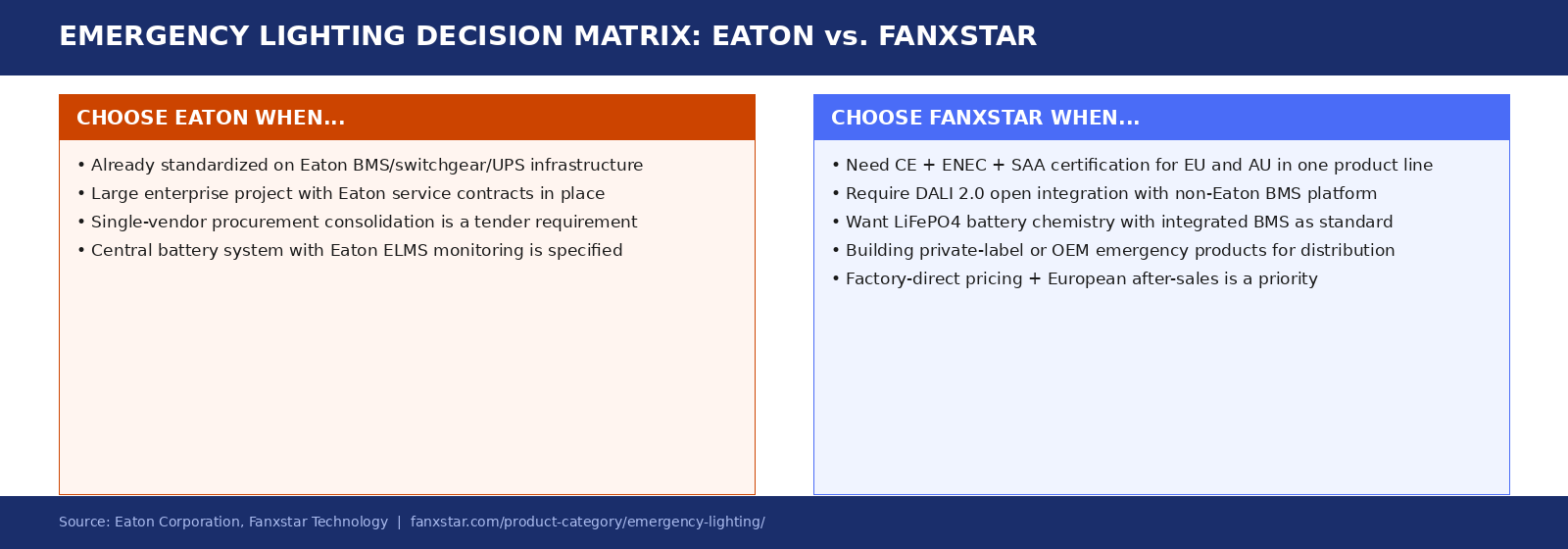
Both Eaton and Fanxstar offer DALI 2.0-compatible emergency products, but the implementation context differs. Eaton’s DALI 2.0 emergency offering is strongest when integrated within Eaton’s own ELMS (Emergency Lighting Monitoring System) infrastructure — the combined system delivers value, but creates vendor dependency. Fanxstar’s DALI 2.0 implementation is designed for open integration with third-party BMS platforms, which suits buyers whose building management infrastructure is not Eaton-standardized.
Certifications for EU, UK, and Australian Markets
For EU markets, emergency lighting products must comply with EN 60598-2-22 (luminaire safety for emergency use) and EN 50172 (emergency escape lighting systems). For UK market post-Brexit, BS EN 60598-2-22 compliance and UKCA marking (or continued CE recognition under transitional provisions) apply. For Australia and New Zealand, AS/NZS 2293 is the operative standard.
Eaton’s European emergency lighting range carries CE marking and is generally compliant with EN standards as a baseline — the company’s European market heritage makes this expected. ENEC certification (third-party verified compliance by a European Notified Body) varies by product series.
Fanxstar’s emergency range carries CE, ENEC, and SAA certifications as standard, with CB scheme compliance available for global mutual recognition. The SAA (Standards Australia) certification on the Fanxstar emergency range is a meaningful competitive differentiator versus European manufacturers, for whom Australian certification is frequently an afterthought — buyers sourcing simultaneously for EU and AU markets can use a single Fanxstar product line rather than managing parallel sourced products.
Specification Comparison Table
| Criterion | Eaton Emergency Lighting | Fanxstar Emergency Lighting |
|---|---|---|
| Battery Technology | NiMH / Lithium (series-dependent) | LiFePO4 standard, integrated BMS |
| DALI 2.0 | Yes (best within Eaton ELMS ecosystem) | Yes (open BMS integration) |
| EU Certifications | CE, EN standards compliance | CE, ENEC, TÜV |
| Australian Certification | Limited / series-specific | SAA standard across range |
| Self-Test Function | Yes (selected products) | Yes (standard) |
| Maintained / Non-Maintained | Both options available | Both options available |
| OEM/Custom Programme | Not available to distributors | Full OEM/ODM programme |
| Pricing Model | Distributor channel; brand premium | Factory-direct to B2B buyers |
| EU After-Sales Presence | Distributor network across Europe | Offices in Spain and Netherlands |
Pricing and Total Cost of Ownership
Unit Cost and Channel Economics
Eaton sells emergency lighting through a distributor channel, which means the end-buyer price reflects Eaton’s list price, distributor margin, and any local stocking costs embedded in the channel. For project buyers with substantial volume, Eaton’s distributor network offers the convenience of local inventory and consolidated invoicing — but the pricing reflects the cost of that distribution infrastructure.
Fanxstar sells factory-direct to B2B buyers and distributors. There is no multi-tier channel margin in the price. For buyers with the logistical capability to manage direct procurement from a China manufacturer — and with European warehouse access through Fanxstar’s Spain/Netherlands infrastructure — the effective per-unit cost for comparable specification product is meaningfully lower. The competitive advantage is not simply price; it is the combination of factory-direct pricing with European after-sales support that removes the traditional trade-off between cost savings and service proximity.
OEM and Custom Emergency Solutions
For distributors building private-label emergency lighting product lines, or project developers requiring bespoke emergency luminaire configurations (custom housing for architectural integration, non-standard battery capacity, specific IP ratings for harsh environments), Eaton does not offer OEM services to the distributor tier. Fanxstar’s OEM/ODM customization programme covers custom emergency products including bespoke battery module design, custom form factors for the “Eside” emergency compartment, and adjusted maintained/non-maintained configurations — with prototype delivery in 3–5 working days. For buyers with differentiation requirements, this capability simply has no equivalent through Eaton’s channel.
If you are evaluating emergency lighting solutions for a new project or OEM programme and want to compare Fanxstar’s product range against your current specification, explore the emergency lighting range or contact the engineering team for a technical consultation.
When Eaton Is the Right Choice
Eaton’s emergency lighting is the stronger choice in contexts where system integration with Eaton’s broader power management infrastructure delivers compounding value: large commercial developments with Eaton switchgear, UPS systems, and BMS infrastructure already standardized; enterprise clients with Eaton service contracts covering multiple electrical systems; and projects where procurement consolidation under a single globally recognized vendor simplifies the tender process even at a cost premium.
For buyers managing very large facilities with dedicated facilities management teams and established Eaton service relationships, the total cost of ownership calculation can favor Eaton despite higher unit prices — particularly where the integration and service continuity value of a unified system is properly accounted for.
Frequently Asked Questions
Is Fanxstar emergency lighting compliant with EN 50172 in Europe?
Fanxstar’s emergency lighting range is designed and certified to comply with EN 60598-2-22 (the luminaire safety standard) and is suitable for EN 50172-compliant emergency escape lighting system installations. ENEC and CE certifications are carried as standard. For project-specific compliance documentation, Fanxstar’s engineering team can provide full test reports, declaration of conformity, and certification paperwork upon request — contact the team at fanxstar.com/contact-us.
What does DALI 2.0 compatibility mean for emergency lighting in practice?
DALI 2.0 compatibility means each luminaire can be individually addressed, monitored, and tested through a central control system using the standardized DALI 2.0 protocol. In an emergency lighting context, this enables automatic self-test scheduling, centralized fault reporting (identifying which specific luminaire has a battery fault or lamp failure), and documentation of test results — replacing manual periodic testing with automated compliance records. This is particularly valuable for EN 50172 compliance in large facilities where manual testing of hundreds of luminaires is operationally impractical.
What is the difference between maintained and non-maintained emergency lighting?
Maintained emergency lighting operates continuously — the emergency luminaire is powered from the mains supply during normal operation and automatically switches to battery backup during a power failure. Non-maintained emergency lighting only illuminates when the mains power fails; it remains dark during normal operation. The choice between them depends on the application: maintained lighting is typically specified for areas where continuous low-level illumination is desired alongside emergency function (corridors, stairwells in occupied buildings), while non-maintained is more common in areas that have adequate normal lighting and only require emergency illumination during evacuation. Fanxstar’s emergency range supports both configurations.
Can I use Fanxstar emergency lighting alongside Eaton switchgear in the same installation?
Yes. Self-contained emergency luminaires (those with integrated battery backup, as opposed to central battery system luminaires) are electrically independent — they receive mains supply for charging and normal operation, then switch to their internal battery during power failure. This makes them compatible with any compliant mains supply infrastructure, including Eaton switchgear. DALI 2.0 addressable luminaires similarly use an open protocol that is compatible with any DALI 2.0-compliant controller, regardless of the broader electrical infrastructure manufacturer.