NVC Lighting is one of China’s most recognizable domestic lighting brands — listed on the Hong Kong Stock Exchange, with revenues exceeding RMB 6 billion and a distribution network spanning tens of thousands of retail and wholesale points across China. For a B2B buyer outside China evaluating LED sources, the NVC name carries a certain weight. But brand recognition built for a domestic market and the operational capabilities required to serve an international B2B buyer are different things — and conflating them is one of the more costly sourcing errors in this industry.
This article compares NVC Lighting directly against export-focused OEM manufacturers: companies whose entire operation is structured around international B2B clients, custom product development, and the certification frameworks required by markets in Europe, Australia, and North America.
Key Takeaways
- NVC Lighting’s strength is domestic China distribution and brand equity — neither of which transfers value to a B2B buyer sourcing for export markets.
- Export-focused OEM manufacturers offer deeper customization, international certifications pre-built into their process, and English-language engineering communication as a core operational competency.
- The right choice depends on your market: if you are selling into China’s domestic channel, NVC is a viable consideration; if you are building a private-label or distribution business outside China, an export-first OEM partner is structurally better suited.
Understanding What NVC Lighting Actually Is
By Julie Zhu, LED Lighting Specialist at Fanxstar Technology · 2026
NVC Lighting (雷士照明) was founded in 1998 in Huizhou, Guangdong and went public on the Hong Kong Stock Exchange in 2010. Its business model is fundamentally oriented toward the Chinese domestic market: a large product portfolio spanning commercial, residential, and industrial categories, sold primarily through a franchised dealer and distributor network within China.
NVC’s international presence exists — they have made investments in international brand partnerships and export volumes — but it is secondary to their core domestic franchise. This matters for procurement decisions because it shapes everything downstream: which certifications their standard products carry, how their engineering team prioritizes customization requests, what languages their technical support operates in, and what minimum order quantities look like for non-standard specifications.
For a buyer sourcing general commercial lighting for resale inside China’s domestic channel, NVC’s brand recognition provides genuine channel value. For a buyer sourcing OEM or private-label LED fixtures for distribution in Europe, the UK, Australia, or North America, that brand recognition is irrelevant — and may come attached to operational constraints that add friction rather than value.
Head-to-Head: NVC Lighting vs. Export-Focused OEM Manufacturers
International Certifications
This is the most consequential difference for export buyers. NVC Lighting’s product catalogue is primarily CE-marked for European market access, but ENEC certification — the more rigorous self-certification scheme that signals third-party-verified compliance — is less systematically present across their industrial range. SAA certification for Australia, ETL/UL for North America, and CB scheme certifications for global mutual recognition are inconsistently available on standard catalogue products.
Export-focused OEM manufacturers build international certification into their factory workflow as a commercial necessity, not an afterthought. A manufacturer like Fanxstar, whose primary customer base is in Europe, Australia, and North America, maintains CE, ENEC, ETL, SAA, CB, and TÜV certifications as baseline requirements — because without them, the product cannot be sold in the buyer’s market. The certification is not a feature; it is a precondition of the business model.
For buyers sourcing products for regulated markets, this is not a minor distinction. A single product recall or customs rejection due to missing certification documentation can erase the savings from a lower unit price many times over.
OEM/ODM Customization Capability
NVC Lighting offers limited OEM/ODM customization to international buyers. Their product development pipeline is primarily driven by the Chinese domestic market’s aesthetic and specification requirements. Custom form factors, application-specific spectrum engineering, non-standard IP ratings, or bespoke electronic integrations (DALI 2.0, Zigbee, 2.4GHz RF) are not core competencies for a domestic-brand manufacturer at this scale — the ROI calculation for bespoke tooling on an international buyer’s small-to-medium order does not work within their operational structure.
Export-focused OEM factories, by contrast, exist specifically to serve this need. Fanxstar’s OEM/ODM customization programme includes ID design, aluminum extrusion mold development, die-casting, dual-color plastic tooling, advanced electronic integration, Dialux simulation, and 3D structural rendering — with prototype delivery in 3–5 working days. This operational model is impossible to maintain while simultaneously running a domestic brand distribution network; the two business models require fundamentally different organizational priorities.
Engineering Communication and After-Sales Support
English-language engineering communication is a core competency for an export-first OEM manufacturer and an operational gap for most domestic China brand manufacturers. When you are evaluating whether a -40°C cold storage fixture meets your project’s specification, or negotiating the terms of a 42-unit MOQ for a custom emergency batten with LiFePO4 battery backup, the difference between fluent technical English and translated product descriptions is not cosmetic — it determines whether misunderstandings get caught before or after a container ships.
Export-focused manufacturers also typically maintain proximity to international buyers: European offices, customer service in local time zones, and engineering contacts who have visited customer facilities in export markets. Fanxstar operates customer service offices and warehouses in Spain and the Netherlands — not as a logistics convenience, but as a structural commitment to after-sales support in the primary markets they serve.
Pricing Structure and MOQ Flexibility
NVC’s pricing reflects a domestic brand premium and a distribution model designed around Chinese channel economics — dealer margins, marketing support programs, and volume commitments calibrated to domestic distributors. For an international B2B buyer without access to NVC’s domestic dealer network, the effective procurement price carries costs that add no value to the buyer’s business.
Export-focused OEM manufacturers offer factory-direct pricing to international buyers as the default commercial model. There is no domestic brand premium, no channel marketing cost embedded in the price, and no misalignment between the buyer’s needs (international B2B, custom specs, export documentation) and the factory’s core operational model. The competitive advantage is not necessarily the lowest unit price, but the best-value combination of price, certification, customization, and support for the specific export market context.
Comparison Summary
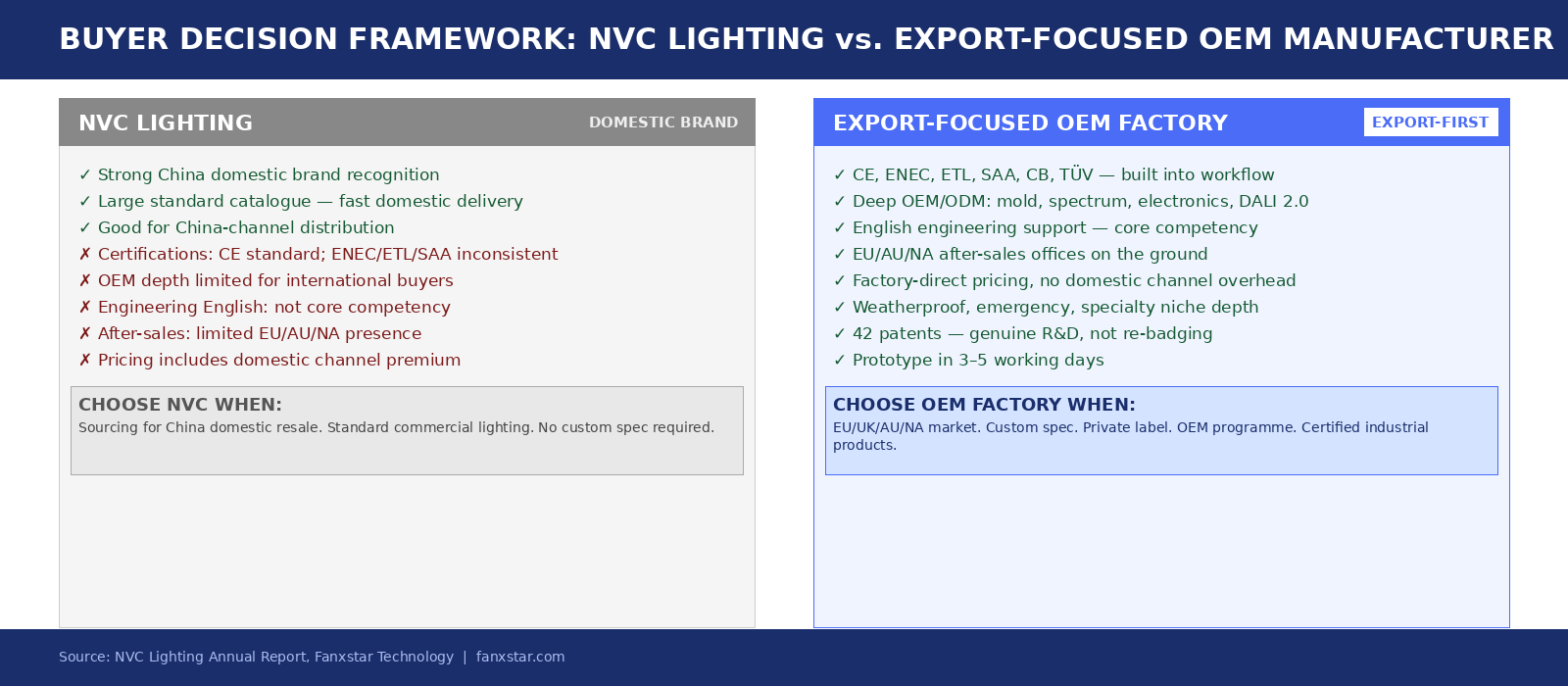
| Criterion | NVC Lighting | Export-Focused OEM Factory |
|---|---|---|
| Primary Market | China domestic | EU, UK, AU, North America |
| Int’l Certifications | CE (standard); ENEC/ETL/SAA inconsistent | CE, ENEC, ETL, SAA, CB, TÜV (core offering) |
| OEM/ODM Depth | Limited; domestic-pipeline priority | Deep; mold, spectrum, electronics, prototype in 3–5 days |
| English Engineering Support | Variable; not core competency | Core operational requirement |
| European After-Sales | Limited local presence | On-ground offices (e.g., Spain, Netherlands) |
| Pricing Model | Domestic channel economics; brand premium | Factory-direct; export-calibrated |
| Specialization | Broad domestic catalogue | Deep niche: weatherproof, emergency, specialty |
When NVC Lighting Is the Right Answer
To be clear: NVC Lighting is a legitimate, substantial business and the right choice in specific contexts. If you are sourcing standard commercial LED fixtures for retail or wholesale distribution within China’s domestic channel, NVC’s brand recognition, dealer network infrastructure, and domestically-optimized pricing model provide genuine advantages. If your specification requirements are standard and your market is China-domestic, the NVC catalogue delivers predictable, brand-supported product.
Similarly, if your project requires products in categories where NVC’s domestic R&D investment is strongest — commercial downlights, office panel lighting, retail track systems — and your market is China or Southeast Asia with relatively relaxed certification requirements, NVC may compete effectively with an export OEM manufacturer on both price and availability.
When an Export-Focused OEM Factory Is the Right Answer
The decision becomes straightforward when any of the following conditions apply: your target market is Europe, the UK, Australia, or North America; your product specification is non-standard (custom CCT, IP rating, form factor, or electronic integration); you need a private-label or OEM programme with genuine engineering support; or you require consistent after-sales communication in English with a party who understands your local market compliance context.
For weatherproof LED fixtures destined for EU industrial applications — cold chain, food processing, harsh outdoor environments — the combination of IP66 certification, ENEC compliance, -40°C cold operation, and IK10 impact resistance is a baseline requirement, not an upgrade. Fanxstar’s weatherproof range is built around exactly these specifications. Explore the weatherproof LED catalogue to compare specification depth against what domestic brand manufacturers offer for export markets.
Choosing your LED manufacturing partner is not purely about unit price — it is about finding a factory whose business model is structurally aligned with your needs as an international buyer. If your business depends on export-market certifications, custom product development, and post-shipment support from a partner who understands your market, contact Fanxstar’s team to discuss your project requirements in detail.
Frequently Asked Questions
Is NVC Lighting ISO certified?
NVC Lighting holds ISO 9001 quality management certification, as do most reputable LED manufacturers of their scale. ISO 9001 certification indicates a documented quality management system but does not by itself confirm compliance with specific product safety standards in export markets — that requires market-specific certifications such as CE, ENEC, ETL, UL, or SAA depending on the destination country. When evaluating any supplier’s certifications, it is important to distinguish between quality management certifications and product safety certifications — they measure different things.
Can NVC Lighting do OEM orders for international buyers?
NVC Lighting does accept some OEM and private-label orders from international buyers, but their OEM programme is not a core business priority — it is a secondary offering relative to their domestic brand distribution. Lead times for custom tooling, English-language technical support, and the depth of electronic customization available (DALI integration, emergency battery system selection, spectrum tuning) are typically more constrained than with factories whose entire business model is structured around international OEM service. For buyers with complex specifications or tight development timelines, this distinction matters significantly.
How do I verify that a Chinese LED manufacturer’s certifications are genuine?
All major international certification bodies maintain publicly searchable databases. CE declarations of conformity can be verified against the relevant notified body. ENEC certificates are searchable at enec.com. UL certifications are searchable at database.ul.com. ETL certifications can be verified through Intertek’s database. SAA/RCM marks can be cross-referenced through the Australian Product Safety database. CB certificates are searchable through the IECEE CB system. Always request the specific certificate number from the supplier and verify it in the relevant database — a product photo showing a certification mark is not independently verifiable proof.
What is the typical MOQ difference between NVC-type domestic brands and OEM factories?
MOQ structures differ significantly by business model. Domestic brand manufacturers typically have MOQs calibrated to their domestic distribution channel economics — which can mean large minimum quantities on standard catalogue products, but limited flexibility on custom items. Export-focused OEM factories generally offer more flexible MOQ structures on custom products because their business model depends on earning development partnerships, not volume commitments. The specific MOQ for a given product depends on factors including tooling amortization, certification costs, and production run efficiency — always discuss this directly with the manufacturer for your specific specification.