

A warranty claim is a moment of truth in your distributor relationship. When a fixture fails prematurely and your distributor needs a resolution, the speed, transparency, and professionalism of your response either strengthens the partnership or erodes it. Research on the Service Recovery Paradox shows that handling a problem well can actually improve customer satisfaction beyond the level it would have been had no failure occurred. For LED lighting manufacturers and distributors operating in B2B markets — where an installer waiting on a warranty replacement holds up an entire project — the warranty claim process is not a back-office administrative function. It is a competitive differentiator. This guide covers the end-to-end warranty claim workflow, where most processes break down, and the operational changes that consistently reduce resolution times and administrative cost.
Key Takeaways
- A manual RMA process typically takes 2–4 weeks from request to resolution; automated warranty management systems compress that to days — the single biggest lever for improving distributor satisfaction and reducing claim-related churn.
- Up to 10% of warranty costs across electronics and tech sectors are attributed to fraud, with 3–5% revenue loss from warranty and RMA fraud — making structured eligibility verification and claim validation essential, not optional overhead.
- Warranty management works best as a shared system across manufacturer, distributor, and installer — fragmented portals and inconsistent policy calls are the primary cause of delayed approvals, re-keyed data, and credits that disappear between parties.
The Anatomy of a Broken Warranty Process
Where B2B Warranty Claims Break Down
Most LED lighting warranty processes fail at the same predictable points. Understanding these failure modes is the first step to eliminating them. According to Continuum’s 2025 B2B warranty management guide, the most common structural failures are:
- Policy documentation scattered across emails and PDFs: When warranty terms are not centrally accessible to every distributor contact handling claims, every claim becomes a negotiation. Different outcomes for similar failures erode trust.
- Manual eligibility verification: Looking up purchase dates, product model numbers, and warranty periods manually against disconnected records wastes time and creates errors. An installer waiting for a response while a project stalls does not understand why this takes days.
- No self-service claim initiation: Requiring distributors to call or email to initiate every claim creates a bottleneck that scales poorly as volume grows.
- No RMA number-based tracking: Without a unique identifier for each claim, neither the manufacturer nor the distributor can track progress, escalate appropriately, or audit resolution times.
- Credit processing disconnected from claim resolution: Credits that are approved but then disappear in the billing system — or require a separate process to apply — are a leading cause of distributor frustration and eroded account profitability.
As Continuum’s LinkedIn analysis of OEM warranty fragmentation notes: “One portal for the OEM. Another process for the distributor. A third workaround for the dealer. That fragmentation creates real problems: conflicting policy calls, re-keyed data at every handoff, slow approvals that frustrate contractors.”
The Cost of Getting It Wrong
Warranty costs account for a significant portion of manufacturing revenue — industry studies cited by DigiWarr’s 2026 warranty management guide show warranty expenses sitting “closer to revenue than many businesses realize,” with a loose warranty claim system affecting “margins, dealer trust and forecasting accuracy.” For LED lighting specifically, the compounding cost is not just the replacement fixture — it is the installer callback, the project delay, the distributor time investment in managing the claim, and the erosion of confidence in the product line that influences the next purchase decision.
Building a Clean RMA Process: Step by Step
Step 1 — Define and Document Your Warranty Policy
Before any automation or tooling, the foundation is a written warranty policy that answers every question a distributor will ask. For LED lighting, this policy must address:
- Warranty duration by product category (commercial weatherproof fixtures, emergency lighting, specialty grow lights, explosion-proof products typically carry different warranty terms reflecting different failure modes)
- What is covered: manufacturing defects, component failures (LED chip, driver, housing), lumen depreciation below defined thresholds (e.g., L70 at rated hours)
- What is not covered: physical damage, moisture ingress beyond the IP rating, voltage spikes outside specified range, unauthorized modifications
- Resolution options: replacement unit, credit, repair — and the timeline commitment for each
- Documentation required to initiate a claim: purchase date, model number, serial number or batch code, failure description, installation photos
Fanxstar’s weatherproof lighting products carry 5–10 year warranties depending on model line, which creates a long-tail claims environment. A well-documented policy prevents disputes about coverage boundaries and gives distributors the information they need to set accurate expectations with their own customers.
Step 2 — Implement a Structured RMA Workflow
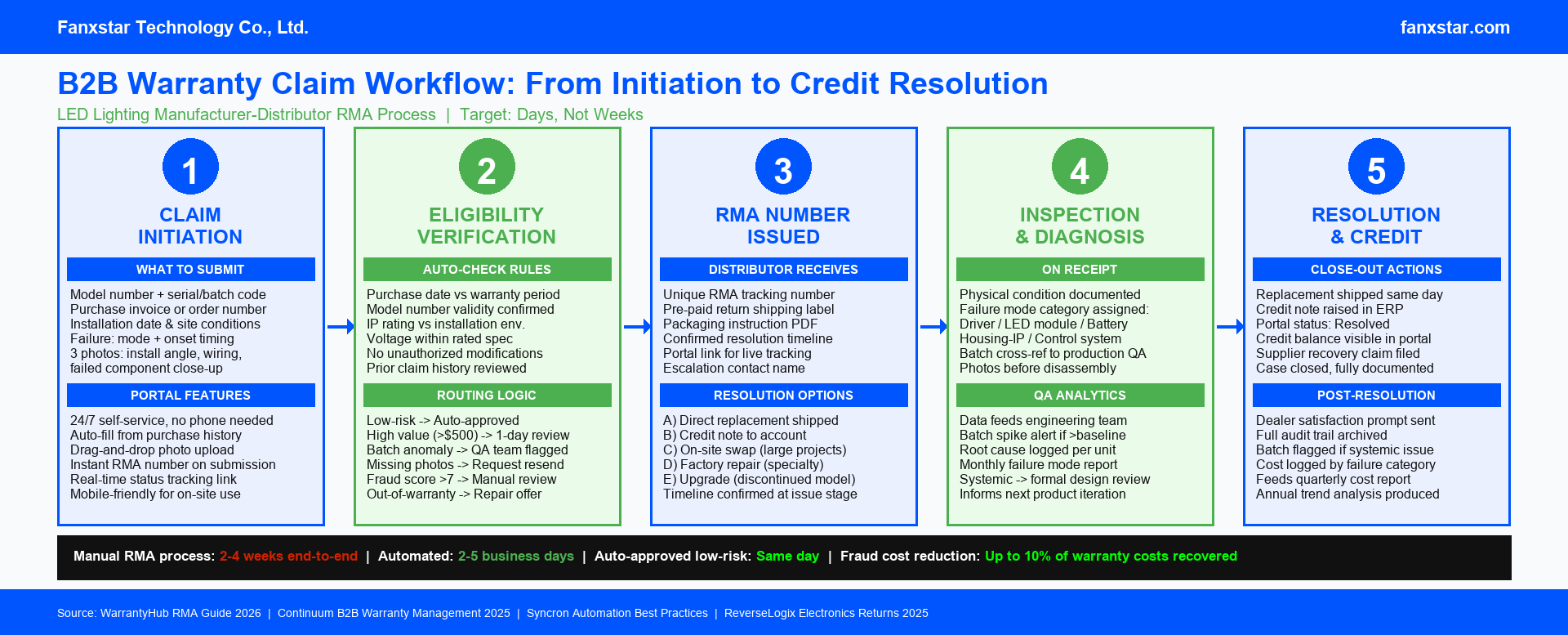
An RMA (Return Merchandise Authorization) is the tracking framework that gives every claim a unique identifier, a defined workflow path, and an auditable history. According to WarrantyHub’s 2026 RMA process guide, a standard automated RMA workflow covers:
- Claim initiation: Distributor submits via self-service portal with required fields (model, serial, failure description, photos)
- Automated eligibility verification: System validates against purchase records, warranty period, and product version — instant approval for eligible claims, flagged for review when outside parameters
- RMA number generation and communication: Distributor receives RMA number, return shipping label (if required), and expected resolution timeline automatically
- Product receipt and inspection: Returned unit logged against RMA number, condition documented, failure mode recorded for product quality analytics
- Resolution and credit processing: Replacement dispatched or credit issued; status updated in distributor portal; financial records updated in ERP
Manual RMA processes take 2–4 weeks end-to-end. Automated systems compress this to days for straightforward claims, with complex or high-value claims handled through a structured review path rather than an ad hoc email chain.
Step 3 — Create a Self-Service Distributor Portal
The single highest-impact operational change for B2B warranty management is a self-service claim portal accessible to distributors 24/7. This eliminates the bottleneck of claims waiting for business-hours staff availability, reduces inbound calls and emails, and gives distributors real-time visibility into claim status without follow-up.
The portal should provide: claim initiation with guided field requirements, RMA number generation, shipping label creation for returns, real-time status tracking, credit balance visibility, and claim history accessible by product model or purchase date. The Philips Lighting (Signify) distributor management model — where all documentation, status updates, and credit approvals flow through a unified portal — demonstrates the operational benchmark that distributors increasingly expect from their LED lighting suppliers.
Documentation Standards That Prevent Disputes
What to Require at Claim Initiation
The documentation required at claim initiation serves two purposes: validating eligibility and capturing failure mode data for product quality analytics. For LED lighting specifically, the required documentation should include:
| Document Type | What It Verifies | Format |
|---|---|---|
| Purchase invoice / order number | Product authenticity, purchase date for warranty period | PDF or portal-linked order reference |
| Model number and serial/batch code | Product generation, production batch for potential recall correlation | Photo of product label, required field in portal |
| Installation photos | Correct installation per spec, IP rating maintained, no physical damage from misuse | 2–3 photos: installed position, wiring entry point, failed component |
| Failure description | Mode (no light output, flicker, partial failure), onset timing, operating conditions | Structured form with defined fields, not free text |
| Installation date and site conditions | Confirms product operated within rated parameters (temperature, humidity, voltage range) | Form fields with defined parameter ranges |
Anti-Fraud Controls That Don’t Slow Legitimate Claims
ReverseLogix’s 2025 warranty and repair guide documents that up to 10% of warranty costs in electronics and tech are fraud-related, with 3–5% revenue impact. Common fraud patterns in LED lighting include: claiming replacements for products outside warranty period, submitting claims for non-Fanxstar products using legitimate purchase documentation, claiming driver failures on modified products, and batch claims for products that were never installed.
The solution is not manual review of every claim — that creates the 2–4 week delay that damages distributor relationships. According to Syncron’s warranty automation best practices, manufacturers can achieve close to 80% claim automation while minimizing fraud risk by: implementing risk scoring on claims (high-value claims, claims without photos, claims from accounts with unusual claim rates are flagged for review), validating against historical claims data to identify pattern anomalies, and automating approval for low-risk claims while routing high-risk ones to a structured review workflow.
Managing Warranty Across a Distributor Network
Standardizing Policy Application Across Markets
For LED lighting distributors operating across multiple markets — Europe (ENEC certified products), Australia (SAA certified), North America (UL/ETL/DLC) — warranty policy consistency is complicated by different regulatory environments and different product variants. The core warranty terms (coverage scope, duration, resolution options) should be identical across markets, while the documentation format and submission language may vary by market. Inconsistent policy application — where a German distributor gets different treatment than an Australian one for the same failure mode — damages manufacturer credibility more than the underlying failure did.
For emergency lighting products with safety-critical functions, warranty policy should also address what happens when a product fails during a scheduled self-test: immediate replacement authorization should be pre-approved for LiFePO4 battery failures within the stated battery lifespan, since an emergency system without functioning batteries represents a compliance risk for the end user, not just a product quality issue.
Using Warranty Data to Drive Product Improvement
The most underutilized benefit of a structured warranty management system is the product quality intelligence it generates. Every claim, by failure mode, by product batch, by installation environment, by time-to-failure, is a data point that product engineering can use to identify systematic quality issues before they become large-scale recall events. According to DigiWarr’s analysis, manufacturers that connect warranty claim data to product engineering close the quality feedback loop that transforms warranty from a cost center into a product development advantage.
Practical implementation: require failure mode categorization on every claim (driver failure, LED module failure, housing/IP failure, control system failure, battery failure for emergency products), export weekly failure mode summaries to the product quality team, and set automatic alerts for any failure mode exceeding baseline rate thresholds. A driver failure rate that suddenly spikes in a specific production batch is a signal worth catching at 50 units, not 500.
Warranty Communication: Setting Expectations Before Claims Happen
Pre-Sale Warranty Communication
Warranty disputes are almost always rooted in unmet expectations. The most effective way to prevent warranty disputes is to communicate warranty terms clearly before the sale — on the product page, in the specification sheet, on the product label, and in the distributor agreement. This creates a documented baseline of what the customer was informed before purchase.
For specialty applications like cold storage, explosion-proof, or medical cleanroom environments, warranty terms often include specific installation requirements (correct IP rating for the environment, correct voltage range, correct mounting orientation for some products). Failure to meet installation requirements may void the warranty — and documenting these requirements in pre-sale materials protects both the manufacturer and the installer.
Frequently Asked Questions
What is an RMA number and why does it matter for warranty claims?
An RMA (Return Merchandise Authorization) number is a unique identifier assigned to each warranty claim that tracks the claim through the entire resolution workflow — from initial submission through return shipment, inspection, resolution, and credit processing. Without an RMA number, claims exist only as emails or spreadsheet rows that can be lost, duplicated, or handled inconsistently. The RMA number creates a traceable chain of custody for both the physical product and the financial transaction, making it possible to audit average resolution times, identify bottlenecks, and generate the analytics needed to improve the process over time.
How should warranty periods be structured for LED lighting products?
Best practice for LED lighting is tiered warranty duration by product type and component: full product warranty (typically 5 years for commercial weatherproof, 3 years for drivers and control components, 10 years for LED chip lumen maintenance at L70), with separate terms for battery components in emergency lighting (LiFePO4 batteries have approximately double the cycle life of older lead-acid or Li-ion alternatives, supporting longer battery warranty periods). Different warranty periods for different components reflect their actual failure profiles and allow manufacturers to offer competitive terms where product durability genuinely supports them, without making blanket commitments on components with shorter real-world lifespans.
How do I reduce warranty claim fraud without slowing legitimate claims?
The answer is risk-based automation: use claim data to score risk (claim amount, time-since-purchase, presence of required documentation, account claim history), automatically approve low-risk claims immediately, and route high-risk claims to a structured one-business-day review — not an open-ended queue. This approach compresses overall cycle time while concentrating human review where it adds value. Requiring installation photos at submission is the single most effective anti-fraud control for physical product claims, because photos that show correct installation are difficult to fake and provide the failure mode context needed for product quality analytics simultaneously.
Interested in understanding Fanxstar’s warranty coverage, documentation requirements, and claim process for weatherproof, emergency, and specialty LED products? Contact the Fanxstar team to discuss distributor partnership terms and our post-sale support framework, including warranty administration for OEM/private-label programs.








