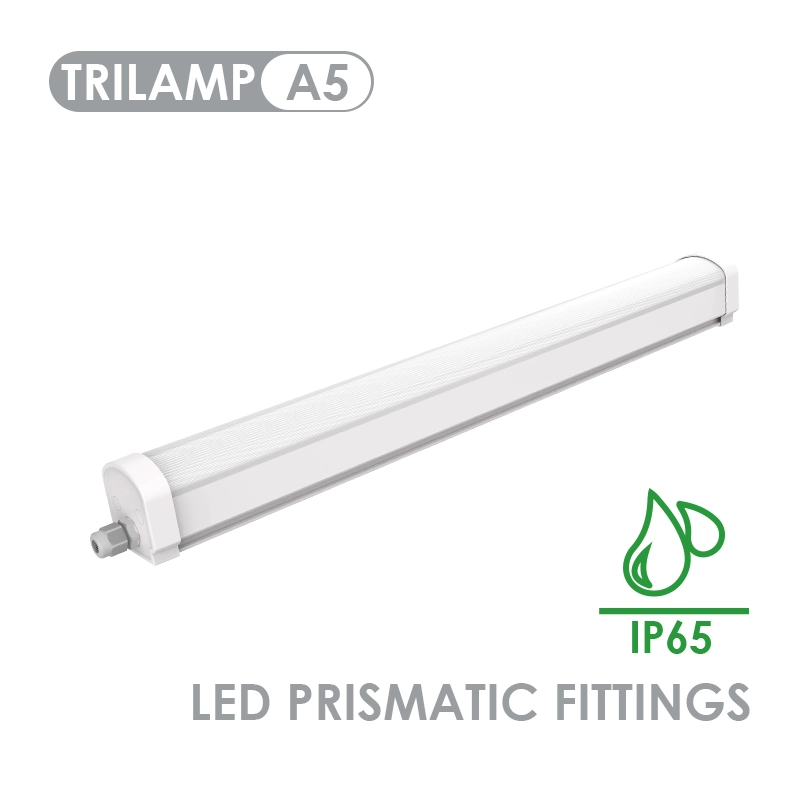
A distributor in the Netherlands receives a pallet of LED weatherproof fixtures. Three cartons are crushed, two lenses are cracked, and one driver module is shattered. The manufacturer insists the packaging was adequate. The distributor files a claim. The freight company denies liability because the damage was “not external.” This dispute — repeated tens of thousands of times annually across global lighting supply chains — has a preventable root cause: the packaging was never validated against shipping conditions before the order shipped. ISTA (International Safe Transit Association) drop test standards exist to close exactly this gap.
Key Takeaways
- ISTA protocols simulate real distribution hazards — drop impacts, vibration, compression, and environmental conditioning in a defined sequence that mirrors parcel carrier handling.
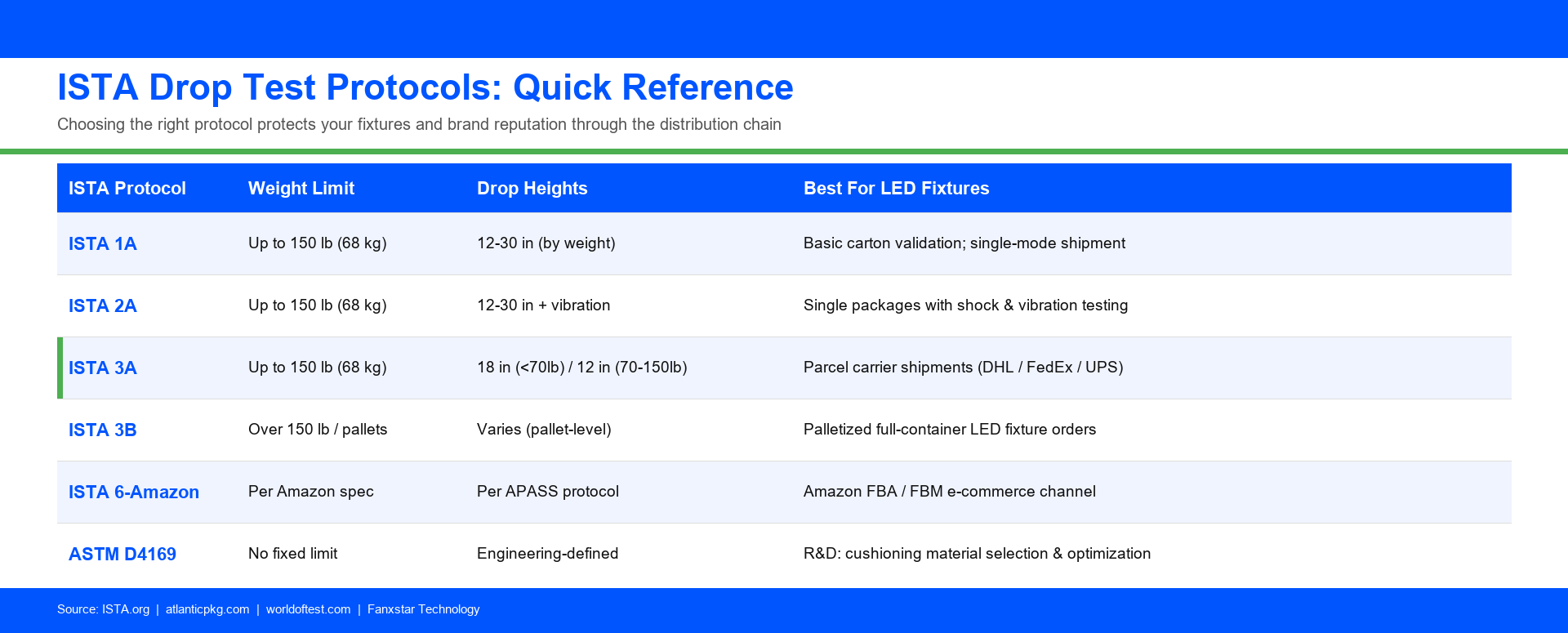
- ISTA 3A is the most relevant protocol for standard LED fixture export cartons up to 150 lb (68 kg) shipped via parcel carriers like DHL, FedEx, or UPS.
- Drop heights depend on package weight — cartons under 20 lb are dropped from 30 inches; 21–40 lb from 24 inches; 41–60 lb from 18 inches; 61–100 lb from 12 inches.
- E-commerce return rates for damaged goods run 15–30% — ISTA-validated packaging can reduce transit damage returns significantly (per Presto Group packaging industry analysis).
- ASTM standards and ISTA standards serve different purposes — ASTM for engineering data and R&D; ISTA for shipping channel pass/fail certification.
Why Drop Testing Matters for LED Lighting Specifically
The Fragility Problem in Lighting Shipments
LED fixtures present a complex packaging challenge: they combine a rigid aluminum housing (impact-resistant) with fragile components — polycarbonate diffusers, glass lenses, driver electronics, and PCB assemblies — that can fail under localized stress that the housing itself absorbs. A tri-proof light may survive a 3-foot drop on its face but shatter its diffuser on an edge drop. A twin-spot emergency luminaire may maintain its housing integrity while its LiFePO4 battery connections are severed by internal movement.
Unlike consumer electronics that typically travel individually packaged in single-mode shipments, industrial lighting fixtures often ship in master cartons of 4–12 units, stacked on pallets, through multiple handling points. Each transfer — manufacturer warehouse to freight forwarder, forwarder to port, port to vessel, vessel to destination port, customs warehouse, final-mile delivery — represents another opportunity for a drop event. Validated packaging must absorb all of them.
Financial Consequences of Packaging Failure
The direct cost of a damaged fixture is the least significant part of the loss. Add: the freight cost for the return shipment, the replacement production and re-shipping cost (typically a second full-cost delivery), the time cost for customs re-clearance, and the relationship cost of a distributor who experienced a 15% damage rate on their first order. A chandelier distributor cited by Tianhua Lighting’s packaging drop test case study reduced damage rates by 90% after implementing ISTA-validated packaging — the implication being that the previous rate was near 10%.
ISTA vs. ASTM: Choosing the Right Standard
What ISTA Does
ISTA (International Safe Transit Association) develops pre-shipment testing protocols that simulate specific distribution channels. Each ISTA protocol defines a rigid sequence of test elements — atmospheric conditioning, manual handling drops, vibration, compression, and rotary drum — that collectively replicate what a package experiences on a real shipping route. The output is a binary pass/fail result against a defined certification threshold. Many major retailers (Amazon, Walmart, Home Depot) and carriers accept or require ISTA certification as proof that packaging will survive their network. Per the Worldoftest packaging standards guide, ISTA’s low flexibility is by design — it ensures that certification results are comparable and not engineering-adjusted.
What ASTM Does
ASTM International standards (particularly D5276 for drop testing and D4169 for shipping container performance) define the physics and methodology of individual tests without prescribing a specific distribution scenario. They give engineers the data needed to design and optimize packaging: which cushioning material at which thickness achieves which G-force attenuation at which drop height. ASTM data is essential for packaging engineers selecting foam types and wall thicknesses. It does not, on its own, certify that a package is ready for FedEx or DHL distribution networks.
The practical workflow: use ASTM-compliant equipment to collect engineering data during packaging design; use ISTA protocols to validate the final design for the intended shipping channel. Fanxstar’s weatherproof and industrial lighting fixtures are packaged using foam insert designs developed through engineering testing and validated against distribution requirements before export.
The ISTA Protocol Family: Which One Applies to Your Shipment
ISTA 1A — Basic Single-Package Testing
ISTA 1A is the entry-level protocol for individually packaged products up to 150 lb. It covers drops from specified heights (30 inches for packages under 20 lb; 24 inches for 21–40 lb; 18 inches for 41–60 lb; 12 inches for 61–100 lb) in a defined sequence of orientations: faces, edges, and corners. ISTA 1A does not include vibration testing, which limits its ability to simulate real carrier network conditions. It remains useful as a quick baseline validation and is accepted by some regional carriers and importers who need documented evidence of basic packaging robustness.
ISTA 2A — Adding Vibration and Environmental Elements
ISTA 2A expands on 1A by adding shock, compression, and vibration testing. It is designed for products up to 150 lb and introduces the simulation of vehicle vibration that occurs during ground transport — the continuous low-frequency stress that loosens connectors, fatigues foam, and causes internal components to migrate within their packaging. For LED fixtures with sensitive driver electronics, vibration testing is more likely to surface failures than drop testing alone.
ISTA 3A — The Standard for Parcel Carrier Shipments
ISTA 3A is the most commonly required protocol for LED lighting shipments dispatched via DHL, FedEx, UPS, or similar parcel delivery networks. It simulates individual parcel handling for packages up to 150 lb (68 kg) and includes atmospheric conditioning, manual handling drop impacts, random vibration with and without compression, concentrated impact testing, drop testing, and rotary drum testing (for applicable package weights). Per the LSO package testing ISTA 3A reference, the protocol applies to standard cartons, flat packages, and elongated packages — covering the full range of LED fixture carton geometries.
The ISTA 3A drop sequence (as detailed in Atlantic Packaging’s ISTA 3A data sheet available from atlanticpkg.com) includes 17 drop orientations before and after vibration sequences, with specific attention to the most-fragile corner and critical orientation — typically the weakest structural point of the carton identified in pre-test analysis. This is where most lighting carton failures occur.
ISTA 3B — Palletized Loads and LTL Freight
When LED fixtures ship as palletized unit loads via LTL freight rather than individual parcel carriers — as is common for full container load exports — ISTA 3B applies. This protocol covers pallet-level testing including tip testing, compression from stacking, and vehicle vibration simulation appropriate for over-the-road trucking. For large emergency lighting project orders shipped on Euro pallets or standard export pallets, ISTA 3B validation provides the evidence chain that the packaging system will survive multimodal transit.
ISTA 6-Amazon (APASS) — E-Commerce Channel
If your LED fixtures will be sold through Amazon FBA/FBM or similar e-commerce fulfillment networks, ISTA 6-Amazon (part of Amazon’s APASS program) applies. This protocol is specific to Amazon’s fulfillment center operations and is mandatory for direct-to-consumer shipments. The test sequence reflects the unique handling profile of automated fulfillment warehouses: conveyor systems, robotic picking, and high-throughput sortation. Standard carton packaging that passes ISTA 3A may still fail ISTA 6-Amazon due to differences in the automated handling simulation.
The ISTA 3A Test Sequence Explained
Step 1 — Atmospheric Conditioning
Before any mechanical testing, packages are conditioned at controlled temperature and humidity — typically 23°C ± 2°C and 50% ± 5% relative humidity for 24 hours. This step matters because carton strength is significantly humidity-dependent: corrugated board loses up to 70% of its stacking strength when wet. Conditioning ensures that test results reflect realistic storage and transit conditions, not an idealized dry-warehouse scenario. Per the TradeAider lighting packaging inspection guide, 24-hour conditioning at these parameters is mandatory for reproducible results.
Step 2 — Manual Handling Drops (Pre-Vibration)
The package is dropped in a defined orientation sequence simulating loading dock and warehouse handling. For standard cartons, this includes drops on faces, edges, and the most-fragile corner before any vibration is applied. The rationale: manual handling damage typically occurs at transfer points, before the package enters the vibration-dominant vehicle transit environment.
Step 3 — Random Vibration
The conditioned and pre-dropped package is mounted on a vibration table and subjected to random vibration profiles that simulate vehicle suspension dynamics across different road surfaces and transport modes. Random vibration — unlike fixed-frequency vibration — tests the package across a spectrum of frequencies simultaneously, which is far more realistic than historical sinusoidal vibration methods.
Step 4 — Drop Testing (Post-Vibration)
After vibration, the drop sequence continues. The packaging is now weakened from the pre-vibration drops and the vibration exposure — just as it would be in real-world transit where a package arrives at a carrier hub already stressed from the first leg. Post-vibration drops complete the 17-orientation sequence, finishing with drops in the most critical orientation identified in pre-test analysis.
Step 5 — Post-Test Inspection
After all mechanical testing, the package is opened and the product inspected for functional damage, cosmetic damage, and packaging integrity. A pass requires that the product meets the defined acceptance criteria — typically: functional operation, no safety hazard creation, and cosmetic damage within defined limits. For LED fixtures, acceptance criteria typically include: driver powers on, all LEDs illuminate, no cracked diffusers, no dislodged components, no exposed electrical hazards.
Defect Classification for Lighting Packaging Inspections
| Defect Class | Definition | Acceptance (ANSI/ASQ Z1.4) | LED Fixture Examples |
|---|---|---|---|
| Critical | Safety risk or regulatory violation | 0% — one failure = batch rejection | Cracked glass, exposed live parts, broken diffuser |
| Major | Functional failure or significant aesthetic damage | 1.5% AQL | Non-functioning LED driver, dislodged lens, bent mounting bracket |
| Minor | Cosmetic imperfection, product still functional | 4.0% AQL | Light surface scuff, minor dent on housing, loose accessory bag |
Practical Packaging Design for LED Fixture Export
The 2-3-5 Corner Convention
When the most fragile corner of a fixture is unknown — common for new product lines entering export — inspectors apply the 2-3-5 corner convention: they test the second shortest, third shortest, and fifth shortest edges from the corner, covering the three weakest structural configurations of a standard carton. For LED fixtures with asymmetric internal weight distribution (heavy driver on one end, lighter diffuser on the other), this convention may underestimate the actual vulnerable corner. Engineering a specific weak-corner identification into the test protocol produces more reliable results.
Foam Density and Profile Matching
The single most common packaging design error for industrial LED fixtures is using generic foam without matching density to the fixture’s weight and drop-height requirement. A fixture weighing 8 kg requires foam with sufficient stiffness to absorb a 76 cm (30 inch) drop without full compression — if the foam bottoms out, the fixture impacts the carton wall directly. Use foam deflection curves (available from foam suppliers) to select density based on the G-force limit of the most fragile component — typically the LED driver or glass diffuser, not the housing.
Integrated Inner Packaging for Multi-Unit Cartons
Multi-unit export cartons present additional complexity: individual units can impact each other during drop events. An outer carton drop generates internal acceleration that causes all units to shift simultaneously. Inner dividers — corrugated cardboard or molded pulp trays — must be designed to maintain unit-to-unit clearance through the entire drop sequence. For Fanxstar OEM/ODM custom packaging projects, we design inner packaging structures specific to each fixture geometry to prevent unit-to-unit contact through validated ISTA test sequences.
Common Questions
Do all LED lighting shipments need ISTA certification?
Not all — but the threshold is lower than most manufacturers expect. Any shipment moving through Amazon FBA requires ISTA 6-Amazon compliance. Most major European retail chains (DIY stores, electrical wholesalers) require documented packaging validation. Project freight shipped direct to a contractor site may not require formal ISTA certification, but conducting drop tests regardless protects against freight damage claims. The cost of packaging validation (typically $500–$3,000 per packaging design at a certified lab) is minimal compared to the cost of a single damaged shipment to a first-time European distributor.
How often must packaging be re-validated?
ISTA certification is specific to the validated packaging configuration. Any change to: carton board specification, foam density, inner packaging design, or fixture weight class requires re-testing. Many manufacturers test seasonally or when changing packaging suppliers. Establishing a packaging specification document with explicit component callouts (board grade, foam type and density, inner tray thickness) is the foundation of a re-validation trigger system.
Can we self-test or does it need to be a certified lab?
Self-testing using ISTA-specification equipment generates useful engineering data and can identify obvious weaknesses before committing to formal certification. However, only tests conducted at ISTA-certified labs (CTTP — Certified Transit Testing Program) produce certificates accepted by retailers and major carriers. The equipment used in-house must be calibrated to ISTA specifications — a drop tester’s release height must be measured to within ±1% of the specified value, and the impact surface must meet defined hardness requirements per ASTM C518 methodology.
What is the most common drop test failure mode for LED weatherproof lights?
For tri-proof and IP65 LED weatherproof fixtures, the most common failure modes in drop testing are: (1) diffuser clip release — the snap-fit or screw connections holding the PC diffuser to the housing are subjected to shock loads they were not designed to absorb in the mounted configuration; (2) driver connector displacement — the internal wiring harness moves under shock, pulling connector pins partially out; (3) end-cap cracking — for aluminum-body tri-proof lights, die-cast end caps can crack at their mounting flange under corner drop orientations. All three failure modes are addressable through internal packaging design without requiring fixture hardware changes.