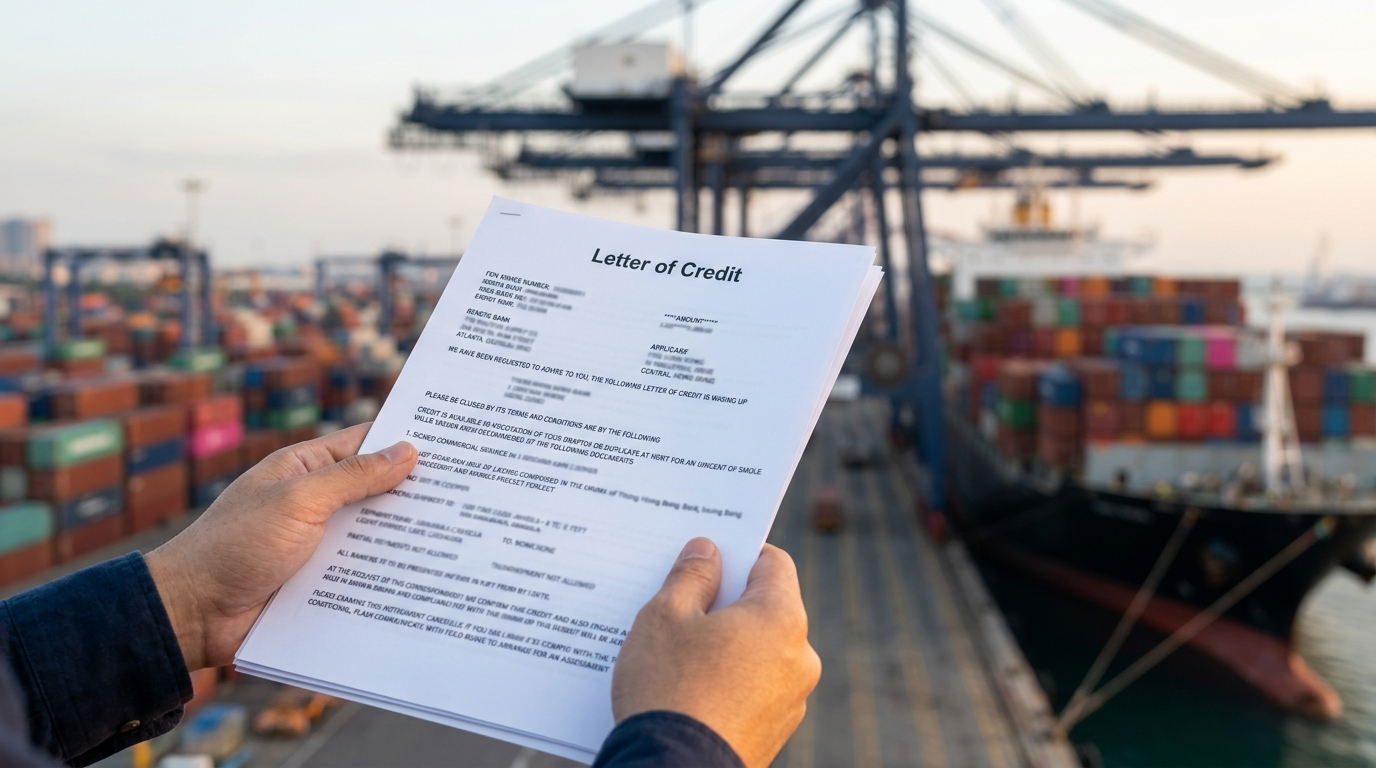
When a European electrical distributor places a $200,000 order for LED weatherproof fixtures from a Chinese manufacturer, neither side knows the other well enough to simply trust. The distributor fears paying and receiving non-compliant goods. The manufacturer fears shipping and never getting paid. A Letter of Credit (L/C) solves exactly this problem — it replaces mutual commercial trust with bank-backed financial commitment, making large international orders viable even between parties who have never worked together before.
Key Takeaways
- An L/C is a bank’s conditional payment promise — the issuing bank guarantees the seller will be paid once compliant documents are presented, regardless of whether the buyer has the funds at that moment.
- Both parties are protected — sellers get payment security; buyers only pay when shipment documents confirm goods were sent as agreed.
- 60–75% of first presentations contain discrepancies — document precision is the single most critical success factor (per ICC Banking Commission data via tradefinanceglobal.com).
- UCP 600 governs all commercial L/Cs — understanding these rules prevents costly mistakes.
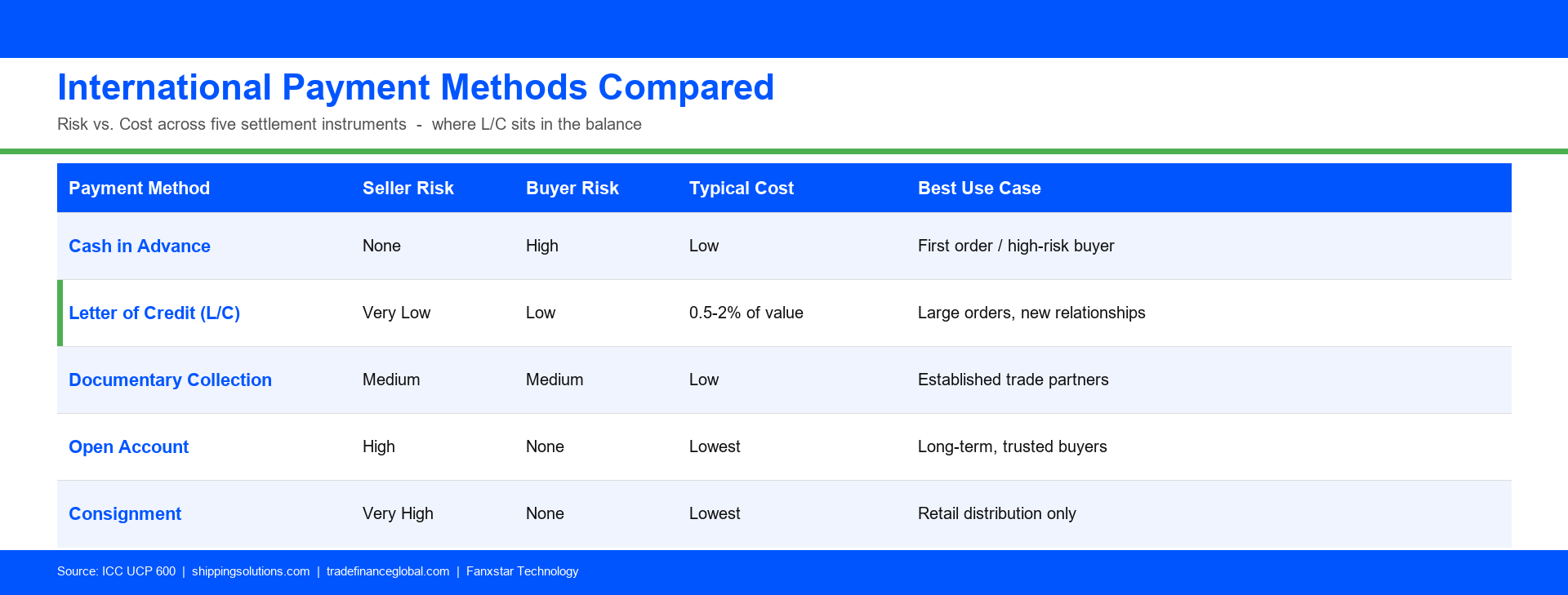
- L/C costs typically run 0.5–2% of the transaction value — a reasonable insurance premium for orders above $50,000.
What Is a Letter of Credit and Why Does It Matter?
The Core Mechanism
A Letter of Credit is a financial instrument issued by a buyer’s bank (the issuing bank) that guarantees payment to the seller (beneficiary) provided the seller presents documents that strictly comply with the L/C’s terms. As the IncoDocts trade finance guide explains, banks deal exclusively with documents — not with the physical goods themselves. This independence from the underlying commercial transaction is both the L/C’s greatest strength and its most demanding characteristic.
In practical terms: the manufacturer ships the goods, assembles the document package, presents it to their local bank, and receives payment. The buyer’s bank then reimburses itself from the buyer’s account. If the goods turn out to be defective, that’s a separate commercial dispute — the L/C has already fulfilled its function.
Why Large Orders Specifically Require L/Cs
For orders below $10,000, a wire transfer in advance or open account may be practical. Once order values cross into the $50,000–$500,000 range common in industrial lighting procurement — full container loads of weatherproof fixtures, emergency lighting systems, or explosion-proof luminaires — the stakes are too high for either side to absorb the loss of a failed transaction. The L/C creates a financial bridge backed by institutional credit.
The Four Main Types of Letters of Credit
Sight L/C vs. Usance (Deferred) L/C
A Sight L/C releases payment immediately upon presentation of compliant documents — typically within 5 banking days. This is the preferred structure for sellers and represents the majority of industrial goods transactions. A Usance (Deferred Payment) L/C allows the buyer a defined credit period — 30, 60, 90, or 180 days after shipment — before payment is due. This structure helps buyers manage cash flow by allowing time to receive and sell goods before the payment obligation falls due, per the ITF trade finance reference on L/C structures.
Confirmed vs. Unconfirmed L/C
In a standard (unconfirmed) L/C, the seller depends on the issuing bank’s creditworthiness. When the buyer’s country or bank carries elevated risk — political instability, sanctions exposure, or a bank with limited international standing — the seller can request a confirmed L/C, where a second bank (usually the seller’s local bank) adds its own independent payment guarantee. Confirmation costs more but removes issuing bank and country risk entirely. For Fanxstar customers in markets with challenging banking environments, our team can advise on which L/C structure best fits your situation.
Revolving and Transferable L/Cs
A Revolving L/C is designed for repeat buyers who order similar goods on a regular schedule — it automatically reinstates up to the original value after each drawing, eliminating the need to open a new L/C for every shipment. A Transferable L/C allows the original beneficiary (e.g., a trading company) to transfer part of the L/C value to a secondary supplier. These specialized structures add flexibility for complex supply chains.
The L/C Process: Step by Step
Phase 1 — Agreement and Application
The process begins in the sales contract. Buyer and seller agree on payment terms: L/C type (sight or usance), currency, expiry date, port of shipment, and the exact document list required. Ambiguity in the sales contract is the primary source of downstream L/C problems. Once agreed, the buyer submits an L/C application to their bank — providing the proforma invoice, company credentials, and collateral if required. Banks typically hold collateral of 0–30% of the L/C value depending on the applicant’s credit standing.
Phase 2 — Issuance and Advising
The issuing bank transmits the L/C to the seller’s bank via SWIFT MT700 message format. The advising bank verifies the L/C’s authenticity and forwards it to the seller (beneficiary). The seller reviews the L/C terms carefully at this stage — this is the last opportunity to request amendments before shipping begins. Per the Shipping Solutions international trade payment guide, L/C amendments require agreement from all parties and can delay the shipment timeline significantly if not handled proactively.
Phase 3 — Shipment and Document Preparation
The seller ships goods according to the L/C’s specified terms and assembles the document package. This is where most transactions succeed or fail. The document set for a typical industrial goods L/C includes:
| Document | Purpose | Common Discrepancy |
|---|---|---|
| Commercial Invoice | States goods description, value, parties | Description doesn’t exactly match L/C wording |
| Bill of Lading (B/L) | Proves goods were shipped; title document | Claused B/L (damaged goods notation), late shipment date |
| Packing List | Details quantities, weights, dimensions | Quantity mismatch with invoice |
| Certificate of Origin | Confirms manufacturing country for customs | Wrong form type for destination country |
| Insurance Certificate | Covers goods in transit (typically 110% of CIF value) | Coverage below required minimum |
| Inspection Certificate | Third-party quality verification (if required) | Issued by unauthorized party |
Phase 4 — Document Presentation and Payment
The seller presents documents to the nominated bank within the L/C’s presentation period (typically 21 days from shipment, before the L/C expiry date). The bank has 5 banking days under UCP 600 Article 14 to examine documents and either honor the presentation or advise discrepancies. If compliant, payment is made. The issuing bank then releases documents to the importer to clear customs and claim the goods.
The Discrepancy Problem: Why 60–75% of Presentations Are Rejected Initially
The Scale of the Issue
According to ICC Banking Commission Senior Technical Advisor data published via the Documentary Credit World analysis of UCP 600 discrepancy rates, an estimated 60–75% of L/C document presentations are refused on first submission. This does not mean payment is lost — most discrepancies are corrected — but it means delays, extra bank fees, and damaged trading relationships. For a manufacturer shipping temperature-sensitive goods or meeting a buyer’s project deadline, a 2-week payment delay caused by a document error has real commercial consequences.
The Most Common Discrepancies in Industrial Goods L/Cs
Document discrepancies in manufactured goods transactions typically fall into four categories:
- Description mismatch — The commercial invoice describes goods using slightly different wording than the L/C. If the L/C says “LED Weatherproof Light IP65 50W” and the invoice says “50W LED Tri-proof Fixture IP65,” a strict examiner may reject it.
- Late shipment or presentation — Goods shipped after the L/C’s latest shipment date, or documents submitted after the expiry date, are automatic grounds for rejection.
- Claused Bill of Lading — Any notation by the carrier indicating damaged or wet goods at loading creates a “claused” (unclean) B/L, which almost no L/C will accept.
- Insurance shortfall — Insurance coverage below 110% of the CIF value is a common but preventable error.
The solution is systematic: use a document checklist built directly from the L/C text before preparing any document, and have an experienced freight forwarder or bank review the package before formal presentation.
L/C Costs: What Buyers and Sellers Actually Pay
Issuing Bank Fees (Buyer Side)
The buyer (applicant) pays the issuing bank an issuance fee, typically 0.5–1.5% of the L/C value per quarter, plus an application fee of $100–$500. Some banks also require a commitment fee if the L/C is not drawn within a specified period. For a $150,000 order, expect to pay $750–$2,250 in issuance fees alone. Banks in countries with tighter credit markets or stricter KYC requirements may charge at the higher end of this range.
Advising and Confirmation Fees (Seller Side)
The seller’s bank charges an advising fee ($50–$200) to verify and forward the L/C. If the seller requests confirmation, add another 0.5–2% of the L/C value — confirmation premiums are dynamic and reflect the issuing bank’s credit rating and country risk, as noted in the King-Hor 2025 L/C overview for freight partners. Discrepancy fees of $100–$300 per presentation are charged when documents require correction and resubmission.
Negotiating the Fee Split
A common trade negotiation point is which party bears the banking charges outside their country. Standard practice is each party pays their own country’s banking fees, but this should be explicitly stated in the L/C and sales contract (“charges outside the issuing country are for the account of the beneficiary” or vice versa). Ambiguity here regularly causes disputes.
L/C vs. Other Payment Methods for Industrial Lighting Orders
When to Use an L/C
An L/C is the right tool when: (1) the order value is substantial ($50,000 or above); (2) the trading relationship is new or the buyer’s country carries elevated political/financial risk; (3) the seller’s bank requires security before extending pre-shipment financing; or (4) the buyer wants documented proof of shipment before releasing funds. For Fanxstar customers placing first-time orders for industrial LED weatherproof lighting or complete emergency lighting systems for large projects, an L/C provides both parties with the framework needed to complete the transaction confidently.
When an L/C May Be Overkill
For repeat buyers with an established payment history, an L/C’s cost and administrative complexity may outweigh its benefits. A Documentary Collection (D/P or D/A) offers similar shipment-document linkage at lower cost, though without bank payment guarantee. Open account terms — the dominant method in established European B2B relationships — work well when both parties have a multi-year track record and the buyer maintains strong creditworthiness.
Practical Tips for Smooth L/C Execution
For Buyers Opening an L/C
Before submitting your L/C application, confirm three things with your supplier: (1) the exact wording of goods description they will use on all documents; (2) whether they can meet the specified shipment date with buffer; and (3) which specific ports, Incoterms, and insurance coverage they need the L/C to specify. A proforma invoice from the supplier is the best template for drafting the L/C application — it ensures terminology alignment from the start. Per the Trade Finance Global comprehensive L/C guide, LCs are accepted and acknowledged across 175 countries, so the framework itself is universal — execution precision is what varies.
For Sellers Receiving an L/C
Review the L/C text immediately upon receipt and before any production or shipping commitment. Check: expiry date is achievable, shipment port matches your logistics plan, document list matches what you can provide, and goods description exactly matches how you will describe them on the invoice. Request amendments in writing immediately if anything is unclear or unachievable. Once production and shipping begin, the window for amendments narrows dramatically.
The Document Review Protocol
Create a column-by-column checklist mapping every L/C requirement to a corresponding document. Have one person prepare documents and a second person cross-check against the L/C text before presentation. This two-step review catches the majority of discrepancies before they reach the bank. For complex multi-part shipments — such as a large emergency lighting project requiring multiple truck loads and partial shipments — engage a specialized trade finance officer or freight forwarder with L/C documentation expertise.
Common Questions
Can an L/C be cancelled after issuance?
Irrevocable L/Cs — the standard under UCP 600 — cannot be cancelled or amended without agreement from all parties: applicant, beneficiary, issuing bank, and confirming bank (if applicable). Revocable L/Cs exist in theory but are rarely issued in practice and provide minimal seller protection. When an L/C says “irrevocable” without other qualification, treat it as a firm bank commitment that cannot be withdrawn unilaterally.
What happens if the goods arrive damaged but documents were clean?
The L/C has already fulfilled its function — payment was made against compliant documents. Damage claims are handled through cargo insurance, not the L/C mechanism. This is why buyers require insurance certificates covering 110% of the CIF value as part of the document package. Sellers should also maintain proper packaging and obtain a clean Bill of Lading from the carrier — any carrier notation of damage at loading creates a claused B/L that most L/Cs will reject.
Is an L/C suitable for OEM/ODM custom orders?
Yes, and it is often the preferred structure for custom manufacturing orders where the goods cannot be resold if the buyer refuses payment. For Fanxstar OEM/ODM customers commissioning custom LED fixtures — including private-label weatherproof lights, specialized grow lights, or explosion-proof luminaires — an L/C protects the manufacturer’s production investment. It also gives the buyer confidence that payment is only released when the shipping documents confirm the agreed specification was delivered.
How long does the L/C process take?
Opening an L/C typically takes 3–7 banking days from application to issuance, with an additional 2–5 days for advising. Add 21 days for document presentation after shipment. The complete cycle from L/C opening to payment receipt — assuming a clean first presentation — typically spans 30–60 days. This timeline must be factored into project scheduling and working capital planning on both sides.
What is a Standby Letter of Credit (SBLC) and is it the same?
An SBLC is a contingent instrument — it pays only if one party defaults or fails to perform. It is not designed for routine shipment document presentation. Documentary credits under UCP 600 (what most people mean when they say “L/C”) pay against compliant shipment documents as the primary transaction mechanism, not as a backup guarantee. The practical distinction: use a documentary L/C for normal payment of goods; use an SBLC or bank guarantee for performance security on a project contract or advance payment protection.