EN IEC 60598-1 is not a marketing credential; it is the general luminaire safety framework that should connect the exact product design, test report, label, instructions, and change-control file. For a lighting buyer, the practical value is not the standard number by itself. The value is knowing whether the exact luminaire version being shipped is covered by the safety design, test evidence, production label, and installation instructions.
EVS EN IEC 60598-1:2024+A11:2024 identifies the current EN IEC 60598-1 base documents and notes that performance is covered by the IEC 62722 series. That boundary matters because buyers should not confuse a luminaire safety standard with a lumen-output, energy-performance, or application-performance promise.
Key Takeaways
- EN IEC 60598-1 is the general safety standard for luminaires; it should be paired with the right Part 2 standard and market requirements.
- A supplier claim is useful only when the test report, BOM, label, installation instruction, and shipped sample describe the same product.
- The Low Voltage Directive makes harmonised standards important for EU market access, but CE responsibility still belongs to the manufacturer or economic operator.
- Changes to drivers, batteries, switches, serviceable parts, cable entries, labels, or sensor modules can reopen the evidence question.
- Fanxstar buyers should treat EN IEC 60598-1 as a release-file gate for weatherproof, linear, emergency, sensor, and custom ODM luminaires.
What EN IEC 60598-1 Covers and What It Does Not Cover
It is a general luminaire safety framework
The first buyer mistake is treating EN IEC 60598-1 as a single magic approval. It is a general safety framework for luminaires. The exact project still needs the right luminaire classification, construction details, electrical protection approach, marking, instructions, and often a particular Part 2 standard for the specific luminaire type. A linear batten, emergency luminaire, recessed luminaire, and weatherproof fixture can share the general framework while needing different evidence paths.
European Commission Low Voltage Directive guidance says the LVD covers electrical equipment between 50 and 1000 V AC or 75 and 1500 V DC. That voltage scope is one reason IEC 60598-1 matters to LED luminaires sold into Europe, but it does not mean a buyer should accept a standard number without product-specific evidence. The standard is a way to structure proof, not a replacement for proof.
| Buyer question | EN IEC 60598-1 answer path | Release evidence |
|---|---|---|
| Is the luminaire in scope? | Check supply voltage, luminaire type, and whether a Part 2 standard also applies. | Model description, voltage range, use environment |
| Is it safe electrically? | Review protection against electric shock, earthing, insulation, creepage, and clearance. | Safety report, wiring diagram, earth continuity evidence |
| Is it safe mechanically? | Review construction, strain relief, suspension, service access, and enclosure details. | Drawings, sample photos, installation instruction |
| Is marking correct? | Confirm supply nature, warnings, rating label, and serviceability language. | Production label, IFU, packaging file |
| Did anything change? | Driver, battery, switch, SPD, controlgear, or serviceable parts can reopen the evidence file. | Change log, BOM lock, retest decision |
It does not prove optical performance
The EVS scope page is especially useful because it states that performance of luminaires is covered by the IEC 62722 series. That boundary protects buyers from a common overclaim. A luminaire can be designed against IEC 60598-1 safety requirements and still need separate evidence for efficiency, lumen output, distribution, flicker, glare, lifetime, sensor behavior, IP rating, and application suitability.
DOE FEMP commercial and industrial LED luminaire guidance keeps buyers focused on luminaire-level performance categories. For Fanxstar projects, this means the compliance file and the performance file should travel together. Safety evidence answers whether the product can be placed on the market under the chosen route. Performance evidence answers whether it will work in a cold storage room, warehouse aisle, parking deck, tunnel, or food-processing washdown area.
How the Standard Connects to CE Marking and LVD Evidence
Harmonised standards are evidence, not a shortcut around responsibility
European Commission LVD harmonised standards page explains that LVD harmonised standard references are published in the Official Journal through Commission implementing decisions. The buyer implication is straightforward: the relevant edition, amendment, and transition status matter. A report that cites an older edition may still be useful background, but it should not be accepted blindly for a new EU-facing production order.
Your Europe CE marking guidance says the manufacturer is responsible for ensuring a product meets all applicable EU requirements and for affixing CE marking. That responsibility does not disappear because a supplier sends a PDF or a catalog claim. The buyer should ask who signs the declaration, which model is covered, which directives are named, which harmonised standards are cited, and what evidence supports the declaration. European Commission EMC harmonised standards page is also relevant when a luminaire includes drivers, controls, sensors, or wireless-adjacent electronics, because EMC evidence should not be hidden inside a safety-only discussion.
Technical documentation should describe the exact product
Your Europe technical documentation guidance says technical documentation must demonstrate that a product complies with all EU requirements. For LED luminaires, that documentation should not be a loose folder of unrelated test reports. It should connect design drawings, BOM, safety report, label, installation instruction, risk review, photos, and change records for the exact fixture being placed on the market.
This matters in ODM work because small changes can look harmless. A new driver, emergency battery, sensor module, gasket, connector, or label revision can affect the compliance boundary. If the buyer approves a sample based on one file and later accepts production based on another file, the standard number no longer protects the decision. The release file has to remain coherent.
The Buyer Evidence File for LED Luminaire Safety
Use a release file instead of a standard-number checklist
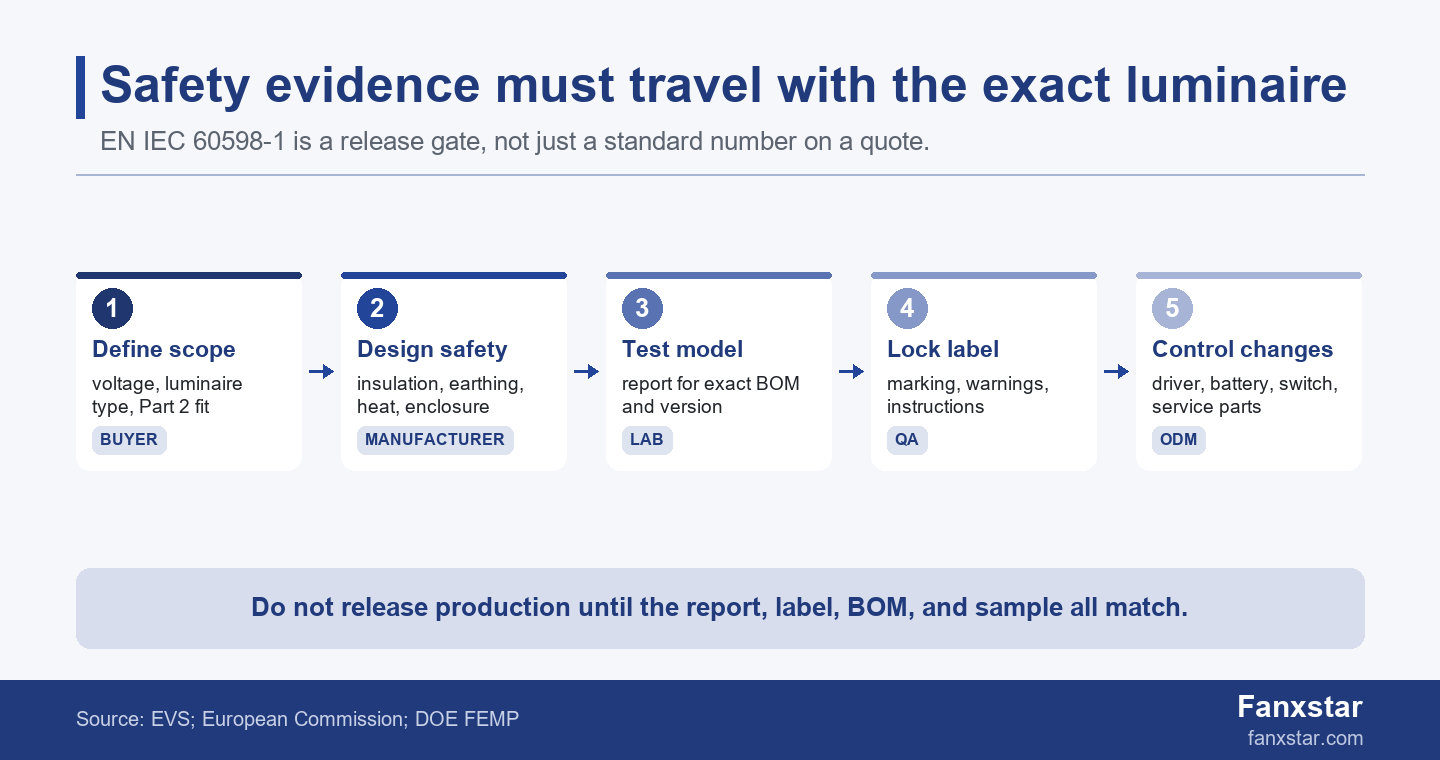
The release file should answer 5 questions before production: what product is in scope, what safety design was tested, what markings and instructions are final, what components are serviceable or non-serviceable, and what changes require review. This is more useful than asking whether the luminaire has EN IEC 60598-1 because it forces the supplier to show the link between design and shipment.
Use this as a scenario estimate for EN IEC 60598-1 buyer release. Based on our analysis of this scenario, 1 model should have one controlled BOM before a report is accepted. Based on our analysis of this scenario, 5 evidence items should be reviewed together: report, BOM, label, instruction, and photos. Based on our analysis of this scenario, 10 years is a useful CE documentation-retention reference from EU guidance. Based on our analysis of this scenario, 2 standards may be involved when a general part and a particular luminaire part both apply. Based on our analysis of this scenario, 1000 V marks the upper supply-voltage scope named in the IEC 60598-1 abstract. Based on our analysis of this scenario, 75 to 1500 V is the DC voltage window named in LVD guidance. Based on our analysis of this scenario, 50 to 1000 V is the AC voltage window named in LVD guidance. Based on our analysis of this scenario, 1 change log should record every driver, label, battery, or controlgear substitution.
Marking and instructions are part of safety, not paperwork
Labels, warnings, supply information, installation instructions, and serviceability language are often treated as final artwork. In safety terms, they are part of the product boundary. A technically sound luminaire can still create buyer risk if the marking uses the wrong supply condition, if the installation instruction hides a limitation, or if the service language suggests a part can be replaced when the evidence file assumes it cannot.
Fanxstar buyers can connect this to LED lighting certification checklist for ODM buyers when a project moves from quotation to sample approval. The best RFQ language names the market, voltage, luminaire type, installation environment, serviceability expectation, emergency or sensor option, and evidence required before production release.
Where Fanxstar ODM Projects Need Extra Discipline
Weatherproof and sensor-ready fixtures create more change points
Weatherproof and vapor-tight fixtures often combine enclosure, gasket, cable entry, diffuser, driver, mounting, and sometimes sensor or emergency options. Relevant Fanxstar starting points include weatherproof LED lighting product platform, vapor tight LED light fixtures, and motion sensor LED lighting. Each added option creates another place where a standard claim can become detached from the shipped product.
For example, a microwave sensor opening can affect sealing. A through-wiring connector can affect strain relief. An emergency battery can affect heat and service instructions. A different driver can change creepage, clearance, thermal behavior, flicker, or component serviceability. The safety file should be reviewed as a system, not as a fixture shell plus loose accessories.
Custom ODM work needs an evidence freeze before tooling or volume release
Use Fanxstar custom LED lighting ODM service when the project needs CCT, optics, sensor placement, housing, wiring, or label adaptation. The sample should define the version that will be tested and produced. If the buyer changes optics after testing, adds a sensor after label approval, or swaps the driver after a thermal review, the evidence decision should be reopened before shipment.
| Product change | Why it matters | Buyer action |
|---|---|---|
| Driver or controlgear | Can change heat, safety spacing, flicker, and serviceability. | Ask whether the test report still applies. |
| Battery or emergency option | Adds charging, heat, marking, and service instructions. | Request battery-specific evidence and label review. |
| Switch, sensor, or socket | Can affect live-part access, marking, and wiring assumptions. | Freeze the exact accessory and wiring path. |
| Housing, gasket, or cable entry | Can change enclosure, strain relief, and installation risk. | Compare sample photos with the certified version. |
| Label or installation sheet | The user receives the compliance boundary through markings and instructions. | Approve the final production artwork. |
What to Request Before Approving a Supplier Claim
Ask for the report boundary in plain language
A good supplier answer should identify the standard edition, test body or lab route, covered model, voltage range, construction version, critical components, label version, and whether the report covers the ordered options. A weak answer simply says the product is EN IEC 60598-1 compliant without connecting the report to the buyer’s fixture. That weak answer is common because sales teams often treat compliance as a static asset while engineering treats it as a controlled product file.
The buyer should also ask whether the product falls under any more specific luminaire requirements, whether the market needs additional national deviations or amendments, and whether the product is intended for ordinary, emergency, hazardous, medical, or special-environment use. If the application changes, the evidence route may also change.
Turn the standard into release language
A practical RFQ sentence can be short: quote the exact luminaire version, state the target market, identify applicable EN IEC 60598 evidence and any Part 2 requirement, provide the test report boundary, lock the BOM and label before production, and identify which changes require retest or engineering review. That sentence prevents the standard number from becoming a vague sales badge.
The final buying rule is simple: do not approve production because a catalog page names EN IEC 60598-1. Approve production only when the safety report, BOM, sample, label, installation instruction, and change-control file all describe the exact luminaire being shipped.
FAQ
Is EN IEC 60598-1 the same as CE marking?
No. EN IEC 60598-1 is a luminaire safety standard, while CE marking is a manufacturer declaration that the product meets applicable EU rules. The standard may help support LVD conformity, but the buyer should still check the declaration, technical file, model scope, and production label.
Does IEC 60598-1 prove LED performance?
No. IEC 60598-1 is about general safety requirements for luminaires, not lumen output, efficiency, glare, flicker, or application performance. Buyers still need photometric, driver, thermal, controls, IP, and installation evidence for the actual project.
What should an ODM buyer request from the supplier?
Request the applicable standard edition, covered model number, test report boundary, BOM, driver and controlgear list, label artwork, installation instruction, sample photos, and a change-control rule. The key is whether those records describe the same fixture that will ship.
When should a test report be reviewed again?
Review it again when the driver, battery, sensor, switch, cable entry, housing, label, serviceable parts, voltage, or intended market changes. Small design changes can affect whether the existing safety evidence still applies to the production version.