Choosing an LED driver brand is one of the most consequential decisions in a commercial or industrial lighting project — and it’s one that often gets made too late in the design process. The fixture gets specified, the chip gets chosen, and then the driver is treated as an afterthought. That’s when problems emerge: incompatible dimming protocols, warranty gaps, or smart-control features that weren’t built in from the start.
Three brands come up consistently in B2B procurement discussions for commercial and industrial LED lighting: Mean Well, Lifud, and Boke. Each has a clearly defined strength. Mean Well is the global reliability benchmark. Lifud has become the go-to for DALI-2 smart lighting integration. Boke leads on dimming flexibility and multi-lamp consistency. Choosing correctly means understanding what each brand optimizes for — and which of those priorities aligns with your application.
This guide compares all three across the dimensions that matter most to procurement engineers and lighting designers: certification depth, dimming protocol support, warranty terms, thermal operating range, and OEM integration suitability.
Key Takeaways
- Mean Well HLG series delivers the strongest warranty (7 years), widest operating temperature range (-40°C to +90°C case temp), and the only Class I Div 2 hazardous location rating among the three — making it the default for harsh industrial and outdoor environments.
- Lifud leads on DALI-2 D4i smart lighting integration, with built-in bus power supply, NFC programmability, CLO, and energy data feedback (IEC 62386 Parts 251–253) — ideal for intelligent commercial buildings and EU/UK smart lighting projects.
- Boke excels at multi-lamp dimming consistency via its proprietary HPC technology, broad protocol support (0-10V, DALI-2, PWM, Casambi), and compact form factors for office and commercial linear applications — plus a DALI Alliance membership that validates its protocol compliance.
Brand Profiles: Where Each Comes From
Mean Well — Taiwan’s Power Supply Institution
Founded in 1982 in New Taipei City, Taiwan, Mean Well is not primarily a lighting company — it is a power supply company that applies industrial-grade power engineering to LED drivers. With revenues exceeding USD 1.35 billion (2021) and over 2,800 employees across facilities in Taiwan, China, the United States, and the Netherlands, Mean Well operates at a scale that enables component-level quality control most competitors cannot match. The HLG series — its flagship LED driver line — carries a 7-year limited warranty, a figure no other driver brand in the commercial space has matched at this product tier. The certification stack is equally distinctive: UL, TÜV/ENEC, CE, CB, and a Class I Division 2 hazardous location rating that makes it the only viable option for oil and gas, chemical processing, and ATEX-adjacent environments where explosive atmospheres must be considered.
Mean Well’s engineering philosophy prioritizes long-term reliability over feature richness. The HLG operates from 90–305 VAC universally and handles case temperatures from -40°C to +90°C under free air convection — a specification that matters enormously in outdoor street lighting, cold storage facilities, and rooftop installations where ambient conditions are unpredictable. Typical lifespan under specified conditions exceeds 62,000 hours according to Mean Well’s own testing documentation.
Lifud — The Smart Lighting Specialist
Lifud, headquartered in Shenzhen, was established in 2007 and has built its reputation almost entirely within the commercial LED lighting ecosystem. Where Mean Well serves a broad industrial power supply market, Lifud focuses specifically on the needs of luminaire manufacturers: panel lights, linear battens, tri-proof fixtures, high bays, and downlights for commercial buildings. The company operates its own UL and DALI certification laboratories and employs over 180 technical staff in R&D, maintaining partnerships with universities including Fuzhou University and Southwest Jiaotong University for driver electronics research.
Lifud’s competitive differentiation is built around DALI-2 intelligence. Its FSD-YD (DT6) and FSD-YE (DT8) series for linear applications are DALI-2 D4i certified — meaning they go beyond standard DALI-2 to support IEC 62386 Parts 251 (luminaire asset data), 252 (energy reporting), and 253 (diagnostics and maintenance). The D4i certification also means Lifud’s linear drivers carry a built-in DALI bus power supply, eliminating the need for a separate bus power unit in smart lighting installations. NFC programmability via mobile app or programmer allows field adjustment of output current, dimming curves, and DALI addresses without rewiring — a practical benefit for large commercial rollouts where consistency across hundreds of fixtures is critical. Lifud also offers CLO (Constant Light Output) across its smart driver range, automatically compensating for LED lumen depreciation over time to maintain target illuminance levels without recalibration.
Boke — Dimming Consistency and Protocol Breadth
Boke (officially BOKE Drivers Co., Ltd.) was established in 2010 in Guangdong Province and has earned National High-Tech Enterprise status alongside a “National Specialized, Sophisticated SME” (Little Giant) designation — recognition that its R&D investment is genuine rather than nominal. With over 100 technical patents and a DALI Alliance membership, Boke’s core intellectual property centers on what it calls HPC (High-Performance Consistency) technology: a proprietary approach to multi-lamp dimming that ensures brightness uniformity across multiple fixtures dimmed on the same circuit, regardless of dimming level. This addresses a real pain point in open-plan office and corridor lighting where slight inter-fixture variation at low dimming levels creates visible hot spots.
Boke’s product range spans DALI-2 DT6 and DT8, 1-10V, PWM, and Casambi wireless — with all models supporting dim-to-off and DIP-switch-selectable current output levels. The 5-year warranty is lower than Mean Well’s benchmark but is standard for the category. Certifications cover CE, UKCA, ENEC-TÜV, RCM, and CCC, making Boke products viable across European, UK, and Australian markets. The brand is also producing in-track drivers and compact office linear formats that Lifud and Mean Well don’t prioritize, giving it a niche in architectural commercial projects where form factor matters as much as spec.
Head-to-Head Specification Comparison
| Specification | Mean Well (HLG) | Lifud (FSD/BDD Series) | Boke (DALI-2 Series) |
|---|---|---|---|
| Founded | 1982, Taiwan | 2007, Shenzhen | 2010, Guangdong |
| Warranty | 7 years (HLG/HLG-C) | 5 years (indoor linear); 8 years (outdoor ACD) | 5 years |
| Efficiency | Up to 96% | Up to 95%+ | Up to 91–94% (linear) |
| IP Rating | IP65 / IP67 | IP20 (indoor linear); IP65/IP67 (outdoor) | IP20 (standard linear) |
| Operating Temp | -40°C to +90°C (case) | -20°C to +70°C (typical) | -20°C to +70°C (typical) |
| DALI-2 | Available (select models) | Full range; D4i certified (Parts 251–253) | Full range; DALI Alliance member |
| NFC Programming | Not standard | Yes — mobile app + programmer | Yes — select D4i models |
| CLO Function | Not standard | Yes (smart series) | Yes (DALI-2 series) |
| Hazardous Location | Class I Div 2 (HL type) | Not rated | Not rated |
| Multi-lamp Consistency | Standard | Standard | HPC patented technology |
| Wattage Range | 40–600W | 10–200W (linear); up to 165W outdoor | 10–200W (linear) |
| Certifications | UL, TÜV/ENEC, CE, CB, PSE | ENEC, CE, CB, UKCA, RCM, SAA, UL (select) | CE, UKCA, ENEC-TÜV, RCM, CCC |
Dimming Protocol Deep Dive
Mean Well: 3-in-1 Universal Dimming
Mean Well’s approach to dimming on the HLG series is pragmatic: offer maximum compatibility. The 3-in-1 dimming (0-10V, PWM signal, and resistance) means the HLG can be retrofitted into virtually any existing control system without a dedicated protocol gateway. DALI-2 is available on select HLG variants but is not the brand’s primary selling point. For projects where the control system is already defined — or where the priority is driver longevity over smart functionality — Mean Well’s universal dimming avoids the over-specification problem of paying for DALI infrastructure that will never be used.
Lifud: DALI-2 D4i as a System Architecture Decision
Lifud’s pitch is that DALI-2 D4i should be the default choice for any commercial building where occupancy sensing, energy reporting, or predictive maintenance is a future requirement — even if those capabilities aren’t being activated on day one. The built-in DALI bus power supply in D4i drivers eliminates a separate BPS unit from the bill of materials, while the NFC programmability means an installer can configure output current, dimming floor, and DALI address from a mobile app in seconds rather than rewiring DIP switches. For lighting specifiers working on BREEAM, LEED, or EN 15232 energy management compliance, the energy data feedback capability of Parts 252 and 253 is not optional — it’s required for top-tier building energy certification.
Boke: Protocol Breadth and HPC Consistency
Boke’s differentiation in dimming is less about depth in a single protocol and more about breadth across multiple protocols combined with a consistency guarantee. The HPC (High-Performance Consistency) patented technology ensures that when 20 or 50 fixtures are dimmed together on the same DALI or 1-10V circuit, the lumen output at any given dim level is identical across all units — eliminating the visual unevenness that standard drivers produce at low dim levels where small current tolerances create noticeable brightness differences. For open-plan offices, hotel corridors, and retail environments where lighting uniformity directly affects perceived quality, this is a meaningful differentiator. The addition of Casambi wireless control and Bluetooth integration in newer Boke product lines also makes it one of the few driver brands addressing the mesh wireless commercial lighting segment directly.
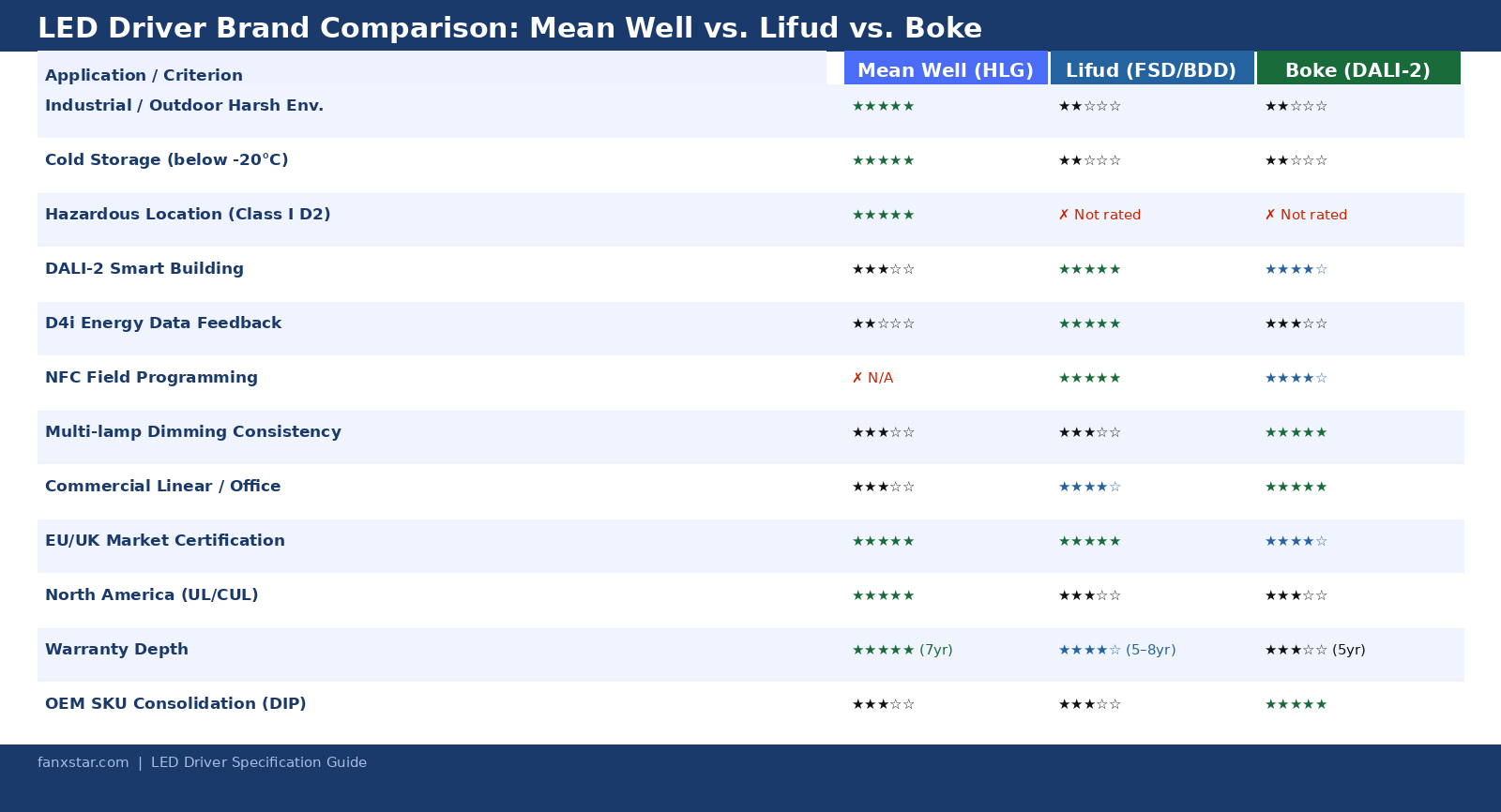
Application-Based Selection Guide
Industrial and Outdoor Harsh Environments
Mean Well is the unambiguous choice for outdoor street lighting, cold storage facilities, rooftop installations, and any environment where the operating temperature regularly drops below -20°C or where moisture, dust, and surge exposure are daily conditions. The IP67 aluminum enclosure, -40°C cold-start capability, Class I Division 2 hazardous location rating, and 7-year warranty create a risk profile that Lifud and Boke’s linear-oriented drivers cannot match. In a cold chain distribution center where the driver sits inside a fixture rated for -30°C ambient, a Mean Well HLG is the engineering-defensible choice; substituting a comparable Lifud or Boke linear driver in the same installation would be a warranty and reliability risk. For Fanxstar’s weatherproof and industrial fixture range, Mean Well HLG drivers are the natural specification partner — particularly for heavy-duty models targeting -40°C operating environments or hazardous locations.
Smart Commercial Buildings and Tenant Fit-Outs
Lifud is the choice when the building management system or lighting controls specification requires DALI-2 with energy data feedback, occupancy integration, or predictive maintenance capability. In a European office building pursuing BREEAM Excellent certification, for example, EN 15232 energy performance classification requires metered lighting data — which Lifud’s D4i drivers provide natively without adding separate sub-metering infrastructure. The NFC programmability also reduces commissioning time on large installations: setting DALI group addresses, dimming curves, and CLO start points for 200 fixtures via a phone app is a materially different installer experience than adjusting physical DIP switches. For Fanxstar’s linear lighting and commercial tri-proof range targeting EU commercial building fit-outs, specifying Lifud DALI-2 D4i drivers is a strong differentiation argument for distributors serving smart building contractors.
Open-Plan Office and Architectural Commercial
Boke becomes the preferred option when visual dimming consistency across many fixtures is the primary concern, or when the project involves multiple control protocols on the same site — for example, a mixed-use development where some zones use DALI-2, others use 1-10V, and a retail section uses Casambi wireless. The HPC technology is particularly relevant in hospitality and retail where smooth, identical dimming from 100% to below 10% across all ceiling fixtures is a quality standard, not a luxury. Boke’s compact in-track driver formats and DALI-2 DT8 tunable white capability also make it well-suited to architectural commercial interiors where CCT tuning (warm to cool white transition across the day) is part of the lighting design brief.
OEM Integration Considerations for Luminaire Manufacturers
For lighting manufacturers and OEM/ODM clients evaluating which driver partner to standardize on, the decision is less about single-project suitability and more about supply chain architecture. Mean Well’s global distribution network — over 245 authorized distributors worldwide — means supply continuity and component availability are largely de-risked, even for small-batch custom work. This matters for OEM clients who need to guarantee parts availability for fixture warranty claims over a 7–10 year product life.
Lifud offers a more engaged OEM partnership model for smart lighting integration: its NFC programming ecosystem (mobile app, PC software, offline programmer, batch NFC for full cartons) is designed specifically for luminaire factories who want to configure drivers at the production line rather than delegating configuration to installers. For a manufacturer building 5,000 units of a DALI-2 D4i office panel light, being able to batch-program output current and DALI parameters across an entire pallet with one NFC session is a genuine assembly line efficiency gain.
Boke’s OEM value is in its DIP-switch current configurability: with 10–16 selectable current levels via external DIP switch, a single Boke driver SKU can cover multiple fixture power ratings, reducing the number of driver variants that need to be stocked, qualified, and certified. This SKU consolidation approach aligns directly with Fanxstar’s own “SKUs-IN-ONE” product philosophy for weatherproof fixtures — and makes Boke a natural driver partner for manufacturers who want to minimize BOM complexity without sacrificing power flexibility.
In practice, most professional luminaire manufacturers — including Fanxstar — specify all three brands across different product lines rather than committing to a single driver partner. The right framework is: Mean Well for outdoor and industrial, Lifud for smart commercial, Boke for commercial linear and office. If you are developing a new fixture line and need help selecting the right driver architecture for your target market and certifications, Fanxstar’s OEM/ODM engineering team works through this specification process as a standard part of the custom lighting development workflow.
Certification Depth by Market
European and UK Markets
All three brands carry CE marking, but the depth behind that marking differs. Mean Well’s HLG series holds TÜV-witnessed ENEC certification — a more stringent route than self-declaration CE — and UL listing for North American requirements, making it the safest choice for products that need dual-market certification. Lifud’s outdoor ACD series carries ENEC, CE, CB, UKCA, RCM, and SAA, making it one of the most broadly certified driver series for multi-market distribution. Boke’s ENEC-TÜV certification covers the EU and UK but has less documented depth on North American UL listing compared to Mean Well. For Australian market (RCM/SAA), both Lifud (ACD outdoor series) and Boke carry the necessary marks; Mean Well carries SAA on select models.
North American Market
Mean Well is the clear leader for North American commercial and industrial projects: UL listing, CUL (Canadian), and the Class I Division 2 HL-type rating give it a certification profile that Lifud and Boke cannot yet match in North America for industrial applications. Lifud and Boke are primarily optimized for European and Asia-Pacific market certifications, with more limited UL coverage on their smart lighting driver lines — a genuine constraint for distributors targeting US or Canadian projects requiring UL-listed components throughout.
Warranty and After-Sales Reality
Warranty terms are only meaningful if the manufacturer will honor them across geographies. Mean Well’s 7-year warranty on HLG/HLG-C is backed by a global distribution network with 245+ authorized distributors and direct offices in the EU (Netherlands) and North America (California), enabling warranty claims to be handled regionally rather than shipped to Taiwan. Lifud’s 5-year indoor / 8-year outdoor warranty terms are competitive, but its after-sales infrastructure is more China-centric — distributors in EU markets handle first-line support, with escalation to Shenzhen. Boke’s 5-year warranty is standard for the category; its European distribution is handled through partners such as Bright Green Connect in the UK.
For B2B buyers managing large-scale commercial installations, the practical warranty question is not the length but the friction: how many steps does it take to get a failed driver replaced, and who bears the cost of the replacement fixture during the claim process? Mean Well’s global distribution depth makes this the lowest-friction answer for international projects. For purely EU market deployments, Lifud and Boke are both well-represented enough that warranty claims are manageable.
Frequently Asked Questions
Can I mix Mean Well, Lifud, and Boke drivers within the same DALI-2 installation?
Yes — DALI-2 interoperability is the protocol’s core promise, and all three brands produce DALI-2 certified products that conform to IEC 62386. However, mixing brands within the same installation introduces commissioning complexity: NFC programming ecosystems are brand-specific (Lifud’s app cannot program a Boke driver), and advanced D4i data functions (energy reporting, diagnostics) will only work if all drivers support Parts 251–253. For installations leveraging full D4i capability, standardizing on a single brand simplifies commissioning, especially when using batch NFC programming at the factory or on-site.
Is Mean Well’s 7-year warranty genuinely better than a 5-year warranty, or is it a marketing number?
The 7-year warranty is backed by documented DMTBF (Demonstration Mean Time Between Failure) testing and accelerated aging, with MTBF exceeding 1.7 million hours under specified conditions. It is a conditional warranty — case temperature must remain below a defined threshold (typically 75°C at the Tc point) to qualify — so real-world warranty validity depends on correct thermal management in the fixture. Provided the fixture designer keeps the Tc point within spec, the 7-year warranty is substantive and distinguishes Mean Well from competitors who offer 5-year terms with less rigorous underlying test documentation.
Which driver brand is best for LED fixtures targeting the EU commercial market?
Lifud is the strongest choice if the fixture needs DALI-2 D4i smart building integration, ENEC certification, and NFC commissioning capability for the European commercial market. Mean Well is preferable if the fixture will be deployed in outdoor or cold-environment applications with IP67 requirements and a long warranty commitment. Boke is well-positioned for office linear and commercial panel applications where multi-lamp dimming consistency and DIP-switch current flexibility are priorities. For Fanxstar-manufactured fixtures targeting EU commercial buyers, the typical specification is Lifud for smart interior applications and Mean Well for weatherproof and industrial product lines — with Boke used for commercial linear formats where CCT tuning and HPC consistency are part of the product brief. Contact Fanxstar’s technical team to discuss driver specification for your project.
What does “HPC technology” in Boke drivers actually mean in practice?
HPC (High-Performance Consistency) is Boke’s patented approach to ensuring that multiple LED fixtures dimmed on the same circuit maintain identical lumen output at any given dim level. In standard drivers, small tolerances in output current accuracy (typically ±5%) mean that at low dim levels — say 10% — some fixtures will be noticeably brighter than adjacent units. Boke’s HPC technology reduces inter-fixture variation to a level where differences are not visible to the human eye across any dim setting from 1% to 100%. This is particularly relevant in open-plan offices, hotel corridors, and retail display lighting where ceiling uniformity is a design quality standard, and where the buyer would notice if half the ceiling was slightly warmer or brighter than the other half.
Fanxstar integrates Mean Well, Lifud, and Boke drivers across its weatherproof, emergency, and linear lighting product lines — selecting each brand based on the application environment, certification requirements, and smart control infrastructure of the target market. If you are developing a custom LED fixture and need driver selection guidance specific to your IP rating, operating temperature, certification stack, and smart control requirements, our OEM engineering team provides technical consultation as a standard part of the custom product development process. Reach out to start the conversation.