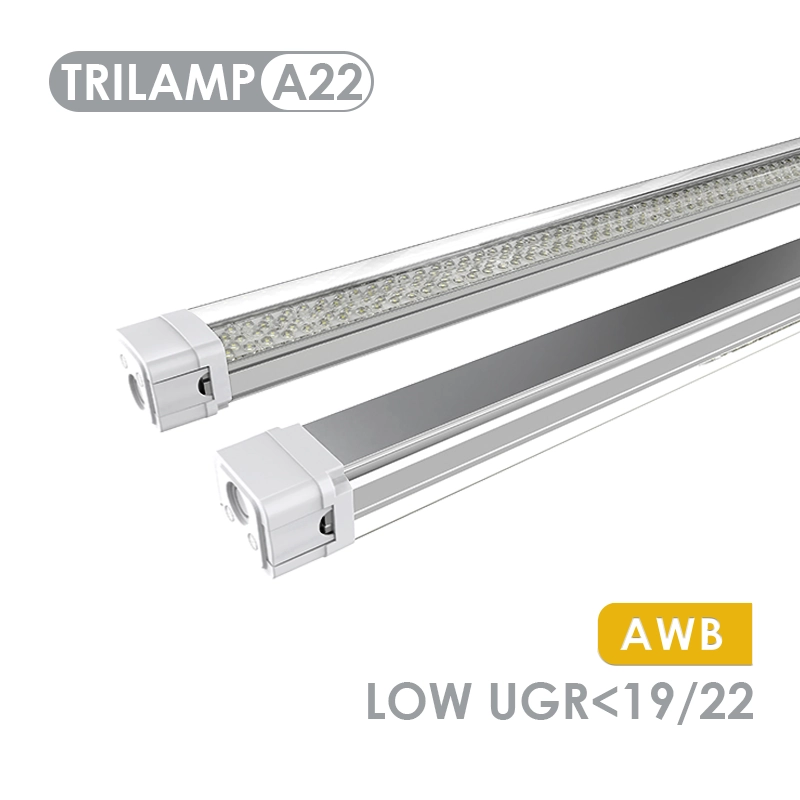
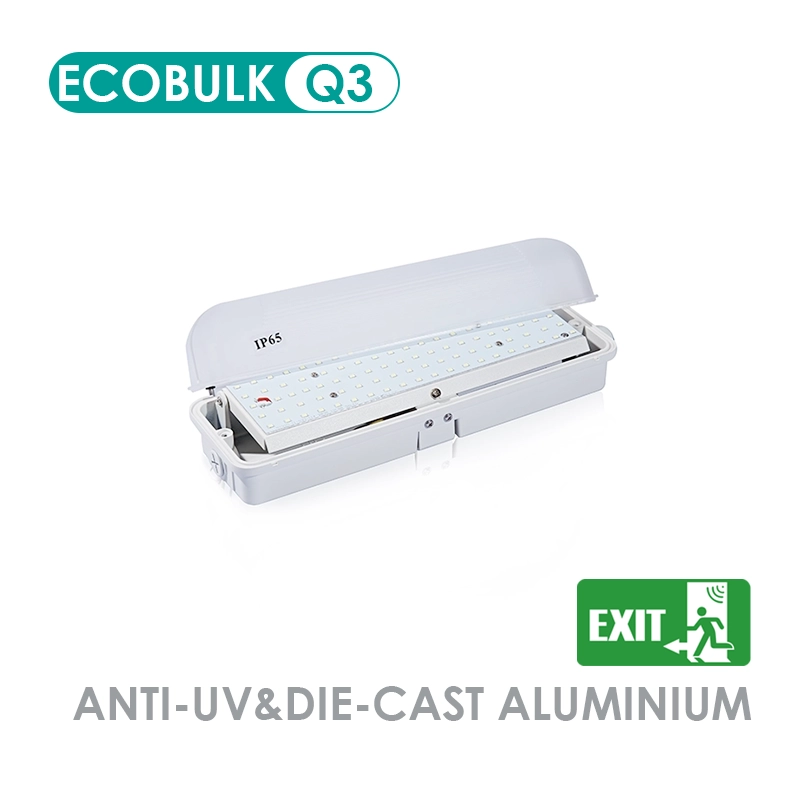
A lighting distributor walks into your showroom. You have 400 SKUs. She needs a tri-proof fixture in 40W and 60W, two color temperatures, linkable. That is four line items — but your catalog lists 23 variants of the same fixture because sales added wattages over three years and marketing created regional bundles nobody reordered. She leaves with a competitor’s two-page spec sheet. SKU proliferation is one of the most common and least-discussed margin killers in lighting manufacturing. This guide walks through why catalog complexity accumulates, how to score every SKU against objective criteria, and the specific product design strategies — adjustable wattage, multi-CCT — that let you serve more markets with fewer line items.
Key Takeaways
- 80% of revenue typically comes from 20% of SKUs — but the tail 80% consumes a disproportionate share of inventory capital, warehouse space, and management attention.
- Lowe’s cut 15% of in-store SKUs and reported a 50-basis-point gross margin improvement as a direct result, per Supply Chain Dive Q3 2025 reporting.
- Modular “SKUs-IN-ONE” designs — adjustable wattage, multi-CCT, sensor-optional — are the structural answer to catalog complexity in LED lighting.
- GMROI scoring (Gross Margin Return on Inventory Investment) reveals which SKUs earn their shelf space and which silently erode capital.
- A repeatable quarterly review cadence prevents rationalized catalogs from growing back — one-time purges are insufficient.
Why Lighting Catalogs Become Unmanageable
The Mechanics of SKU Proliferation
SKU proliferation rarely happens by accident — it happens by design, one justifiable decision at a time. A distributor in Spain requests a 4000K version of your tri-proof because local preference runs cool-white. A project contractor in Australia needs a 277V variant. A retail buyer at a home improvement chain asks for a private-label bundle of four fixtures. Each request is individually rational. Cumulatively, they compound into a catalog that nobody can navigate and a warehouse that cannot be efficiently managed.
In the LED lighting industry, the problem is structural. Unlike a fashion brand where variants are colors and sizes, lighting variants are technical: wattage, CCT, voltage, IP rating, lens angle, mounting type, emergency backup option, sensor option, dimming protocol (DALI vs. 0-10V vs. Triac). A single fixture platform can theoretically spawn hundreds of unique combinations. Without governance, it will.
According to CXTMS’s 2026 supply chain analysis, Dollar General reported that SKU reductions were a “big win” — cutting 1,000 SKUs with plans to eliminate more — while Advance Auto Parts launched 250 line reviews targeting unproductive SKUs as part of a broader inventory overhaul. These are not lighting companies, but the dynamics are identical: every SKU added is a pick location, a purchase order line, a forecasting variable, and a capital allocation that must earn its keep.
The Hidden Costs of a Bloated Catalog
Carrying costs for inventory typically run 20–30% of inventory value per year when you account for storage, insurance, handling, obsolescence, and the capital cost of money tied up in stock. A lighting SKU that sits in a warehouse for 18 months without selling may have cost more in carrying charges than it contributes in margin when it eventually moves. The 2025 Netstock Supply Chain Planning Benchmark Report found that 17% of SMBs carry more than 10% of their inventory unsold for 12+ months, with excess stock averaging 38% of total SMB inventory.
For lighting manufacturers, there are additional costs specific to the product category: tooling and mold management across variants, multi-variant certification overhead (CE, UL, SAA, TUV applied to each distinct product code), technical documentation maintenance, and the increased complexity of quality control across a wider product range. Each of these is a legitimate operational cost that scales with SKU count.
The ABC/XYZ Framework: Scoring Your Catalog
ABC Analysis: Revenue Contribution
ABC analysis ranks every SKU in your catalog by its contribution to total revenue. The categorization is typically:
- A-items (top 10-20% of SKUs): Contribute 70–80% of total revenue. These are core products — protect stock levels, prioritize production slots, maintain certification currency.
- B-items (next 30% of SKUs): Contribute 15–20% of revenue. These are solid performers that warrant continued investment but less premium treatment than A-items.
- C-items (bottom 50% of SKUs): Contribute 5–10% of revenue. These require scrutiny — some are strategically important (low-volume but high-margin, or specification-critical), but most are candidates for consolidation or discontinuation.
For a lighting manufacturer, an ABC analysis rarely produces the expected results on first run. Products that were originally launched as “strategic” or “customer-requested” frequently end up in the C tier with cumulative sales that do not justify their ongoing management overhead.
XYZ Analysis: Demand Predictability
ABC tells you what sells. XYZ tells you how predictably it sells — which matters for inventory planning and safety stock calculations. X-items have stable, predictable demand; Y-items have seasonal or trend-influenced variation; Z-items have erratic or infrequent demand. Combining ABC and XYZ creates a 9-cell matrix that informs differentiated inventory strategies. An AX item (high revenue, stable demand) warrants a just-in-time approach. A CZ item (low revenue, erratic demand) is almost always a discontinuation candidate unless there is a compelling strategic reason to keep it.
GMROI: The Financial Lens
GMROI (Gross Margin Return on Inventory Investment) = Gross Margin / Average Inventory Cost. It tells you how much gross profit you earn for every dollar of inventory you carry. A GMROI of 3.2 or higher is a common retail benchmark; below 1.0 means you are effectively losing money by holding the product, per Mobile Inventory’s SKU rationalization analysis. For lighting products, GMROI calculations must include all product-specific costs: inbound freight from the factory, import duties, certification costs amortized across units sold, and the specific warehousing footprint for bulky fixtures.
The Lighting-Specific Answer: Modular Product Design
Adjustable Wattage: One SKU, Multiple Power Outputs
The most impactful structural solution for LED lighting catalog complexity is adjustable wattage design. A single fixture with a driver configurable at 36W/50W/70W via a physical switch or dip-setting eliminates three separate SKUs while serving the same wattage range. The inventory position simplifies to one product code; the buyer gets flexibility without needing to commit to a wattage at order time.
This approach — which Fanxstar refers to as its “SKUs-IN-ONE” product philosophy — reduces production line complexity (fewer model changeovers), simplifies certification (one product tested across its operating range rather than three separate files), and concentrates demand onto a single high-volume SKU that benefits from better pricing at component level. Fanxstar’s weatherproof lighting range applies this principle extensively — configurable wattage and CCT settings reduce the physical SKU count substantially while maintaining specification flexibility for project applications.
Multi-CCT Technology: Eliminating Color Temperature Variants
Color temperature variants are one of the most common sources of SKU proliferation in commercial lighting. Stocking 3000K, 4000K, and 5000K versions of the same fixture triples the inventory position for what is, electrically, the same product. Multi-CCT or tunable-white technology embeds a simple CCT selector into the fixture, allowing the installer to set the color temperature during installation. This collapses three SKUs into one.
The business case is straightforward. A distributor carrying a single multi-CCT tri-proof fixture at 40W/50W/60W with 3CCT selection covers nine permutations of the traditional catalog with a single stock-keeping unit. For facilities managers who standardize on lighting but serve different space types — office areas at 4000K, reception at 3000K, high-bay storage at 5000K — this is functionally superior to stocking multiple fixed-CCT variants.
Sensor and Emergency Options: Modular Add-Ons vs. Separate SKUs
Emergency backup modules and motion sensor options create another branch of SKU complexity. The traditional approach creates separate product codes for each combination: standard / with emergency / with sensor / with both. The modular approach designs the base fixture with a plug-in or snap-fit accessory bay, so the accessory is a separate SKU but the base product remains a single code. This concentrates inventory investment in the high-volume base product and allows accessories to be stocked at lower, more predictable quantities.
For distributors, this model is operationally superior — they can hold a single base SKU and fulfill both standard and emergency applications from the same bin location, adding the emergency module at the time of pick. For manufacturers, it simplifies production planning and reduces the number of finished-goods positions to manage. If you’re evaluating emergency lighting solutions that use this modular approach, the flexibility it creates across a wide range of application requirements is a tangible differentiator.
Running a SKU Rationalization Sprint
Phase 1: Data Assembly (Days 1–7)
Pull the following data for every active SKU in your catalog for the trailing 24 months: total units sold, average selling price, cost of goods sold per unit, average inventory on hand (in units and value), days of inventory on hand, number of unique customers or orders, and return/claim rate. If you have multiple channels (direct, distributor, retail, online), segment the data by channel — a SKU that is a C-item overall may be an A-item in a specific channel that you want to protect.
Phase 2: Scoring and Segmentation (Days 8–14)
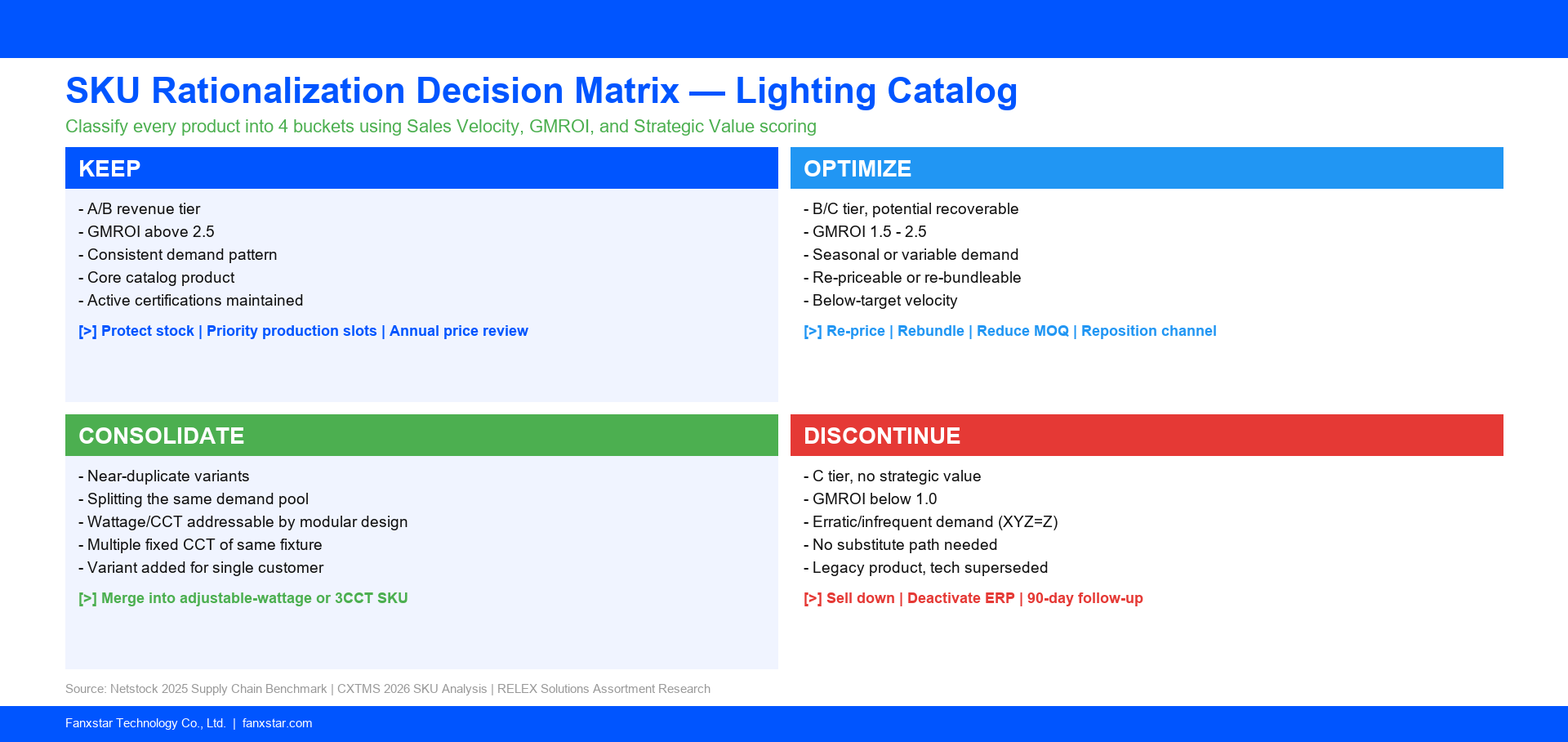
Score every SKU across five dimensions: sales velocity (units moved per month), gross margin percentage, GMROI, demand predictability (CV of monthly sales), and strategic value (is this a spec-required product, a gateway to an account, or a platform product that enables other sales?). Assign each a composite score and sort the catalog into four buckets: Keep, Optimize (maintain but adjust pricing or packaging), Consolidate (merge into a broader variant or replace with a modular equivalent), and Discontinue.
| Decision | Criteria | Action |
|---|---|---|
| Keep | A/B revenue tier, GMROI > 2.5, consistent demand | Protect stock levels; review pricing annually |
| Optimize | B/C tier, GMROI 1.5–2.5, salvageable with changes | Re-price, re-bundle, reduce MOQ commitments |
| Consolidate | Near-duplicate variants splitting the same demand pool | Merge into modular product or single configurable SKU |
| Discontinue | C tier, GMROI < 1.0, erratic demand, no strategic value | Sell down existing stock; remove from active catalog |
Phase 3: Stakeholder Alignment (Days 15–21)
SKU rationalization fails most often not during the data phase but during the communication phase. Sales teams resist discontinuing SKUs because they worry about losing accounts. Product managers resist eliminating variants they championed. The key is to involve these stakeholders early, share the GMROI data transparently, and establish that the goal is not to shrink the product offering but to strengthen it — concentrating resources on the products that earn them. For each proposed discontinuation, document the customer impact and the available substitute, and give account managers 60–90 days advance notice to manage the transition.
Phase 4: Execution and Sell-Down (Days 22–30)
For SKUs being discontinued, options include: markdown pricing to accelerate sell-through, bundling with A-items, returning stock to the factory (if within contractual terms), or writing off the remaining inventory. Deactivate discontinued SKUs in the ERP system promptly — leaving them active invites accidental reorders. Set a 90-day post-discontinuation review to measure the actual impact on carrying costs, warehouse utilization, and sales of substitute products.
Preventing Catalog Creep: Governance for the Long Term
The New-SKU Gate
A rationalized catalog grows back without governance. The most effective prevention mechanism is a formal new-SKU approval gate: every proposed new product or variant must pass a review that includes a sales forecast with market evidence, a GMROI projection at 12 months, an assessment of which existing SKU (if any) it displaces, and sign-off from operations on the inventory and certification implications. A “one-in, one-out” policy — where adding a new SKU requires identifying a candidate for consolidation or retirement — creates a discipline that prevents casual proliferation.
Quarterly Review Cadence
SKU performance reviews should be quarterly, not annual. The lighting market moves fast — a specification change by a major contractor, a price shift from a competing manufacturer, or a new building code requiring different emergency lighting configurations can quickly move a product from B-tier to C-tier. Quarterly reviews with consistent GMROI and velocity metrics catch drift early, before it becomes inventory liability.
For manufacturers evaluating their product architecture from the ground up — or distributors looking for a supplier whose catalog structure supports rather than complicates their own inventory management — Fanxstar’s OEM/ODM customization services are designed to build configurable products that serve multiple markets from a single production base, reducing the SKU footprint while expanding specification coverage.
Frequently Asked Questions
How many SKUs is too many for a lighting manufacturer?
There is no universal answer — the right number depends on market breadth, channel complexity, and operational capacity. The more useful question is: what percentage of your SKUs generate less than 1% of revenue each, and do those products justify their carrying and management costs? If more than 30–40% of your catalog falls into this tail, rationalization will almost certainly improve both margin and operational efficiency. The goal is not minimum SKU count but maximum SKU productivity.
Will discontinuing SKUs hurt customer relationships?
It can, if managed poorly. The key is advance notice, a clear substitute recommendation, and a transparent rationale. Most buyers understand product lifecycle management — what they do not tolerate is surprise discontinuations mid-project or in the middle of a purchasing cycle. With 60–90 days notice and a clear migration path to a substitute or modular equivalent, the majority of discontinuations can be executed without losing the customer relationship.
What is the difference between SKU rationalization and SKU optimization?
SKU rationalization is the decision process — keep, optimize, consolidate, or discontinue. SKU optimization is the design process — engineering products to cover more use cases with fewer product codes, through adjustable wattage, multi-CCT, or modular accessories. Both are necessary. Rationalization without product design optimization simply defers the problem; you will rebuild complexity at the next product launch cycle. Optimization without rationalization leaves the existing catalog inefficiency in place. The two processes are most powerful when run together.
How does SKU rationalization affect certification costs?
Positively. Every product code with a distinct specification requires its own certification filing — CE, UL, SAA, TUV. Consolidating three fixed-CCT variants into one multi-CCT product reduces the certification surface by two-thirds for that product family. Over a catalog of 200 SKUs, this can represent tens of thousands of dollars in annual certification renewal fees, plus the engineering time required to manage compliance documentation across a larger portfolio. The savings compound as certifications come up for renewal each year.
To explore how a rationalized, modular product architecture applies to industrial and commercial lighting applications, browse Fanxstar’s application scenarios — each application page maps a small number of optimized product configurations to a wide range of real-world specification requirements.