Your LED fixture passed every electrical safety test. The certifications are in order. The packaging looks sharp. Then a major retailer rejects your first shipment because the barcode won’t scan — and they charge you a $50 expense offset per receipt on top of it. For lighting manufacturers entering retail channels, barcode compliance is not an afterthought. It is a gate. This guide explains exactly what EAN-13 and UPC-A standards require, how to register correctly through GS1, and the specific print and placement rules that prevent costly chargebacks.
Key Takeaways
- GS1-issued GTINs are mandatory — third-party reseller barcodes routinely fail retailer registry validation and will get shipments rejected.
- EAN-13 is the global default for lighting products sold outside North America; UPC-A works for the US and Canada, and the two formats are technically compatible on modern scanners.
- Print quality matters as much as the number — undersized X-dimensions, missing quiet zones, and low-resolution printing cause scan failures even when the GTIN is valid.
- Every product variant needs its own unique GTIN — different wattages, CCTs, pack sizes, and voltages each require a separate barcode assignment.
- Retailer-specific requirements exist on top of GS1 standards — Walmart, Target, and Amazon each add layers that manufacturers must check separately.
EAN-13 vs. UPC-A: Understanding the Difference
What Each Format Is For
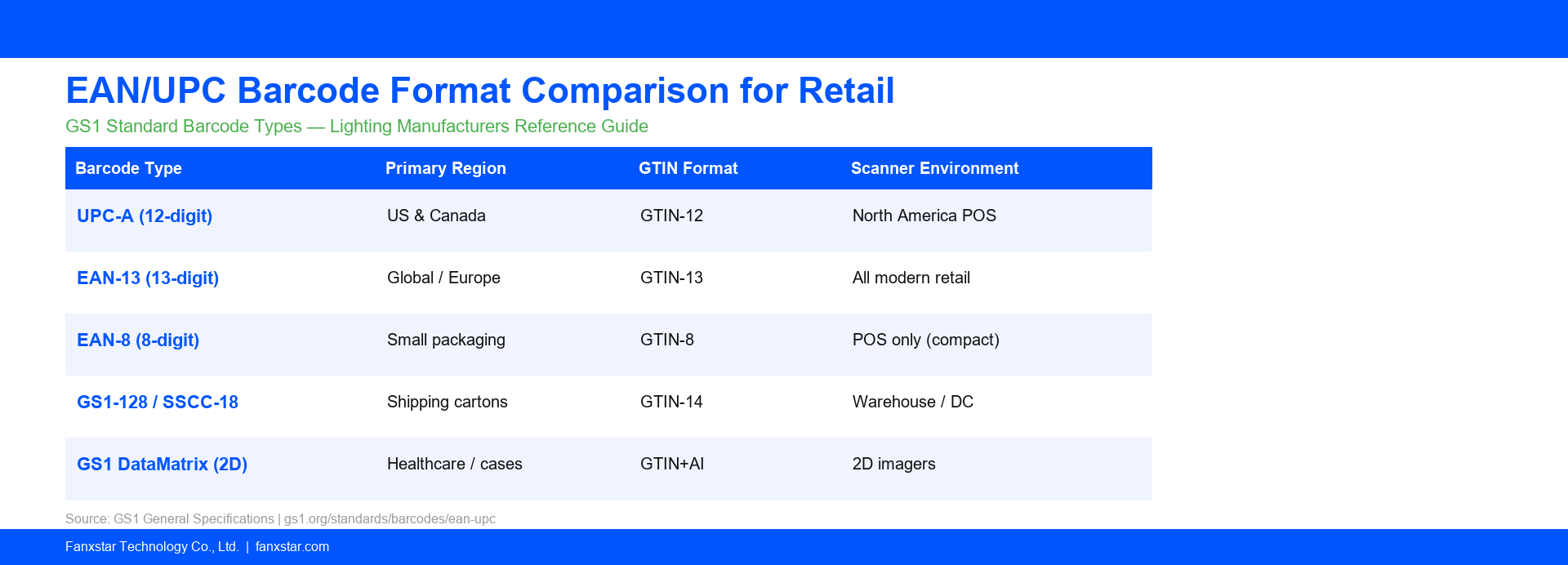
UPC-A (Universal Product Code) is a 12-digit barcode that has been the North American retail standard since the 1970s. EAN-13 (European Article Number, now formally called GTIN-13 by GS1) is a 13-digit format used internationally. Structurally, EAN-13 is UPC-A with a leading country-prefix digit prepended — which means every UPC-A is a valid EAN-13 with a leading zero. Modern point-of-sale scanners in the United States and Canada are “EAN-aware” and can read both formats without adjustment, according to GS1 US’s official EAN vs. UPC guidance.
For a lighting manufacturer like Fanxstar supplying global distributors — from European wholesalers to Australian project contractors — EAN-13 is the practical default. It is accepted everywhere, whereas UPC-A alone can create friction with non-North American retail systems.
The GTIN Umbrella
Both formats fall under the broader GS1 standard called GTIN (Global Trade Item Number). GTIN is the identification number itself; EAN-13 and UPC-A are the physical barcode symbologies that encode it. Retailers and platforms like Amazon do not verify that a barcode looks right — they verify that the GTIN resolves to a registered product in the GS1 Global Registry. A barcode generated from an unregistered or third-party-resold number will fail this check regardless of how well it scans optically.
| Feature | UPC-A | EAN-13 |
|---|---|---|
| Digits | 12 | 13 |
| Primary region | US & Canada | Global (international standard) |
| Accepted on Amazon | Yes (US marketplace) | Yes (especially EU) |
| Relationship | Subset of EAN-13 (leading zero) | Superset — accepts UPC-A |
| Recommended for | US-only retail | Multi-market distribution |
GS1 Registration: How to Get a Legitimate GTIN
Join Your National GS1 Organization
The only path to GTINs that major retailers will accept is through a national GS1 member organization. In the United States this is GS1 US; in China it is GS1 China (administered through the Article Numbering Center of China, ANCC). GS1 issues a Company Prefix — a unique numeric identifier assigned to your brand — from which you derive individual GTINs for each product. The prefix length varies based on the subscription tier and determines how many unique GTINs you can generate: a 7-digit prefix supports up to 100,000 unique items; a 9-digit prefix supports 1,000 items.
Annual membership fees vary by country and prefix length. In the US, GS1 US fees range from roughly $250/year for small businesses (10 GTINs) to several thousand dollars annually for larger prefixes. This is a one-time setup cost that unlocks verifiable product identity globally — a non-negotiable investment for any manufacturer entering retail.
What You Cannot Do: Third-Party Reseller Barcodes
A persistent problem in lighting supply chains is the use of barcodes purchased from third-party resellers who sell individual GTINs without a proper company prefix assignment. These numbers may scan correctly at a printer, but they fail when retailers verify them against the GS1 Global Registry. As noted in GS1’s UPC barcode operations guide, Macy’s imposes a $50 expense offset per receipt plus 50% of merchandise cost for UPC/GTIN/EAN non-compliance — a steep penalty that far exceeds the cost of proper registration.
Assign One GTIN Per Variant
This is where lighting manufacturers routinely underestimate the scope of the task. GS1 rules require a unique GTIN for each distinct product variant. For a tri-proof LED fixture, that means separate GTINs for each wattage option (e.g., 36W, 50W, 70W), each color temperature (3000K, 4000K, 5000K, 6500K), each pack size (single unit vs. carton of 10), and each voltage configuration (120V vs. 277V). A product line that appears to have 5 SKUs on paper may require 40 or more GTINs when all variants are counted.
Print Specifications: What Makes a Barcode Scan
X-Dimension and Magnification
The X-dimension is the width of the narrowest bar in a barcode symbol. For EAN-13 and UPC-A, the nominal X-dimension at 100% magnification is 0.330 mm. GS1 permits a magnification range of 80%–200%, per the GS1 Canada EAN/UPC Symbol Reference. At 80% magnification, bar width drops to 0.264 mm — the technical minimum. Most high-volume retail environments — supermarkets, warehouse clubs, home improvement chains — achieve better performance at 100%–120% magnification. Going below 80% risks scan failure and will result in rejected shipments.
Recommended physical dimensions at key magnification levels (EAN-13, including quiet zones):
| Magnification | Width (incl. quiet zones) | Min. Bar Height | Retail Use |
|---|---|---|---|
| 80% | 29.83 mm | 18.29 mm | Technical minimum — not recommended |
| 100% | 37.29 mm | 22.86 mm | Standard — recommended |
| 120% | 44.75 mm | 27.43 mm | More stable — preferred for large packaging |
Quiet Zone Requirements
The quiet zone is the blank, unmarked space on either side of the barcode. For EAN-13, the left quiet zone must be at least 11 module-widths; the right quiet zone at least 7 module-widths. For UPC-A, both sides require at least 9 module-widths. Encroachment by text, artwork, fold lines, or packaging features into the quiet zone is a primary cause of scan failures in the field. When placing the barcode on carton packaging, always verify the quiet zone in the physical print proof — not just in the digital file.
Color and Print Resolution
The ideal color combination is black bars on a white background. All colors in the red spectrum must be avoided for the bars, because most retail scanners use a red light source that cannot distinguish red bars from a white background. Backgrounds should be uniform in color and devoid of textures. For direct thermal or laser printing of labels, a minimum resolution of 300 DPI is recommended for reliable scan quality. At 203 DPI, printing is acceptable at 100% magnification or above but becomes risky for smaller-format packaging.
Barcode Placement on Lighting Product Packaging
Carton and Box Products
Per the GS1 US Bar Code Symbol Placement Guidelines, trade items intended for scanning at point of sale must carry an EAN-13, UPC-A, EAN-8, or UPC-E barcode. For boxed products — the standard format for most LED fixture retail packaging — the exposed surface of the box is the preferred location. The barcode should be consistently placed within a product category to enable reliable scanning during receiving and at checkout. A common placement is the lower-right area of the back panel, clear of folds and edges.
For shipping cartons sent to a retailer’s distribution center, GS1-128 labels carrying the SSCC-18 (Serial Shipping Container Code) are additionally required by most major retailers. This is separate from the consumer-facing EAN/UPC barcode on the individual product box. Retailers like Walmart require specific SSCC formatting and placement as part of their supplier compliance programs.
Multi-Pack and Bundle Considerations
If you sell a 4-pack or 10-pack of LED fixtures as a retail unit, that multi-pack requires its own GTIN — separate from the single-unit GTIN. The individual fixtures inside may or may not carry their own barcodes depending on whether they are ever sold individually. GS1’s GTIN Allocation Rules govern these decisions, and getting them wrong results in inventory discrepancies at the retailer’s DC. When in doubt, assign a new GTIN rather than reusing an existing one — reusing codes across variants is one of the most common and costly barcode compliance errors.
For lighting manufacturers looking to expand into retail with a structured product lineup, Fanxstar’s weatherproof lighting range is designed with consistent product variant architecture that maps cleanly to GS1 GTIN assignment — each wattage and CCT is a defined, separate SKU with distinct packaging specifications.
Retailer-Specific Requirements You Cannot Ignore
Amazon
Amazon requires a valid, unique GTIN for most new product listings. Since 2016, Amazon has mandated that GTINs be issued through official GS1 membership and verified against the GS1 Global Registry. Products with unverified GTINs will receive an “Invalid GTIN” error and cannot be listed. Amazon also offers GTIN Exemption for certain categories, but this is not a long-term solution for manufacturers building a retail presence — it limits listing quality and brand registry participation.
Walmart
Walmart’s 408-page Supply Chain Packaging Guide specifies barcode requirements at both the consumer item level (UPC-A) and the case level (GS1-128 / SSCC-18). Walmart imposes chargebacks for non-compliant labels, and these penalties apply from the first shipment. Thermal transfer printing is required for shipping labels — inkjet and laser are explicitly prohibited on carton labels.
European Retailers
European retail chains (Leroy Merlin, MediaMarkt, Carrefour, and electrical wholesale groups) uniformly require EAN-13. Products without a valid EAN registered through GS1 will not pass supplier onboarding. European distribution also often requires GS1 DataMatrix on outer cases for traceability, alongside the consumer-facing EAN-13 on each product unit.
Common Mistakes Lighting Manufacturers Make
Reusing the Same GTIN Across Variants
This is the number-one cause of inventory failures at retail. A 40W/4000K fixture and a 50W/5000K fixture are not the same product — they require different GTINs. When a retailer’s system cannot distinguish between variants at the barcode level, stock reconciliation breaks down, leading to incorrect reorders, phantom inventory, and eventually a supplier compliance audit.
Printing at Insufficient Resolution
Factory-applied barcodes printed at 203 DPI on low-grade thermal paper often degrade during shipping and warehousing. By the time the product reaches the retail shelf, the barcode fails quality verification. GS1 uses an ANSI/ISO barcode quality grading system (grades A through F) — most major retailers require a minimum ANSI grade of C or higher. Testing barcodes with a calibrated verifier before shipment is strongly recommended for any manufacturer entering a new retail channel.
Missing Quiet Zones Due to Packaging Design
Designers frequently reduce quiet zones to fit packaging artwork. This is especially common on smaller lighting accessory packaging where space is tight. Any violation of the quiet zone — even by a millimeter — can reduce scan reliability from near-100% to under 70% in automated receiving environments.
Step-by-Step: Getting Barcode-Ready for Retail
The Setup Process
- Join GS1 through your national GS1 organization (GS1 US, GS1 China/ANCC, GS1 UK, etc.) and obtain a Company Prefix.
- Audit your product variants — list every combination of wattage, CCT, pack size, and voltage that will be sold as a distinct retail unit, and assign a unique item reference number to each.
- Calculate GTINs — combine your Company Prefix + Item Reference + Check Digit (calculated per GS1 formula) for each variant.
- Register products in the GS1 Registry (Verified by GS1) with complete product data: name, brand, category, dimensions, weight, and images.
- Generate barcode artwork in vector format (EPS or SVG) at the correct magnification (recommend 100%–120%) with verified quiet zones.
- Verify print quality using a calibrated barcode verifier before submitting packaging proofs to your retailer.
- Submit to retailer product databases (Walmart Item 360, Target’s POL, Amazon Seller Central) using GS1-registered data as the source of truth.
If your lighting catalog includes OEM or private-label programs for distributor partners, Fanxstar’s OEM/ODM customization services include packaging specification support — ensuring that private-label products are correctly configured for retailer barcode compliance from the outset.
Frequently Asked Questions
Can I use the same EAN barcode for the same product sold in different countries?
Yes — a single EAN-13 is globally valid and does not change based on the destination market. However, if the product is physically different (e.g., different voltage for UK vs. US markets), it is a distinct product variant and requires its own GTIN. Physical format differences — different packaging, different plug type — always trigger a new GTIN assignment.
Do EAN barcodes expire?
The GTIN number itself does not expire. However, GS1 membership requires annual renewal fees, and if your membership lapses, your company prefix may eventually be reassigned to another organization. Products already in retail circulation will continue to scan, but you lose the ability to register new products or maintain the GS1 Registry data that retailers use to verify your GTINs.
What is the difference between EAN-13 and GS1 DataMatrix?
EAN-13 is a 1D linear barcode used for consumer-facing retail scanning at point of sale. GS1 DataMatrix is a 2D matrix barcode capable of encoding more data (batch number, serial number, expiry date) in a smaller footprint. DataMatrix is increasingly required on outer shipping cases and in healthcare or traceability applications. For standard retail lighting packaging, EAN-13 or UPC-A remains the primary consumer barcode. The GS1 standard is also moving toward “GS1 Digital Link” — a QR code-based format that encodes the GTIN and links to product data online — as a future successor to 1D barcodes.
What happens if a retailer rejects my barcode?
Rejection consequences vary by retailer. Amazon flags non-compliant shipments and may impose manual relabeling chargebacks. Walmart and other major retailers can impose financial penalties per shipment and, after repeated violations, may suspend the supplier relationship. The corrective path is to relabel products with compliant barcodes (which adds cost and time) or, in cases of fundamental GTIN errors, withdraw the product and relist under a corrected code. Prevention — verifying compliance before the first shipment — is substantially cheaper than remediation.
For lighting brands expanding into global retail channels, working with a manufacturing partner that understands compliance requirements at the factory level saves significant downstream friction. Contact the Fanxstar team to discuss packaging and labeling setup for retail-ready LED lighting products.