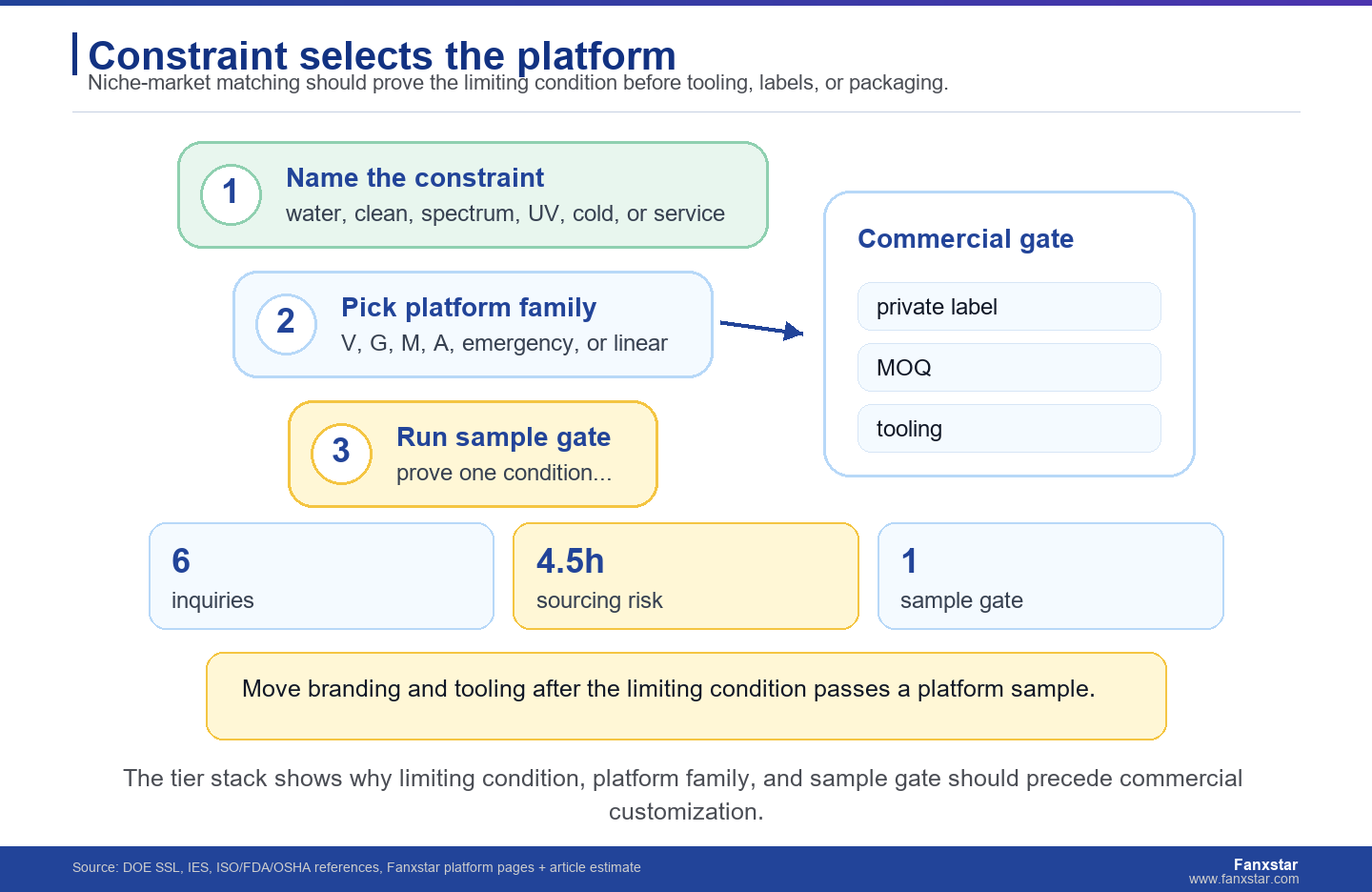
Specialty LED lighting applications become expensive when buyers start with a niche label instead of the constraint that makes the niche difficult. Aquaculture, cleanroom, food, retail, UV, cold, logistics, and controlled-agriculture projects do not need the same product platform, even when they all sound like custom lighting. The right match starts with the limiting condition, then moves to the closest proven Fanxstar platform and one sample gate that can prove the decision.
That is how platform-based specialty LED lighting ODM avoids both generic catalog selling and unnecessary new tooling.
Key Takeaways
- Name the limiting condition: Water, cleaning, spectrum, UV, corrosion, controls, or service access decides platform fit.
- Use existing platforms first: Start with V-series, G-series, M-series, A-series, or linear references before new tooling.
- Define a sample gate: One sample should prove the limiting condition, not every future option.
- Keep claim boundaries visible: Food, cleanroom, UV, and healthcare-adjacent applications need careful evidence language.
- Move commercial work later: Private label, MOQ, packaging, and tooling should follow platform proof.
Match The Limiting Constraint Before The Market Label
The market name tells you where the product goes; the constraint tells you which platform can survive there.
DOE solid-state lighting resources support a system view of LED performance, and IES standards reinforce application-specific lighting decisions. For specialty procurement, that means the buyer should not start with a generic phrase such as niche market light. Start with the limiting condition: water, cleanability, spectrum, UV boundary, cold, sensor logic, corrosion, battery backup, or maintenance access.
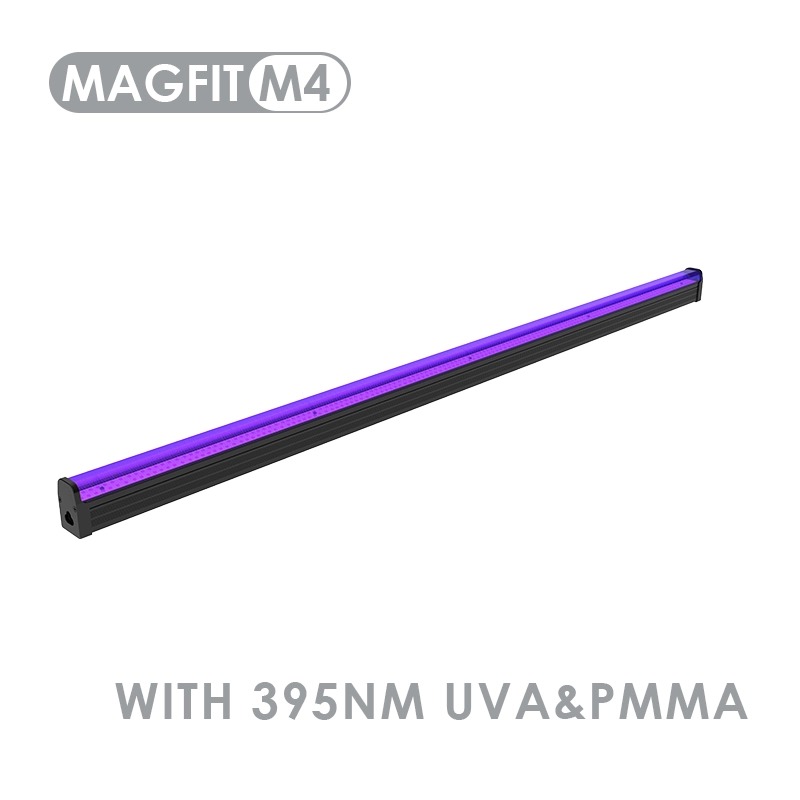
Fanxstar platform-based ODM becomes useful when the buyer can say which family is closest to the risk. V-series products are better starting points for aquaculture and controlled grow applications. G-series references belong in cleanroom conversations. M4F and M4B belong in fresh, display, or UV-related linear discussions. A-series weatherproof products belong where cleaning, dust, corrosion, or ingress risk dominates.
Niche Does Not Always Mean New Tooling
Specification note: For specialty LED lighting applications and product platform matching, the point behind “Niche Does Not Always Mean New Tooling” should become a reviewable acceptance line. The RFQ should state the site condition, the product evidence, the sample observation, the approver, and the fallback if Fanxstar recommends a standard platform or ODM change. That keeps buyers can over-customize every inquiry or, in the opposite direction, force unrelated applications onto one product platform from being hidden inside a general fixture preference.
A buyer may need custom CCT, optics, dimming, sensor integration, connector, cable exit, label, or packaging without needing a blank-sheet housing. The first question is whether an existing platform can prove the limiting condition. If it can, tooling should wait. If it cannot, the evidence from the failed platform test should define exactly what new structure must solve.
Regulated Or Hygiene-Adjacent Markets Need Boundary Language
Specification note: For specialty LED lighting applications and product platform matching, the point behind “Regulated Or Hygiene-Adjacent Markets Need Boundary Language” should become a reviewable acceptance line. The RFQ should state the site condition, the product evidence, the sample observation, the approver, and the fallback if Fanxstar recommends a standard platform or ODM change. That keeps buyers can over-customize every inquiry or, in the opposite direction, force unrelated applications onto one product platform from being hidden inside a general fixture preference.
Cleanroom, food, UV, medical-adjacent, and controlled-environment projects can easily drift into overclaims. ISO, FDA, OSHA, and other official sources should be used as boundaries. A fixture can support a facility requirement, but it does not validate a cleanroom, certify a food process, or replace professional safety review. That boundary makes the article and the RFQ more credible.
Commercial Terms Should Follow Technical Proof
Specification note: For specialty LED lighting applications and product platform matching, the point behind “Commercial Terms Should Follow Technical Proof” should become a reviewable acceptance line. The RFQ should state the site condition, the product evidence, the sample observation, the approver, and the fallback if Fanxstar recommends a standard platform or ODM change. That keeps buyers can over-customize every inquiry or, in the opposite direction, force unrelated applications onto one product platform from being hidden inside a general fixture preference.
MOQ, private label, packaging, and tooling discussions are easier after platform proof. If the sample proves water boundary, surface cleanability, spectrum, UV shielding, or service access, the buyer can commercialize with fewer assumptions. If it fails, the buyer learns which constraint needs engineering attention before money is spent on appearance or packaging.
Niche Application Matrix
A product platform should be chosen because it proves the constraint that makes the niche difficult.
| Niche Market | Dominant Constraint | Platform Starting Point | Sample Gate |
|---|---|---|---|
| Aquaculture and algae | Water, corrosion, spectrum, cable sealing | V10, V40, V80, V9, VC150 | Wet boundary plus spectrum target |
| Cleanroom and pharmaceutical support | Surface, ceiling interface, cleaning, document scope | G1 and G2 cleanroom references | Mounting drawing and cleanability review |
| Food, retail, or fresh display | Hygiene, color rendering, lens, corrosion, service access | M4F, A14, A10, waterproof or vapor-tight families | Visual sample plus cleaning assumption |
| Industrial or logistics niche | Sensor logic, maintenance height, dust, traffic | B1, M4N, B4, A16S, weatherproof families | Controls test in the real aisle pattern |
The table keeps specialty applications from becoming a list of unrelated markets. Each row translates a market into a constraint, a platform starting point, and a sample gate. That is the difference between practical ODM and a vague promise to customize anything.
Scenario Estimate: Platform Matching Saves Sourcing Time
A little constraint sorting can prevent repeated supplier clarification loops.
The scenario uses 6 niche inquiries in one sourcing round. If constraint-first matching saves 45 minutes of clarification for each inquiry, the buyer removes 270 minutes, or 4.5 hours. The estimate is not a productivity guarantee. It illustrates why the first RFQ should say which platform family is likely to fit and which condition the sample must prove.
The decision implication is to create a short platform map before supplier outreach. Put each inquiry into V-series, G-series, M-series, A-series, emergency, or linear platform logic. Then ask the supplier to challenge the match. A useful answer is either yes, here is the sample gate, or no, this constraint needs another family or engineering review.
RFQ Checklist For Specialty LED Lighting Applications
A good specialty RFQ converts a niche idea into a platform test.
Ask for application, limiting condition, target market, operating environment, installation drawing, optical or spectrum target, controls, cleaning or exposure, material boundary, certification or document need, preferred platform family, sample pass condition, target quantity, private-label requirement, packaging requirement, and decision timeline. Keep the first sample focused on the condition that can kill the project.
Relevant Fanxstar starting points include Fanxstar custom LED lighting ODM service, Fanxstar specialty LED grow lights, Fanxstar LED lighting for medical and cleanroom environments, and Fanxstar weatherproof LED lighting product platform. Buyers can contact Fanxstar for an ODM lighting quote once the platform test is clear.
How To Turn The Site Requirement Into Supplier Evidence
Depth in specialty LED lighting applications and product platform matching comes from proving the installation logic, not from adding more fixture descriptions. The buyer is working inside niche markets where one supplier may need to support clean, cold, wet, grow, emergency, infrastructure, and hazardous-adjacent projects, where the wrong assumption can travel from the quotation into samples, drawings, purchasing, installation, and maintenance. Buyers can over-customize every inquiry or, in the opposite direction, force unrelated applications onto one product platform. A useful supplier brief makes that risk visible before the first price comparison.
Match each application to the smallest stable platform that can meet exposure, optics, controls, compliance, and service evidence without unnecessary redesign.
Start With The Condition That Can Falsify The Product Choice
The first review question is not whether weatherproof, linear, grow, emergency, medical/cleanroom, explosion-proof, and ODM-modified Fanxstar product platforms are available. It is which site condition would make a good-looking product unacceptable. That condition may be temperature, water path, cleaning chemistry, photoperiod, classified atmosphere, hygiene geometry, dimming behavior, route visibility, service access, or document traceability. If the condition is not written down, the RFQ invites every supplier to answer a different question.
A stronger brief writes one sentence for the failure mode and one sentence for the acceptance evidence. For example, the buyer should state what would count as a failed sample, what document would close the review, what operating condition must be shown on the datasheet, and which decision must be escalated to the engineer, quality team, farm operator, food-safety team, or authority having jurisdiction. This does not slow procurement; it removes the back-and-forth that happens when price is compared before the product has earned the right to be compared.
Translate Product Features Into Reviewable Gates
Feature lists are easy to misread because the same word can mean different things in different rooms. “Sealed” may mean splash resistance in one project, cleanability in another, and dust control in a third. “Emergency” may mean route recognition, backup duration, battery service access, or local testing responsibility. “Custom” may mean a harmless cable length change or a new optical, thermal, or certification burden. The procurement file should translate each feature into an acceptance gate.
The useful gates are practical: what condition is being controlled, what product evidence supports it, what sample behavior must be observed, what document must be archived, and what decision remains outside the supplier’s authority. Fanxstar can support weatherproof, linear, grow, emergency, medical/cleanroom, explosion-proof, and ODM-modified Fanxstar product platforms, but the buyer should still ask for one application scorecard, one platform shortlist, one modification boundary, one evidence pack, and one decision on what must remain standard. When those gates are separate, the supplier can give a clean yes, no, or “needs review” answer instead of burying uncertainty inside a quotation note.
Use A Scenario Estimate To Expose Hidden Coordination Cost
If a distributor handles six niche application requests and treats every one as a new custom product, even one avoidable sample round per request can create six extra sample cycles before a sellable range is clear. The number is an illustrative planning estimate, not a claim from a specific Fanxstar project. Based on our analysis of this scenario, its value is that it makes the hidden cost visible. Calculated from the scenario estimate, every repeated review minute becomes a real schedule burden once it is multiplied by fixture count. Data from the acceptance-gate table should therefore be reviewed before final supplier comparison. Research from the source matrix should stay attached to the RFQ so a low fixture price does not hide extra drawings, late certificate review, repeated sample changes, or a maintenance plan that should have been checked before ordering.
The buyer can reduce that cost by creating a small evidence table before supplier comparison. One column names the zone or use case. One column names the risk being controlled. One column names the required document or sample observation. One column names the person who can approve it. One column records whether the product is standard, ODM-modified, or not suitable. This table also helps Fanxstar keep ODM work disciplined: customization should solve the written constraint, not expand because the original requirement was vague.
Keep ODM Changes Inside A Controlled Path
ODM flexibility is valuable only when the change is tied to a measurable reason. A housing change should answer a material, sealing, cleaning, corrosion, or mounting problem. An optical change should answer a task-plane, biological, glare, aisle, or uniformity problem. A control change should answer dimming, sensor, emergency, photoperiod, or automation behavior. A document change should answer certification, quality, audit, or facility approval needs. Without that link, customization becomes a risk multiplier.
The safer path is to approve changes in layers. First select the closest standard platform. Then mark the exact gap that prevents acceptance. Then request one controlled adjustment. Then test the sample against the original gate. If the sample fails, record whether the failure came from the product, the site assumption, the installation detail, or the document pack. That record is what turns a specialty lighting project from trial-and-error into repeatable procurement.
Evidence Notes To Keep With The RFQ
The following evidence notes should stay with the RFQ rather than being scattered across emails. They give the buyer a compact way to connect third-party or official references with the local decision, while keeping the supplier claim inside its proper boundary.
- Regulatory or standards boundary: According to DOE solid-state lighting, Specialty LED applications should be evaluated at system level, not by brightness alone. Use this source when the RFQ turns specialty LED lighting applications and product platform matching into a product claim.
- Safety or operating requirement: According to IES standards, Application lighting needs documented criteria rather than generic product claims. Use this source when the RFQ turns specialty LED lighting applications and product platform matching into a product claim.
- Design evidence: According to ISO 14644-1 cleanrooms and associated controlled environments, Cleanroom-related specialty lighting claims require controlled-environment boundaries. Use this source when the RFQ turns specialty LED lighting applications and product platform matching into a product claim.
- Maintenance evidence: According to FDA Food Code 2022, Food-adjacent specialty applications must respect sanitation and facility boundaries. Use this source when the RFQ turns specialty LED lighting applications and product platform matching into a product claim.
- Procurement evidence: According to OSHA warehousing hazards and solutions, Logistics and industrial specialty lighting must consider traffic and maintenance risks. Use this source when the RFQ turns specialty LED lighting applications and product platform matching into a product claim.
The final commercial comparison should happen only after those notes are complete enough for review. Fanxstar can help map applications to product platforms, while channel strategy, local certification priorities, and SKU rationalization remain buyer decisions. That boundary is not a disclaimer at the end of the process; it is a buying rule at the beginning.
Related Fanxstar Guides
- Specialty LED Lighting ODM For Extreme Environments
- Aquaculture LED Lighting Guide
- Cleanroom LED Lighting Guide
Niche Platform Matching Action Card
- Name the limiting condition.
- Choose the closest platform family.
- Write one sample pass gate.
- Delay tooling until proof passes.
- Record claim boundaries for regulated spaces.
Frequently Asked Questions
How should buyers choose a platform for a niche lighting market?
Start with the limiting condition, then choose the closest proven product family. The market label helps orientation, but water, cleanability, spectrum, UV boundary, corrosion, controls, or service access should drive platform choice.
Does specialty LED lighting always require new tooling?
No. Many projects can start from an existing Fanxstar platform with custom CCT, optics, electronics, sensor logic, connector, label, or packaging. New tooling should follow evidence that a platform cannot prove the limiting condition.
What is the most useful first sample gate?
The best first sample gate proves the condition that can kill the project, such as water boundary, cleanability, spectrum repeatability, UV shielding, corrosion exposure, or maintenance access.