Weatherproof LED lighting is chosen badly when IP rating becomes the whole specification instead of the first screening gate. Wet, dusty, and corrosive environments damage fixtures through different paths: water entry, gasket aging, cable stress, clip corrosion, lens retention, sensor behavior, and service difficulty. A buyer should therefore classify exposure before comparing wattage, length, CCT, sensor option, or price.
The right Fanxstar weatherproof platform is the one whose body, material, connection, and service method match the site risk.
Key Takeaways
- Use IP as a gate: IP rating helps screen enclosure protection, but it does not define chemistry, impact, mounting, or service access.
- Name the exposure: Wet washdown, dusty storage, corrosive air, and semi-outdoor routes need different proof.
- Inspect the body details: Lens, clips, gasket, cable gland, fasteners, housing material, and end caps carry the real risk.
- Count service cost: A weatherproof fixture that is hard to open or reach can add repeated maintenance hours.
- Sample the failure mode: A10, A14, A16, A22, A32, and A3-NA references should be tested against the actual environment.
Start With Exposure Mechanism, Not A Rating Label
An IP rating says something important, but it does not say everything the site can do to the fixture.
IEC 60529 is the reference family behind IP-code thinking, but procurement teams should avoid turning one enclosure label into a whole project decision. A wet food area, a dusty warehouse, a coastal canopy, and a chemical-adjacent industrial room can all ask for weatherproof lighting while attacking the fixture through different parts. The buyer should name the exposure path first: liquid water, dust, vapor, salt, cleaning chemistry, vibration, impact, or difficult access.
Fanxstar weatherproof LED lighting product platform gives several starting points, including vapor-tight, aluminum weatherproof, selectable-beam, motion-sensor, and heavy-duty fixtures. The platform decision becomes clearer when the RFQ states what the environment does. A gasket question is different from a housing-material question. A cable-entry question is different from a lens-retention question. A sensor question is different from a washdown question.
Wet Sites Need Cleaning And Cable Details
Specification note: For weatherproof LED lighting for wet, dusty, and corrosive environments, the point behind “Wet Sites Need Cleaning And Cable Details” should become a reviewable acceptance line. The RFQ should state the site condition, the product evidence, the sample observation, the approver, and the fallback if Fanxstar recommends a standard platform or ODM change. That keeps an IP rating can be mistaken for a complete durability decision even when corrosion, gasket compression, cleaning method, cable entry, and service access are the actual failure drivers from being hidden inside a general fixture preference.
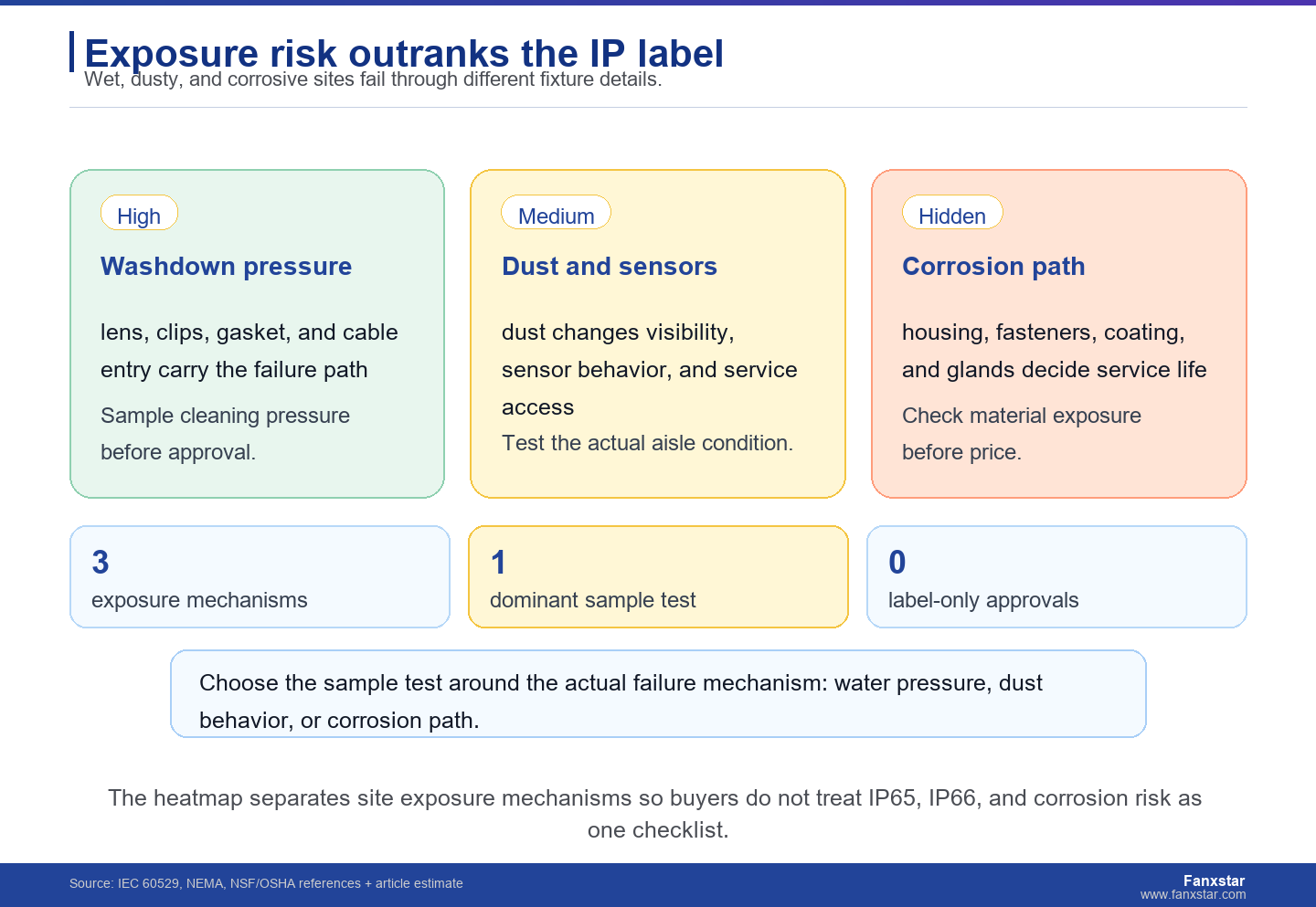
Wet-site buyers should separate rain, condensation, routine wipe-down, low-pressure cleaning, and process washdown. According to 9 CFR Part 416, sanitation in regulated food environments is a facility and operational responsibility. Lighting supports that responsibility only when the fixture does not create avoidable traps or service problems. Ask for gasket design, clip material, lens retention, cable gland, end-cap detail, and cleaning assumptions before approving a sample.
Dusty Sites Need Visibility, Sensor, And Access Logic
Specification note: For weatherproof LED lighting for wet, dusty, and corrosive environments, the point behind “Dusty Sites Need Visibility, Sensor, And Access Logic” should become a reviewable acceptance line. The RFQ should state the site condition, the product evidence, the sample observation, the approver, and the fallback if Fanxstar recommends a standard platform or ODM change. That keeps an IP rating can be mistaken for a complete durability decision even when corrosion, gasket compression, cleaning method, cable entry, and service access are the actual failure drivers from being hidden inside a general fixture preference.
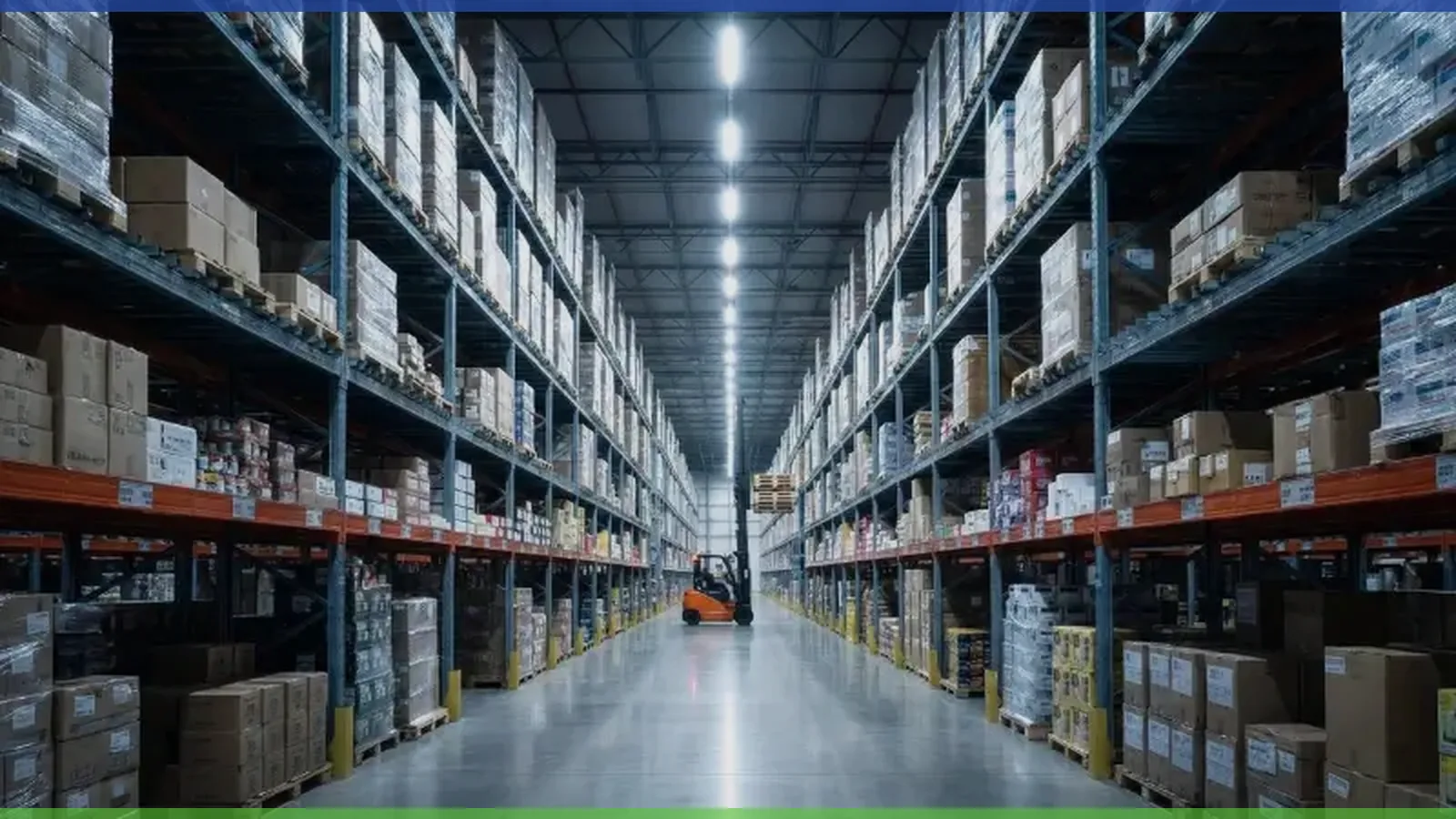
According to OSHA warehousing hazards and solutions, warehouse risk includes movement, storage, and traffic conditions. A dusty warehouse fixture is therefore not only an enclosure choice. The buyer should ask whether dust accumulation affects lens cleaning, sensor operation, heat dissipation, and service height. A weatherproof motion product such as A16S may be useful, but only if the detection zone and cleaning plan fit the actual aisle.
Corrosive Sites Need Material Proof
Specification note: For weatherproof LED lighting for wet, dusty, and corrosive environments, the point behind “Corrosive Sites Need Material Proof” should become a reviewable acceptance line. The RFQ should state the site condition, the product evidence, the sample observation, the approver, and the fallback if Fanxstar recommends a standard platform or ODM change. That keeps an IP rating can be mistaken for a complete durability decision even when corrosion, gasket compression, cleaning method, cable entry, and service access are the actual failure drivers from being hidden inside a general fixture preference.
Corrosion-sensitive environments require a materials conversation before a wattage conversation. Housing material, coating, screws, clips, brackets, cable gland, and lens chemistry can decide lifetime fit. NEMA enclosure references are useful because they remind buyers that environmental protection is broader than water entry. For Fanxstar, aluminum-backed and heavy-duty waterproof references such as A10 and A32 should be discussed with a clear exposure note rather than a vague rugged claim.
Application Matrix For Wet, Dusty, And Corrosive Sites
The fixture family changes when the exposure mechanism changes.
| Exposure Type | IP Label Is Not Enough Because | RFQ Evidence | Product Direction |
|---|---|---|---|
| Wet washdown | Water pressure, cable entry, lens retention, and cleaning chemistry vary by site | Cleaning method, ingress test scope, gasket and clip details | A14/A3-NA vapor-tight or A10 aluminum waterproof platform |
| Dusty warehouse | Dust plus traffic can affect visibility, service, and sensor behavior | Mounting height, dust type, sensor zone, service access | A16/A16S, A22, A32, or motion-sensor weatherproof products |
| Corrosive industrial area | Housing material and fastener choice can fail before LEDs do | Material, coating, fastener, cable gland, cleaning chemical notes | A10/A32 aluminum-backed references with corrosion discussion |
| Outdoor or semi-outdoor route | Rain, humidity, UV, vibration, and service height interact | Ingress, impact, bracket, surge, cable routing, replacement method | Weatherproof batten or aluminum platform by exposure |
The matrix keeps the buyer from asking for “the best IP65 light” without telling the supplier what the site does. If the room has daily washdown, choose a product conversation around gasket, lens, clip, cable, and cleaning assumptions. If the space has dust and sensor controls, discuss detection and cleaning access. If corrosion is the threat, start with housing material and fasteners. The right product family emerges from the exposure map.
Scenario Estimate: Access Detail Becomes Maintenance Time
Weatherproof design includes the minutes a technician spends touching the fixture.
The scenario uses 150 sealed luminaires. If unclear cable entry, slow latches, or awkward mounting add 4 extra minutes per fixture, one service or cleaning-related access cycle adds 600 minutes, or 10 hours. Two cycles per quarter create 20 extra hours under these assumptions. The point is not that every site will see that number. The point is that service access is a real procurement variable, not a cosmetic preference.
This calculation changes the RFQ. Ask where the cable enters, how the lens opens, how clips are retained, whether tools are needed, whether the driver is accessible, and whether a replacement can happen without disturbing the room. For a food plant, that reduces sanitation coordination. For a parking garage, it reduces lift time. For a warehouse, it reduces work near traffic. The best weatherproof fixture is often the one that makes future maintenance predictable.
RFQ Checklist For Weatherproof LED Lighting
A useful weatherproof RFQ names the exposure, the product detail, and the sample proof.
Ask for site type, indoor or outdoor boundary, water exposure, dust exposure, chemical or salt exposure, operating temperature, cleaning method, mounting height, bracket method, cable-entry direction, lens material, clip and fastener material, sensor requirement, emergency requirement, corrosion expectation, service access, certification or test report need, sample pass condition, and target quantity. Mark which fields are must-have and which fields can adapt from a platform.
Relevant Fanxstar starting points include Fanxstar IP65 and IP66 waterproof LED lights, Fanxstar vapor tight LED light fixtures, Fanxstar aluminum weatherproof LED luminaires, and Fanxstar custom LED lighting ODM service. When the exposure map is ready, buyers can contact Fanxstar for an ODM lighting quote with a sample task the supplier can actually test.
How To Turn The Site Requirement Into Supplier Evidence
Depth in weatherproof LED lighting for wet, dusty, and corrosive environments comes from proving the installation logic, not from adding more fixture descriptions. The buyer is working inside washdown rooms, parking structures, utility spaces, canopy edges, processing corridors, and dusty industrial aisles, where the wrong assumption can travel from the quotation into samples, drawings, purchasing, installation, and maintenance. An ip rating can be mistaken for a complete durability decision even when corrosion, gasket compression, cleaning method, cable entry, and service access are the actual failure drivers. A useful supplier brief makes that risk visible before the first price comparison.
Define the exposure mechanism first, then choose the housing, diffuser, seal, cable entry, mounting, and maintenance plan.
Start With The Condition That Can Falsify The Product Choice
The first review question is not whether IP65/IP66 weatherproof lights, vapor-tight fixtures, aluminum weatherproof luminaires, heavy-duty weatherproof lines, and emergency battens are available. It is which site condition would make a good-looking product unacceptable. That condition may be temperature, water path, cleaning chemistry, photoperiod, classified atmosphere, hygiene geometry, dimming behavior, route visibility, service access, or document traceability. If the condition is not written down, the RFQ invites every supplier to answer a different question.
A stronger brief writes one sentence for the failure mode and one sentence for the acceptance evidence. For example, the buyer should state what would count as a failed sample, what document would close the review, what operating condition must be shown on the datasheet, and which decision must be escalated to the engineer, quality team, farm operator, food-safety team, or authority having jurisdiction. This does not slow procurement; it removes the back-and-forth that happens when price is compared before the product has earned the right to be compared.
Translate Product Features Into Reviewable Gates
Feature lists are easy to misread because the same word can mean different things in different rooms. “Sealed” may mean splash resistance in one project, cleanability in another, and dust control in a third. “Emergency” may mean route recognition, backup duration, battery service access, or local testing responsibility. “Custom” may mean a harmless cable length change or a new optical, thermal, or certification burden. The procurement file should translate each feature into an acceptance gate.
The useful gates are practical: what condition is being controlled, what product evidence supports it, what sample behavior must be observed, what document must be archived, and what decision remains outside the supplier’s authority. Fanxstar can support IP65/IP66 weatherproof lights, vapor-tight fixtures, aluminum weatherproof luminaires, heavy-duty weatherproof lines, and emergency battens, but the buyer should still ask for one water/dust/corrosion exposure note, one gasket and cable-entry check, one cleaning-method review, one mounting mockup, and one replacement-access test. When those gates are separate, the supplier can give a clean yes, no, or “needs review” answer instead of burying uncertainty inside a quotation note.
Use A Scenario Estimate To Expose Hidden Coordination Cost
If 100 fixtures need eight extra minutes each during maintenance because clips, cable entry, or mounting access were not checked in the sample stage, the site absorbs 800 minutes, or 13.3 hours, of avoidable touch time. The number is an illustrative planning estimate, not a claim from a specific Fanxstar project. Based on our analysis of this scenario, its value is that it makes the hidden cost visible. Calculated from the scenario estimate, every repeated review minute becomes a real schedule burden once it is multiplied by fixture count. Data from the acceptance-gate table should therefore be reviewed before final supplier comparison. Research from the source matrix should stay attached to the RFQ so a low fixture price does not hide extra drawings, late certificate review, repeated sample changes, or a maintenance plan that should have been checked before ordering.
The buyer can reduce that cost by creating a small evidence table before supplier comparison. One column names the zone or use case. One column names the risk being controlled. One column names the required document or sample observation. One column names the person who can approve it. One column records whether the product is standard, ODM-modified, or not suitable. This table also helps Fanxstar keep ODM work disciplined: customization should solve the written constraint, not expand because the original requirement was vague.
Keep ODM Changes Inside A Controlled Path
ODM flexibility is valuable only when the change is tied to a measurable reason. A housing change should answer a material, sealing, cleaning, corrosion, or mounting problem. An optical change should answer a task-plane, biological, glare, aisle, or uniformity problem. A control change should answer dimming, sensor, emergency, photoperiod, or automation behavior. A document change should answer certification, quality, audit, or facility approval needs. Without that link, customization becomes a risk multiplier.
The safer path is to approve changes in layers. First select the closest standard platform. Then mark the exact gap that prevents acceptance. Then request one controlled adjustment. Then test the sample against the original gate. If the sample fails, record whether the failure came from the product, the site assumption, the installation detail, or the document pack. That record is what turns a specialty lighting project from trial-and-error into repeatable procurement.
Evidence Notes To Keep With The RFQ
The following evidence notes should stay with the RFQ rather than being scattered across emails. They give the buyer a compact way to connect third-party or official references with the local decision, while keeping the supplier claim inside its proper boundary.
- Regulatory or standards boundary: According to IEC 60529 degrees of protection provided by enclosures, IP ratings describe enclosure protection boundaries, not complete project suitability. Use this source when the RFQ turns weatherproof LED lighting for wet, dusty, and corrosive environments into a product claim.
- Safety or operating requirement: According to NEMA enclosure standards reference, Enclosure selection should consider water, dust, corrosion, and installation conditions. Use this source when the RFQ turns weatherproof LED lighting for wet, dusty, and corrosive environments into a product claim.
- Design evidence: According to NSF food equipment standards portfolio, Cleanable and hygienic environments require attention beyond an IP label. Use this source when the RFQ turns weatherproof LED lighting for wet, dusty, and corrosive environments into a product claim.
- Maintenance evidence: According to 9 CFR Part 416 Sanitation, Food processing environments make cleanable facility conditions part of the procurement boundary. Use this source when the RFQ turns weatherproof LED lighting for wet, dusty, and corrosive environments into a product claim.
- Procurement evidence: According to OSHA warehousing hazards and solutions, Dusty logistics spaces require lighting decisions tied to traffic, storage, and worker visibility. Use this source when the RFQ turns weatherproof LED lighting for wet, dusty, and corrosive environments into a product claim.
- Audit trail: According to FEMP energy-efficient lighting, Lighting upgrades should consider energy, maintenance, controls, and performance together. Use this source when the RFQ turns weatherproof LED lighting for wet, dusty, and corrosive environments into a product claim.
The final commercial comparison should happen only after those notes are complete enough for review. Fanxstar can recommend product platforms and ODM adjustments, while the buyer owns the exposure map, cleaning chemistry, corrosion assumptions, and local installation method. That boundary is not a disclaimer at the end of the process; it is a buying rule at the beginning.
Related Fanxstar Guides
- Cold Storage and Food Processing LED Lighting Guide
- Commercial Infrastructure LED Lighting Guide
- Specialty LED Lighting ODM Buyer Guide
Weatherproof Sample Action Card
- Classify the exposure mechanism.
- Request body, gasket, lens, and cable details.
- Add cleaning or dust assumptions.
- Check service access before price comparison.
- Test one failure mode per sample.
Frequently Asked Questions
Is IP65 enough for wet industrial lighting?
IP65 can be a useful starting point, but it does not define cleaning pressure, chemicals, cable entry, lens retention, impact, corrosion, or service access. The RFQ should name the actual exposure.
What is the difference between weatherproof, vapor-tight, and tri-proof?
Weatherproof is the broad application term, vapor-tight usually emphasizes sealed damp or wet fixtures, and tri-proof is often used for water, dust, and corrosion resistance. Buyers should still verify the exact test scope and environment fit.
Which Fanxstar products should buyers compare first?
A10, A14, A16, A22, A32, and A3-NA are useful starting references. The final choice depends on water exposure, dust, corrosion, mounting, sensor needs, and service access.