Dairy farm lighting is one of those areas where getting the specification wrong has direct, measurable consequences — not just on operating costs, but on milk yield, herd health, and worker safety. A milking parlor isn’t a warehouse or a processing plant. It combines the most demanding washdown environment in agricultural operations with biologically sensitive lighting requirements that influence cow hormones, milk production rates, and stress behavior. Standard industrial fixtures fail here quickly and expensively. And fixtures that survive the environment but deliver the wrong spectrum or the wrong lux level at the wrong time of day undermine the photobiological program the herd manager has designed.
This guide covers the specific requirements of milking parlor lighting — from the photobiology of bovine vision and long-day lighting protocols, through the fixture specifications that make the difference between a six-month replacement cycle and a seven-year installation.
Key Takeaways
- Lactating cows require 150–200 lux for 16–18 hours per day to maximize milk yield through hormonal stimulation; milking points specifically require 300–500 lux for worker safety and accurate udder inspection.
- Cows have dichromatic vision peaking in the blue (451 nm) and green (555 nm) range — daylight CCT of 4000–5500K is optimal; blue-rich light at night suppresses melatonin and disrupts circadian rhythms.
- Milking parlors require at minimum IP66 protection, with IP69K the correct specification for high-pressure washdown zones (up to 1,450 psi, 80°C water temperature). IK10 impact resistance is non-negotiable in any parlor with equipment traffic or livestock contact.
Why Milking Parlor Lighting Requires a Specialized Approach
The Photobiology Behind Long-Day Lighting Protocols
The connection between light exposure and dairy cow productivity is not theoretical — it’s a well-documented endocrinological mechanism. Light reaching the cow’s retina suppresses melatonin production during the light phase and stimulates the release of insulin-like growth factor-1 (IGF-1) and prolactin, both of which directly influence milk production and feed intake. Research indicates that maintaining ≥150 lux for 16–18 hours daily can boost milk yield by approximately 7–8%, with measurable results typically appearing after 2–3 weeks on the new lighting schedule.
The corollary is equally important: the dark period (6–8 hours of <10 lux) is as critical as the light period. Long-day lighting protocols require a sustained, uninterrupted darkness period — which means parlor operations during that window should use minimal-intensity red lighting (which doesn’t activate bovine photoreceptors) rather than switching full-spectrum fixtures on for late-night milking shifts.
Dry cows have a different requirement: they benefit from a short-day protocol (8–10 hours of light followed by 14–16 hours of darkness) in the period before calving. This short-day exposure results in greater responsiveness to long-day lighting post-calving, translating to higher early-lactation milk yield. Any lighting system installed in a multi-purpose barn housing both lactating and dry cows must address the conflicting photoperiod requirements of different herd groups — typically through zone-separated lighting controls.
Bovine Vision and Spectrum Selection
Dairy cows are dichromats — they have two types of color receptors, with peak sensitivity in the blue range (around 451 nm) and the green range (around 555 nm). Their visible spectrum extends from approximately 400 nm to 680 nm — meaning they cannot perceive red light effectively, which is why low-level red LEDs are used as a “night light” that allows worker access during the dark phase without triggering melatonin suppression in the herd.
For the light phase, 4000–5500K CCT LEDs provide the blue-green dominant spectrum that activates bovine photoreceptors most effectively. Very high CCT (above 6500K, bluish-white) increases blue light content further but carries risk of increased cortisol (stress hormone) in some herd conditions. Avoid warm-white (2700–3000K) LED fixtures in primary dairy spaces — the red-shifted spectrum is poorly perceived by cows and fails to deliver the photostimulation benefit even at adequate lux levels.
Lux Level Requirements by Barn Zone
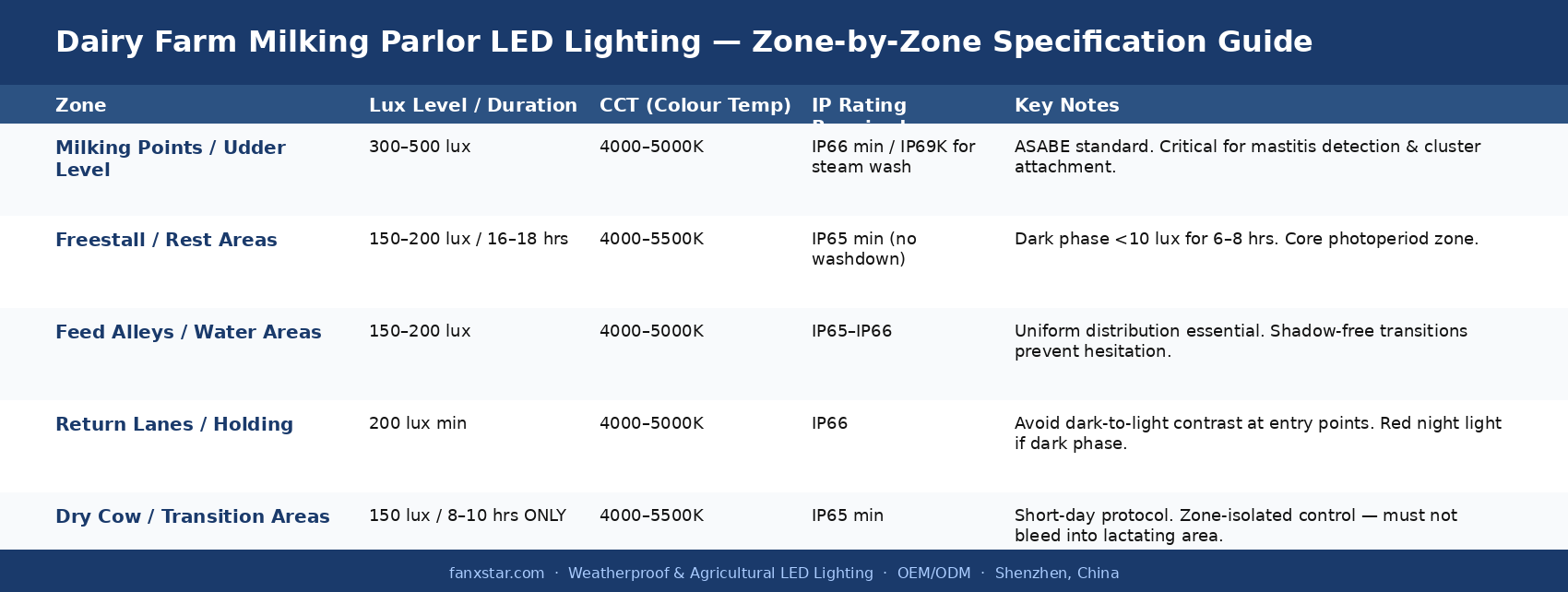
| Zone | Required Lux (Light Phase) | Dark Phase Target | Notes |
|---|---|---|---|
| Milking points / udder level | 300–500 lux | Red light only <5 lux white | ASABE standard; required for mastitis detection and cluster attachment |
| Freestall / rest areas | 150–200 lux | <10 lux | Sufficient for photoperiod stimulation; avoid exceeding 200 lux to prevent over-stimulation in resting animals |
| Feed alleys / water areas | 150–200 lux | <50 lux acceptable | Ensures cow movement without shadow-induced hesitation; uniform distribution required |
| Return lanes / holding areas | 200 lux minimum | Red light if dark phase active | Avoid shadow gradients at transitions; cows stop at dark-to-light boundaries |
| Dry cow / transition areas | 150 lux / 8–10 hrs only | <10 lux / 14–16 hrs | Short-day protocol; requires zone-isolated control to avoid conflicting with lactating cow schedule |
Fixture Requirements: Why Standard Industrial LEDs Fail in Dairy Environments
The Washdown Reality: IP65 Is Not Enough
This is the single most consequential specification error in dairy farm lighting purchases. IP65 rating — dust-tight and resistant to low-pressure water jets — is a standard weatherproof specification for warehouses, parking structures, and outdoor commercial environments. It is not sufficient for milking parlor sanitation protocols.
Milking parlors in EU, UK, and Australian operations are subjected to daily high-pressure washdowns using water temperatures up to 60–80°C and chemical sanitizers at concentrations that degrade standard polycarbonate housings. Most “waterproof” or generic IP65 LEDs are not designed for the 1,000+ psi pressure washers used in dairy sanitation — fixtures crack at seal points, moisture infiltrates drivers, and short circuits follow within 3–6 months of installation.
The correct minimum specification for milking parlor fixtures is IP66 (protection against powerful water jets from any direction) for areas with standard pressure washing. For rotary parlors and flush-down areas where high-pressure, high-temperature steam cleaning is used, IP69K is the required rating — certifying the fixture against water temperatures up to 80°C at close range and up to 1,450 psi pressure. IP69K is a significantly more demanding test than IP67 (temporary submersion); they measure different failure modes and an IP67 rating does not imply IP69K compliance.
Material Selection for Ammonia Resistance
Beyond the IP rating, the material composition of the fixture housing determines whether it survives the chemical environment of an active dairy. Milking parlors maintain ammonia concentrations from animal respiration and organic decomposition that, over months of exposure, cause stress cracking and yellowing in standard polycarbonate (PC) diffusers.
PMMA (acrylic) is chemically inert to ammonia and maintains approximately 92% light transmission over a decade of service, while standard PC diffusers can lose significant output within two years from ammonia-induced lens degradation. For fixture bodies, AL6063 aluminum alloy provides both structural integrity and thermal conductivity for heat dissipation. Mounting hardware must be 304 or 316 grade stainless steel — standard zinc-plated or galvanized hardware corrodes within one season of ammonia and sanitizer exposure, creating mechanical failure and contamination risk.
Impact Resistance: IK10 in Livestock Environments
Livestock contact, equipment movement in active parlors, and accidental impact from milking machinery are everyday events in an operational dairy. IK10 impact resistance — certifying the housing can withstand a 20-joule impact without compromising seal integrity — is the minimum requirement. A cracked fixture in a food-production environment is a contamination risk and an electrical safety hazard simultaneously; the consequences of a single fixture failure in a certified dairy operation extend beyond the replacement cost of the fixture itself.
Flicker-Free Operation and Light Uniformity
Why Flicker Matters for Milk Letdown
Dairy cows are sensitive to flicker, particularly at frequencies below the human flicker fusion threshold. A flicker index above 3% can induce subtle stress responses in the herd that manifest as reduced willingness to enter the parlor, slower milk letdown, and higher cortisol levels — all reducing milking efficiency. Industry standards for milking parlor lighting specify uniformity ≥0.8 and flicker index ≤3%, and these figures should be verified against driver specifications, not assumed from the LED module rating alone.
Flicker in LED fixtures originates from the driver, not the LED chips. Drivers operating with high current ripple on the output — particularly low-cost designs that reduce output capacitance to minimize cost — produce flicker even from high-quality LEDs. Specify drivers with PWM dimming frequencies above 1kHz, or amplitude-dimming designs that eliminate flicker entirely.
Shadow Elimination in Parlor Design
Dairy cows have limited depth perception and are sensitive to sharp light-to-dark transitions. A cow approaching a shadow boundary on the parlor floor will frequently stop, hesitate, or refuse to proceed — a behavior that disrupts parlor throughput and increases handler stress on the animal. Providing optimal light distribution — with no dark spots throughout the parlor — is essential to prevent startle responses and maintain smooth cow flow.
The lighting layout must achieve uniformity ratios meeting ASABE EP344.3 standards, which specify a maximum uniformity ratio of 1.5:1 to 2:1 across visually intensive areas like milking stalls. Linear fixtures with wide-beam diffusers placed at appropriate spacing deliver better uniformity than point-source high bays in low-ceiling parlor configurations. Suspended mounting below structural members, trusses, and equipment prevents the trusses from creating shadow patterns at floor level.
Applying Fanxstar Weatherproof Technology to Agricultural Environments
The same engineering disciplines that Fanxstar applies to cold chain logistics, food processing plants, and industrial wash-down facilities translate directly to dairy farm milking parlor requirements. IP66-rated weatherproof LED fixtures with PMMA diffusers, 316-grade stainless steel hardware, and IK10-rated housings address the environmental specification. Flicker-free drivers with appropriate dimming capability support both the biological lighting protocol (full output during the 16-18 hour light phase, controlled reduction for dark-phase transitions) and the energy management objectives of the operation.
For operations with rotary parlors, extended wash-down zones, or high-temperature steam sanitization protocols, we can configure IP69K-rated custom solutions with ammonia-resistant coatings through our OEM/ODM customization program. Standard IP65/IP66 weatherproof configurations are available from our weatherproof LED product range for freestall barn and feed alley applications where daily high-pressure washdown is not used.
If your dairy operation also requires emergency egress lighting in the parlor or holding areas — a requirement under most EU and UK agricultural building codes for commercial operations — our emergency lighting range includes maintained and non-maintained options for agricultural facility compliance.
Frequently Asked Questions
What is the optimal CCT for dairy cow milking parlor LED lights?
The optimal CCT range for the light phase in dairy operations is 4000–5500K, aligning with the cool white / daylight spectrum. This range emphasizes the blue-green wavelengths that bovine photoreceptors are most sensitive to (peaks at 451 nm blue and 555 nm green), maximizing the photostimulation effect on melatonin suppression and IGF-1 production. Avoid warm white (2700–3000K) for primary dairy spaces — the red-shifted spectrum is poorly perceived by cows. For the dark phase, red LEDs in the 620–680 nm range (which fall outside the bovine visible spectrum) allow worker visibility without disrupting melatonin production in the herd.
How long do LED fixtures last in a milking parlor washdown environment?
Service life in milking parlors depends almost entirely on whether the correct IP rating has been specified. Fixtures rated IP65 typically fail within 3–12 months in daily washdown environments. IP66-rated fixtures with appropriate chemical-resistant housings (PMMA or coated aluminum, stainless steel hardware) and proper factory sealing should achieve 5–7 years of service life in standard parlor washdown conditions. For high-pressure steam cleaning environments (IP69K required), properly specified fixtures should achieve comparable service life when cleaned according to manufacturer instructions — typically ≥50,000 hours LED module life.
Does the long-day lighting protocol work for all cows in a mixed barn?
Not without zone separation. Lactating cows benefit from 16–18 hours of light at ≥150 lux, while dry cows require a short-day protocol of 8–10 hours of light followed by 14–16 hours of darkness to maximize early-lactation yield after calving. In a barn housing both groups, this requires independently controlled lighting zones for each cow group. Failure to provide the correct photoperiod for dry cows — particularly exposing them to long-day lighting — can reduce the hormonal sensitivity response that drives higher milk yield post-calving.
What CRI is required for milking parlor lighting?
A minimum CRI of 80 is generally specified for milking parlor environments where workers need to perform health inspections and detect abnormalities in udder health, milk color, and hygiene conditions. For operations with intensive health monitoring requirements or compliance with specific veterinary inspection standards, CRI 90+ is preferred — higher CRI values at 4000–5000K provide more accurate color discrimination for detecting the early signs of mastitis (redness, swelling, discharge changes) and other udder conditions that present as color or texture changes.
Specifying LED lighting for a dairy facility, milking parlor, or agricultural processing environment? The combination of IP rating, material selection, spectrum, and flicker specification is the difference between a seven-year installation and a six-month replacement cycle.
Fanxstar’s engineering team specializes in application-specific LED solutions for demanding environments. Tell us about your facility and get a free technical specification review.