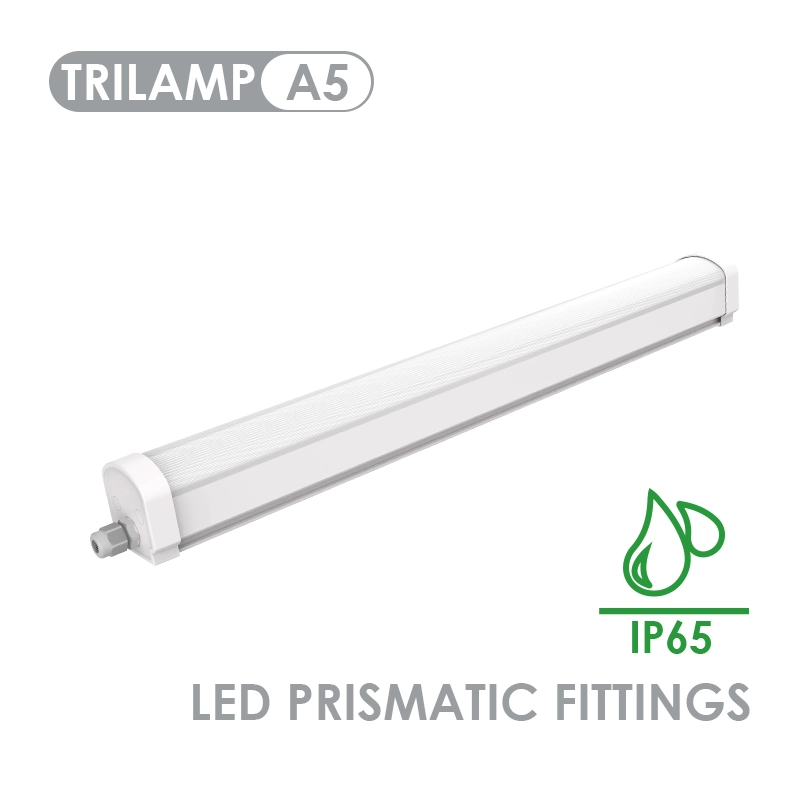
In the world of industrial procurement, the allure of the “budget” option is powerful. When faced with the task of outfitting a 50,000-square-foot warehouse or a multi-level parking structure with LED tri-proof lights, a 40% difference in upfront price can represent thousands of dollars in initial savings. However, for facility managers and business owners, this initial price tag is a deceptive metric.
The true cost of a lighting system is not what you pay to acquire it, but what you pay to keep it running over its operational life. Cheap LED tri-proof lights often create a “maintenance debt” that comes due within the first 24 months. By analyzing the Total Cost of Ownership (TCO), we discover that budget fixtures can cost nearly double that of premium solutions over a five-year horizon. This is driven by aggressive lumen depreciation, higher failure rates, and staggering “electricity taxes” caused by poor luminous efficacy.
5-Year Total Cost of Ownership (TCO) Comparison
|
Expense Category |
Budget Lighting Path |
Fanxstar Premium Path |
|---|---|---|
|
Initial Fixture Investment |
$4,000 |
$8,500 |
|
Electricity Consumption (5-Year Total) |
$12,000 |
$4,200 |
|
Maintenance Labor & Lift Rentals |
$5,500 |
$0 (Within Warranty) |
|
Regulatory Compliance & Safety Audits |
$2,000 |
$400 |
|
Total Project Expense |
$23,500 |
$13,100 |
Note: Data based on an average industrial installation running 12 hours/day at $0.12/kWh.
Key Takeaways
-
Beyond the Price Tag: Initial savings on budget tri-proof lights are usually erased within 18-24 months by higher energy and maintenance costs.
-
Efficacy is Money: High-efficiency LEDs (>160 lm/W) drastically reduce the long-term “electricity tax” compared to budget alternatives.
-
Component Integrity: Driver quality is the primary predictor of lifespan; uncertified drivers are the leading cause of early system failure.
-
Smart Controls: Integration of motion sensors and DALI dimming can extend fixture life by 30% and slash energy bills by an additional 50-70%.
-
Durability Ratings: IP66 and IK10 ratings are non-negotiable for harsh environments to avoid premature housing degradation.
The Deep Dive: Hidden Expenses of Low-Cost Lighting
1. The “Electricity Tax” of Low Efficacy
Luminous efficacy—measured in lumens per watt (lm/W)—is the most critical factor in industrial lighting ROI. Cheap tri-proof lights typically utilize older LED chips and inefficient drivers, resulting in efficacy ratings between 100 and 120 lm/W. In contrast, premium fixtures like those from Fanxstar often exceed 160 lm/W.
To achieve the required foot-candles for safety in a factory, a low-efficacy fixture must draw more wattage. This extra power consumption acts as a monthly “tax” on your utility bill. Over thousands of fixtures, this discrepancy accounts for the single largest cost difference in the TCO model.
2. The Logistics of Failure
When a $40 fixture fails in a warehouse with 30-foot ceilings, the cost of the replacement light is the smallest part of the bill. You must account for:
-
Scissor Lift Rental: Often costing $200-$500 per day.
-
Labor Costs: Licensed electricians for after-hours work.
-
Operational Downtime: The cost of stopping a production line or blocking a parking aisle.
Budget lights typically have a 3-5% annual failure rate, whereas premium fixtures target less than 0.1% within the warranty period. The labor to replace a cheap light can be 5 times the cost of the light itself.
The Anatomy of Quality: Component-Level Engineering
Driver Reliability and Global Certification
The driver is the “brain” of the tri-proof light. It converts high-voltage AC to low-voltage DC. Low-quality drivers use substandard electrolytic capacitors that dry out under heat, leading to flicker, stroboscopic effects, and total failure. Premium drivers are engineered for thermal resilience and electromagnetic compatibility (EMC).
Certification is the only way to verify these claims. We recommend only installing fixtures that carry recognized safety marks:
|
Certification |
What It Guarantees |
|---|---|
|
CE & ENEC |
Complies with European safety, health, and environmental standards. |
|
LVD (Low Voltage Directive) |
Ensures electrical safety during operation and prevents shock hazards. |
|
EMC (Electro Magnetic Compatibility) |
Prevents the light from interfering with Wi-Fi, sensors, or heavy machinery. |
Thermal Management: The Silent Life-Killer
LEDs do not “burn out” like incandescent bulbs; they slowly dim. This process, called lumen depreciation, is accelerated by heat. Cheap tri-proof lights often use plastic housings with poor heat dissipation. Premium models utilize aluminum-core PCBs and advanced heat sinks to draw thermal energy away from the LED chips.
Maintaining a junction temperature below 65°C can extend an LED’s life to 50,000 or even 100,000 hours (L70). A poorly cooled budget light may lose 30% of its brightness within just 12,000 hours, necessitating a full facility relamping years before expected.
Energy Savings Through Smart Integration
A significant portion of the cost of “cheap” lights is the missed opportunity for automation. Modern industrial environments are rarely occupied 24/7 at 100% capacity. Premium motion sensor lighting systems allow for adaptive illumination.
-
Microwave Sensors: These can detect motion through thin walls and obstacles, making them perfect for complex warehouse layouts.
-
Daylight Harvesting: Fixtures near windows or skylights dim automatically when natural light is sufficient, saving up to 40% on daytime energy use.
-
DALI 2.0 Control: Allows for centralized management of lighting zones, making it easy to schedule dimming during off-peak hours.
By choosing fixtures compatible with these technologies, the ROI period can be shortened by 12-18 months.
Environmental Protection: Understanding IP and IK Ratings
Tri-proof lights are named for their resistance to Water, Dust, and Corrosion. However, not all “protections” are equal. Budget fixtures often use low-grade gaskets that become brittle over time, allowing moisture to seep in and cause short circuits.
-
IP66/IP69K: This is the standard for high-pressure washdowns and dusty environments. A premium seal ensures that even after five years of cleaning, the internals remains bone-dry.
-
IK10 Impact Resistance: In parking garages or gymnasiums, fixtures are subject to physical impacts. An IK10 rating means the housing can withstand a 20-joule impact (roughly equivalent to a 5kg weight dropped from 40cm).
Tri-proof vs. LED Street Lights: Choosing the Right Tool
A common mistake in industrial outdoor/semi-outdoor projects is substituting tri-proof lights for street lights or vice versa to save costs. While both are durable, their optical distributions are vastly different.
Street lights are designed for “long and narrow” light patterns (Type II or III optics) to cover roadways. Tri-proof lights provide a wide, uniform beam (120 degrees) to illuminate vertical surfaces like warehouse shelving or garage walls. Using the wrong fixture leads to “hot spots” and dark zones, increasing the number of fixtures required and driving up both energy and installation costs.
Summary: Making a Future-Proof Investment
The data is clear: cheap LED tri-proof lights are a high-interest loan taken out against your future maintenance budget. By investing in quality from the start, you secure lower energy bills, eliminate the logistical nightmare of frequent repairs, and ensure a safer, more productive environment.
When evaluating your next lighting project, ask for the LM-80 reports (chip longevity), the ISTMT (thermal testing), and the TM-21 (projected life). A manufacturer like Fanxstar that provides this transparency is a partner in your long-term financial success.
Frequently Asked Questions (FAQ)
1. What exactly does the “Tri” in Tri-proof stand for?
Conventionally, “tri-proof” refers to a fixture being Waterproof, Dustproof, and Anti-corrosive. Some modern manufacturers also include Impact-resistance (IK rating) as part of this protective trifecta. They are specifically designed for environments where standard LED battens would fail due to moisture or airborne particulates.
2. How can I tell if a light is “cheap” just by looking at the spec sheet?
Look at the Luminous Efficacy. If it is below 130 lm/W, the manufacturer is likely using older, cheaper LED chips. Also, check the warranty; any manufacturer offering less than 5 years for an industrial product likely does not trust their own thermal management or driver quality.
3. Why is “Flicker-Free” important in industrial tri-proof lights?
Cheap drivers often produce a 100Hz/120Hz flicker that is invisible to the eye but causes headaches, eye strain, and can even cause dangerous “stroboscopic effects” where rotating machinery appears to be standing still or moving slowly. Premium drivers ensure a “Flicker-Free” output for worker safety.
4. Is it worth upgrading to IP69K?
IP69K is only necessary if you are in the food and beverage industry where equipment is subjected to high-pressure, high-temperature steam cleaning. For standard parking garages and warehouses, IP65 or IP66 is perfectly sufficient and more cost-effective.
5. Can I replace the components in a premium tri-proof light?
Yes. One of the hallmarks of a premium fixture is modularity. High-quality lights often allow for the driver to be replaced without discarding the entire housing and LED board, further reducing the lifetime environmental impact and cost.