

Three cities. Three completely different manufacturing ecosystems. And yet, every week, B2B buyers searching for LED lighting suppliers in China find themselves choosing between them — often without a clear framework for doing so. Shenzhen, Ningbo, and Xiamen each have genuine strengths and real limitations. Picking the wrong hub for your product type, certification requirements, or logistics profile can add months to your timeline, inflate your per-unit cost, or leave you with a supplier who can’t support your market’s compliance needs.
This guide breaks down the structural differences between these three sourcing hubs — not by listing suppliers, but by analyzing what each city’s manufacturing ecosystem is actually optimized to deliver, and mapping that to the decisions that matter for weatherproof, emergency, and specialty LED buyers.
Key Takeaways
- Shenzhen is the right hub for electronics-intensive, custom-engineered, or OEM/ODM LED projects where access to a dense component supply chain, rapid prototyping, and deep electronics integration (DALI 2.0, smart controls, emergency circuits) is the priority.
- Ningbo excels for export-volume, logistics-efficient sourcing where port access, hardware component integration, and supply chain cost are the dominant factors — particularly for buyers shipping large quantities to Europe or North America via ocean freight.
- Xiamen is a viable secondary hub for outdoor, waterproof, and smart LED applications with a smaller but quality-oriented supplier base, strong state-enterprise quality culture, and direct shipping access to Southeast Asia and Australia.
- Shenzhen + surrounding Guangdong province (including Fanxstar’s production in Dongguan/Huizhou) represents the most complete ecosystem for specialized weatherproof and emergency LED manufacturing with full OEM/ODM capability.
Why Hub Selection Matters More Than Supplier Selection
Most sourcing guides focus on evaluating individual suppliers — their certifications, factory size, and sample quality. But before you evaluate any single factory, the city it operates in shapes what that factory can efficiently do. Manufacturing ecosystems are not portable: a factory in Shenzhen can turn a new PCB design into a functional prototype in three to five working days because it sits within a 30-minute drive of every electronic component it needs. That same factory relocated to a city without that component density would lose that capability entirely.
Hub selection, then, is really a decision about which industrial ecosystem best fits your product’s bill of materials, your regulatory requirements, and your logistics chain. For LED lighting buyers, three cities dominate this conversation: Shenzhen (and surrounding Guangdong), Ningbo (Zhejiang Province), and Xiamen (Fujian Province).
What Makes an LED Sourcing Hub?
A true manufacturing hub offers more than individual factories — it provides the surrounding ecosystem those factories depend on. For LED lighting, the relevant ecosystem elements are: LED chip sourcing (Epistar, Lumileds, Bridgelux authorized distributors), driver electronics (capacitors, MOSFETs, control ICs), optical components (polycarbonate lens blanks, aluminum extrusion houses), metal fabrication (die casting, sheet metal), and certification testing labs (UL, CE, ENEC, SAA). The city where all of these coexist within short transport distance is the city where your supplier can do things quickly and competitively.
Shenzhen and Guangdong: The Electronics-First Ecosystem
Shenzhen’s dominance in electronics manufacturing is a matter of industrial record. The city and its surrounding Pearl River Delta region hosts one of the most integrated hardware production ecosystems ever assembled — with component suppliers, PCB fabricators, injection molders, and assembly houses operating within a region where, as researchers from RIETI have documented, most component suppliers are located within a one-hour drive of any given manufacturer.
For LED lighting specifically, this density translates to tangible sourcing advantages:
Electronics Integration Depth
Smart LED drivers, DALI 2.0 dimming modules, emergency battery management systems (BMS), Zigbee-enabled lighting control, and 2.4GHz RF wireless circuits — these are all electronics-intensive subsystems. Building them requires access to a real-time component supply chain, specialist PCB designers, and electronics engineers who work iteratively. Shenzhen has all of this. The Huaqiangbei electronics market alone — a complex spanning over 20 shopping buildings — provides immediate access to components that might take weeks to source elsewhere. For an OEM/ODM manufacturer like Fanxstar, having Dongguan and Huizhou production facilities within the same Guangdong ecosystem means that the same component supply chain that powers Shenzhen’s prototype shops is equally accessible for production-scale manufacturing.
Rapid Prototyping
When Fanxstar quotes prototype delivery in three to five working days for custom LED projects, that timeline is only achievable because of Guangdong’s supply chain density. In a city where injection molding shops, aluminum extrusion houses, PCB fabricators, and LED assembly specialists are clustered within short logistics reach, a new product concept can move from design file to physical sample inside a working week. Buyers evaluating OEM/ODM proposals should always ask their potential supplier where their sub-component suppliers are located — because the honest answer tells you what their actual prototype lead time will be, not what their sales presentation says.
Certification Lab Access
Shenzhen and Guangdong host testing and certification laboratories from all major international bodies — TÜV, SGS, Bureau Veritas, Intertek, and others all operate testing facilities in the region. For LED products targeting EU (CE/ENEC), North America (UL/ETL), or Australia (SAA) markets, proximity to accredited labs shortens the certification timeline significantly, because product iterations — which always happen during certification — don’t require shipping samples across the country between tests.
Limitations of the Shenzhen Ecosystem
Shenzhen’s cost base is higher than secondary manufacturing cities. Labor costs, industrial land prices, and overheads in Shenzhen proper have risen substantially over the past decade. Many manufacturers have responded by maintaining R&D and sales functions in Shenzhen while relocating production to nearby Dongguan, Huizhou, or other Pearl River Delta cities — preserving ecosystem access while reducing operational costs. For a buyer, this means the Guangdong ecosystem as a whole is more relevant than Shenzhen city limits alone.
Ningbo and Zhejiang: The Port-Optimized Ecosystem
Ningbo’s manufacturing identity is shaped by one overwhelming fact: it sits adjacent to the world’s largest port by cargo tonnage. The Port of Ningbo-Zhoushan has maintained the top position in global cargo throughput for 15 consecutive years (per Ningbo municipal government data), handling 33.35 million TEUs of container traffic in 2022 alone — the third largest container volume globally, behind only Shanghai and Singapore.
For buyers whose primary consideration is getting large volumes of finished product to European or North American markets efficiently and economically, Ningbo’s port access is a structural advantage that no other manufacturing hub can replicate.
Export Infrastructure Efficiency
Factories located near Ningbo port benefit from shorter inland transport legs, faster customs clearance (attributable to an experienced, export-oriented logistics infrastructure), and direct ocean freight connectivity to over 600 ports in more than 100 countries. For high-volume orders — full container loads of standard weatherproof fixtures, linear battens, or motion sensor lights — this can reduce total landed cost meaningfully compared to equivalent products shipped from Guangdong.
Hardware and Mechanical Component Clusters
Zhejiang Province, of which Ningbo is the main export city, has particularly strong manufacturing clusters in hardware, electrical appliances, plastics, and precision components. Cixi county within Ningbo is known as a major electric appliances manufacturing hub, with around 10,000 appliance-related factories. For LED products with a heavier mechanical bill of materials — housings, mounting hardware, terminal blocks, aluminum profiles — Ningbo’s supply chain can be competitive. Ningbo also holds a distinction few Chinese cities can match: it has the largest number of national single-product champion enterprises in manufacturing among all Chinese cities, reflecting deep specialization in specific product categories.
Limitations of the Ningbo Ecosystem
Ningbo’s electronics integration depth is shallower than Shenzhen’s. For LED products requiring sophisticated driver electronics, smart control integration, or custom battery management systems, the supply chain support is less immediate. Ningbo manufacturers often source electronics sub-components from Guangdong, introducing a supply chain dependency that can extend lead times for electronics-intensive products. For standard, stable products — commercial battens, basic weatherproof fixtures, standard motion sensor lights — this limitation matters less. For DALI 2.0-controlled systems, emergency lighting with LiFePO4 BMS, or custom smart lighting, it matters more.
Xiamen and Fujian: The Outdoor and Export-Quality Ecosystem
Xiamen is a smaller and more specialized manufacturing hub. Several of China’s established LED manufacturers have Xiamen roots — Leedarson (Zigbee and smart lighting, founded 2000), Yankon (LED tubes and bulbs), and Xiamen Topstar (state enterprise, 500,000 m² facility, 25 million lamps/month capacity). The city’s manufacturing culture carries a quality orientation shaped partly by its state enterprise history and partly by its strong export focus to Southeast Asia, Australia, and Japan.
Outdoor and Waterproof Applications
Fujian province, per industry sourcing analyses, has developed particular competence in outdoor and waterproof LED applications — including streetlights and garden lighting. This specialization makes Xiamen a reasonable sourcing hub for IP65/IP66 outdoor fixtures destined for Southeast Asian or Australian markets, where direct shipping routes from Xiamen are efficient.
Smart Lighting and IoT Integration
Leedarson, headquartered in Xiamen, has built a significant global position in Zigbee and Wi-Fi integrated LED lighting — reflecting that Xiamen has developed competence in smart lighting adjacent to its outdoor/commercial base. For buyers specifically seeking smart LED products for residential or commercial IoT applications, Xiamen suppliers are worth evaluating.
Limitations of the Xiamen Ecosystem
Xiamen’s supplier pool is substantially smaller than either Shenzhen/Guangdong or Ningbo/Zhejiang. The depth of OEM/ODM customization capability — particularly for specialized industrial applications like explosion-proof, medical-grade, or ultra-low-temperature weatherproof products — is more limited. For buyers needing deep engineering customization with full certification support, Xiamen should be treated as a secondary or complementary hub rather than a first choice.
Hub Comparison: Side-by-Side Analysis
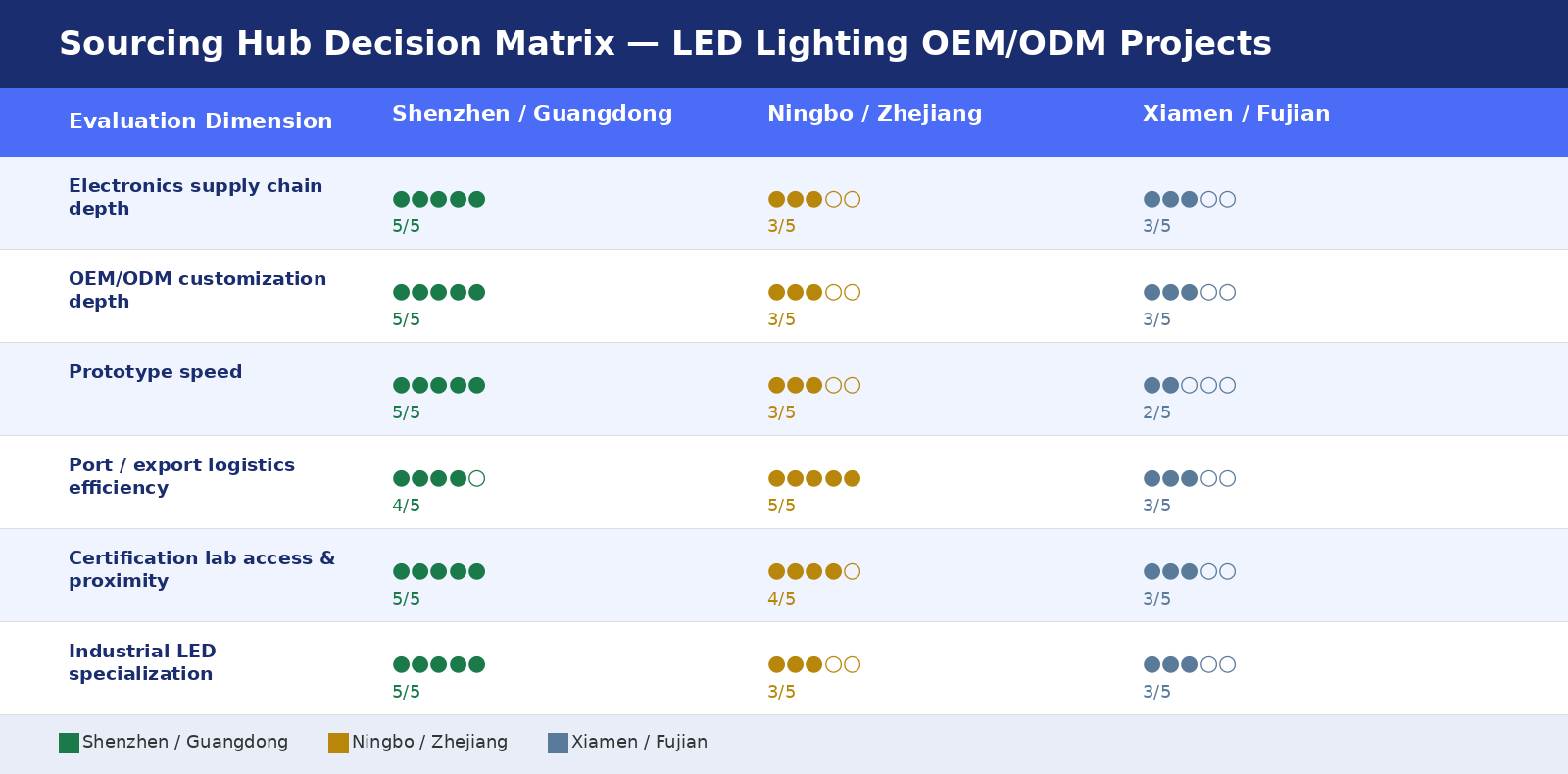
| Dimension | Shenzhen / Guangdong | Ningbo / Zhejiang | Xiamen / Fujian |
|---|---|---|---|
| Electronics supply chain depth | ★★★★★ — World’s most comprehensive | ★★★ — Adequate for standard products; GD sourcing for complex electronics | ★★★ — Smart lighting niche strength |
| OEM/ODM customization depth | ★★★★★ — Full: ID, mold, electronics, certification | ★★★ — Mechanical customization strong; electronics customization limited | ★★★ — Outdoor/commercial products; limited for specialty industrial |
| Prototype speed | 3–5 working days (electronics-capable) | 5–10 working days (mechanical-focus products) | 7–14 working days (smaller supplier ecosystem) |
| Port / export logistics | Shenzhen Port (world 3rd by containers); HK airport adjacent | Ningbo-Zhoushan Port (world 1st by cargo tonnage, 3rd by containers) | Xiamen Port — strong SE Asia, AU routes; smaller scale |
| Certification lab access | ★★★★★ — All major bodies (TÜV, SGS, UL, Intertek) on-site | ★★★★ — Major labs present; some niche certs require GD travel | ★★★ — Standard certs available; specialist labs in GD |
| Best for (LED category) | Weatherproof industrial, emergency lighting, OEM/ODM, smart/DALI, specialty industrial | Commercial battens, standard weatherproof, motion sensor lights, high-volume standard products | Outdoor IP65 fixtures, garden/street lighting, Zigbee smart lighting, SE Asia/AU supply chain |
| Cost position | Mid–premium (complexity justified); Dongguan/Huizhou production reduces vs. Shenzhen city | Mid (port efficiency offsets manufacturing costs for high-volume) | Mid (comparable to Ningbo for matched product types) |
The Decision Framework: Matching Your Project to the Right Hub
Choose Guangdong (Shenzhen ecosystem) if:
- Your product involves electronics integration — DALI 2.0, Zigbee, emergency BMS, custom driver circuits
- You need OEM/ODM customization: new mold development, custom optics, proprietary form factor
- You require CE, ENEC, UL/ETL, SAA certification with active engineering support during testing
- Your application is specialized industrial: cold storage (-40°C), explosion-proof, medical-grade, IP68 seawater
- You need rapid prototype iterations (target: 3–5 working days)
Choose Ningbo if:
- You are placing large-volume orders of standard or near-standard products where per-unit landed cost is the dominant variable
- Your bill of materials is mechanically intensive (housings, mounting systems, terminal hardware) rather than electronics-intensive
- Your primary destination market is Europe or North America via ocean freight and you want to maximize port efficiency
- Your product is relatively stable (established design, low iteration rate) and you are in production-scale buying mode
Consider Xiamen as a secondary option if:
- Your primary markets are Southeast Asia or Australia, where Xiamen port routing is efficient
- Your LED category is outdoor IP65 streetlighting or Zigbee-integrated smart commercial lighting
- You are evaluating a diversified supplier base to reduce single-region concentration risk
What Hub Analysis Doesn’t Tell You
Hub selection is a starting filter, not a final answer. Within Guangdong alone, there are thousands of LED manufacturers — ranging from globally certified engineering manufacturers to factories that print certifications they don’t hold. Within Ningbo, there are suppliers with genuine ISO 9001 systems and suppliers who file the documentation but don’t live it. The hub gives you the structural conditions; evaluating individual suppliers within that hub requires a different, more granular process: factory audits, certification verification (always confirm UL Yellow Cards directly on the UL Product iQ database; CE technical files should be available on request), and sample testing under real-world conditions.
For buyers specifically evaluating weatherproof or emergency LED suppliers in the Guangdong ecosystem, the relevant verification points extend beyond basic certification. A manufacturer claiming 7–10 year warranty coverage on industrial fixtures should be able to demonstrate the production quality systems — 100% aging tests, IK10 impact testing protocols, thermal cycle testing — that make that warranty credible. Suppliers in the Shenzhen/Guangdong ecosystem with genuine engineering depth will welcome these conversations. Those who deflect them are telling you something important. The Fanxstar OEM/ODM process details the specific engineering verification steps we run on every custom project — which gives buyers a useful reference point for what rigorous OEM qualification looks like in this hub.
Frequently Asked Questions
Can I source from multiple hubs for the same project?
Yes, and for large, multi-SKU projects it is sometimes the right approach. Electronics-intensive components (drivers, control modules, emergency battery units) are best sourced from Guangdong, while standard mechanical housing components or mounting hardware can be sourced from Ningbo if that reduces landed cost. The practical challenge is supply chain coordination: managing two supplier relationships, two quality inspection processes, and two shipping legs adds overhead. For most buyers, a single integrated manufacturer who manages their own supply chain — sourcing components from the best regional suppliers and assembling at a single production location — is more operationally efficient than a DIY multi-hub approach.
Does hub location affect product certifications?
Directly, no — certifications are issued to specific product models by accredited testing laboratories, not to geographic locations. But hub location affects the practical timeline and cost of achieving certification, because it determines how close your supplier is to accredited test labs, how easily they can run iterative samples during the test-fix-retest cycle, and whether their engineering team has worked with those labs before. A Guangdong manufacturer with established relationships at TÜV Rheinland’s Guangdong lab will navigate the ENEC certification process faster than an equivalent manufacturer in a city where that working relationship doesn’t exist.
How do I verify that a supplier actually manufactures in the hub they claim?
Request the manufacturing facility address and match it to the address on their business license (营业执照, yíngyè zhízhào). Ask for factory photos with identifiable location markers, or use Google Maps satellite view to verify the facility footprint. A trading company operating from a commercial office building in Shenzhen may claim “Shenzhen manufacturing” while actually outsourcing production to a third-party factory they don’t manage. This distinction matters significantly for OEM/ODM projects where quality control and IP protection depend on dealing directly with the actual production facility. See also our article on how to identify genuine manufacturers versus trading companies using sample cost structures and factory audit signals.
Is Zhongshan or Dongguan worth considering instead of Shenzhen?
Absolutely — and experienced LED buyers often evaluate the broader Guangdong region rather than Shenzhen city specifically. Zhongshan (sometimes called “China’s Lighting Capital”) hosts over 8,000 lighting-related enterprises in Guzhen Town alone, making it the most concentrated LED-specific manufacturing cluster in the world. Dongguan and Huizhou are major production cities within the same Pearl River Delta ecosystem, with lower land and labor costs than Shenzhen city proper while retaining full access to the shared component supply chain. Fanxstar’s own production operations are in Dongguan and Huizhou — precisely because of this cost-ecosystem balance. When evaluating Guangdong suppliers, look at the whole Pearl River Delta, not just Shenzhen addresses.
Understanding which city a manufacturer is actually based in — and what that ecosystem realistically enables — is one of the most practical sourcing filters available to B2B buyers. It won’t tell you everything about a supplier, but it will tell you what they can plausibly do. If you’re evaluating specialized weatherproof or emergency LED suppliers in the Guangdong ecosystem, contact Fanxstar’s engineering team for a technical consultation on your project requirements — we’re happy to discuss how our production setup maps to your specific application.








