A distributor managing a 2,000-fixture installation in a cold storage facility gets a call: three fixtures have failed simultaneously. The issue is driver failure — the most common catastrophic failure mode in LED luminaires. If you have replacement drivers on the shelf, the technician is back on site tomorrow with the solution. If you don’t, you’re placing an emergency order, paying premium expedite pricing, and explaining to a customer why their temperature-controlled facility has dark zones for the next 10–14 days. This scenario plays out across commercial and industrial LED lighting installations every week, and the distributors who handle it smoothly have answered one critical question correctly: how much spare parts inventory do I actually need? This guide provides a data-driven framework for calculating the right percentage of LED drivers and chips to hold, segmented by product application and service level commitment.
Key Takeaways
- LED drivers fail before LED chips do — a pro-grade driver has an MTBF of 50,000–100,000 hours at rated temperature, while the LED chip maintains L70 lumen output at 100,000+ hours — meaning drivers are the primary spare part that determines your field service inventory requirements.
- A practical starting point for spare driver inventory is 5–10% of the installed unit count per product generation — adjusted upward for harsh environments (elevated temperature, vibration, high humidity above IP rating), longer delivery lead times, and mission-critical applications where downtime cost is high.
- ABC-VED analysis — classifying spare parts by value (A/B/C) and criticality (Vital/Essential/Desirable) — allows spare parts budgets to be concentrated on the components that actually matter: high-failure-rate, hard-to-source, long-lead-time items rather than commodity parts readily available from distributors.
Why LED Drivers Are Your Primary Spare Parts Concern
The Weakest Link in an LED Luminaire System
LED lighting is sometimes marketed on the basis of 100,000-hour chip lifespans — and LED chip reliability genuinely is extraordinary. But as Hyperlite Lighting’s 2026 analysis of TM-21 projections explains, “a 100,000-hour LED chip paired with a 20,000-hour driver is effectively a 20,000-hour fixture.” In industrial environments where ambient temperatures can reach 40°C near roof decks or 60°C+ in direct sun on building exteriors, driver capacitor life compresses dramatically.
According to GRE Alpha’s analysis of LED driver MTBF methodology, pro-grade drivers are typically rated at 55,000–100,000 hours MTBF at 25°C ambient — but this rating degrades significantly as operating temperature increases. Every 10°C rise in capacitor temperature approximately halves capacitor lifespan (the Arrhenius relationship), meaning a driver operating at 55°C rather than 25°C may have an effective lifespan of 6,000–12,000 hours instead of the rated value. For a 24/7 installation, that is less than 18 months of operational life.
This physics reality defines your spare parts strategy: drivers are your highest-probability failure item and your primary service inventory requirement. LED chips, by contrast, rarely fail catastrophically — their primary failure mode is gradual lumen depreciation, which manifests over years, not the sudden “fixture off” events that require immediate replacement.
Secondary Spare Parts: LED Modules vs. Chips
While individual LED chip replacement is not practical in the field (chips are soldered to COB boards at the factory), LED module assemblies — the circuit board + chip array + phosphor package — are field-replaceable in many commercial fixture designs. For manufacturers offering modular weatherproof lighting with serviceable LED boards, stocking replacement LED modules makes sense for larger installations where the fixture housing is in good condition but the LED board has reached end-of-lumen-life after 50,000–80,000 operating hours.
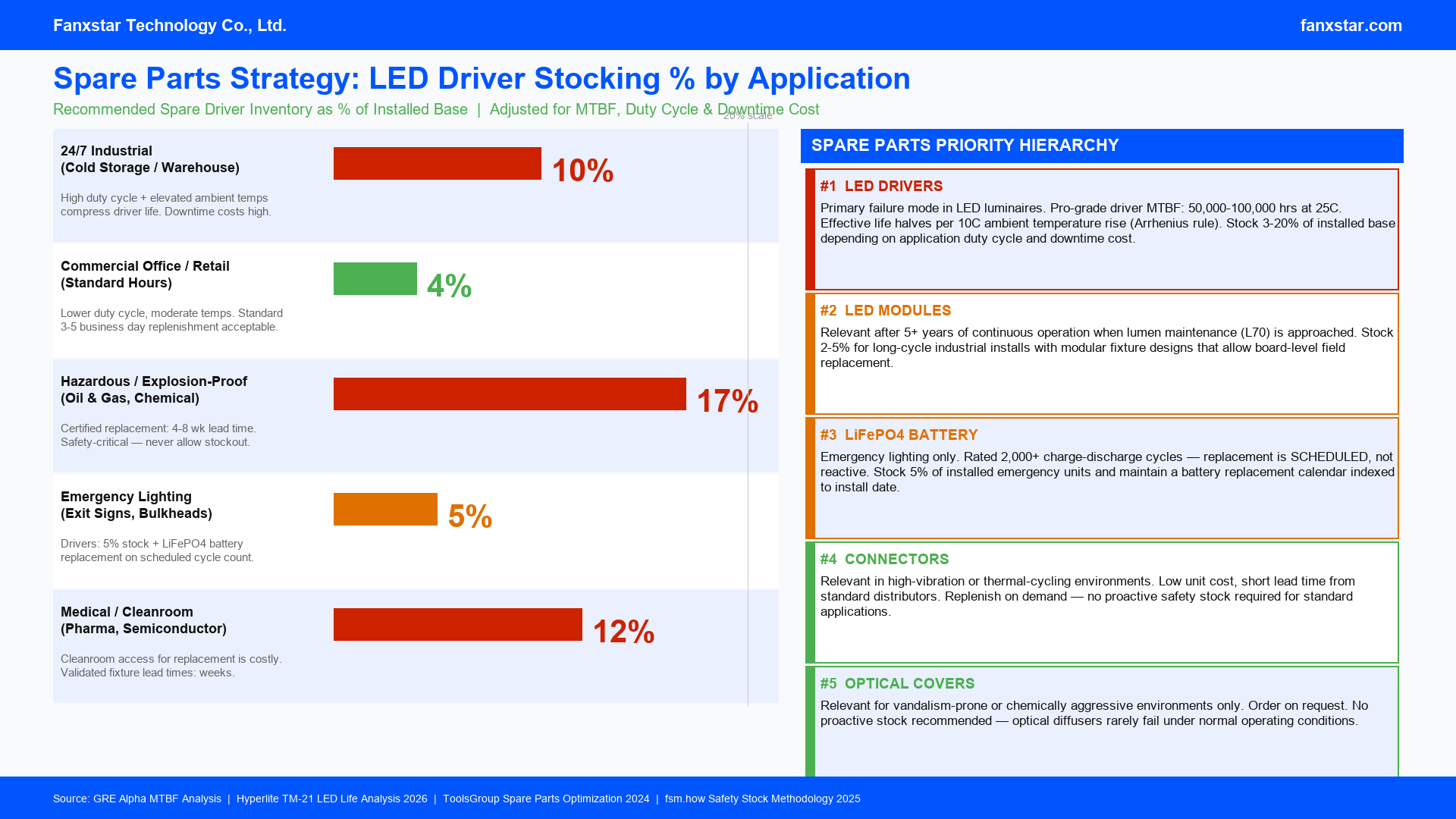
For standard commercial installations, the spare parts priority hierarchy is:
- LED drivers — highest failure probability, mission-critical replacement, primary spare parts budget allocation
- LED modules/boards — relevant for long-cycle installations (warehouse, industrial) after 5+ years operation
- Connectors and wire harnesses — occasional failure in high-vibration or thermal-cycling environments
- Optical covers/diffusers — relevant for vandalism-prone environments; low engineering priority otherwise
- Batteries (emergency lighting) — LiFePO4 batteries require planned replacement per manufacturer schedule, typically 8–10 years
The Calculation Framework: How Many Drivers to Stock
The Basic MTBF-Based Calculation
The starting point for spare parts quantity is the expected annual failure rate derived from the driver’s MTBF rating. The inverse of MTBF gives the failure rate per operating hour. For annual planning:
Annual Failure Rate = (Annual Operating Hours) / MTBF
For an 8,760 hour/year (24/7) application with a driver MTBF of 50,000 hours at operating temperature:
Annual Failure Rate = 8,760 / 50,000 = 0.175 = approximately 17.5 failures per 100 installed units per year
For an office lighting application at 3,000 hours/year with the same driver:
Annual Failure Rate = 3,000 / 50,000 = 0.06 = approximately 6 failures per 100 installed units per year
This calculation gives you the expected number of drivers you will need annually — but expected is not a stocking target. You need safety stock to cover demand variability, delivery lead time, and the non-uniform distribution of actual failures.
Safety Stock: Converting Expected Failures to Stocking Levels
The standard safety stock formula used in spare parts management accounts for demand variability and lead time uncertainty:
Safety Stock = Z × σ_demand × √Lead Time
Where Z is the service level factor (1.65 for 95% availability, 2.33 for 99%), σ_demand is the standard deviation of monthly driver demand, and Lead Time is the replenishment lead time in months.
For a practical starting point without historical failure data, many spare parts specialists recommend the fixed percentage method: hold safety stock equal to 10–20% of expected annual consumption (not installed base). For LED drivers with a 5–10% annual failure rate in commercial applications, this translates to a stocking level of approximately 0.5–2% of the installed driver population at any given time — which for a 500-unit installation means 3–10 spare drivers on the shelf.
Practical Spare Parts Percentages by Application
Rather than pure mathematical modeling (which requires historical failure data that most distributors don’t have at installation start), the following segmented percentages provide a working framework based on application risk and service level requirements:
| Application Type | Annual Operating Hours | Recommended Spare Driver % | Rationale |
|---|---|---|---|
| 24/7 Industrial (cold storage, warehouse, parking) |
8,000–8,760 hrs | 8–12% | High duty cycle + elevated ambient temps compress driver life; downtime costs are high |
| Commercial Office/Retail (standard operating hours) |
2,500–4,000 hrs | 3–5% | Lower duty cycle, moderate temps; standard 3–5 business day delivery acceptable |
| Hazardous / Explosion-Proof (oil & gas, chemical) |
6,000–8,760 hrs | 15–20% | Long certified replacement lead time; safety-critical downtime; harsh chemical/thermal environment |
| Emergency Lighting (exit signs, bulkheads) |
Continuous standby | 5% drivers + batteries per schedule | Battery replacement is scheduled; driver spares cover random failures; building compliance requires rapid resolution |
| Medical / Cleanroom (pharmaceutical, semiconductor) |
6,000–8,760 hrs | 10–15% | Cleanroom access for replacement is operationally costly; validated fixtures may have long replacement lead time |
Adjusting for Lead Time and Product Generation
Spare parts percentages should be adjusted upward when your supplier’s delivery lead time for replacement drivers exceeds 5 business days. For ATEX/IECEx explosion-proof LED fixtures, where certified replacement components may require 4–8 weeks from a manufacturer in China, the on-hand spare parts requirement is substantially higher than for standard commercial weatherproof fixtures that can be replenished within a week.
Product generation is also relevant. When a manufacturer transitions to a new driver generation, spare parts for the previous generation become progressively harder to source. The electronic component lead time optimization framework from Perceptive IC recommends classifying components by lead time and criticality: long-lead, single-source components warrant just-in-case buffers, while commodity components with multiple sources remain candidates for just-in-time replenishment. For specialized LED drivers from a specific manufacturer, always negotiate a “last-time-buy” arrangement when you learn a product is being discontinued — this is the moment to build a 2–3 year spare parts reserve rather than scrambling for obsolete components at premium prices after end-of-life.
ABC-VED Analysis: Allocating Your Spare Parts Budget
Why Not All Spare Parts Deserve Equal Attention
Most spare parts budgets are too thin to stock everything. ABC-VED analysis — combining value classification (A = high annual cost, B = medium, C = low) with criticality classification (V = Vital, system down without it; E = Essential, degraded operation; D = Desirable, minor convenience) — creates a structured prioritization framework.
For LED lighting spare parts:
- A-Vital: ATEX-certified or DALI-compatible specialty drivers — high unit cost, specific certification required, long lead time, system-critical. Maximum stocking priority, hold 15–20% of installed quantity.
- B-Vital: Standard commercial LED drivers — moderate unit cost, widely available, 5–10 day lead time. Hold 5–8% of installed quantity.
- B-Essential: LED module assemblies — hold 2–5% of installed quantity for long-cycle installations.
- C-Essential: Connectors, end caps, cable glands — low cost, short lead time, hold minimal stock; replenish on demand.
- C-Desirable: Optical diffusers, decorative covers — order only on request; no proactive stocking required.
According to ToolsGroup’s 2024 spare parts inventory optimization research, structured ABC analysis combined with probabilistic demand forecasting consistently produces outcomes of 10+ percentage points improvement in service levels with simultaneous 15–25% reduction in total inventory investment — the mathematical proof that targeted spare parts strategy outperforms blanket percentage rules.
Supplier Partnerships That Reduce Your Spare Parts Burden
Negotiating Spare Parts Commitments at Time of Purchase
The best moment to negotiate spare parts supply commitments is during the initial product purchase negotiation — not after installation when leverage is reduced. When evaluating an LED lighting supplier for a significant installation, include the following spare parts commitments in your purchasing terms:
- Spare parts availability commitment: Manufacturer commits to maintaining replacement driver availability for a minimum period (typically 7–10 years) after last production date of the model
- Last-time-buy notification: Minimum 12-month notice before discontinuing any model, enabling a final protective buy
- Spare parts kit with initial order: Negotiate inclusion of 5% spare drivers in the initial order at production cost — avoids premium pricing on a future spot order
- Firmware compatibility guarantee: For DALI or smart control compatible drivers, ensure future hardware revisions maintain backward compatibility with installed control systems
Fanxstar’s OEM/ODM customization service includes the ability to develop product lines with modular driver designs — enabling field replacement of drivers without replacing the entire fixture. This architectural decision at the design stage dramatically reduces the total cost of long-term spare parts management for installers and facility managers operating large LED lighting deployments.
When to Use Vendor-Managed Inventory for Spare Parts
For distributors managing multiple large-scale LED installations, vendor-managed inventory (VMI) arrangements with the manufacturer can reduce the capital investment in spare parts while maintaining availability. Under a VMI arrangement, the manufacturer holds consignment inventory at a central warehouse and ships spare drivers within 24–48 hours on demand. The distributor pays only when inventory is consumed, eliminating the carrying cost of stocking multiple driver generations simultaneously.
VMI is most appropriate for distributors with: total installed base exceeding 1,000 units, product portfolio spanning multiple driver generations, and geographic concentration that makes a single manufacturer’s warehouse an efficient replenishment source. For distributors serving customers across multiple regions, a hybrid approach — VMI for specialty/slow-moving drivers, local stock for standard high-turnover models — typically delivers the best combination of availability and capital efficiency.
Frequently Asked Questions
How long should I expect an LED driver to last in a cold storage warehouse?
In a cold storage environment where ambient temperatures are consistently low (0–5°C), LED driver lifespans are typically extended beyond rated values — electrolytic capacitors last longer at low temperatures. However, the thermal cycling from start-up to operating temperature creates mechanical stress on solder joints and components. Expect effective driver life of 40,000–60,000 operating hours in properly designed fixtures in cold storage, compared to 20,000–30,000 hours in high-ambient-temperature environments. At 8,760 annual operating hours, this translates to 4.5–7 years before the first driver generation begins experiencing meaningful failure rates.
Should I stock spare LED chips or complete LED modules?
For most commercial and industrial LED lighting, stock complete LED modules (circuit board + chip array), not individual chips. Field replacement of individual LED chips is not practical — it requires soldering equipment, ESD precautions, phosphor-matched chip selection, and thermal compound application that are not feasible in the field. LED modules designed for field replacement are available in modular fixture designs and can be swapped in minutes with basic tools. Confirm with your LED lighting manufacturer whether their fixtures are designed for module-level serviceability before developing a spares strategy based on module replacement.
What spare parts do I need for emergency lighting systems?
For LiFePO4 emergency lighting systems, the spare parts strategy differs from general LED fixtures. LiFePO4 batteries have approximately double the cycle life of older chemistries — rated for 2,000+ charge-discharge cycles — but still require planned replacement. Battery replacement should be scheduled based on the manufacturer’s cycle life specification and installation date, not failure events. Maintain a spare battery inventory of approximately 5% of installed units to cover replacements and unscheduled failures. For the LED driver and module components in emergency luminaires, apply the same 5% stocking recommendation used for standard commercial applications, since emergency fixtures typically operate in lower-stress thermal environments than industrial installations.
To discuss spare parts availability, lead time commitments, and modular serviceability options for Fanxstar products across weatherproof, emergency, and specialty LED categories, contact our team for a distributor partnership discussion — including how our OEM/ODM programs can be designed with field serviceability as a core product requirement.