Direct downlighting is efficient, but in the wrong environment it creates a visual problem that lux targets alone never reveal: harsh shadows, high-contrast hotspots, and a ceiling that feels absent from the space. In open-plan offices, libraries, conference rooms, atriums, and courtrooms — any space where occupants spend extended time looking across a room rather than straight down — 100% uplight suspended fixtures solve all three problems at once. The light bounces off the ceiling, spreads uniformly across the room, and the UGR (Unified Glare Rating) score becomes mathematically undefined because there is nothing to measure: the fixture produces no direct glare. Getting there in practice requires the right ceiling, the right suspension height, the right lumen output, and a clear understanding of where pure indirect lighting works and where a direct/indirect split is the smarter engineering choice. This guide explains all of it.
Key Takeaways
- 100% uplight fixtures are automatically UGR-compliant — the DesignLights Consortium notes that UGR is undefined for pure indirect products because they produce no discomfort glare, meeting DLC Premium requirements by definition.
- A white matte ceiling with ≥ 80% reflectance is a prerequisite, not a preference — dark or wood-paneled ceilings can reduce effective floor illuminance by up to 70% compared to a high-reflectance white surface, as the LightNOW efficiency modeling data shows.
- Suspend the fixture ≥ 24 inches from the ceiling and use spaces with ≥ 10 ft ceiling height — below this threshold, indirect lighting loses its spread advantage and creates a dim “gray sky” effect with no task illuminance benefit.
What 100% Uplight Actually Means — and When to Use It
The Physics of Indirect Illumination
A 100% uplight (fully indirect) suspended fixture directs all of its light output upward toward the ceiling. The ceiling acts as a secondary diffuse emitter: it absorbs some percentage of the incident light and reflects the rest back into the room in a wide, lambertian distribution — the same way a matte white surface scatters light in all directions simultaneously. The result is an ambient field with no shadows, no visible hot spots, and no direct line of sight to any bright source. This is why the DesignLights Consortium’s UGR Fact Sheet categorically states that UGR is undefined for 100% uplight products — they automatically satisfy DLC Premium glare requirements because discomfort glare cannot be generated by a source the observer never directly sees.
EN 12464-1, the European standard for indoor workplace lighting, recommends UGR < 19 for offices and screen-based work environments. Per ERCO’s UGR guidance, the scale runs from 13 (barely perceptible glare) to 28 (extreme glare), and each step of 3 represents the smallest noticeable difference. 100% indirect fixtures skip this calculation entirely. For a specifier submitting a design to a client whose brief requires UGR compliance for screen-based workstations, pure indirect lighting is the most defensible solution — no calculation needed, no dependency on room geometry.
Where Pure Indirect Makes Sense — and Where It Doesn’t
The architectural application guide from Architect Magazine cites an important warning from lighting designer Michael Hennes: used on its own without any direct component, indirect lighting can leave “the space feeling dull, like being outside with a gray sky, because nothing is punched up or highlighted.” The 100% uplight configuration is therefore best suited to spaces where visual comfort and uniformity are the primary goals, not spaces where accent lighting or task-area emphasis is also required. Strong candidates include open-plan offices, reading rooms and libraries, conference rooms, lobbies with high matte ceilings, courtrooms, and educational classrooms. Poor candidates include spaces with dark timber or exposed concrete ceilings, retail environments where merchandise needs directional spotlighting, and any space with ceiling height below 10 feet where the spread of reflected light is insufficient to cover the floor area effectively.
The Two Non-Negotiable Prerequisites: Ceiling Height and Reflectance
Minimum Ceiling Height: 10 Feet, Optimal ≥ 12 Feet
Multiple fixture specification sources confirm that indirect/direct pendant lighting is best suited for spaces with ceilings of 10 feet or more. The GlowbackLED specification guide specifically states that direct/indirect fixtures perform best where “the pendant linear fixture is going to be suspended over 24 inches from the ceiling” in spaces with “10+ ft ceilings.” This 24-inch clearance between the top of the fixture and the ceiling is critical: it allows the upward light beam to spread horizontally before hitting the ceiling, creating a broad wash rather than a concentrated bright spot directly above the fixture. At heights below 10 feet, the spread is too narrow and the ceiling-to-floor bounce path is too short to generate a uniform ambient field.
For spaces with 12-foot or greater ceilings — atriums, double-height lobbies, library reading rooms — 100% uplight fixtures deliver their best performance. The PacLights architectural linear guide notes that suspended systems “work particularly well in spaces with high ceilings (12 feet or more) where traditional fixtures would create harsh shadows.” At 14–16 foot ceiling heights, the reflected field is so diffuse that uniformity ratios on the work plane can approach 0.7 or better — comparable to a high-quality panel grid — while completely eliminating direct glare from the observer’s field of view.
Ceiling Reflectance: The Efficiency Multiplier That Specifiers Overlook
Ceiling reflectance is not an aesthetic choice when a 100% uplight fixture is involved — it is a lighting efficiency variable that can change the required lumen output of the installation by a factor of three or more. The LightNOW efficiency modeling analysis demonstrates this starkly: for a 100% uplight luminaire, raising ceiling reflectance from a low value to 80%, with walls at 70–80%, reduced required total lumen output from approximately 63,000 lumens to roughly 19,000 lumens for the same maintained illuminance target — an immediate 70% reduction in both capital cost and energy consumption. A white matte ceiling (light reflectance value ≥ 80%) is therefore the prerequisite surface finish for any indirect lighting design. Matte finish is critical: a glossy or semi-gloss ceiling will specularly reflect the beam from the fixture, creating a visible bright spot on the ceiling directly above each unit rather than a diffuse ambient spread.
The architectural lighting principle cited in Architect Magazine’s direct/indirect specification guide is equally applicable to 100% uplight: “If the ceiling is white, then there is more contribution onto the work surface below. Dark, wood ceilings normally have a finish that will reflect the lens of the uplight, for a less desirable result.”
Direct/Indirect Split Ratios: Choosing the Right Distribution
100% Up vs. 70/30 vs. 50/50 — What Each Delivers
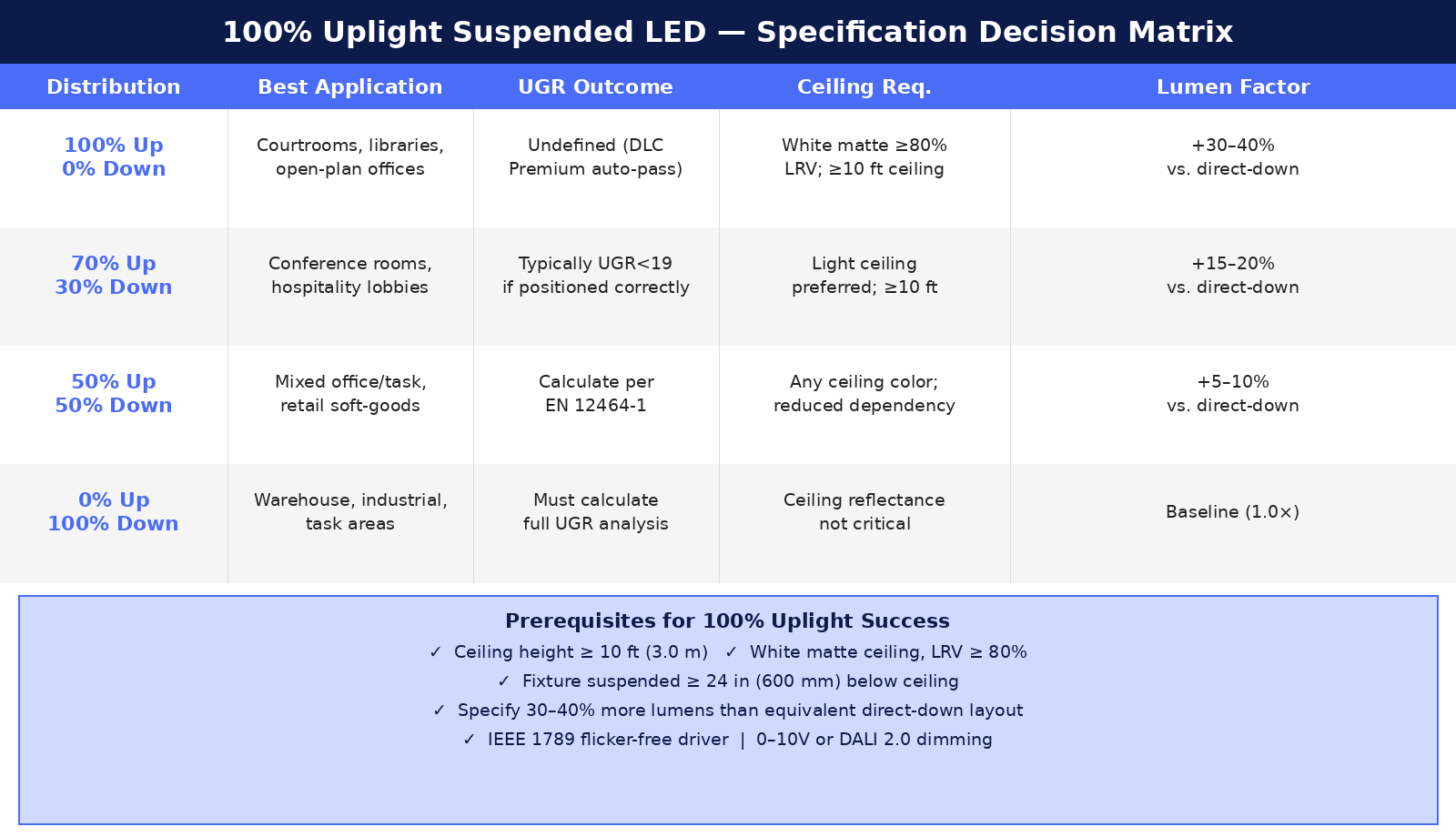
Many suspended linear LED fixtures on the market offer field-adjustable direct/indirect split ratios via DIP switch. This allows the installer to select the uplight percentage at commissioning rather than at the specification stage — a meaningful flexibility advantage for spaces where the final ceiling condition may vary. The common ratios and their application profiles are:
| Distribution Ratio (Up/Down) | Best Application | UGR Impact | Ceiling Requirement |
|---|---|---|---|
| 100% / 0% | Courtrooms, libraries, open-plan offices, healthcare corridors | UGR undefined — automatic DLC compliance | White matte ≥ 80% LRV, ≥ 10 ft height |
| 70% / 30% | Conference rooms, hospitality lobbies, hotel corridors | Typically UGR < 19 if properly positioned | Light ceiling preferred; 10 ft minimum |
| 50% / 50% | Mixed office/task environments, retail soft-goods sections | UGR depends on room geometry; calculate | Any ceiling color; reduced reflectance dependency |
| 0% / 100% | Task areas, warehouse, industrial, perimeter accent | Must be calculated per EN 12464 / IES method | Ceiling reflectance largely irrelevant |
Note that the LED Lighting Supply specification reference confirms that up/down distribution fixtures with 60% uplight and 40% downlight deliver “balanced workspace illumination and reduced screen glare” — confirming that even partial uplight contributions meaningfully reduce glare versus pure direct-down fixtures.
Lumen Output: Compensating for Ceiling Bounce Loss
A 100% uplight fixture must produce significantly more delivered lumens than an equivalent direct-down fixture to achieve the same maintained footcandle level on the work plane. This is because every bounce off the ceiling incurs a reflectance loss: a ceiling at 80% LRV absorbs 20% of incident light on each bounce, and inter-reflections between ceiling, walls, and floor continue to reduce the effective flux. A rough design rule: for a 100% uplight installation targeting 400 lux on the work plane in a space with a white matte ceiling and walls at 70% LRV, expect to specify approximately 30–40% more installed lumens than a direct-down scheme targeting the same lux level. This is not inefficiency — it is the energy cost of eliminating all glare — and the occupant wellbeing, productivity, and compliance benefits frequently justify it.
Key Specification Parameters
Suspension Hardware: Aircraft Cable, Sloped Ceiling Kits, and Continuous Runs
Standard suspended linear fixtures ship with aircraft cable suspension kits, typically 8–10 feet of adjustable stainless cable per drop point. The cable length is field-adjustable using gripper fittings, which allows precise height tuning after installation — important for achieving the ≥ 24-inch ceiling clearance regardless of floor-to-ceiling height variation within the same space.
For sloped or vaulted ceilings — a common challenge in converted industrial buildings, A-frame roofs, and institutional spaces — Alcon Lighting notes that aircraft cable canopy kits with 180° adjustable grippers allow pendant fixtures to hang plumb from a sloped ceiling, ensuring the fixture body remains level while the suspension adapts to the roof pitch. This is a specification-critical accessory that should be called out explicitly in project documents for any space with ceiling pitch above 5°.
For large open-plan spaces, continuous-run capability allows multiple fixture bodies to be linked end-to-end with no visible gap at the joint. This produces a seamless line of light rather than a series of individual pendants — an architectural finish quality that reduces ceiling clutter and simplifies the visual language of the space. Continuous-run linear systems are available in standard lengths (2 ft through 8 ft per section) and can span runs of 20 meters or more with appropriate branch wiring at intervals.
CCT Options and Dimming Controls
For 100% uplight applications in offices and educational spaces, the most common CCT choices are 3000K (warm white, suitable for hospitality-influenced environments), 4000K (neutral white, the standard for open-plan office and educational), and 5000K (cool white/daylight, used in healthcare and technical facilities). Specification-grade architectural linear fixtures typically offer five CCT options — including 3500K and 5700K — along with field-selectable wattage settings via DIP switch, allowing a single SKU to serve multiple project specifications.
Dimming should be specified as 0–10V as a minimum for all commercial applications, with DALI 2.0 DT8 for projects requiring tunable white (variable CCT) or integration with a building management system. IEEE 1789 flicker compliance is a standard requirement for any space where occupants may spend more than four hours continuously — which describes virtually every office or educational application.
OEM Customization for Architectural Projects
Standard off-the-shelf suspended linear fixtures are constrained in three ways that architectural projects frequently encounter: fixed housing widths that don’t match the project’s design language, limited finish options (typically black or white powder coat only), and maximum standard lengths of 8 feet that require visible joints in long continuous runs. OEM linear LED development resolves all three.
Custom aluminum extrusion profiles allow housing cross-sections to be matched to the architectural context — a narrower profile for a minimalist aesthetic, a wider housing for projects requiring higher lumen output in a single line. RAL powder coat colors allow the fixture body to disappear against a painted ceiling or to act as a deliberate architectural element. And custom wiring configurations within a continuous housing can eliminate all visible connectors from runs of 20+ meters. Fanxstar’s OEM/ODM engineering team specializes in exactly this type of architectural customization: from initial Dialux simulation confirming the lumen output required for the specified ceiling reflectance and suspension height, through 3D structural rendering for client approval, to certified mass production with 100% pre-shipment aging tests. Explore Fanxstar’s custom linear LED capabilities.
Installation Checklist Before Commissioning
| Checkpoint | Requirement | If Not Met |
|---|---|---|
| Ceiling height | ≥ 10 ft (3.0 m) | Switch to 70/30 or 50/50 ratio; recalculate lux |
| Ceiling surface finish | White matte paint, LRV ≥ 80% | Respec lumen output; consider 50/50 ratio |
| Fixture-to-ceiling clearance | ≥ 24 in (600 mm) | Visible ceiling hotspot; shorten cable to increase clearance |
| Lumen output spec | 30–40% above direct-down equivalent for same lux target | Under-lit work plane; respec wattage or add fixtures |
| Dimming control | 0–10V minimum; DALI 2.0 for BMS integration | No scene control; energy code compliance risk |
| Flicker compliance | IEEE 1789; < 1% preferred for extended-occupancy spaces | Occupant fatigue; specify IEEE 1789-compliant driver |
| Sloped ceiling hardware | 180° adjustable canopy gripper kit if pitch > 5° | Fixture hangs at angle; uneven beam distribution |
Frequently Asked Questions
Do 100% uplight suspended fixtures meet UGR < 19 requirements for offices?
Yes — and more definitively than any other fixture type. UGR is technically undefined for 100% indirect products because the formula requires a luminous source in the observer’s field of view, which a pure uplight fixture does not provide. The DesignLights Consortium’s UGR guidance explicitly states that these fixtures automatically meet DLC Premium discomfort glare requirements. For project documentation, citing the DLC guidance is sufficient to demonstrate UGR compliance without a room-specific UGR calculation.
What ceiling color is needed for uplight fixtures to work effectively?
A white matte finish with a light reflectance value (LRV) of ≥ 80% is the standard requirement. Matte finish is essential because gloss or semi-gloss ceilings specularly reflect the uplight beam, creating a visible bright patch directly above each fixture rather than a diffuse spread. Dark ceilings — grey, timber stain, exposed concrete — reduce effective floor illuminance dramatically and may require two to four times the installed lumen output of a white ceiling installation to hit the same lux target.
Can uplight fixtures be used on sloped or vaulted ceilings?
Yes, provided sloped-ceiling canopy kits with 180° adjustable grippers are specified. These kits allow the fixture to hang plumb regardless of roof pitch, ensuring uniform suspension height and preventing the uneven beam distribution that results from a tilted fixture body. For pitches greater than approximately 20°, the reflected light distribution should be verified by photometric simulation because the asymmetric ceiling geometry changes the inter-reflection pattern compared to a flat ceiling.
How much more lumen output is needed compared to direct-down lighting?
For a space with white matte ceilings at ≥ 80% LRV and walls at ≥ 70% LRV, plan for approximately 30–40% more installed lumens versus a direct-down layout targeting the same maintained lux level. This accounts for ceiling absorption losses and the multi-bounce nature of indirect illumination. In spaces with lower ceiling or wall reflectance, the required uplift in lumen output increases substantially — modeling in DIALux or Relux with accurate surface reflectance inputs is strongly recommended before finalizing the specification.
Is a direct/indirect split better than 100% uplight for most commercial spaces?
For most large open-plan offices and educational facilities, a 70/30 (uplight/downlight) split delivers the best balance of glare control and task-area efficiency. The 30% downlight component adds enough directionality to prevent the “gray sky” effect of pure indirect lighting, while the 70% uplight component keeps UGR well within EN 12464-1 limits. Pure 100% uplight is the optimal choice when absolute glare elimination is the brief — courtrooms, reading rooms, sensitive-display areas, and spaces where occupant visual tasks require maximum visual comfort across extended periods.
Selecting the right uplight suspended fixture requires more than choosing a distribution ratio — it demands a clear analysis of ceiling height, surface reflectance, lumen output requirements, and control integration. Fanxstar’s engineering team works directly with architects and facility developers to deliver custom linear LED solutions — including OEM housing profiles, RAL finish matching, and pre-production DIALux photometric validation. Contact us to discuss your high-ceiling lighting project.