California’s Title 24 building energy standards are among the most demanding in the world for commercial and industrial lighting. For linear LED lighting — the fixture category that dominates warehouses, manufacturing floors, cold storage facilities, supermarkets, and open-plan offices — the 2022 edition introduced meaningful changes that affect both product selection and system design. If you are specifying, importing, or supplying linear LED fixtures for California construction or major renovation projects, understanding what Title 24 actually requires — beyond the headline “use LEDs” — is essential to avoid costly redesigns and failed inspections.
This guide focuses specifically on linear LED luminaires: battens, linear strip fixtures, vapor tight profiles, and similar form factors. It covers the efficacy requirements, lighting power density (LPD) rules, control mandates, and the JA8 certification framework that applies to many indoor residential applications. It also addresses what changed in 2022 relative to the previous code cycle, and where linear lighting sits within both the nonresidential and residential compliance pathways.
Key Takeaways
- All permanently installed luminaires in California buildings must be high-efficacy under Title 24 2022 — for commercial and industrial applications, this effectively means LED, with efficacy requirements ranging from 65 to 100+ lm/W depending on space type and LPD method.
- The 2022 code shifted from fluorescent-baseline LPD calculations to LED-baseline, tightening allowable lighting power density figures across most commercial space categories.
- Lighting controls are mandatory for most commercial applications — vacancy or occupancy sensors, daylight harvesting, and automatic shutoff are required in specified spaces regardless of the fixture efficacy.
- Linear fixtures installed in residential applications must meet JA8 requirements to qualify as high-efficacy unless they fall into automatically qualifying categories.
- Outdoor LED luminaires are automatically classified as high-efficacy, but outdoor lighting power and BUG (Backlight, Uplight, Glare) requirements still apply to commercial outdoor applications.
Understanding Title 24 for Lighting: The Framework
What Title 24 Is and When It Applies
Title 24 is California’s Building Energy Efficiency Standards, developed and updated by the California Energy Commission (CEC). The standards are updated every three years; the 2022 edition took effect on January 1, 2023. Title 24 applies to new construction, permitted alterations, and additions to buildings throughout California. It does not apply to replacing a light bulb in an existing building without a building permit — but it does apply to permitted lighting renovation projects, which includes virtually any planned re-lighting of a commercial or industrial facility that requires electrical permit.
Title 24 for lighting is structured differently for residential and nonresidential buildings. For nonresidential buildings — including warehouses, manufacturing plants, cold storage facilities, retail spaces, offices, and parking structures — the primary compliance tool is lighting power density (LPD): a maximum wattage per square foot for each space type. For residential buildings — including single-family homes, apartments, and dwelling units — LPD calculations are not used; instead, all permanently installed luminaires must qualify as high-efficacy under the JA8 framework.
Title 20 vs. Title 24: An Important Distinction
Title 20 is California’s appliance efficiency regulation, covering products sold at retail. Title 24 is a building code applied at the time of construction or renovation inspection. A product can be Title 20 compliant — meaning it meets the minimum efficacy requirements to be sold in California — but not satisfy Title 24 if the overall lighting power density of the installed system exceeds the code-mandated limit. Conversely, a linear LED batten used in a warehouse installation may satisfy Title 24 LPD requirements at the system level without individually bearing a Title 20 efficacy label. Understanding which regulation governs your specific situation — product sale or building installation — clarifies which compliance path is relevant.
Nonresidential Lighting: LPD Rules for Linear Fixtures
Lighting Power Density and the 2022 Shift
For commercial and industrial buildings, Title 24 compliance for lighting is primarily demonstrated through the Lighting Power Density (LPD) method. LPD is defined as the total rated wattage of installed lighting divided by the floor area in square feet. Each space category has a maximum allowable LPD value, and the installed system must not exceed it. The 2022 code made a significant methodological change: LPD calculations now use LED lighting as the baseline, replacing the fluorescent baseline used in previous editions. Because LEDs are inherently more efficient than fluorescent at equivalent light output, the effective LPD allowances were tightened — a project that passed under 2019 rules may not pass under 2022 rules using the same fixtures.
The three compliance methods available under Title 24 for nonresidential LPD are prescriptive, performance, and tailored. The prescriptive method is the most common for straightforward projects: it provides a fixed W/ft² allowance for each space type, and the designer must select fixtures such that the total installed wattage stays within that limit. The performance method allows more flexibility by modelling the building’s overall energy use, while the tailored method permits detailed space-by-space analysis for complex layouts. For most warehouse, manufacturing, and cold storage lighting projects — the core application territory for Fanxstar’s linear and weatherproof LED products — the prescriptive method is both the simplest and most commonly applied.
Representative LPD Values for Common Industrial and Commercial Spaces
| Space Type | Typical 2022 LPD Allowance (W/ft²) | Linear Fixture Relevance |
|---|---|---|
| Warehouse — storage (non-refrigerated) | ~0.48 W/ft² | High — linear vapor tight or high bay strip lights common |
| Manufacturing / workshop | ~0.95 W/ft² | High — linear industrial battens and high bay strips |
| Office — open plan | ~0.61 W/ft² | High — recessed or suspended linear LED is the dominant fixture type |
| Retail — general merchandise | ~1.19 W/ft² | Medium — linear fixtures used in back-of-house; track dominates sales floor |
| Food processing / cold storage | ~0.95–1.09 W/ft² | High — IP-rated and cold-rated linear vapor tight fixtures essential |
| Parking structure (enclosed) | ~0.21 W/ft² | High — linear vapor tight fixtures and battens dominate this application |
Note: Exact LPD values are defined in Table 140.6-C of the 2022 California Energy Code. Always consult the current CEC standard for the precise value applicable to your specific space classification. Values shown are illustrative and may not reflect the most current code text.
Minimum Efficacy Requirements
Beyond LPD, individual luminaires must meet minimum efficacy requirements. Title 24 requires all installed lighting to meet minimum efficacy standards ranging from 65 to 100 lm/W depending on the fixture type and application. For commercial LED linear fixtures, meeting these efficacy requirements while staying within the LPD budget requires products with well-designed optical systems — high-output LED packages, efficient drivers, and low fixture losses. A linear batten specified at 100W that delivers 12,000 lm achieves 120 lm/W, comfortably above the threshold; the same fixture with a cheap driver and poorly designed optics might deliver only 8,000 lm at 100W (80 lm/W), which may or may not satisfy the LPD budget depending on the space and spacing design.
Residential Applications: JA8 Certification for Linear LED
What JA8 Requires
For residential buildings in California, all permanently installed luminaires — including linear fixtures installed in kitchens, utility rooms, garages, and covered outdoor areas — must be classified as high-efficacy. The JA8 (Joint Reference Appendix 8) framework defines the technical requirements that luminaires must meet to qualify. Products must be certified to the CEC and marked with “JA8-2022” (or “JA8-2022-E” for the more stringent ENERGY STAR Elevated version).
JA8 requirements for LED luminaires include a minimum efficacy of 45 lm/W, high colour rendering (CRI ≥ 90), colour temperatures between 2,700 K and 4,000 K, dimmability to at least 10%, a minimum rated life of 15,000 hours, and low flicker performance. The specificity of the JA8 framework — particularly the CRI ≥ 90 and CCT restriction — has practical implications for industrial-origin LED products: many standard commercial/industrial linear LED fixtures use a CRI 80 specification and are available in 5,000 K CCT, which would not qualify for residential JA8. When products are intended to cross over between commercial and residential applications in California, the JA8 requirements must be factored into the product specification from the design stage.
Automatically Qualifying Categories
Certain luminaire types are automatically classified as high-efficacy under Title 24 without requiring individual JA8 certification. These include pin-based linear fluorescent luminaires with electronic ballasts, high-pressure sodium luminaires, and — most relevantly — LED luminaires installed outdoors. For indoor linear LED fixtures in residential applications, JA8 certification is generally required unless the fixture falls into one of the automatically qualifying categories.
Lighting Control Requirements: The Non-Negotiable Layer
Why Efficacy Alone Is Not Enough
A common misconception among specifiers is that installing high-efficacy LED fixtures is sufficient for Title 24 compliance. Controls compliance is an entirely separate requirement — and for most commercial applications, it is mandatory regardless of how efficient the installed luminaires are. The 2022 code strengthened and extended control requirements across both residential and nonresidential buildings.
Key Control Requirements for Nonresidential Linear Lighting
For commercial and industrial spaces where linear fixtures are commonly used, the primary control requirements include automatic shutoff controls (spaces must have an automatic shutoff system that turns off lighting during unoccupied periods), vacancy or occupancy sensors in specific space types, and — for spaces with sufficient glazing — daylight harvesting controls that automatically dim or switch off linear fixtures in daylit zones when natural light is adequate. California’s 2022 Energy Code requires occupancy or vacancy sensors to be automatic, turning lights on or off based on occupancy detection.
For linear fixtures in large open-plan warehouses or manufacturing floors, daylight harvesting is particularly relevant when skylights or high clerestory windows are present. The code specifies that when daylight provides more than 150% of the illuminance achievable from controlled lighting alone, the controlled lighting power in the daylit zone must be reducible by at least 90%. Linear fixtures in these environments must therefore be specified with dimming capability (typically 0–10 V or DALI) to allow integration with a daylight sensor and control system.
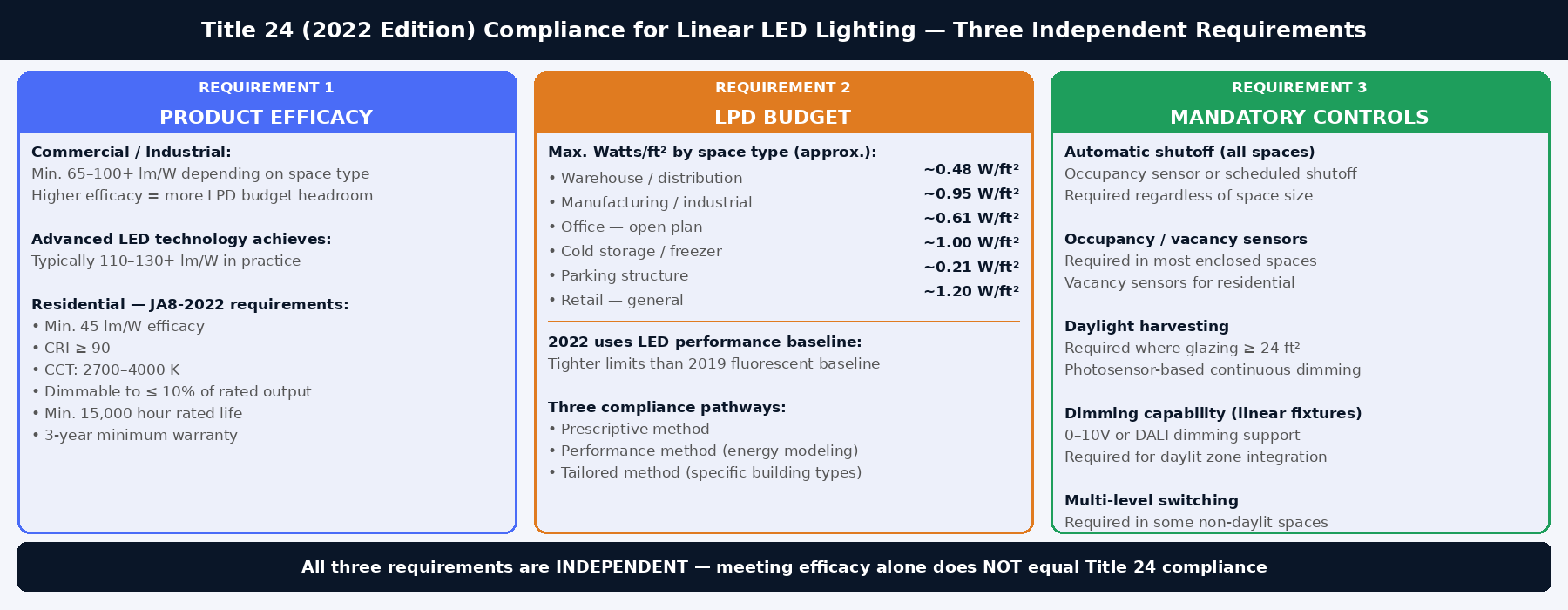
Title 24 2022 compliance for linear LED lighting: product efficacy, LPD budget, and controls are three independent requirements that must all be met simultaneously.
Linear Lighting in Cold Storage and Industrial Environments: Practical Implications
IP Rating, Temperature Range, and Title 24 Compatibility
California’s food processing, cold chain logistics, and industrial sectors demand linear luminaires that satisfy both Title 24 energy requirements and the environmental durability requirements of their operating environment. A cold storage facility operating at -10°C to -30°C requires luminaires that maintain rated lumen output throughout that temperature range — many standard commercial linear fixtures lose significant output at low temperatures due to driver limitations, and the LPD budget that was satisfied in a commissioning test at ambient temperature may no longer be met in steady-state cold operation.
IP-rated vapor tight fixtures and tri-proof linear battens designed for cold chain applications — like those in Fanxstar’s weatherproof LED range — address this by specifying operating temperature ranges to -40°C with maintained lumen output. For Title 24 compliance in cold storage applications, the rated lumen output used in the LPD calculation should be the output at operating temperature, not simply the datasheet value at 25°C ambient. This distinction is often missed in initial specifications and only surfaces during commissioning or energy audit.
Motion Sensor Integration for Parking and Storage
For parking structures and warehouse aisles — two of the highest-volume applications for linear vapor tight and batten fixtures — motion sensor-integrated luminaires offer a practical path to satisfying Title 24’s occupancy control requirements while minimising installation complexity. Rather than running separate control wiring to standalone sensors, fixtures with integrated PIR (passive infrared) or ultrasonic sensors provide occupancy-linked dimming or switching at the luminaire level. The 2022 code requires automatic shutoff controls in virtually all commercial spaces; motion-sensor linear fixtures address this requirement directly. Fanxstar’s motion sensor LED range includes models specifically designed for parking and warehouse applications with this functionality built in.
Frequently Asked Questions
Do standard industrial linear LED battens from overseas manufacturers qualify for Title 24?
Standard industrial linear battens typically qualify for Title 24 in nonresidential applications if they meet the minimum efficacy requirements (65–100+ lm/W depending on space type) and the installed system stays within the space’s LPD allowance. They do not generally qualify for residential high-efficacy requirements unless they hold specific JA8-2022 certification from the CEC — which requires CRI ≥ 90, CCT between 2,700–4,000 K, dimmability to 10%, and minimum 15,000 hour life. Most standard commercial/industrial battens (CRI 80, 5,000 K, without dimmability) would not meet JA8.
How does the 2022 Title 24 shift from fluorescent baseline affect product selection?
The shift to LED-baseline LPD calculations means that the allowable watts-per-square-foot for many space types is now lower than what would have passed under a fluorescent reference. In practice, this pushes specifiers toward higher-efficacy LED products — fixtures above 100 lm/W rather than the 80–90 lm/W range that was adequate under earlier editions — to stay within the tighter LPD budget. For manufacturers, it means that medium-grade commercial linear fixtures that were compliant under 2019 rules may now require a design upgrade to achieve the same LPD compliance margin in equivalent spaces.
Are there Title 24 requirements for outdoor linear fixtures on commercial buildings?
Yes. Outdoor lighting attached to commercial buildings falls under Title 24’s outdoor lighting requirements. LED luminaires installed outdoors are automatically classified as high-efficacy, so there is no efficacy certification requirement in the same sense as indoor fixtures. However, outdoor luminaires of 6,200 initial lumens or more must comply with BUG (Backlight, Uplight, Glare) requirements, outdoor lighting power limits apply to facade and decorative lighting, and automatic shutoff controls are required. For outdoor perimeter linear fixtures, canopy lighting, and loading dock illumination, both the LPD budget and the control requirements must be addressed in the project compliance documentation.
How do I demonstrate Title 24 compliance for a major re-lighting project?
For a permitted re-lighting project in a commercial or industrial building, Title 24 compliance is typically demonstrated through a compliance report prepared by the project’s electrical engineer or lighting designer using CEC-approved compliance software. The report documents the installed lighting power, the applicable LPD allowances, the control strategies deployed, and the results of acceptance testing. Acceptance testing for lighting controls — verifying that occupancy sensors, daylight sensors, and automatic shutoff systems function as specified — is a mandatory step before the building department signs off on the permit.
Title 24 compliance for linear lighting is ultimately a product selection and system design challenge, not a box-checking exercise. The 2022 code’s tightened LPD requirements meant that only genuinely high-performance linear luminaires — with efficacy well above 100 lm/W, rated at operating temperature for cold environments, and specified with appropriate control interfaces — could consistently deliver compliant designs with adequate margin. Those same principles carry forward into the 2025 edition, which took effect January 1, 2026 with further reductions in LPD allowances across most space types.
Fanxstar’s linear lighting range and weatherproof battens are engineered for the demanding performance requirements of industrial and commercial environments. If you are specifying lighting for a California facility and want to understand how specific products fit within Title 24 LPD requirements, contact our engineering team for project-specific support including Dialux photometric simulation and compliance documentation review.