At some point, almost every B2B buyer sourcing LED lighting in China gets burned by the same mistake: they think they are dealing with a manufacturer, and they are not. The supplier has a professional website, factory photos, ISO 9001 certificates, and detailed product specs. They respond to technical questions fluently. They offer CE-certified products with competitive pricing and reasonable MOQs. And then the first production run arrives, and something is wrong — a component substitution, a certification that doesn’t match the actual product, a quality inconsistency that no amount of emails can resolve. The root cause is almost always the same: the buyer was dealing with a trading company pretending to be a factory, and when quality problems emerged, the trading company had no way to fix what they never controlled.
This guide provides seven concrete verification methods. Each one is independently actionable — you don’t need all seven to get a clear picture, but each one adds evidence. Taken together, they make it very difficult for a trading company to successfully impersonate a manufacturer.
Key Takeaways
- No single signal is conclusive — look for converging evidence across multiple verification methods. A trading company that passes one test can still fail three others.
- The business license (营业执照) is the single most reliable paper-trail signal — manufacturing companies list production/processing terms; trading companies list trade/import-export terms. This is a public record that cannot be faked.
- Address mismatch between company registration and “factory” address is a near-certain indicator of a trading company sourcing from third-party manufacturers.
- Sample cost structure reveals supply chain control — factories charge for engineering time and materials; trading companies charge because they are paying a third-party factory on your behalf.
- OEM/ODM response quality is the deepest test — a factory can discuss mold tooling, PCB modifications, and certification implications from first principles; a trading company cannot.
Why the Distinction Matters for LED Lighting Buyers
Trading companies and factories are both legitimate business models. Trading companies can provide genuine value — they handle logistics complexity, offer multi-product consolidation, provide stronger English-language communication, and sometimes access products at lower MOQs than direct factory minimums. For buyers testing a new product category in small quantities, a well-run trading company can be the right choice.
But for B2B buyers sourcing specialized LED products — weatherproof industrial fixtures, emergency lighting with certified battery systems, OEM/ODM custom designs, or any product where certification authenticity is non-negotiable — the factory-vs-trading-company distinction has direct operational consequences:
Quality control: A factory controls the entire production process from component sourcing to final assembly. When quality problems emerge, they can investigate the root cause on the production line and implement corrective action. A trading company cannot do this because they don’t control the production line. They relay your complaint to a third-party factory, whose response and timeline they can’t guarantee.
Certification authenticity: CE, ENEC, UL/ETL, and SAA certifications are issued to specific legal entities for specific product models. A trading company may present certificates that were issued to a manufacturer they source from — which means the certificate name doesn’t match the supplier name on your purchase order. This creates a technical compliance gap in your product liability chain, and in some jurisdictions it can mean your product doesn’t legally qualify as certified.
OEM/ODM capability: Custom product development requires direct factory access — you need to be able to discuss tooling changes, PCB modifications, component substitutions, and compliance implications with engineers who actually manage those variables. A trading company cannot do this, because the engineers are at the factory, not at the trading company. For OEM/ODM projects involving proprietary fixture designs or application-specific engineering, only a direct factory relationship provides the control that serious customization requires.
After-sales reliability: When a fixture fails in the field two years into a project, the supplier’s ability to investigate, diagnose, and honor warranty claims depends entirely on whether they control the production process. Trading companies operating across multiple source factories — which may change between your orders without notice — cannot provide meaningful long-term product support.
The 7 Verification Methods
Method 1: Read the Business License Business Scope
Every company registered in China has a business license (营业执照, yíngyè zhízhào) containing a field called “business scope” (经营范围). This is a legally registered statement of what the company is authorized to do. It is a public record, verifiable against the State Administration for Market Regulation (SAMR) database.
The key words to look for are:
- Factory indicators: 生产 (production), 制造 (manufacturing), 加工 (processing), 研发 (R&D). These terms indicate a company registered to manufacture.
- Trading company indicators: 贸易 (trade), 经销 (distribution), 进出口 (import/export), 批发 (wholesale). These terms indicate a company registered to buy and resell.
Request the business license directly. Any legitimate supplier — factory or trading company — will provide it without hesitation. If a supplier declines to share their business license, treat this as a serious red flag regardless of what they claim about their facilities. Once you have the license, verify the 18-digit Unified Social Credit Code (USCC) on gsxt.gov.cn (SAMR’s national enterprise information system) to confirm the document is authentic and current.
Note that some companies have hybrid business scopes — both production and trade terms. This is common for manufacturers that also source complementary products from partner factories to fill out a broader catalog. A hybrid scope is not deceptive; it simply means you should ask specifically which products in their catalog they manufacture themselves versus source externally.
Method 2: Compare Company Address vs. Factory Address
Ask the supplier for two addresses: their company registration address and their factory address. For a genuine manufacturer, these will be the same address or both within the same industrial zone. For a trading company, they will be different — because the trading company operates from a commercial office, and the factory they source from is a separate legal entity at a different location.
Verify both addresses using Google Maps satellite view or Baidu Maps. Factories are located in industrial zones, typically on the outskirts of cities, with large rooftop footprints, loading docks, and parking consistent with a manufacturing operation. A supplier whose address resolves to a high-rise commercial office building in a city center business district is almost certainly a trading company, regardless of what their website says.
Real LED manufacturers in Guangdong — including Fanxstar’s operations in Dongguan and Huizhou — are consistently located in industrial park addresses, not commercial CBD towers. This is not a coincidence: factories require industrial zoning, high-voltage power supply, and logistics access that commercial buildings don’t provide.
Method 3: Verify Certification Name Against Supplier Legal Name
CE, ENEC, UL, ETL, and SAA certificates are issued to specific named legal entities. The company name on the certificate and the company name on your purchase order should be the same legal entity. If they differ, the certification is technically held by a different company — which may mean the product you are receiving does not legally carry that certification in your market.
For UL/ETL certifications, verify directly on the UL Product iQ database (iq.ul.com) — every valid UL certificate has a public listing. For CE technical files, the manufacturer should be able to produce the Declaration of Conformity with their legal company name as the declarant. For ENEC, verify against the ENEC certificate database. If a supplier presents certificates that name a different company, ask directly: “Is this certificate held by your company, or by the factory you source from?” A trading company that answers honestly will tell you it belongs to their source factory. One that doesn’t answer honestly is now a compliance and liability risk.
This verification step is particularly important for emergency lighting targeting EU/UK markets, where IEC 60598-2-22 compliance must be demonstrable through a traceable certification chain, and for explosion-proof fixtures where ATEX certification authenticity has safety-critical implications. Fanxstar’s certifications are all held in Fanxstar’s legal name — buyers can and should request to verify this directly.
Method 4: Ask About Production Process Details
Ask technical questions that require production-floor knowledge to answer specifically. Trading companies can answer general product specification questions (IP rating, wattage, CCT options) because those are listed on the product datasheet. They cannot answer process questions with specifics, because they weren’t there when the product was made.
Useful questions include:
- “What PCB substrate do you use for this driver, and why?”
- “What aging test duration do you run, and at what temperature?”
- “How do you verify IP66 sealing — what is your specific test procedure and sample rate?”
- “What is your IK10 test method, and what machinery do you use?”
- “If I want to change the CCT from 4000K to 3000K, what specifically changes in the production process?”
A factory engineer answers these with specifics — test durations in hours, temperatures in degrees, machinery names, sample rates per batch. A trading company contact answers in generalities or defers: “I’ll check with our technical team.” The deferral itself is informative. Genuine manufacturers have engineers in the building. Trading companies do not — their “technical team” is a WhatsApp message to a factory contact.
Method 5: Analyze the Sample Cost Structure
Sample cost structure reveals supply chain position more reliably than most other signals. As we covered in our earlier article on why factories charge for samples, the composition of sample costs is different for manufacturers versus trading companies.
A factory’s sample costs reflect actual engineering inputs: engineering time to pull a production line for a non-standard run, material costs for a partial batch, tooling setup time. These costs are specific to the work involved and proportional to the complexity of what was requested. A factory can explain exactly why the sample costs what it does.
A trading company’s sample costs include the factory’s sample charge plus the trading company’s margin plus handling. The result is often a higher-than-expected sample cost for a standard product, with a vague explanation like “sample service fee” or “special handling.” Alternatively, a trading company may try to source a sample by pulling inventory from a secondary supplier — which is why trading company samples sometimes arrive faster than factory lead times would allow.
If a supplier quotes a sample delivery time shorter than any plausible factory production timeline (for a non-stocked custom product), they are either pulling existing inventory or sourcing from a nearby supplier. Neither scenario is what a buyer ordering an OEM/ODM product needs.
Method 6: Examine the Product Range Width and Coherence
A factory’s product range reflects its production equipment and engineering specialization. An injection molding facility optimized for LED fixture housings will produce LED fixtures — not also furniture, kitchen appliances, and power tools. Product range coherence is a signal of genuine manufacturing focus.
Trading companies, by contrast, source from multiple factories across multiple categories. Their product catalogs often include items that no single factory would logically produce together. A catalog offering LED high bays, outdoor garden lights, solar street lights, LED strips, and decorative pendants — all listed with equal detail and availability — is almost certainly a trading company catalog, because no factory efficiently produces all of these categories from the same production equipment.
For LED lighting specifically, meaningful specialization looks like: a focused product family (weatherproof fixtures in IP65/IP66/IP68 variants), a clearly articulated engineering identity (industrial harsh environments, emergency systems, specialty spectra), and a consistent set of certifications that match the product range. Fanxstar’s focus on weatherproof lighting and emergency solutions — with 42 patents and production operations in Dongguan and Huizhou — reflects this kind of genuine manufacturing specialization. A catalog with 400 unrelated SKUs from a company with no described production facility does not.
Method 7: Request a Live Factory Tour (Virtual or In-Person)
This is the most direct verification method. A genuine factory will welcome factory visits — their production floor is evidence of their capabilities, and showing it to prospective buyers builds confidence. A trading company that claims to be a factory will find reasons to make a visit difficult: “the factory is too far,” “production is busy this week,” “we can send photos instead.”
For buyers who cannot visit in person, a live video call walkthrough of the production floor is a reasonable alternative. Key things to ask to see during a factory tour or video walkthrough:
- SMT (Surface Mount Technology) assembly lines — trading companies do not have these; every real LED electronics manufacturer does
- PCB aging test ovens with products actively running through them
- IP testing equipment (water ingress test chambers for IP65/IP66 rated products)
- Raw material storage with identifiable component brands (Bridgelux, Lumileds, or other recognized LED chips)
- Workers in production, not in a showroom
If a supplier offers pre-prepared factory video footage rather than a live walkthrough, be cautious — pre-recorded videos can show any facility, not necessarily the one that will produce your order. A live video call that allows you to ask “can you show me the aging test ovens?” and receive an immediate response is much harder to fake.
The Signal Summary: What to Collect
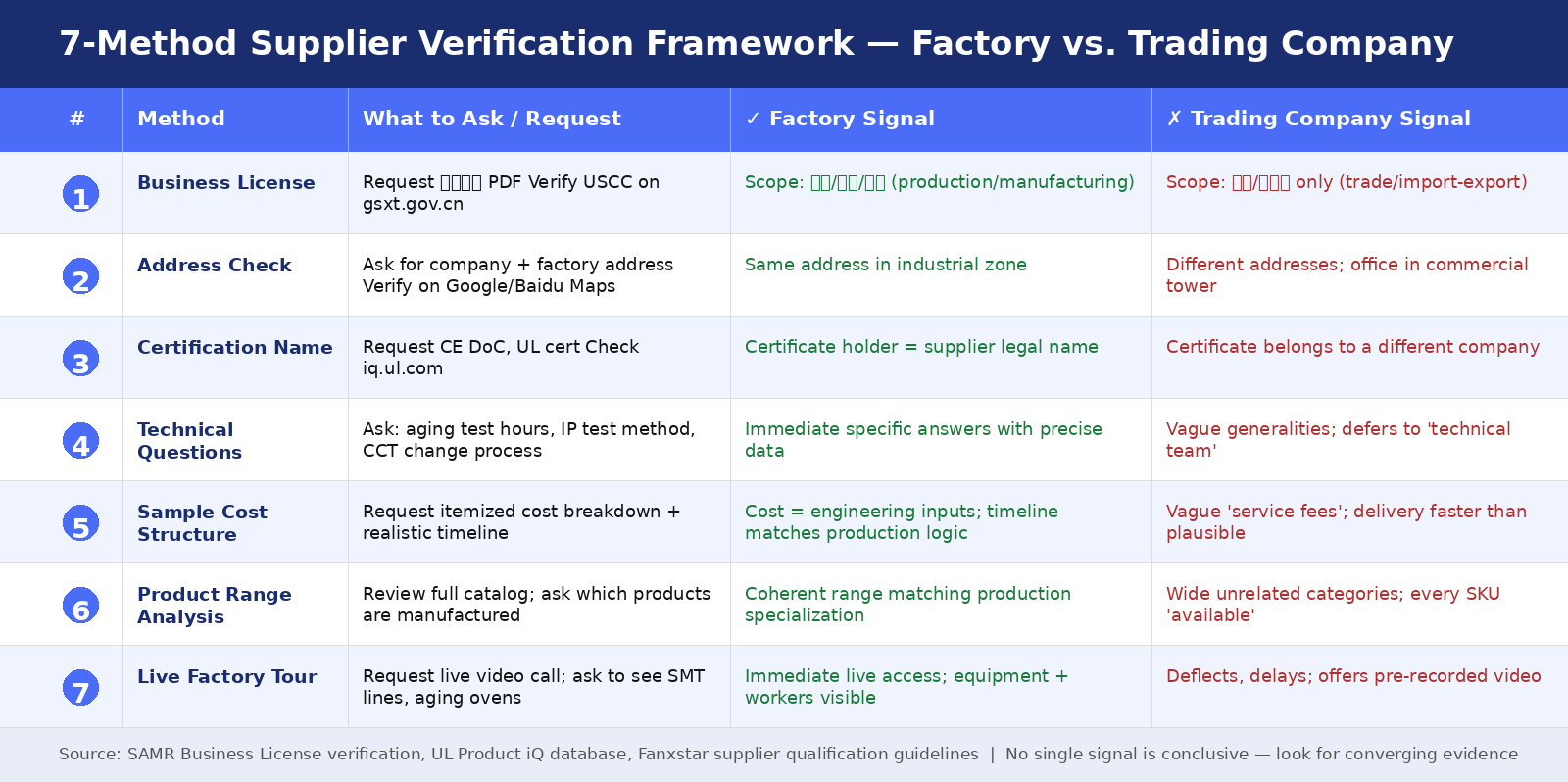
| Method | What to Request | Factory Signal | Trading Company Signal |
|---|---|---|---|
| 1. Business license | Business license PDF; verify USCC on gsxt.gov.cn | Scope includes 生产/制造/加工 | Scope shows 贸易/经销/进出口 only |
| 2. Address check | Company address + “factory” address; verify on satellite maps | Same address in industrial zone with large footprint | Different addresses; company in commercial tower |
| 3. Certification name | CE DoC, UL certificate; verify on UL Product iQ | Certificate holder name matches supplier name exactly | Certificate holder is a different company name |
| 4. Technical questions | Process-level questions: aging test procedure, IP test method, CCT change process | Immediate, specific answers with precise numbers | Generalizations; defers to “technical team”; delayed responses |
| 5. Sample cost | Detailed sample cost breakdown + timeline | Cost explained by engineering inputs; timeline matches production logic | Vague “service fees”; delivery faster than production logic allows |
| 6. Product range | Full product catalog; ask which products they manufacture vs. source | Coherent range matching production specialization; honest about sourced items | Wide, unrelated categories; every product “available”; no honest differentiation |
| 7. Factory tour | Live video walkthrough; request to see SMT lines, aging ovens, IP test chambers | Immediate live access; equipment visible; workers present | Deflects, delays, offers pre-recorded video instead |
When a Trading Company Is Actually the Right Choice
This guide focuses on how to identify trading companies — but that identification shouldn’t automatically lead to disqualification. Trading companies serve legitimate roles in the LED supply chain, and experienced buyers know when to use them.
A trading company makes sense when: you need very small quantities (below factory MOQs) for market testing; you need multiple unrelated product categories in a single consolidated shipment; you are entering a new market and want a partner who handles import/export documentation, customs compliance, and logistics on your behalf; or you need products that are essentially standardized commodity items where the certification risk is low and factory identity matters less.
The critical error is not working with a trading company — it is working with a trading company while believing you are working with a factory, and making sourcing decisions based on that false belief. A trading company that is transparent about what it is can be a good partner. A trading company pretending to be a manufacturer is a liability.
Frequently Asked Questions
Can I ask a supplier directly whether they are a factory or a trading company?
You can, and you should — but direct self-identification is not reliable on its own. Many trading companies will describe themselves as “factory” or “manufacturer” regardless of their actual business structure. The answer to this question is useful context, but it should be verified against the business license business scope, address evidence, and at least two or three other signals from the methods above. A supplier who states they are a factory and then provides a business license with only trade/import-export scope has contradicted themselves — which is itself informative.
What is a “hybrid” factory and how do I handle it?
A hybrid manufacturer produces some products in-house and sources others from partner factories to offer a broader catalog. This is common and not inherently problematic — but it requires you to be specific about which products are factory-produced versus sourced. Ask exactly which products in your order they manufacture themselves. For sourced products, ask the identity of the source factory and whether you can verify certifications directly. A hybrid manufacturer who is transparent about this structure is being honest with you. One who claims to manufacture everything when they clearly cannot is not.
Does buying from a trading company invalidate CE certification?
Technically, CE certification is held by the entity named on the Declaration of Conformity (DoC) — typically the manufacturer or the EU-authorized representative. If the product you receive was manufactured by a third-party factory that holds the CE certificate, and you are selling it under your brand in the EU, you become the importer of record and carry responsibilities under the relevant EU directives. The trading company in the supply chain does not eliminate those responsibilities — it just adds a layer that can obscure the paper trail regulators need. For products targeting EU markets — including emergency lighting under EN 60598-2-22 or weatherproof fixtures under EN 60598-1 — working directly with the certified manufacturer simplifies compliance documentation significantly. See our emergency lighting range for details on how Fanxstar supports certification documentation for EU market buyers.
How do I verify UL certification authenticity?
UL (and ETL) certifications can be verified directly on the UL Product iQ database at iq.ul.com. Search by the supplier’s legal company name or the certification number shown on the certificate. The database shows the certified entity name, the specific product models covered, the certification scope, and the current status (active or expired). If a supplier’s certification doesn’t appear in the database, or appears under a different company name, it is either not a genuine UL certification or it belongs to a different company — both of which matter for buyers specifying UL/ETL-listed products for North American projects. The Fanxstar about page lists our active certifications, and we provide certificate documentation as a standard part of any product inquiry.
What markup do trading companies typically add over factory price?
Trading company margins on LED lighting products typically run 15–30% over factory cost, varying by product category, order volume, and supply chain competition in that category. For specialized products (custom OEM designs, certified emergency systems, application-specific industrial fixtures) where the trading company has no real alternative source, margins can be higher. Buyers can benchmark by comparing Alibaba-listed prices against 1688.com listings for the same or comparable products — 1688 is China’s domestic wholesale platform where factories sell direct to domestic buyers, so price comparisons give a rough indication of the factory-to-consumer spread.
Dealing directly with a genuine manufacturer eliminates this margin entirely — which is why factory-direct pricing is one of the most consistent advantages of identifying and working with real manufacturers. If you’re evaluating weatherproof or emergency LED manufacturers in the Guangdong ecosystem, contact Fanxstar directly — we’re happy to walk through our factory verification documentation, including our business license, factory address, and certificate portfolio, as part of any initial project discussion.