In the technical landscape of industrial and commercial lighting, selecting the appropriate LED topology is the most critical decision for optimizing luminous efficacy and thermal reliability. While Chip-on-Board (COB) technology serves a vital niche in localized accent lighting, SMD2835 (Surface Mounted Device) has emerged as the definitive standard for high-performance linear systems. For engineers at Fanxstar, the preference for SMD2835 is rooted in its superior heat dissipation profile, modular design versatility, and high energy efficiency, which together ensure that every watt of energy is converted into stable, uniform light.
Key Takeaways
-
Efficacy Benchmarks: SMD2835 LEDs deliver industry-leading efficiency, with many Fanxstar luminaires reaching up to 185 lm/W, significantly outperforming dense COB arrays in linear runs.
-
Thermal Management: By distributing heat across a larger surface area, SMD chips maintain lower junction temperatures, extending L80 service life to 74,000+ hours.
-
Visual Uniformity: The 120-degree wide beam angle inherent in SMD technology eliminates “hotspots” and creates homogenous illumination across long warehouse aisles.
-
Safety & Compliance: SMD-based systems integrate seamlessly with flicker-free drivers and meet rigorous ATEX and CE certifications for hazardous environments.
-
Design Agility: Modular SMD strips allow for ultra-slim fixtures and seamless end-to-end splicing, crucial for modern architectural and industrial aesthetics.
Technical Framework: Comparing SMD and COB Topologies
The core distinction between these two technologies lies in their architecture. Choosing the right luminous engine requires a deep dive into how light is generated and managed within the fixture’s housing.
Luminous Efficacy and Energy Density
SMD2835 chips are engineered for high-flux efficiency. In standard industrial applications, these chips provide roughly 140 lm/W as a baseline, while Fanxstar’s high-performance models push this boundary to 185 lm/W. While COB LEDs excel in high-density, point-source brightness (ideal for spotlights), their efficiency often drops in linear applications. This is due to the “thermal quenching” effect where the extreme density of a COB array causes heat to build up faster than it can be dissipated, reducing total light output per watt.
|
Technical Metric |
SMD2835 Linear System |
COB LED Strip/Array |
|---|---|---|
|
Initial Efficacy |
140 – 185 lm/W |
~100 – 120 lm/W (Linear) |
|
Thermal Dissipation |
Distributed (Large Surface) |
Concentrated (Point-Source) |
|
Shadow Management |
Soft, Shadow-free |
High-Contrast, Focused |
|
Chromatic Stability |
High (Precise Binning) |
Moderate (Heat-induced shift) |
|
Manufacturing Cost |
Cost-Efficient (Modular) |
Higher (Complex Encapsulation) |
Junction Temperature and Lifespan (L80)
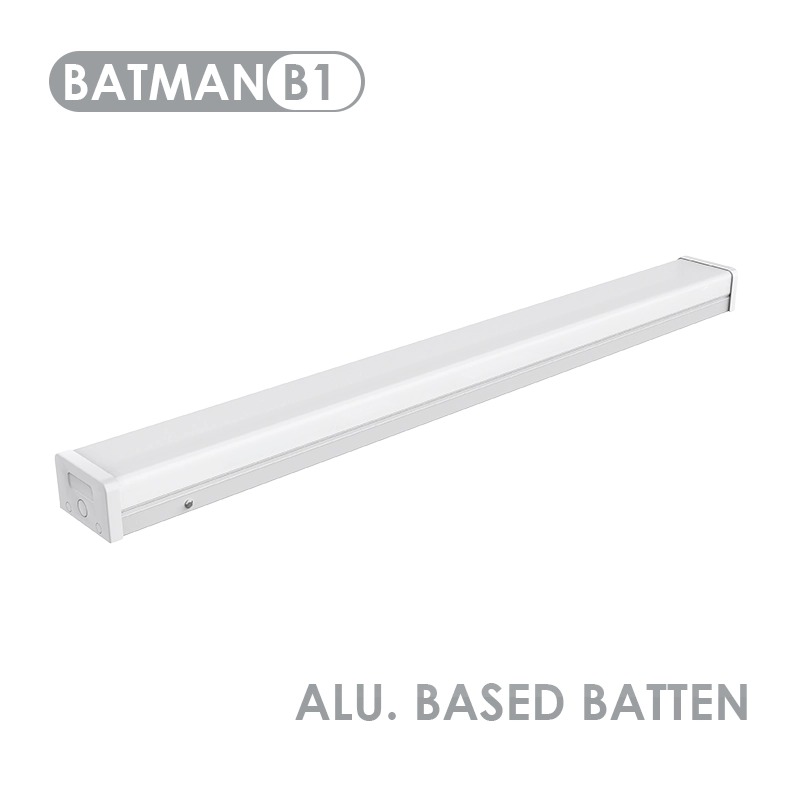
The enemy of LED longevity is heat. SMD2835 chips utilize a wider lead frame that facilitates rapid thermal conduction to the AL6063 aluminum substrate. This keeps the junction temperature significantly lower than COB equivalents. A lower operating temperature translates directly into longer warranty periods and reduced lumen depreciation. Fanxstar’s Batman B1 and B2 series, for example, leverage this thermal advantage to provide a service life of 74,000 hours at L80, ensuring reliable brightness for a decade or more.
The Design Versatility of SMD2835 Linear Modules
For modern linear lighting design, flexibility is paramount. SMD technology allows manufacturers to produce ultra-narrow strips that fit into slim, vapor-tight housings without compromising on luminous flux.
Seamless Splicing for Continuous Light
Retail and warehouse environments demand uninterrupted lines of light. Seamless splicing is a core feature of SMD2835 systems. These fixtures connect end-to-end with zero gaps, providing a uniform “opal” glow that is difficult to replicate with COB point-sources. This continuity is essential for reducing ocular fatigue and ensuring that SKU labels are legible from the top rack to the warehouse floor.
“In a high-rack environment, the uniformity of the light field is just as important as the total lumen count. SMD2835 provides the homogenous spread needed to eliminate the ‘cave effect’ in narrow aisles.”
Real-World Performance and Industrial Integrity
Fanxstar’s engineering team has rigorously tested SMD linear lighting across various specialty applications. Our Trilamp series utilizes high-efficacy SMD chips to achieve 185 lumens per watt, setting a benchmark for energy-saving industrial lighting. In extreme cold storage (-40°C), SMD technology remains technically stable, providing instant-on full brightness while legacy technologies flicker or fail.
Specialized Applications: Marine and Agriculture
For demanding sectors like vertical farming, our Seaweed series uses advanced 2835R Pro chips. These modules deliver up to 270 lm/W in specific spectra, supporting plant growth with minimal heat emission. This prevents substrate deformation and keeps cooling loads manageable, providing a high ROI for agricultural producers.
|
Application Area |
Recommended LED Technology |
Primary Engineering Priority |
|---|---|---|
|
Warehouse Logistics |
SMD2835 (Ra 80) |
Maximum lm/W & L80 Lifespan |
|
Cleanroom/Pharma |
SMD2835 (Sealed) |
Hygienic Housing & IP66 Protection |
|
Textile/Printing |
SMD2835 (Ra 90+) |
Chromatic Fidelity (CRI) |
|
Emergency Exits |
SMD2835 (Low Voltage) |
BMS Integration & Reliability |
Control Systems and Dimming Integration
Modern industrial facilities rely on demand-driven lighting. SMD2835 systems are natively compatible with advanced dimming protocols, including DALI 2.0, 0/1-10V, and Zigbee. Because SMD chips respond linearly to current reduction, they provide smooth dimming down to 1% without the color shifting often seen in high-power COB units. This supports daylight harvesting strategies that can slash total energy costs by up to 80%.
Summary: Why SMD is theLogical Linear Choice
When evaluating the total cost of ownership, the technical case for SMD2835 is definitive. It offers the best balance of luminous output, thermal stability, and application versatility. By utilizing a distributed chip layout, it protects the fixture from heat-related aging and ensures a consistent visual environment for workers. As industrial lighting moves toward Industry 4.0 and IoT integration, the modular nature of SMD-based luminaires will remain the foundation of energy-efficient facility management.
Frequently Asked Questions (FAQ)
What makes SMD2835 better for linear lighting than COB?
SMD2835 chips are designed for wide-area distribution. They spread light evenly along the fixture, eliminating the “focused hotspots” that occur with COB. This ensures superior uniformity in long linear runs, which is critical for warehouse aisles and large retail spaces.
How does heat management differ between these two technologies?
SMD technology manages heat by distributing it across the entire circuit board. COB chips concentrate all heat into a single, small ceramic plate. In a linear fixture, the distributed heat model of SMD results in lower junction temperatures and a longer-lasting LED driver.
Can I use SMD2835 for high-accuracy color work?
Absolutely. High-quality SMD2835 chips are available with CRI values of Ra>90 and Ra>95, making them excellent for textile inspection, printing facilities, and hospitals where color precision is mandatory.
Does SMD2835 save more energy than COB?
In a linear lighting application, yes. Because SMD chips don’t suffer as much from “thermal quenching” (efficiency loss due to heat), they can deliver up to 185 lm/W, providing more usable light for the same power input compared to dense COB arrays.
Are SMD linear lights safe for hazardous zones?
Yes, provided they are in the correct housing. Fanxstar offers vapor-tight and explosion-proof linear lights that use SMD2835 chips. Their low heat emission makes them safer for environments with combustible dust or gases (ATEX/IECEx compliant).
Ready to upgrade your industrial facility? Explore Fanxstar’s High-Performance Linear Lighting Portfolio and discover the difference of professional engineering.