Battery backup in emergency LED lighting should be compared by route responsibility, maintenance workflow, and evidence quality, not by battery label alone. A self-contained exit sign, an emergency batten, an external battery pack, and a self-test fixture can all be correct in different projects. The buyer's task is to compare how each option behaves during power loss, how it is tested, how it is serviced, and how its documentation fits local code review.
That comparison keeps emergency lighting procurement focused on route reliability rather than catalog shortcuts.
Key Takeaways
- Compare route role first: Exit signs, bulkheads, battens, and spotlights serve different emergency-route functions.
- Battery architecture matters: Internal batteries, external packs, and self-contained fixtures change service access and records.
- Testing is part of procurement: A backup option is not complete unless the buyer understands test method, indicator logic, and documentation.
- Code review stays local: Duration, placement, testing, and acceptance must be confirmed with local code and authority review.
- Use samples to prove maintenance: The sample should show battery access, wiring, status indication, and replacement path.
Start With Route Responsibility Before Battery Type
The right backup option is the one that keeps the route evidence maintainable.
According to 29 CFR 1910.37, exit-route safeguards must be maintained so the route remains usable. For lighting buyers, that shifts the conversation from battery label to route responsibility. A sign above a door, a bulkhead in a stairwell, a batten in a parking garage, and a spotlight in a corridor create different test and maintenance patterns. The product question comes after the route role is clear.
NFPA and local code requirements influence duration, placement, testing, and acceptance, so the supplier should avoid blanket compliance promises. A supplier can provide datasheets, wiring diagrams, battery information, status indicator behavior, installation instructions, and sample hardware. The buyer, designer, inspector, and authority having jurisdiction decide final acceptance. That boundary is especially important when emergency lighting overlaps wet, industrial, or hazardous areas.
Self-Contained Exit Signs Simplify Wiring But Multiply Units
Specification note: For battery backup options for emergency LED lighting, the point behind “Self-Contained Exit Signs Simplify Wiring But Multiply Units” should become a reviewable acceptance line. The RFQ should state the site condition, the product evidence, the sample observation, the approver, and the fallback if Fanxstar recommends a standard platform or ODM change. That keeps a battery choice can look cheaper at purchase but create too many inspection points, service visits, or unclear responsibilities over the life of the route from being hidden inside a general fixture preference.
Self-contained exit signs such as E5 and E6 can be practical for distributed routes because each sign carries its own emergency function. The hidden issue is portfolio management. Many small units can mean many batteries, many test points, many replacement dates, and many mounting conditions. The RFQ should ask how the sign is mounted, how battery status is shown, how testing is performed, and how replacement is handled. A good quote makes that future work visible.
Emergency Battens Combine Utility Light And Backup Behavior
Specification note: For battery backup options for emergency LED lighting, the point behind “Emergency Battens Combine Utility Light And Backup Behavior” should become a reviewable acceptance line. The RFQ should state the site condition, the product evidence, the sample observation, the approver, and the fallback if Fanxstar recommends a standard platform or ODM change. That keeps a battery choice can look cheaper at purchase but create too many inspection points, service visits, or unclear responsibilities over the life of the route from being hidden inside a general fixture preference.
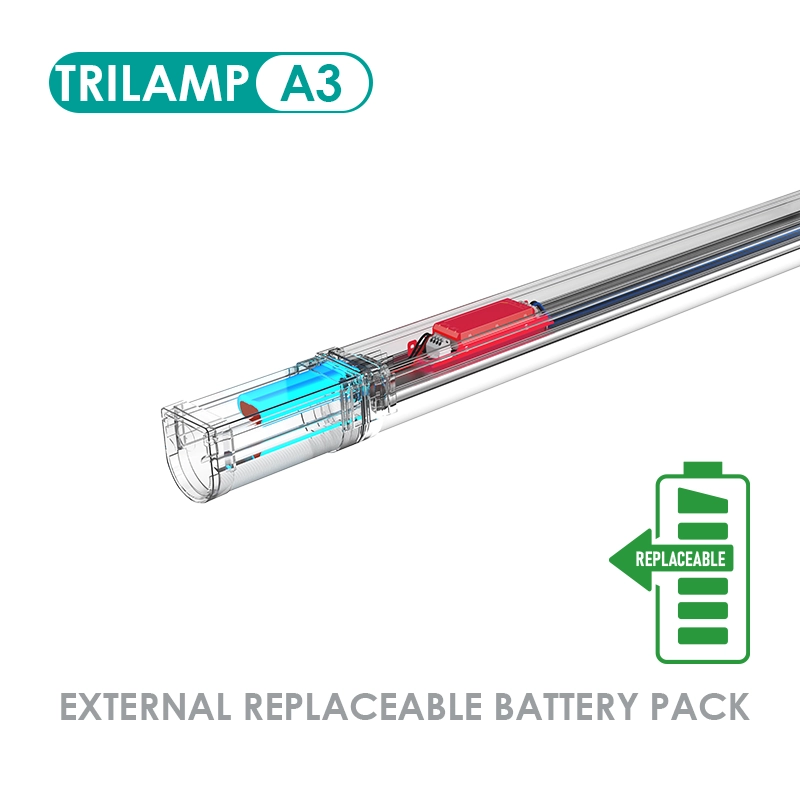
A weatherproof emergency batten such as A8 or A3 can be useful in parking, utility, and industrial routes where normal lighting and emergency function share a housing. The buyer should compare maintained versus non-maintained behavior, wiring method, battery location, ingress boundary, and driver access. If the fixture is mounted high or in a wet area, battery service can become more important than the battery label itself.
External Battery Packs Separate Service But Add Interfaces
Specification note: For battery backup options for emergency LED lighting, the point behind “External Battery Packs Separate Service But Add Interfaces” should become a reviewable acceptance line. The RFQ should state the site condition, the product evidence, the sample observation, the approver, and the fallback if Fanxstar recommends a standard platform or ODM change. That keeps a battery choice can look cheaper at purchase but create too many inspection points, service visits, or unclear responsibilities over the life of the route from being hidden inside a general fixture preference.
External battery packs can be useful when the luminaire environment is wet, hot, cramped, or hard to service. They can also add cable, connector, enclosure, compatibility, and certificate questions. The buyer should ask where the pack mounts, what enclosure protects it, how it connects, what happens during replacement, and which documentation ties the pack to the luminaire. Separation is valuable only when the interface is controlled.
Comparison Matrix For Battery Backup Options
The best battery backup option is the one whose maintenance story matches the route.
| Backup Option | Best Fit | Buyer Risk | Evidence To Compare |
|---|---|---|---|
| Self-contained exit sign | Distributed exit route signage | Many units, scattered test responsibility, mounting variation | Viewing distance, battery type, test method, replacement access |
| Emergency batten with internal battery | Utility corridors, parking, plant areas | Fixture and battery service become one maintenance path | Maintained/non-maintained mode, wiring, thermal limit, ingress scope |
| External battery pack | Wet or hard-to-service luminaires needing separated service | Cable path, box location, compatibility, and certificate boundary | Pack location, connector, enclosure, runtime target, approval documents |
| Self-test emergency fixture | Large portfolios where manual inspection is costly | Test signal is misunderstood or not tied to records | Indicator logic, test interval, battery status, record workflow |
The comparison keeps procurement neutral. A self-test fixture can reduce manual uncertainty in a large portfolio, but it still needs record workflow. An external pack can improve access, but it creates a compatibility boundary. A self-contained sign can simplify installation, but it multiplies distributed maintenance. The buyer should compare unit cost only after the testing and service model is visible.
Scenario Estimate: Distributed Batteries Create Touch Time
A cheap emergency unit can become expensive if every check requires manual detective work.
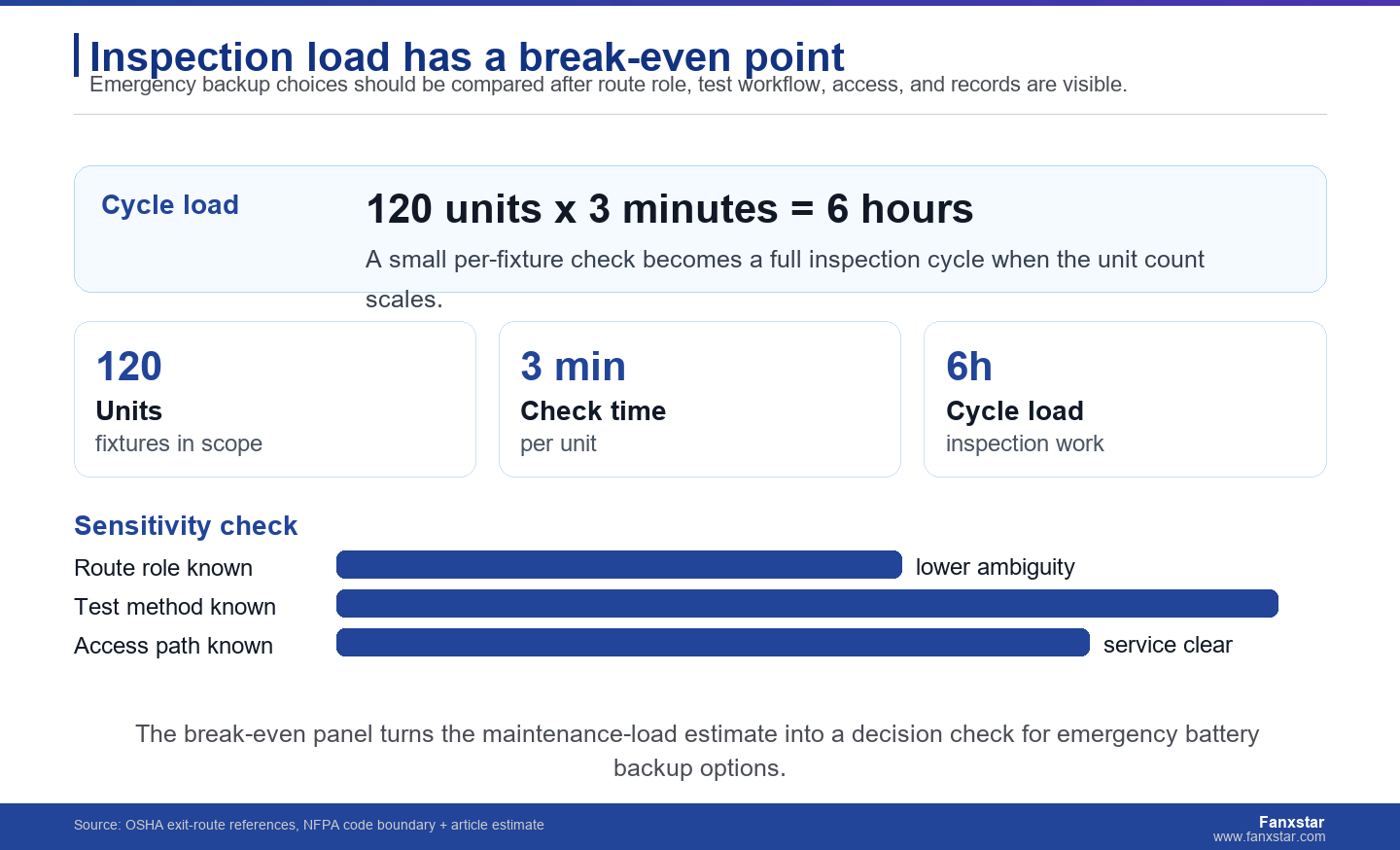
The scenario uses 120 emergency units. If each unit takes 3 minutes to reach, inspect, and record, one routine check cycle takes 360 minutes, or 6 hours. That is before replacing batteries, correcting failed indicators, or resolving inaccessible units. The estimate does not define legal inspection intervals; it shows why testing method and record workflow should appear in the RFQ.
Self-test functions, visible indicators, accessible battery compartments, and clear product labels can reduce uncertainty. They do not remove the buyer responsibility to follow local code and internal safety procedures. The practical procurement question is: how will the facility team know that each emergency unit is ready, and how quickly can it act when one is not?
RFQ Checklist For Emergency Battery Backup
The RFQ should make battery service and records comparable.
Ask for route type, product type, maintained or non-maintained behavior, required local code review, battery chemistry, backup duration target, charging method, indicator logic, test method, replacement path, wiring diagram, mounting height, ingress requirement, ambient temperature, certificate scope, spare battery policy, and sample pass condition. For a comparison article, competitor brands can be mentioned neutrally when needed, but competitor domains should not be linked or treated as authority sources.
Relevant Fanxstar starting points include Fanxstar emergency exit signs, Fanxstar LED emergency battens, Fanxstar emergency bulkhead lights, and Fanxstar custom LED lighting ODM service. Buyers can contact Fanxstar for an ODM lighting quote once route role and maintenance workflow are defined.
How To Turn The Site Requirement Into Supplier Evidence
Depth in battery backup options for emergency LED lighting comes from proving the installation logic, not from adding more fixture descriptions. The buyer is working inside exit routes, stairwells, parking garages, utility corridors, and commercial spaces where backup lighting must stay serviceable, where the wrong assumption can travel from the quotation into samples, drawings, purchasing, installation, and maintenance. A battery choice can look cheaper at purchase but create too many inspection points, service visits, or unclear responsibilities over the life of the route. A useful supplier brief makes that risk visible before the first price comparison.
Compare centralized, self-contained, and hybrid backup options by route role, inspection labor, wiring risk, replacement access, and failure visibility.
Start With The Condition That Can Falsify The Product Choice
The first review question is not whether emergency battens, emergency bulkheads, exit signs, emergency spotlights, and ODM battery pack variants are available. It is which site condition would make a good-looking product unacceptable. That condition may be temperature, water path, cleaning chemistry, photoperiod, classified atmosphere, hygiene geometry, dimming behavior, route visibility, service access, or document traceability. If the condition is not written down, the RFQ invites every supplier to answer a different question.
A stronger brief writes one sentence for the failure mode and one sentence for the acceptance evidence. For example, the buyer should state what would count as a failed sample, what document would close the review, what operating condition must be shown on the datasheet, and which decision must be escalated to the engineer, quality team, farm operator, food-safety team, or authority having jurisdiction. This does not slow procurement; it removes the back-and-forth that happens when price is compared before the product has earned the right to be compared.
Translate Product Features Into Reviewable Gates
Feature lists are easy to misread because the same word can mean different things in different rooms. “Sealed” may mean splash resistance in one project, cleanability in another, and dust control in a third. “Emergency” may mean route recognition, backup duration, battery service access, or local testing responsibility. “Custom” may mean a harmless cable length change or a new optical, thermal, or certification burden. The procurement file should translate each feature into an acceptance gate.
The useful gates are practical: what condition is being controlled, what product evidence supports it, what sample behavior must be observed, what document must be archived, and what decision remains outside the supplier’s authority. Fanxstar can support emergency battens, emergency bulkheads, exit signs, emergency spotlights, and ODM battery pack variants, but the buyer should still ask for one route responsibility map, one backup-duration statement, one inspection method, one replacement-access check, and one failure-notification plan. When those gates are separate, the supplier can give a clean yes, no, or “needs review” answer instead of burying uncertainty inside a quotation note.
Use A Scenario Estimate To Expose Hidden Coordination Cost
If a site uses 140 self-contained battery units and each annual check adds four minutes beyond the planned inspection route, the buyer creates 560 minutes, or 9.3 hours, of extra annual touch time. The number is an illustrative planning estimate, not a claim from a specific Fanxstar project. Based on our analysis of this scenario, its value is that it makes the hidden cost visible. Calculated from the scenario estimate, every repeated review minute becomes a real schedule burden once it is multiplied by fixture count. Data from the acceptance-gate table should therefore be reviewed before final supplier comparison. Research from the source matrix should stay attached to the RFQ so a low fixture price does not hide extra drawings, late certificate review, repeated sample changes, or a maintenance plan that should have been checked before ordering.
The buyer can reduce that cost by creating a small evidence table before supplier comparison. One column names the zone or use case. One column names the risk being controlled. One column names the required document or sample observation. One column names the person who can approve it. One column records whether the product is standard, ODM-modified, or not suitable. This table also helps Fanxstar keep ODM work disciplined: customization should solve the written constraint, not expand because the original requirement was vague.
Keep ODM Changes Inside A Controlled Path
ODM flexibility is valuable only when the change is tied to a measurable reason. A housing change should answer a material, sealing, cleaning, corrosion, or mounting problem. An optical change should answer a task-plane, biological, glare, aisle, or uniformity problem. A control change should answer dimming, sensor, emergency, photoperiod, or automation behavior. A document change should answer certification, quality, audit, or facility approval needs. Without that link, customization becomes a risk multiplier.
The safer path is to approve changes in layers. First select the closest standard platform. Then mark the exact gap that prevents acceptance. Then request one controlled adjustment. Then test the sample against the original gate. If the sample fails, record whether the failure came from the product, the site assumption, the installation detail, or the document pack. That record is what turns a specialty lighting project from trial-and-error into repeatable procurement.
Evidence Notes To Keep With The RFQ
The following evidence notes should stay with the RFQ rather than being scattered across emails. They give the buyer a compact way to connect third-party or official references with the local decision, while keeping the supplier claim inside its proper boundary.
- Regulatory or standards boundary: According to 29 CFR 1910.37 Maintenance, safeguards, and operational features for exit routes, Emergency signs and safeguards must be maintained so exit routes remain usable. Use this source when the RFQ turns battery backup options for emergency LED lighting into a product claim.
- Safety or operating requirement: According to OSHA emergency exits eTool, Emergency-route requirements belong to the workplace exit plan, not to fixture marketing alone. Use this source when the RFQ turns battery backup options for emergency LED lighting into a product claim.
- Design evidence: According to NFPA codes and standards, Battery backup duration, testing, and life-safety requirements must be confirmed by local code and authority review. Use this source when the RFQ turns battery backup options for emergency LED lighting into a product claim.
- Maintenance evidence: According to FEMP energy-efficient lighting, Lighting procurement should include energy, maintenance, and performance tradeoffs. Use this source when the RFQ turns battery backup options for emergency LED lighting into a product claim.
- Procurement evidence: According to UL Solutions hazardous locations services, Where emergency lighting overlaps hazardous areas, certification scope must be reviewed separately. Use this source when the RFQ turns battery backup options for emergency LED lighting into a product claim.
The final commercial comparison should happen only after those notes are complete enough for review. Fanxstar can provide battery, wiring, product, and sample evidence, while code duration, inspection frequency, and final life-safety acceptance stay with the project authority. That boundary is not a disclaimer at the end of the process; it is a buying rule at the beginning.
Related Fanxstar Guides
- Emergency and Hazardous Location LED Lighting Guide
- Commercial Infrastructure LED Lighting Guide
- Weatherproof LED Lighting For Harsh Sites
Battery Backup Comparison Action Card
- Map each unit to a route role.
- Compare internal and external battery access.
- Request test and indicator behavior.
- Attach record workflow to the RFQ.
- Confirm local code before approval.
Frequently Asked Questions
Which emergency lighting battery backup option is best?
There is no universal best option. Self-contained signs, emergency battens, external packs, and self-test fixtures fit different route, wiring, access, and record workflows.
Can buyers compare backup products by runtime alone?
No. Runtime target matters, but buyers should also compare maintained behavior, testing, indicator logic, battery access, temperature, ingress, wiring, and local code acceptance.
Which Fanxstar emergency products are useful references?
E5/E6 exit signs, A8/A3 emergency battens, C300E/Q-series bulkheads, X4 self-test lamps, and X-series emergency spotlights are useful starting points depending on route role and service plan.