A print shop that invests in accurate colour management — calibrated monitors, profiled printers, RIP software — and then lights the verification area with a standard 4000K CRI 80 LED batten is making a costly mistake. Every proof approval, colour match decision, and press sheet sign-off made under inaccurate light carries the risk of a reprint. Lighting is the final step in the colour management chain, and for commercial print operations it is governed by an international standard with very specific requirements. This guide explains exactly what the standard demands, why common LED linear choices fail to meet it, and how to specify a fixture that makes colour-critical work genuinely reliable.
Key Takeaways
- ISO 3664:2009 is the controlling standard for print shop lighting — it mandates D50 (5000K) illumination, CRI ≥ 90 (with each individual R value ≥ 80), 2000 lux for critical proof viewing, and tight chromaticity tolerance within 0.005 of D50 coordinates.
- CRI Ra alone is insufficient: a fixture rated CRI 90 may still have very low R9 (deep red rendering). For print applications, specify CRI Ra ≥ 95 with R9 ≥ 80 explicitly — both values must appear on the datasheet.
- Flicker is a separate, mandatory requirement — even a high-CRI fixture will cause visual fatigue and camera shutter artefacts on the press floor if it flickers above the IEEE 1789 threshold.
- Zone your print shop: proof viewing stations need D50, CRI 95+, 2000 lux and UGR < 19; the general production floor needs a different (less demanding) specification — mixing the two creates unnecessary cost without benefit.
ISO 3664:2009 — What the Standard Actually Requires
The Three Non-Negotiable Parameters
ISO 3664:2009 is the international standard for viewing conditions in graphic technology and photography. According to GTI Graphic Technology, it specifies three controlling parameters for a compliant proof-viewing light source. First, chromaticity: the light source must have chromaticity coordinates within a 0.005 radius of the D50 chromaticity point (x = 0.3457, y = 0.3585). This is a tighter tolerance than simply purchasing a “5000K” LED fixture — standard 5000K LEDs can sit outside this radius by several times. Second, CRI: the general CRI (Ra) must be 90 or greater, and each individual R value used in the calculation must be 80 or greater. Third, illuminance level: the standard defines two conditions — P1 (critical evaluation) at 2000 lux ±500 lux, and P2 (practical appraisal) at 500 lux.
The 2009 revision of the standard also tightened UV requirements: the metamerism index for the UV range must be less than 1.5 (compared to 4.0 in the 2000 version). This matters because many printing papers contain optical brightening agents (OBAs) that fluoresce under UV — a fixture with insufficient UV output will cause those papers to appear duller than they will under standard D50 conditions, producing incorrect proof approvals.
D50 vs 5000K: Why They Are Not the Same Thing
This distinction trips up many procurement decisions. D50 is a theoretical illuminant defined by a specific spectral power distribution curve — it approximates “warm daylight” at a correlated colour temperature of approximately 5000K. But not every LED product marketed as “5000K” meets the D50 chromaticity specification. Waveform Lighting’s guidance notes that in terms of MacAdam ellipses, the distance between a standard 5000K LED point and true D50 can be approximately 19 steps — a colour difference of Delta E ≈ 21, which is visually significant. The correct way to verify compliance is to check that the fixture’s chromaticity coordinates fall within the 0.005 tolerance radius of D50 as specified in the standard, not to rely on the CCT claim alone.
This is the reason that facilities managers who retrofit a print floor with generic “5000K” LED battens and expect colour accuracy to improve are often disappointed. The colour temperature label is not a guarantee of D50 spectral compliance.
CRI Ra, R9, and Why Both Must Be Specified
The Problem With CRI Ra as a Standalone Metric
Standard CRI Ra is calculated as the average of eight pastel-coloured test samples (R1 through R8). The metric has a critical blind spot: it does not include saturated colours — particularly deep red (R9). As Waveform Lighting documents, most LED manufacturers reduce the amount of red wavelength energy in favour of green because green is more efficient for lumen output. This produces high Ra scores while deeply misrepresenting saturated reds — exactly the colours that matter most when approving a CMYK print job with red ink coverage. A fixture with CRI Ra = 90 and R9 = 0 will pass standard LED procurement specifications but will make reds appear washed out or brownish on press sheets.
The correct specification for print shop linear lights is CRI Ra ≥ 95 with R9 ≥ 80 as explicit, separate requirements. Both values must appear on the manufacturer’s datasheet — not estimated, not implied. If a manufacturer cannot provide verified R9 data, the fixture should not be used for colour-critical work.
SDCM Tolerance: Colour Consistency Across Multiple Fixtures
A single fixture meeting D50 and CRI 95 requirements is a necessary condition, but not sufficient. A print shop typically installs many fixtures across a floor area — if those fixtures have different chromaticity points due to manufacturing variation, the proof viewing area will have inconsistent light colour from one end to the other. The standard measurement for this is SDCM (Standard Deviation of Colour Matching), also known as MacAdam ellipses. A 3-step SDCM (≤ 3 MacAdam ellipses) is the professional specification for colour-critical environments — it means all fixtures from the same production batch will appear visually identical. A 5-step SDCM (common in standard commercial LED products) introduces colour variation that is perceptible to a trained eye and problematic for consistent proof evaluation. When sourcing linear lights for a print shop, request SDCM ≤ 3 in writing as part of the purchase specification.
Flicker-Free: A Mandatory Requirement, Not an Optional Feature
Why Flicker Matters in a Print Environment
Print shops operate in an environment where two distinct flicker-related problems occur. First, visual fatigue: operators evaluating colour on press sheets and proofs for extended periods under flickering light experience increased eye strain, headaches, and reduced discrimination accuracy. The IEEE 1789-2015 standard on LED flicker recommends a flicker index below 0.1 at 100% power to minimise risk of these effects. Standard LED drivers operating at 100/120Hz mains frequency can produce visible or sub-visible flicker if they use low-quality ripple-current drivers.
Second, camera interaction: modern digital press environments include in-line cameras for colour verification, automated inspection systems, and documentation cameras. These systems use electronic shutters that interact with LED flicker to produce banding artefacts in captured images — this can corrupt automated colour verification data or require constant image correction. Purpose-built print shop LED fixtures explicitly specify flicker-free operation — it must be verified through the driver specification, not assumed from the fixture description.
What “Flicker-Free” Means on a Datasheet
When evaluating datasheets, look for: a driver with active power factor correction (PFC > 0.95); total harmonic distortion (THD < 10%); and explicit flicker percentage or flicker index values at full load. A fixture described simply as “LED batten” or “LED linear” without driver specifications should be disqualified from consideration for colour-critical work. Quality industrial LED linear fixtures from manufacturers with proper engineering depth will provide all three driver parameters in their technical documentation.
Illuminance Requirements by Zone
Proof Viewing Stations: The 2000-Lux Standard
ISO 3664 condition P1 — critical evaluation of printed colour — requires 2000 lux ±500 lux at the viewing surface. JUST Normlicht’s implementation guidance adds that uniformity across the viewing surface must be maintained: illuminance at the edge of surfaces up to 1m² must not drop below 75% of the maximum value measured in the centre. This rules out single-point pendant lights or fixtures with poor beam uniformity — you need linear battens with wide, even distribution mounted at the correct height above the work surface to achieve both the 2000-lux target and the uniformity requirement simultaneously.
For a standard proof viewing desk (approximately 1.2m × 0.8m), the calculation depends on fixture mounting height and lumen output. A 4-foot (1200mm) LED linear fixture at CRI 95+ with 4000–5000 lumens output mounted at approximately 0.8–1.0m above the desk surface typically delivers the required illuminance. For larger proof rooms or press sheet evaluation areas, fixtures must be spaced and sized to maintain uniformity — a Dialux or similar simulation is recommended before installation.
General Production Floor: A Different Specification
Not every square metre of a print shop requires D50 CRI 95+ lighting. The general production floor — where stock is handled, machines are operated, and finished goods are stored — typically requires 500 lux of comfortable, glare-free task lighting. For this zone, a CRI 90+ linear batten with UGR < 19 and flicker-free driver at a lower CCT (4000K is acceptable for non-colour-critical tasks) delivers an appropriate specification at significantly lower per-fixture cost. Mixing the two specifications — high-quality D50 fixtures over proof areas, practical CRI 90+ fixtures over production areas — is the correct approach both technically and economically.
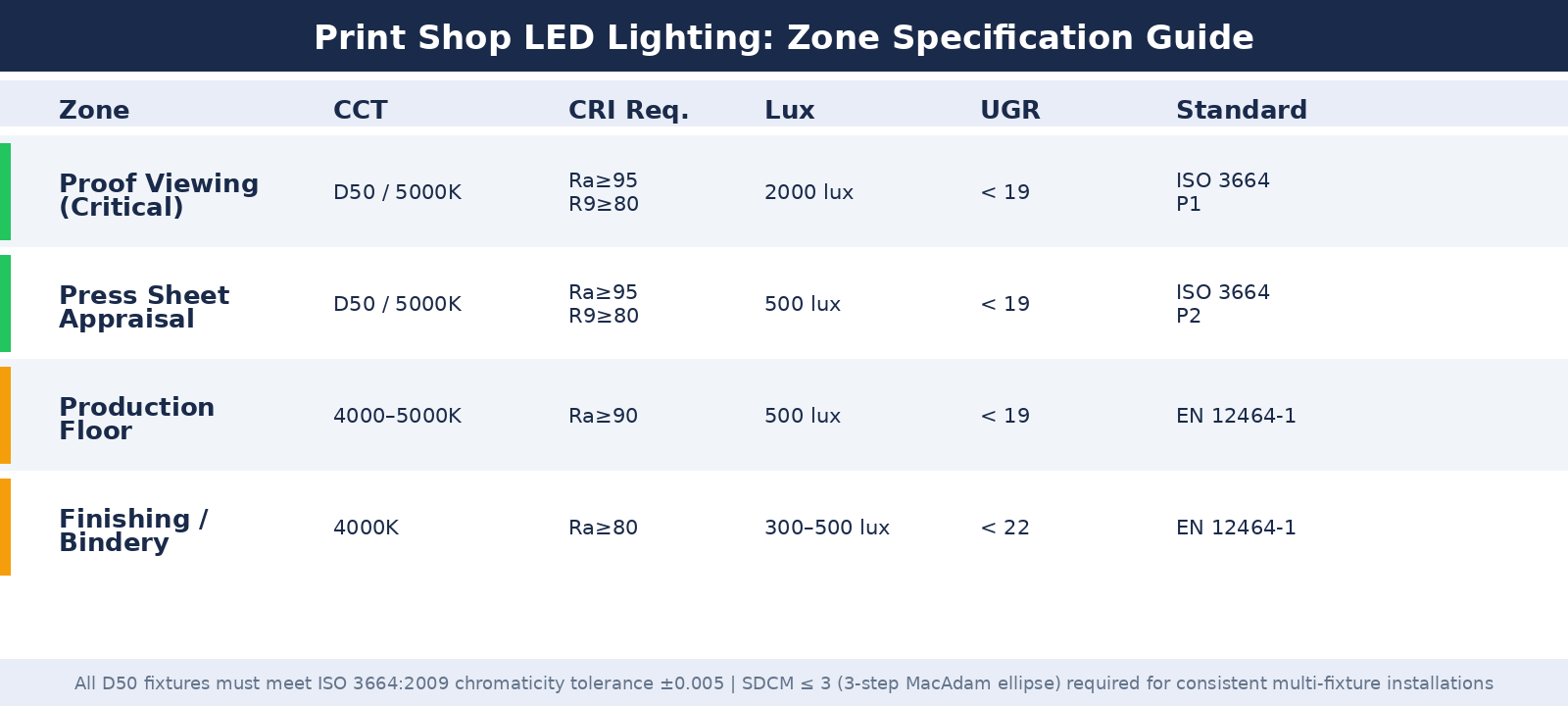
| Zone | CCT | CRI (Ra / R9) | Lux Target | UGR | Standard |
|---|---|---|---|---|---|
| Proof viewing station | D50 / 5000K | Ra ≥ 95 / R9 ≥ 80 | 2000 lux ±500 | < 19 | ISO 3664:2009 P1 |
| Press sheet appraisal | D50 / 5000K | Ra ≥ 95 / R9 ≥ 80 | 500 lux | < 19 | ISO 3664:2009 P2 |
| General production floor | 4000–5000K | Ra ≥ 90 | 500 lux | < 19 | EN 12464-1 |
| Finishing / bindery | 4000K | Ra ≥ 80 | 300–500 lux | < 22 | EN 12464-1 |
UGR and Visual Comfort for Sustained Colour Work
Why UGR < 19 Is Non-Negotiable for Colour Appraisal Areas
Unified Glare Rating (UGR) is a calculated value measuring discomfort caused by luminaire brightness relative to the surrounding field of view. A value of 19 is the maximum recommended for sustained visual work such as office tasks and CAD — and proof viewing in a print shop is at least as demanding as those activities, if not more so. A glare-heavy fixture — even one meeting all CRI and colour temperature requirements — will cause operators to unconsciously avert their gaze, increasing fatigue and reducing the accuracy of fine colour judgements.
Modern LED linear fixtures achieve UGR < 19 through optical design: micro-prismatic diffusers that refract light at specific angles away from the observer’s eye, or deep louvre systems that shield the source from direct view. Simply using a frosted diffuser does not guarantee UGR < 19 compliance — the photometric file must be verified against the standard geometry for the specific installation configuration. Top-tier UGR < 19 LED linear luminaires achieve efficacy of over 130 lm/W, so the optical engineering required for low glare does not have to come at the cost of energy efficiency.
Specifying LED Linear Lights for Print Shop OEM and Distributor Requirements
What to Look for in a Manufacturing Partner
For lighting distributors serving the print and graphic arts sector, supplying genuinely ISO 3664-compliant fixtures requires working with a manufacturer who can provide verified photometric documentation — not marketing claims. Specifically, a competent supplier should be able to provide: the spectral power distribution (SPD) curve showing D50 compliance, not just a CCT label; the full R1–R14 colour rendering data showing R9 value explicitly; SDCM batch tolerance certificates (≤ 3 MacAdam ellipses); driver flicker index data at full load; and UGR values calculated from the photometric file using LDT or IES format data.
Distributors sourcing from manufacturers who cannot provide this level of documentation are exposed to client complaints and returns when the fixtures fail colour critical evaluations after installation. The specification chain — from the print shop’s ISO 3664 requirement, through the distributor’s product choice, to the manufacturer’s engineering capability — is only as strong as the weakest link. Fanxstar’s OEM/ODM customisation service supports distributors needing to develop private-label high-CRI LED linear fixtures with specific spectrum engineering, verified photometric outputs, and certification documentation for their target markets.
Why Spectrum Engineering Makes the Difference
Achieving CRI Ra 95 with R9 ≥ 80 at 5000K requires deliberate phosphor selection and LED chip optimisation — it is not the default outcome of standard LED manufacturing. Standard white LEDs use a blue-pump LED coated with a yellow phosphor, which produces relatively weak red output. High-CRI, high-R9 LEDs add a secondary red phosphor layer or use a violet-pump with a more complete phosphor mix. The result is a richer, fuller spectrum that accurately renders the entire visible range — at a modest efficiency cost (typically 10–15% lower lm/W compared to equivalent standard CRI products). For print shop applications, this efficiency tradeoff is entirely justified by the business value of accurate colour decisions. OEM clients who specify custom LED linear products through Fanxstar can specify target CRI and R9 values as part of the LED chip sourcing brief — enabling the supply of fixtures that meet, rather than approximate, the ISO 3664 requirement.
Frequently Asked Questions
Is a standard 5000K LED batten good enough for a print shop?
In most cases, no. A standard 5000K LED batten typically has CRI Ra 80–90 and makes no guarantee about R9, chromaticity tolerance relative to D50, or flicker performance. For proof viewing and press sheet evaluation under ISO 3664:2009 conditions, you need a fixture with documented D50 chromaticity compliance (within 0.005 of the D50 point), CRI Ra ≥ 95 with R9 ≥ 80, flicker-free driver, and 2000 lux at the work surface. Standard commercial battens do not meet these requirements and will produce unreliable colour assessments.
Can I use D65 (6500K) instead of D50 (5000K) for colour viewing?
D65 is the standard for digital display calibration and digital arts workflows, not for print. ISO 3664:2009 specifies D50 as the reference illuminant for evaluating printed colour. The chromaticity difference between D50 and D65 is approximately 19 MacAdam ellipse steps — visually significant enough to cause systematic colour judgement errors when comparing print output to a digital proof on a D65-calibrated monitor. If your workflow includes direct comparison of printed sheets to calibrated displays, the correct approach is a D50-compliant viewing area for print evaluation and a D65-calibrated monitor separately. Waveform Lighting’s D50 knowledge base covers this distinction in technical detail.
How often should print shop lights be replaced to maintain colour accuracy?
LED lamps experience colour shift (Duv drift) over their operational life as the phosphor ages. For ISO 3664 compliance, the lighting should be verified periodically with a spectroradiometer — ideally annually for high-usage proof viewing areas. Most professional-grade high-CRI LED linear fixtures are rated for 50,000 hours at ≥70% lumen maintenance (L70), but colour shift can occur before the fixture fails photometrically. Preventive replacement cycles of 3–5 years are common in demanding print environments. Contact Fanxstar for guidance on high-CRI LED linear solutions with documented colour stability for graphic arts applications.
Sourcing high-CRI LED linear fixtures for print or graphic arts facilities?
Fanxstar’s engineering team works with distributors and project developers to deliver high-CRI linear LED solutions with verified photometric data and full OEM/ODM customisation for graphic arts, food inspection, and colour-critical industrial environments. Tell us your specification requirements and get a free technical consultation.